How Much to Have Exhaust Tips Welded on?
Having exhaust tips welded on often costs about $75 to $250 total at a muffler shop, with simple weld-on tips near the lower end and custom fitment, stainless work, or bumper trimming pushing it higher. A bad weld or wrong tip size can leave leaks, rattles, crooked tips, or a bill that doubles after rework. This guide breaks down parts, labor, fitment risk, and material match so you can price the job before you call.
How much does it cost?


The total usually has three parts: the tips themselves, labor to fit and weld them, and any extra fabrication if the inlet size or bumper opening does not line up cleanly. A simple straight-on install with common sizes is cheaper than a job that needs adapters, trimming, or repositioning.
Typical shop price components
For a basic weld-on tip job, many shops charge for the tip, a minimum labor amount, and shop supplies such as wire, shielding gas, and abrasives. If the work takes longer than the minimum, the bill can move toward the shop’s hourly rate. Tax is usually added at the end.
| Quote item | Common pricing method | What changes it |
|---|---|---|
| Exhaust tips | $25 to $150 each | Material, finish, wall style, shape, brand |
| Labor | $75 to $150 minimum, or hourly | Fit-up time, welding process, alignment |
| Shop supplies | $10 to $30 | Gas, wire, grinding, cleaning materials |
| Extra fabrication | Varies by job | Adapters, trimming, cutout work, spacing fixes |
| Tax | Local rate | Shop location |
Why the quote changes by fitment
Fitment drives price. A tip that matches the pipe outside diameter and lands centered in the bumper opening takes less time than one that needs a reducer, an extension, or a different angle. If the shop has to correct a poor previous setup, labor goes up fast.
What a shop quote includes
A good quote separates parts, labor, and any added fabrication. That matters because two jobs that both end with welded tips can differ by more than the tip price alone. One may be a straightforward weld. The other may need trimming, adapters, or a rework of the outlet angle.
Parts, labor, and shop supplies
Parts cover the tip or tips themselves. Labor covers measuring, cutting, fit-up, tack welding, final welding, and checking alignment. Shop supplies are small but real costs, and many shops add them as a fixed fee rather than itemizing every consumable.
Minimum charges, tax, and add-ons
Many muffler shops and custom exhaust shops use a minimum labor charge even if the welding itself is quick. That protects the shop from spending time on setup for a tiny job. Tax and any extra fabrication are added after the base labor and parts are set.
Exhaust tip fitment basics
Fitment starts with pipe outside diameter and tip inlet outside diameter. Exhaust tip inlets need to match the pipe size closely enough for a solid fit-up before welding. Common pipe sizes include 2.25, 2.5, and 3.0 inches, but the exact outside diameter should be checked rather than guessed.
Pipe OD and tip inlet OD
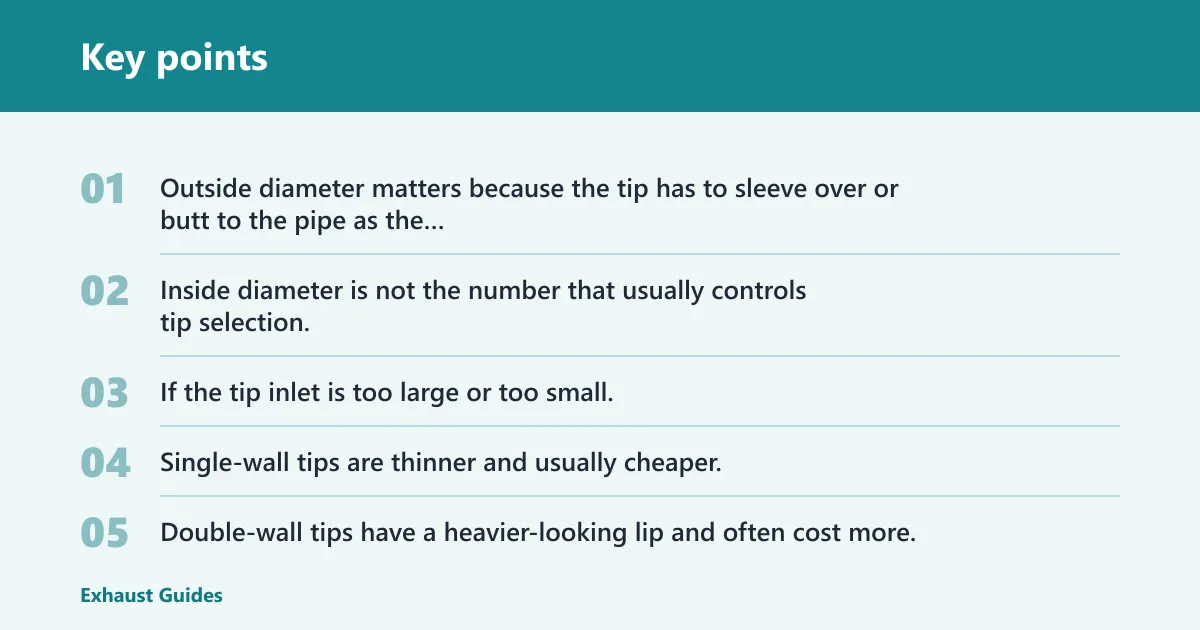
Outside diameter matters because the tip has to sleeve over or butt to the pipe as the shop plans it. Inside diameter is not the number that usually controls tip selection. If the tip inlet is too large or too small, the shop may need an adapter or custom fabrication to make the joint weldable.
Single-wall, double-wall, and tip styles
Single-wall tips are thinner and usually cheaper. Double-wall tips have a heavier-looking lip and often cost more. Round, oval, slash-cut, and rolled-edge styles all change both price and labor, because some shapes are easier to center and secure than others.
When adapters or trimming are needed
If the tip inlet does not match the pipe OD, an adapter may be needed. If the bumper opening is too tight, the outlet may need trimming, a shorter tip, or a different angle. Any of those adds time and can move the job from simple welding to light fabrication.
Say your sedan has a 2.25-inch pipe and you buy a 2.5-inch tip because it looks close. The shop may be able to adapt it, but that extra work is part of the quote, and it is one reason the same-looking tip can cost more to install than expected.
How welding labor is priced
Welding labor is usually priced by an hourly shop rate or a minimum labor charge. A simple weld-on tip may only need a short fit-up, tack time, and final weld, but alignment work can take longer than the welding itself. MIG is common for fast shop work; TIG is slower and usually costs more.
MIG vs TIG work
MIG welding is often used for exhaust work because it is fast and practical for mild-steel exhaust systems and many stainless jobs with the right filler and setup. TIG can produce very clean welds and is often preferred for thin material or stainless work that needs a neater finish, but it usually adds labor time.
Fit-up, tack time, and alignment
Fit-up is the part many quotes miss. The shop has to measure, position the tip, check protrusion, confirm the angle, and tack it before final welding. If the tip sits crooked or too far in or out, the work has to be redone before the final bead goes in.
Minimum labor charges
Even a short job can hit the shop minimum. That is why one welded tip may not be much cheaper than two if the setup time is similar. Once the car is on the lift and the welder is out, the fixed minimum often matters more than the number of beads laid down.
Does material choice change the price?
Yes. Material choice changes both labor and risk. Stainless steel, aluminized steel, and chrome-plated finishes do not all behave the same under heat. Stainless-to-stainless welding is usually the easiest material match, while stainless-to-mild steel can bring corrosion concerns and more attention to filler choice and finish.
Stainless to stainless welding
Stainless-to-stainless welding is usually the cleaner path because the materials are more compatible. That does not make the job automatic, but it lowers the chance of premature rust at the joint compared with mixing metals. Stainless tips are also common because they tend to hold up better than basic steel parts.
Stainless to mild steel corrosion risk
Welding stainless to mild steel is possible in many cases, but it is not a throwaway detail. The joint can corrode sooner if the material mix is ignored, especially where road salt or water sits. That is one reason a shop may suggest an adapter, different filler, or a different tip material.
Finish and discoloration concerns
Chrome-plated finishes and polished tips need care during welding because heat can discolor the finish near the weld zone. Black ceramic finishes can also show heat marks if the tip is overheated. Some tips have drain holes or orientation marks that should stay positioned correctly so water does not sit inside the tip.
Can your bumper clearance raise the bill?
Yes. Bumper clearance can change the labor as much as the welding itself. If the tip sits too close to the bumper cover or points toward a cutout edge, the shop may need to shorten it, change the angle, or add heat protection. Dual outlets and centered alignment can add even more setup time.
Tip length, angle, and protrusion
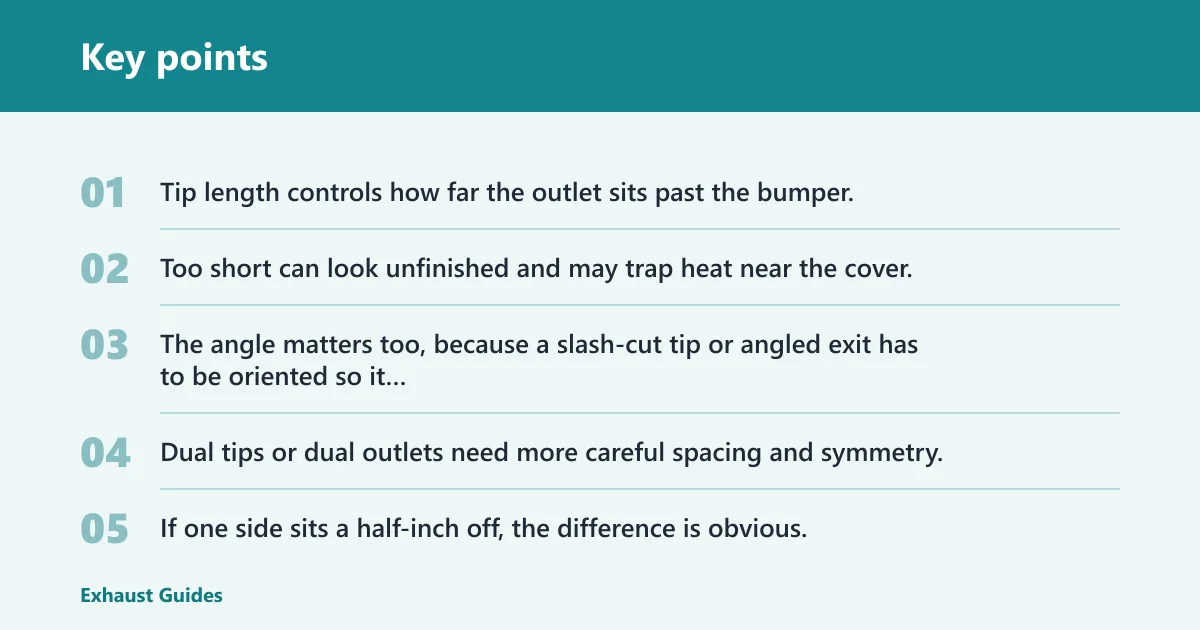
Tip length controls how far the outlet sits past the bumper. Too short can look unfinished and may trap heat near the cover. Too long can hang past the body line. The angle matters too, because a slash-cut tip or angled exit has to be oriented so it looks centered and clears surrounding trim.
Dual outlets and centered alignment
Dual tips or dual outlets need more careful spacing and symmetry. If one side sits a half-inch off, the difference is obvious. That extra alignment work is one reason dual-tip jobs often cost more than a single straight outlet, even before any custom cutting begins.
Heat shielding and melt risk
If the tip sits very close to the bumper cover, the shop may recommend a heat shield or a different placement. Plastic trim can soften if the outlet is too close or aimed poorly. That is a fitment problem, not just a style choice, and it can turn a cheap weld into a more involved repair.
Picture a hatchback with a black ceramic rolled-edge tip that extends just 1/4 inch past the bumper cutout. The shop may need to reposition it farther out or angle it differently to reduce heat risk, which adds labor even though the part looked right on paper.
Exhaust tip worksheet
This is the information a shop needs to price welded tips accurately. Bring the measurements, and the estimate is more likely to be useful on the first call. Leave out one of these details, and the quote may shift after the car is inspected.
Measurements to bring to the shop
| Measurement or detail | Example entry | Why it matters |
|---|---|---|
| Pipe OD | 2.25 in | Determines inlet match |
| Tip inlet OD | 2.25 in or 2.5 in | Shows whether the tip fits directly |
| Tip length | 6 in, 8 in, 12 in | Controls protrusion and clearance |
| Material | Stainless, aluminized steel, chrome-plated | Affects welding and durability |
| Number of tips | 1 or 2 | Changes labor and alignment time |
| Outlet setup | Single outlet or dual outlet | Dual setups take more layout work |
| Bumper clearance | 1/2 in, 1 in, 2 in | Helps avoid melt risk and bad protrusion |
| Trimming or adapters needed | Yes or no | Changes fabrication time and cost |
Fill-in cost calculator
Parts: tip(s) $_____
Labor: $_____
Shop supplies: $_____
Additional fabrication: $_____
Subtotal: $_____
Tax: $_____
Contingency for fitment surprises: $_____
Estimated total: $_____
Quote checklist for phone calls
- Give the pipe OD and the tip inlet OD.
- Say whether you want one tip or two.
- State the tip style: round, oval, slash-cut, or rolled-edge.
- Tell the shop the material and finish you want.
- Ask if trimming, adapters, or bumper work could be needed.
- Confirm the labor minimum and whether tax is added.
Can any exhaust shop weld on tips?
Most custom exhaust shops and muffler shops can weld on tips, and many full-service repair shops can as well if they have welding equipment and layout space. The better question is whether the shop will inspect fitment first. A shop that skips measurements can leave you with crooked tips or a poor seal.
A mobile welder may be available for simple work, but exhaust jobs still need clearance checks, pipe access, and final alignment. That is why a fixed bay with a lift is often the safer option for anything beyond a basic tip swap.
Do I need clamp-on or welded exhaust tips?
Clamp-on tips make sense when you want a quick change, easier removal, or a lower-cost cosmetic update. Welded tips are the better choice when you want a permanent fit, cleaner alignment, or a tip that will not slide loose over time. If the joint must be precise, welding is usually the better route.
Clamp-on is not automatically cheaper once fitment problems appear. A loose clamp-on tip can still need trimming or adjustment, and it may rattle if the size is off. Welded tips cost more up front when labor is involved, but they usually stay put better.
Will welding exhaust tips on damage my exhaust?
Proper welding should not damage the exhaust, but poor fit-up can. Too much heat, weak prep, or the wrong material match can cause discoloration, warping, or leaks at the joint. If the tip sits too close to the bumper, the real damage risk may be to the bodywork rather than the pipe.
How long does it take to weld on exhaust tips?
Most straightforward weld-on tip jobs take about 30 minutes to 1 hour, including fit-up, tack welding, and final alignment. If the shop needs adapters, trimming, or dual-outlet spacing work, the job can take longer. The welding itself is often the quick part.
Can stainless steel exhaust tips be welded to mild steel pipe?
Yes, in many cases stainless steel exhaust tips can be welded to mild steel pipe, but the shop should treat it as a material-mix job, not a standard one. The main concerns are corrosion at the joint, weld procedure, and whether the finish will hold up after heat cycles and road exposure.
Should I buy tips first or ask the shop to source them?
Buying tips first works if you already know the pipe OD, the inlet OD, and the clearance you need at the bumper. Letting the shop source them can be smarter if the vehicle needs a special angle, a dual setup, or a material match. That reduces the chance of buying the wrong size.
Frequently asked questions
How much to get exhaust tips welded
Many people pay about $75 to $250 total, but the actual cost depends on the tip price, labor minimum, and whether the shop needs to trim, adapt, or reposition the outlet. A simple straight weld on common pipe sizes stays near the low end. Custom fitment pushes the price higher.
How much to weld exhaust tips
Expect the labor portion to start around a shop minimum, often $75 to $150, with parts added on top. If the weld takes little time but setup is straightforward, the total may stay modest. If the pipe size and inlet size do not match cleanly, the labor bill rises.
How much does it cost to get exhaust tips welded?
A realistic estimate starts with the tip cost, then adds labor, shop supplies, tax, and any fabrication. Stainless tips, dual outlets, or bumper clearance work can move the total well beyond a basic job. Ask for the quote in pieces so you can see where the money goes.
What affects the cost to weld exhaust tips on?
Pipe size, tip inlet size, material, finish, number of tips, bumper clearance, and whether adapters are needed all affect price. Labor time changes too, especially if the shop must correct angle, protrusion, or centering. Those are the details that separate a quick weld from fabrication.