Best Exhaust Grinders (2026): Based on Specs and Reviews
The best grinder for exhaust fabrication is a 4.5-inch variable-speed angle grinder for cutting and weld cleanup, plus a compact die grinder for tight access. That pairing cuts thin-wall pipe with less heat and less chance of gouging. Pick the wrong tool and you waste tubing, overgrind welds, and create fit-up problems that take longer to fix than the original cut. This guide shows which grinder fits each exhaust task, what features matter, and how to avoid thin-wall damage and rework.
Quick comparison
| Product | Badge | Best for | Price | ||
|---|---|---|---|---|---|
 | Bosch GWS8-45 4-1/2 In. Angle GrinderBosch | Our pick | 4-1/2 In. · GWS8-45 · Angle | $79.99 Price as of 19 Oct 2026 | View |
 | Makita 9005B 5-Inch Angle Grinder , TealMakita | Also great | 5-Inch · 9005B · Teal | $230.19 Price as of 19 Oct 2026 | View |
 | DEWALT Angle Grinder, One-Touch Guard, 4-1/2 -Inch (DWE4011)DEWALT | Also great | 4-1/2-Inch · DWE4011 · One-Touch | $69.99 Price as of 19 Oct 2026 | View |
 | Astro 204 ONYX Composite 1/4-Inch 90 Degree Angle DieAstro Pneumatic Tool | Pair with it | 1/4-Inch · 204 · Die | $74.27 Price as of 19 Oct 2026 | View |
The main trade-off is access versus coverage. A 4-1/2 inch angle grinder is the best general-purpose pick for exhaust work, while a die grinder is the better tool when the joint sits near a subframe, axle tube, or hanger bracket.
If you are choosing one first, start with the grinder that matches the job most often in your bay or garage. The rest of the article breaks that down by cut quality, wall thickness, and where your hands actually fit.
How we chose
The comparison below focuses on exhaust-specific work: thin-wall tubing, weld cleanup, seam dressing, hanger removal, and cramped under-car access. It also weighs wheel safety, compatibility, fatigue, and the cost of discs and burrs, not just the base tool.
For every choice, the key question is simple: does the tool remove material cleanly without warping the pipe, chewing up the weld, or forcing extra rework?
Two safety points drive nearly every recommendation here. Wheel RPM must match the rating printed on each abrasive wheel, and the spindle thread or collet must fit the accessory you plan to use.
Bosch GWS8-45: best for weld cleanup
- 7.5 amp motor delivers 11,000 no-load rpm
- Slim-grip design provides outstanding user comfort
- Durable carbon brushes deliver extended tool life
The Bosch GWS8-45 is a strong fit for weld grinding, deburring, and light cutting on exhaust tubing. A 4-1/2 inch angle grinder is lighter and easier to place for typical fabrication tasks, which matters when you are dressing a bead on thin-wall pipe instead of flattening a large panel.
Its slim-grip body helps when you are working one-handed under a car or reaching around a header collector. The common 5/8-11 spindle thread also matters because it opens up broad wheel and accessory availability.
The drawback is reach and coverage. A smaller grinder removes less material per pass than a larger one, so long seams take more passes and more time.
Makita 9005B: best for larger surfaces
- Powerful 9 AMP motor with lightweight design
- Ball bearing construction for long tool life
- Removable side handle for operator comfort
The Makita 9005B suits longer weld seams, broader patch areas, and jobs where surface coverage matters more than tight access. A 6 inch angle grinder covers more surface per pass, so it can shorten cleanup on larger exhaust sections or fabrication plates.
That extra coverage comes with a cost. It is heavier and harder to steer than a 4-1/2 inch grinder, which makes it less friendly around tucked-in exhaust runs, crossmembers, and tight exhaust tunnel bends.
Use this kind of grinder when the workpiece is open enough that reach is not the limiting factor. If the pipe sits close to the floor pan or a suspension link, a smaller grinder is usually the safer pick.
DEWALT DWE4011: best for fast general cutting
- One-Touch guard eliminates need for a tool
- Quick-Change wheel release allows tool-free removal
- 12,000 rpm motor designed for faster material removal
The DEWALT DWE4011 fits users who want a compact 4-1/2 inch grinder for cutting and cleanup work on exhaust pipe. Based on the published product details, its quick wheel release and one-touch guard are useful when you switch between cut-off wheels, flap discs, and grinding wheels during fit-up.
This is a practical shop choice for repetitive trim-and-check work. The listed 12,000 rpm motor gives it the speed expected of a small angle grinder, but the wheel still has to stay within the rating printed on the abrasive wheel.
The drawback is the usual one for a compact grinder: it can be easy to lean too hard on thin-wall tubing. That is how you ovalize a tube end, chatter a cut, or dig a groove that shows up after the joint is tacked.
Astro 204 ONYX: best for tight-access cleanup
- Composite handle reduces vibration during use
- Lever throttle provides precise feathering control
- Rear exhaust air directs away from work surface
The Astro 204 ONYX is the clearest fit when exhaust work moves into cramped quarters. A right-angle air die grinder gives better access in confined spaces, and die grinders are the right tool for detailing, weld cleanup, and local material removal where an angle grinder will not fit.
Its 1/4-inch collet matches a common die grinder accessory size, so it accepts many burrs and small grinding or polishing bits. That makes it useful for stitch cleanup, port matching, and knocking down weld high spots without cutting a larger area than needed.
The drawback is obvious: a die grinder removes less material than a larger angle grinder, so it is not the tool for major cutoff work. It also adds compressor dependence, which can matter if your shop air is undersized.
Exhaust grinder decision table
| Task | Best grinder type | Ideal disc / collet size | Recommended RPM range | Typical mistake | When to choose air vs corded vs cordless |
|---|---|---|---|---|---|
| Cutting exhaust tube to length | 4-1/2 inch angle grinder | Thin cut-off wheel; 5/8-11 spindle thread for broad wheel choice | Match the wheel rating printed on the disc | Forcing the wheel sideways and heating the tube edge | Air only if access is tight; corded for long shop cuts; cordless for mock-up away from power |
| Beveling for fit-up and weld prep | 4-1/2 inch angle grinder | Flap disc or grinding disc sized for the grinder | Match the wheel rating printed on the disc | Cutting too deep and thinning the joint edge | Corded for repeated prep; cordless if you need to move around the vehicle |
| Weld dressing and bead cleanup | 4-1/2 inch angle grinder | Flap disc | Match the wheel rating printed on the disc | Pressing too hard and flattening the weld crown | Corded for sustained work; cordless for quick correction in the field |
| Tight-access weld cleanup | Right-angle air die grinder | 1/4-inch collet burr or small abrasive bit | About 20,000-22,500 RPM free speed, while staying within accessory limits | Using an aggressive burr where a light touch is enough | Air is best when the area is cramped and the compressor can keep up |
| Long seam cleanup on open parts | 6 inch angle grinder | Grinding disc or flap disc sized for the grinder | Match the wheel rating printed on the disc | Using a heavy grinder where a smaller tool would be easier to control | Corded for continuous runtime; cordless only if your battery platform is already in place |
| Hanger cleanup and bracket detailing | Die grinder | 1/4-inch collet accessory | Tool and accessory limit must both be respected | Overworking a small area and thinning nearby material | Air for access, electric for convenience, cordless for mobile work |
How to choose the right grinder for exhaust work
The safest choice starts with the task, not the brand. For exhaust fabrication, the right tool is the one that removes enough material without overheating stainless, chewing up thin-wall tubing, or forcing extra correction later.
Task fit for exhaust work
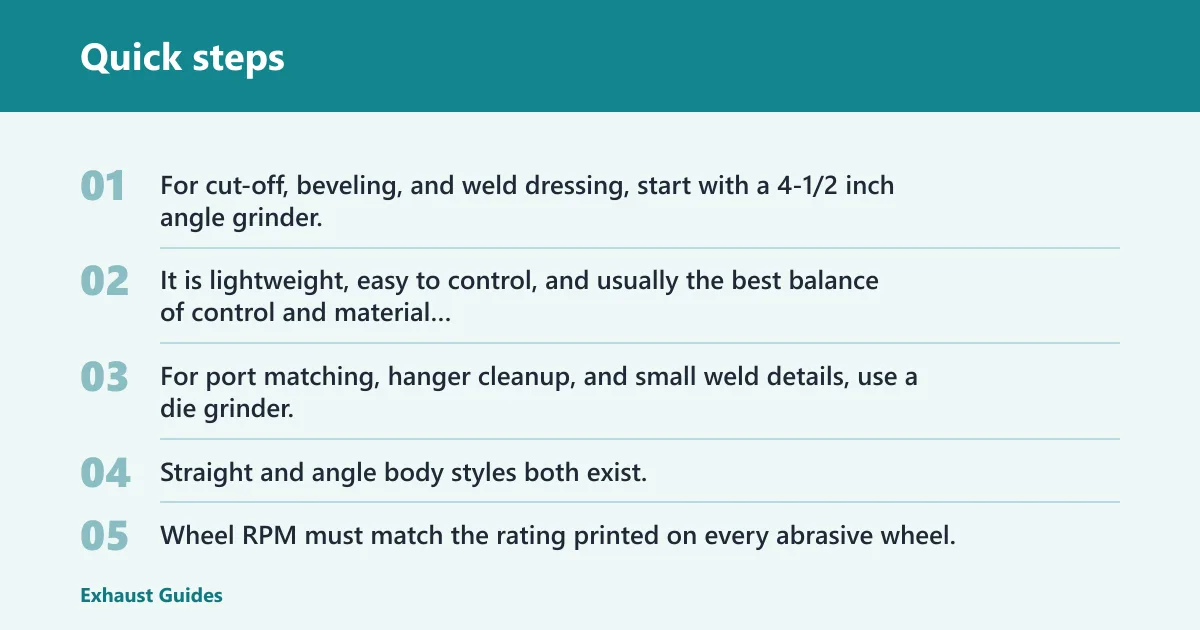
For cut-off, beveling, and weld dressing, start with a 4-1/2 inch angle grinder. It is lightweight, easy to control, and usually the best balance of control and material removal for pipe and bracket work.
For port matching, hanger cleanup, and small weld details, use a die grinder. Straight and angle body styles both exist, and the angle body is often easier to steer around tubing and brackets.
Safety and RPM limits
Wheel RPM must match the rating printed on every abrasive wheel. That rule applies to every disc you install, and it matters more on exhaust work because thin-wall tubing gives you very little margin for error if a wheel grabs or shatters.
Do not assume a faster tool is better. A wheel that is rated for the grinder can still chatter, overheat stainless, or cut an oval if you force it through a tube end.
Access, weight, and fatigue
A 4-1/2 inch grinder is easier to hold steady around the subframe, axle tube, and muffler hanger. A 6 inch grinder covers more surface per pass, but the added weight makes it less friendly in tight spaces and on long overhead work.
Say your exhaust run sits close to a rear crossmember. A large grinder may remove the weld faster, but the extra bulk can push the guard into the surrounding hardware before the disc ever reaches the bead.
Accessory and cost considerations
Total cost is not just the tool. You also need cut-off wheels, flap discs, grinding discs, carbide burrs, and a backup pad if you plan to polish or blend edges cleanly.
The spindle thread matters too. The 5/8-11 spindle thread is the common US standard on most grinders, and that affects what specialty wheels you can source quickly. Die grinders usually use a 1/4-inch collet, which is the standard for many small burrs and finishing bits.
What size grinder is best for exhaust fabrication?
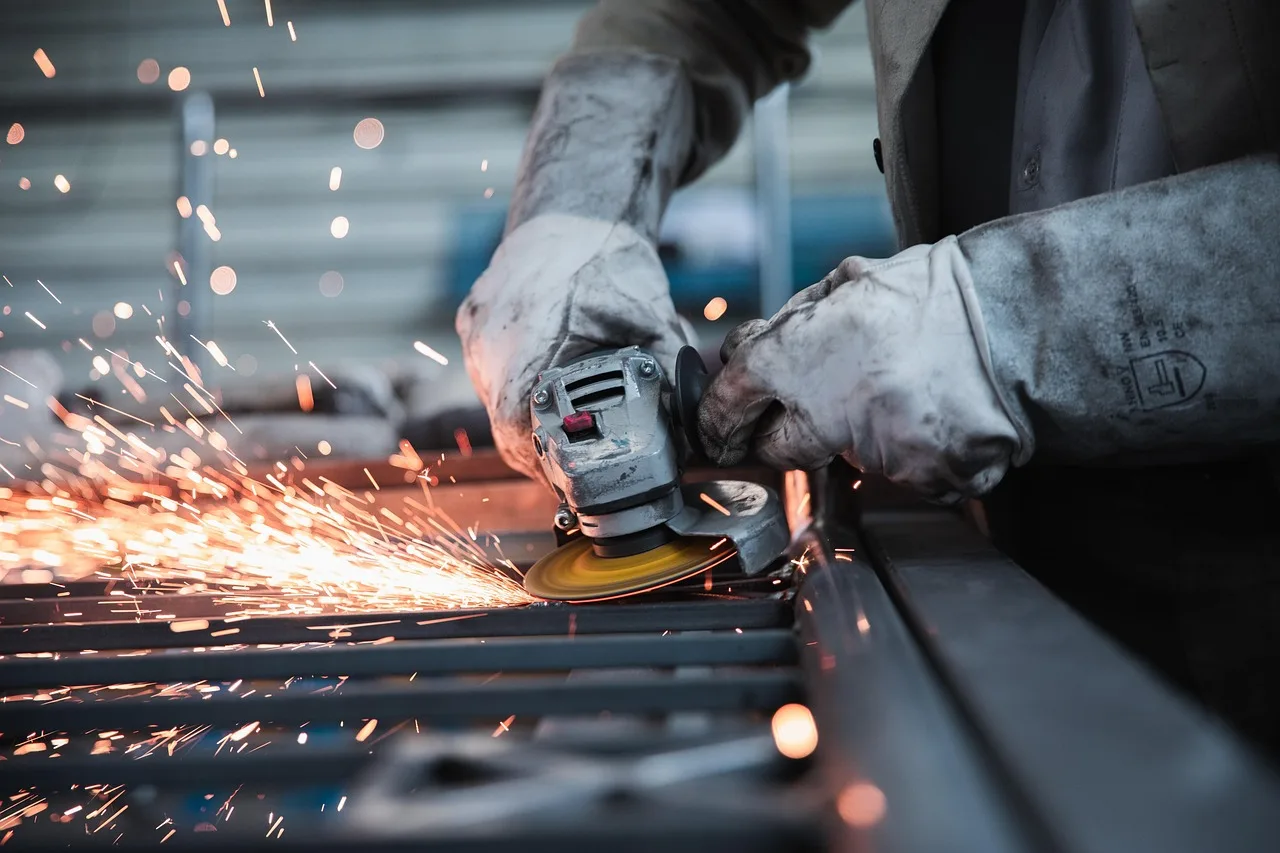
For most exhaust work, a 4-1/2 inch grinder is the best size because it balances control, reach, and ease of use around thin-wall tube. A 6 inch grinder is better when you need to cover more surface per pass on open seams or larger fabricated pieces.
4-1/2 inch versus 6 inch
The 4-1/2 inch grinder is the safer default for pipe work. It is lighter and easier to place, which matters when the tube is tucked near a floor pan, heat shield, or suspension part.
The 6 inch grinder makes sense when the weld run is long and exposed. It removes material faster across a wider area, but the larger body is harder to place in cramped spaces.
When a smaller grinder is the safer pick
Use the smaller tool when you are near thin-wall tubing, a freshly tacked joint, or stainless tubing that can discolor from heat. A light touch matters more than brute force in those situations.
A common first-timer mistake is to attack a small tube with a large wheel because it seems faster. The result is often a gouged bead, a hot blue stain on stainless, or a tube end that no longer fits squarely into the next section.
When surface coverage matters more
Choose the larger grinder when the part is open enough that access is not the problem. Long seam dressing, larger flat brackets, and extended cleanup areas are where a 6 inch tool earns its place.
Air grinder vs electric grinder?
Air grinders win on access and compactness, while electric grinders win on convenience and sustained work. If the job is under the car and tight around brackets or axle tubes, air often fits better; if the job is long and shop-based, electric usually makes more sense.
Air for access and speed
A right-angle air die grinder is common in body and welding shops because it reaches places a larger electric grinder cannot. Its free speed is typically around 20,000-22,500 RPM, which suits fine cleanup and detailing work when used with the correct accessory.
Air tools also keep the body small. That helps when your hands have to stay out of the line of fire around subframes, mufflers, and spring perches.
Corded electric for sustained power
A corded electric grinder is the best choice for continuous runtime on long jobs. It keeps going without battery swaps, and higher sustained power under load helps when you are grinding long seams, cleaning multiple brackets, or trimming a batch of parts in one session.
Cordless for portability
A cordless grinder is the best option for field work and mock-up. Battery platform matters because it affects tool compatibility, runtime, and how many tools you can share packs with, and brushless motors generally run cooler and last longer than brushed designs.
The drawback is simple: battery tools trade runtime for portability. If you are grinding several joints in a row, spare batteries become part of the setup cost.
Which one should you buy?
Buy a 4-1/2 inch angle grinder first if you cut, bevel, and dress welds most often. Buy a compact die grinder next if your work includes tight brackets, hanger cleanup, or weld finishing where a large grinder cannot reach.
If your work is mostly shop-based and long in duration, a corded grinder is the safer value. If you move between vehicle and bench, a cordless grinder is easier to carry, but only if you already have a solid battery platform.
If your priority is the cleanest access around cramped exhaust sections, choose an air die grinder. If your priority is fewer cords and faster setup, choose electric.
Picture an axle-side patch where the pipe sits inches from a bracket. A 4-1/2 inch grinder can handle the cut and most of the cleanup, while a die grinder finishes the corner that the larger wheel cannot reach without touching the surrounding hardware.
For most buyers, the practical order is clear: start with a 4-1/2 inch angle grinder, add a die grinder for access, and move to a 6 inch grinder only if your jobs regularly involve larger open surfaces.
Maintenance checklist for a straight, safe grinder
- Inspect every wheel for damage before installation.
- Confirm the wheel RPM rating matches the grinder speed.
- Check that the guard is installed and positioned for the task.
- Verify the spindle thread or collet fits the accessory correctly.
- Listen for bearing noise, wobble, or unusual vibration.
- Keep the wheel flat and avoid side loading a cut-off disc.
- Clean dust and metal grit from vents and housings after use.
- Replace worn brushes or damaged accessories before the next job.
Frequently asked questions
What is the best grinder for exhaust fabrication?
The best grinder for exhaust fabrication is a 4-1/2 inch angle grinder for cutting, weld cleanup, and deburring, plus a die grinder for tight spots. That combination covers most pipe, hanger, and seam work without forcing you to overgrind thin-wall tubing or overheat stainless.
What kind of grinder is this?
This is a handheld power tool used for cutting, grinding, and cleanup work on metal. For exhaust fabrication, the important distinctions are body size, accessory type, and access. A 4-1/2 inch angle grinder handles general tasks, while a die grinder handles detailing and cramped reaches.
Which grinder is best for welding and cutting exhaust pipe?
A 4-1/2 inch angle grinder is the best all-around choice for welding and cutting exhaust pipe. It is light enough to control well on thin-wall tubing and versatile enough for cut-off wheels, flap discs, and light grinding without forcing you into a larger, harder-to-handle tool.
Should I buy a straight die grinder or angle grinder?
Buy an angle grinder first if you need cutting, beveling, and weld cleanup. Buy a die grinder if your work is mostly detailing in tight spaces. Many exhaust jobs need both, but the angle grinder earns the first slot because it handles the larger share of material removal.