Best Quiet Exhausts for Motorcycles (2026): Specs and Reviews
The Yoshimura R-77 mufflers with sound insert baffles represent the top choice
Best quiet exhaust for motorcycles: Best pick & why
The Yoshimura Alpha-T system offers the most reliable path for riders needing strict compliance, specifically within California where CARB-compliant variants are available. While the system typically requires an ECU tune to maximize performance, its internal design focuses on street-legality and durability rather than raw decibel volume. For most U.S. states, however, the SuperTrapp Super Quiet Muffler provides a more practical balance, starting around $70, offering adjustable tone, and delivering a significant weight savings of 2 to 4 pounds compared to stock units.
Quick comparison
Use the table below to snapshot the price brackets and primary attenuation methods for the top six options. The choice between a $15 insert and an $800 full system depends heavily on whether you are fixing a stock pipe or replacing the entire muffler assembly.
| Product | Badge | Best for | Price | ||
|---|---|---|---|---|---|
 |
Carven Exhaust R-Series Performance Muffler 3"Carven Exhaust | Our pick | 3" · 4.2 · R-Series Performance Muffler | $104.00
Price as of 16 Oct 2026
|
View |
 |
PACEWALKER Motorcycle Slip On Muffler, 2" Universal CarbonPACEWALKER | Also great | 2" · 4.3 · Carbon Fiber Slip-On | $49.99
Price as of 16 Oct 2026
|
View |
 |
Bicycle Exhaust Sound System, Bike Motorcycle Spoke TurboStepOK | Also great | $18.57
Price as of 16 Oct 2026
|
View | |
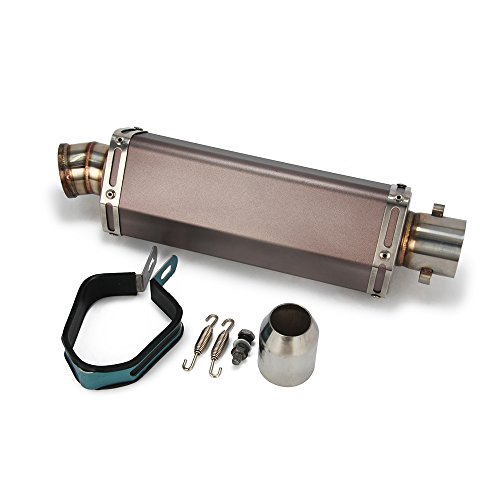 |
Universal 1.5-2" Inlet Hexagon Exhaust Muffler Pipe Slip OnFast Pro | Budget pick | 1.5-2" · 4.1 · Universal Hexagon Muffler | $41.99
Price as of 16 Oct 2026
|
View |
How we chose
Selections in this guide rely on four specific criteria. First, verify the packing type: baffle plates and disc stacks generally attenuate low-end thump better than dense fiberglass wool for long-term maintenance. Second, check fitment compatibility; many slip-ons are universal by diameter but require specific hanger locations. Third, evaluate the legal risk, as removing a catalytic converter often violates local ordinances regardless of the muffler used. Finally, compare the decibel reduction against the engine’s natural pulse rate, since single-cylinder thumpers behave differently from inline-fours.
dB Killer: best for tight budgets
For the lowest-cost intervention, a sound insert mounted inside an existing stock exhaust tip is the clear winner. These devices cost less than $15 and reduce volume by 3-5 dB, which is enough to move a bike from “illegal” to “tolerated” in many residential zones. This method disrupts the exhaust flow slightly, causing a minor loss of top-end power, but it preserves the original factory pipe’s weight and corrosion resistance. It is strictly a band-aid solution; if the stock muffler is failing, replacing the whole unit is the only durable fix.

- Cost: Under $15
- Reduction: 3-5 dB
- Installation: Bolt-on to existing tip
- Drawback: Minor power curve disruption and limited decibel drop
SuperTrapp: best for adjustable tone
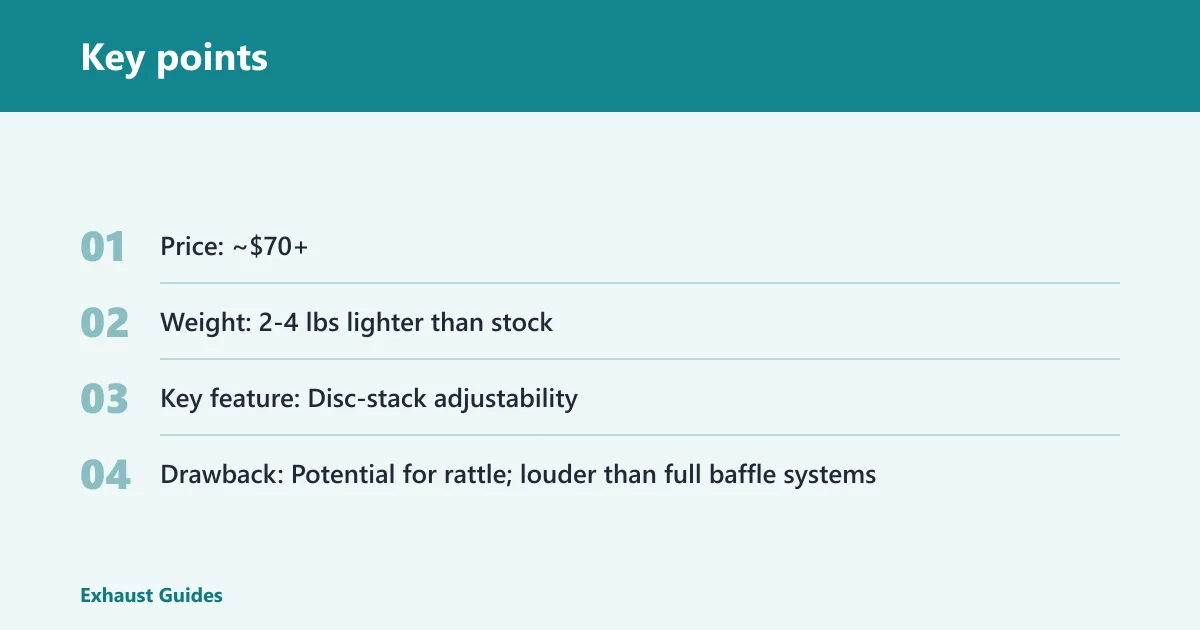
SuperTrapp Super Quiet Mufflers start around $70 and use a disc-stack design rather than traditional fiberglass packing. This engineering allows the user to add or remove internal discs, effectively tuning the exhaust tone from a muted “street” sound to a sharper “racing” tone. The steel construction is durable, and the system typically sheds 2 to 4 pounds off the stock system. Based on manufacturer specs and buyer feedback, the adjustability is the key feature; however, the disc-stack design can be prone to rattling if not assembled with care, and it is louder than a sealed Delkevic system.
- Price: ~$70+
- Weight: 2-4 lbs lighter than stock
- Key feature: Disc-stack adjustability
- Drawback: Potential for rattle; louder than full baffle systems
Fuel: best value slip-on
Fuel slip-on exhausts typically cost between $150 and $300 and are often reported to run only about 1 to 3 dB over stock noise levels. This makes them a strong choice for riders who want a visual upgrade without dealing with excessive drone. The weight savings are moderate, but the primary benefit is the balance of cost and legal compliance in many states. A common first-timer mistake is assuming that because a slip-on is “quiet,” it can be installed without checking if the headpipe is also part of a cat-delete kit, which drastically increases overall drone even with a quiet muffler.
- Price: $150-$300
- Noise: 1-3 dB over stock
- Key benefit: Moderate weight savings, low noise premium
- Drawback: Can still be loud on high-RPM inline-fours without proper baffling
Delkevic: best near-stock sound
Delkevic full noise-reduction systems generally range from $300 to $800. These are not just mufflers; they are engineered replacements for the stock exhaust system that mimic factory noise levels while often improving flow. The near-stock volume makes them ideal for riders who want to meet strict noise ordinance thresholds without buying a new bike. The downside is the price. At the high end of the range, the system is comparable in cost to premium performance brands, but the payoff is a legal, quiet ride that feels like the factory setup.
- Price: $300-$800
- Noise: Near stock levels
- Key benefit: Strict compliance for legal riding
- Drawback: High cost; little performance gain over stock
Leo Vince X3: best for weight loss
Leo Vince X3 slip-ons are priced between $400 and $650 and feature a packed silencer designed to reduce weight, commonly by roughly 4 to 7 lbs. This significant mass drop improves the bike’s handling, particularly in corners, without the system becoming aggressively loud. The packing material is designed to last, but it does require periodic inspection for moisture ingress. Say your bike is a sport-touring model where tail weight affects stability; this exhaust delivers a manageable volume with a noticeable handling benefit, though the price point is steep for a simple muffler replacement.
- Price: $400-$650
- Weight: 4-7 lbs reduction
- Key benefit: Significant weight loss with manageable noise
- Drawback: Premium price; packed silencer requires maintenance
Yoshimura: best for CARB legal
Yoshimura Alpha-T and ST systems range from $500 to $900. These are street-legal in California, a major differentiator for riders in strict states. The systems often require an ECU tune to ensure the air-fuel mixture remains safe and efficient after the flow changes. While they are high-performance, they are not the quietest option on this list; they prioritize flow and legality in a regulated environment over pure silence. If you are not in a CARB state, this model may be overkill for a rider’s needs.
- Price: $500-$900
- Legal: CARB-compliant variants available
- Key benefit: Performance with regulatory compliance
- Drawback: Requires ECU tune; high cost; not the quietest option
Quiet Exhausts matrix → Decibel levels vs stock / Packing type and cost
The following matrix details the attenuation methods, specific cost brackets, and expected noise levels relative to stock equipment. Note that decibel measurements are highly dependent on test methodology; SAE J1287 static tests and real-world riding conditions will yield different numbers. A 3 dB difference is perceived as a noticeable change, while 10 dB is perceived as half as loud.
| Product/System | Packing Type | Price Range | Noise vs Stock | Repacking Interval |
|---|---|---|---|---|
| dB Killer / Sound Insert | Insert/Baffle | < $15 | -3 to -5 dB | N/A (Non-repackable) |
| SuperTrapp Super Quiet | Disc-stack | ~$70+ | Adjustable (Variable) | N/A (Mechanical) |
| Fuel Slip-on | Baffle/Fiberglass | $150-$300 | +1 to +3 dB | 2-3 years |
| Delkevic System | Packed Silencer | $300-$800 | 0 dB (Near Stock) | 3-4 years |
| Leo Vince X3 | Packed Silencer | $400-$650 | Variable (Weight focused) | 3-4 years |
| Yoshimura Alpha-T/ST | Cartridge/Wool | $500-$900 | Performance Focused | 4-5 years |
Which one should you buy? → By budget bracket / By noise ordinance threshold
For riders with a noise ordinance limit of 80 dB at 50 feet, a sound insert on a stock pipe is often sufficient to drop the bike into the legal zone. If the limit is stricter, or if the bike is a high-RPM inline-four that “screams” at high RPMs, the Delkevic near-stock system is the safest legal choice. For a budget under $100, the SuperTrapp disc-stack offers the most value, allowing you to dial in the tone to a legal level. If you are in a CARB state, the Yoshimura system is the only option that balances performance with strict regulatory compliance, though it is the most expensive. A common decision error is buying a cheap slip-on and ignoring the cat-delete pipe; removing the catalytic converter adds significant drone that a quiet muffler cannot fully cancel.
Frequently asked questions
What is the quietest aftermarket motorcycle exhaust?
The Delkevic noise-reduction system is generally the quietest aftermarket option, running at near-stock noise levels. It is engineered to meet factory volume standards while improving flow. For a lower-cost alternative, a SuperTrapp with all internal discs installed will be quieter than most open baffles, though it is still typically louder than a full Delkevic system.
How do dB killers work on motorcycle exhausts?
dB killers are inserts that mount inside the exhaust tip. They disrupt the laminar flow of exhaust gases, causing sound waves to interfere with each other and dissipate as heat. This reduces volume by 3-5 dB. The result is a minor restriction in top-end power, as the gases have to navigate a tighter path, but it is the most cost-effective way to quiet a stock exhaust without replacing the entire muffler.
Are SuperTrapp exhausts actually quiet?
SuperTrapp mufflers are adjustable, meaning they can be quieted by installing all internal discs. However, they are generally louder than dedicated quiet systems like Delkevic. The “quiet” version is still a performance muffler and will have a higher pitch and sharper tone than a factory pipe. They are best for riders who want a balance between a sporty sound and neighborhood tolerance.
How much do quiet motorcycle exhausts cost?
The cost varies by approach. A dB-killer insert costs under $15. A SuperTrapp muffler starts around $70. Budget slip-ons like Fuel range from $150 to $300. Premium near-stock systems like Delkevic cost between $300 and $800. Performance-focused legal systems like Yoshimura range from $500 to $900. The most expensive option is a full custom quiet system, which can exceed $1,500.
Does adding a baffle reduce horsepower?
Yes, adding a baffle or a dB-killer reduces horsepower. It creates a restriction in the exhaust port, which increases backpressure. This reduces the efficiency of the scavenging process, where exhaust gases are pulled out of the cylinder. The drop is usually small, often less than 2-3%, but it is measurable. For a naturally aspirated engine, this restriction also slightly increases pumping losses, reducing overall efficiency.