How Much Horsepower Does a Motorcycle Exhaust Add?
A motorcycle exhaust usually adds a small gain from a slip-on and a somewhat larger gain from a full system, with bigger changes more likely when the bike is tuned for it; many bikes gain more midrange torque than peak horsepower. Fit the wrong exhaust and you can pay for noise, lose low-end response, or see almost no dyno change. This guide breaks down peak horsepower, torque, and tune dependence so you can judge what your bike is likely to gain from a slip-on, full system, or ECU tune.
How much horsepower does a motorcycle exhaust add?
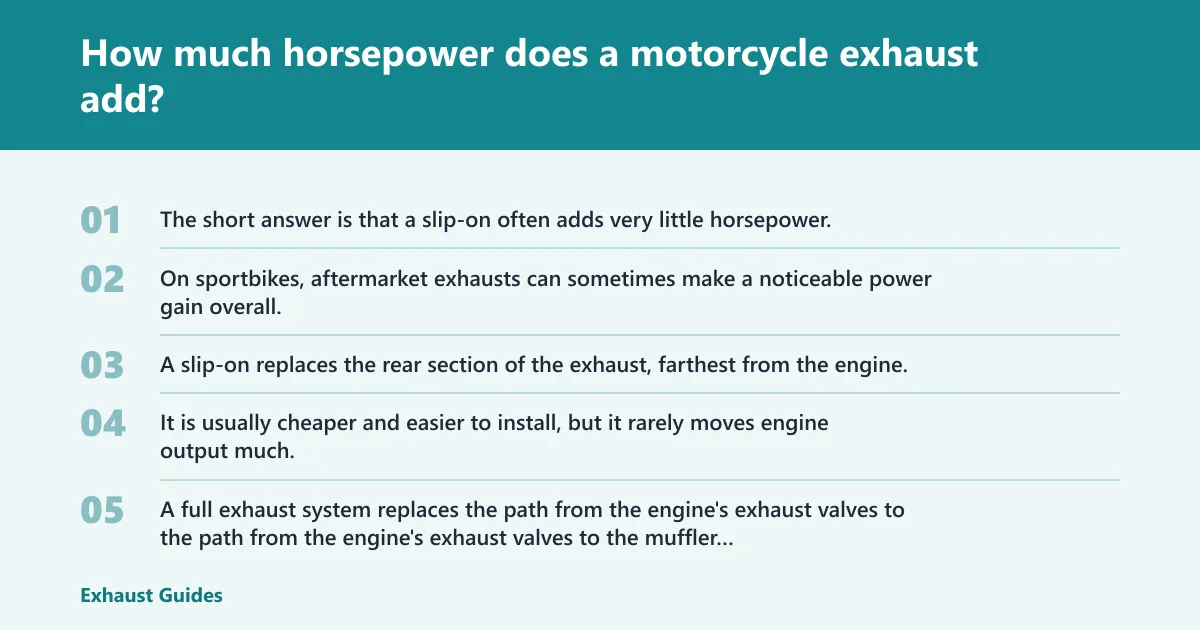
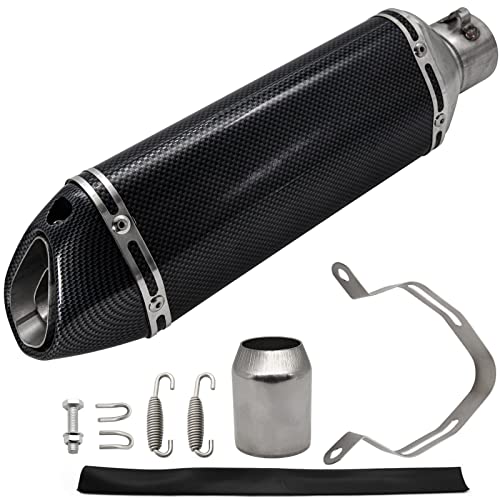


The short answer is that a slip-on often adds very little horsepower, while a full exhaust system can add a modest amount, especially on bikes with stock exhausts that are restrictive. On sportbikes, aftermarket exhausts can sometimes make a noticeable power gain overall, though many motorcycles see smaller gains unless fueling and intake support the change.
Slip-on vs full exhaust: what changes horsepower?
A slip-on replaces the rear section of the exhaust, farthest from the engine. It is usually cheaper and easier to install, but it rarely moves engine output much. A full exhaust system replaces the path from the engine’s exhaust valves to the muffler tip, so it has more horsepower potential and can alter the dyno curve.
That difference matters because the front half of the exhaust does much of the work that affects scavenging, backpressure, and pulse timing. Change only the last section and sound, plus weight, often shift more than output. Replace headers and mid-pipe too, and the engine can breathe differently through the rev range.
Why a full system has more horsepower potential
A full exhaust can improve airflow more meaningfully than a slip-on, which is why it is the setup that actually moves horsepower numbers on many bikes. The common result is not a huge peak jump. Instead, the dyno curve may rise earlier, hold power better through the middle of the rev range, or move the strongest part of the curve upward.
On some motorcycles, the peak horsepower number barely moves while rideability improves. On others, especially sportbikes, a good system can be worth the cost if the rest of the setup matches it.
📊 It claims many aftermarket exhausts can be 30-40% lighter than stock. Source: Can Aftermarket Exhausts Increase Motorcycle Horsepower….
What kind of power gain should you expect?

Peak horsepower gains are modest and bike-dependent. A full system can add meaningful power on some sportbikes, but cruisers, touring bikes, and adventure bikes often see smaller peak gains and more change in throttle response or midrange torque. The same exhaust can behave very differently depending on displacement, tuning, and whether the stock system was already restrictive.
Peak horsepower vs midrange torque
Peak horsepower is the highest number on the dyno chart. Midrange torque is the stronger pull you feel in the meat of the revs. An exhaust can improve one without moving the other much, especially when the factory tune was aimed at emissions, noise, or broad usability rather than maximum output.
That is why a bike may feel quicker from 3,000 to 6,000 rpm even if the top-line horsepower number stays close to stock. The chart changes shape. The ride does too.
Why the dyno curve can change without a big peak number
A full system can improve airflow at certain engine speeds more than others. That can pull harder in one part of the rev range and flatten in another. Harley-Davidson dyno runs are often cited for gains in the 2000-4000 rpm range, which is a good example of how lower-rpm response can improve without a dramatic peak change.
Suppose a 1,200cc naked bike gains only 3 hp at peak after exhaust work, but the curve gains 5 to 7 hp in the middle. The bike may feel stronger in normal riding even though the maximum number looks small.
Typical ranges by motorcycle segment
| Motorcycle segment | Exhaust type | Realistic horsepower gain | Likely rpm effect | Tune requirement | Legal/noise risk |
|---|---|---|---|---|---|
| Sportbike, 600-1000cc | Slip-on | 0–2 hp | Small change, often mostly sound | Usually no | Moderate to high if louder than stock |
| Sportbike, 600-1000cc | Full system | 5-10 hp | Can add in midrange and at peak | Often yes | Moderate to high |
| Naked bike, 700-1000cc | Slip-on | 0–1 hp | Minor curve change | Usually no | Moderate |
| Naked bike, 700-1000cc | Full system | 2–5 hp | Often stronger midrange pull | Sometimes | Moderate to high |
| Cruiser, V-twin | Slip-on | 0–1 hp | May improve low-rpm feel slightly | Usually no | Moderate |
| Cruiser, V-twin | Full system | 2–4 hp | More change in 2000-4000 rpm range | Often recommended | Moderate to high |
| Adventure bike, 800-1300cc | Slip-on | 0–1 hp | Little peak change, possible throttle feel change | Usually no | Moderate |
| Adventure bike, 800-1300cc | Full system | 2–5 hp | Can smooth midrange, sometimes shifts peak later | Sometimes | Moderate to high |
For a sportbike, the commonly cited 7-10 hp result fits the upper end of the usual range. For cruisers and ADV bikes, the same money often buys less peak horsepower and more sound, weight reduction, or response.
Do aftermarket motorcycle exhausts need a tune?
Some do, some do not. A tune or remap matters more when the exhaust changes airflow enough to affect fueling, especially on a full system. If the bike runs too lean after the change, power can flatten, throttle response can worsen, and engine heat can rise.
When fueling can go too lean
Exhaust changes can reduce exhaust backpressure and alter how much air the engine moves at certain rpm. If the ECU does not add enough fuel to match, the mixture can go lean. That does not mean every bike becomes unsafe, but it does mean the gain you expected may not appear without calibration.
Brands that pair headers, mid-pipes, and mufflers often note a tune requirement because the total airflow change is larger than a muffler swap alone. Bikes with closed-loop fuel control can correct part of the map in some areas, but not always enough across the full rev range.
Signs your bike may benefit from a tune
- Throttle feels hesitant or abrupt after the exhaust install.
- The bike surges at steady throttle.
- There is a flat spot in the midrange that was not there before.
- The exhaust brand specifies remapping for that exact setup.
- You installed a full system, not just a rear can.
Picture a 900cc twin with a full system and no fueling change. It may sound stronger, but the dyno trace can show a dip around the midrange instead of a gain. A proper tune often restores that part of the curve and lets the exhaust do its job.
How much weight can a motorcycle exhaust save?
Weight savings are common, but they are secondary to power for most buyers. Many aftermarket exhausts are 30-40% lighter than stock, and a full exhaust on a Ducati Panigale can save approximately 10 lb. Titanium systems usually save more than stainless steel systems because the material itself is lighter.
Common weight savings by material
Titanium, carbon fiber outer sleeves, and thinner-wall construction all reduce mass. A slip-on may save a few pounds. A full system can save more, but the exact number depends on the bike and whether the factory exhaust includes heavy catalysts and large steel headers.
Weight loss matters most when the stock system is unusually heavy or mounted high on the bike. Reducing mass near the center of the machine can also make direction changes feel easier, even if horsepower barely changes.
When weight loss matters more than horsepower
If your bike already makes enough power for its use, shaving weight may be a better reason to buy an exhaust than chasing a small top-end gain. That is especially true on heavy touring or adventure bikes, where a modest exhaust save can be felt more than a marginal horsepower change.
Are motorcycle exhaust upgrades street legal?
Maybe, but not always. Loud aftermarket systems can exceed local noise limits, and emissions rules can also affect legality. Stock motorcycles are required to operate under 84 dB on the highway in some references, but local rules vary. An exhaust that is acceptable in one place can fail inspection or draw attention elsewhere.
Why some loud systems fail compliance
Noise compliance depends on the muffler, the catalyst, the test method, and the jurisdiction. Removing a catalyst, choosing an open muffler, or using a race-only system can push sound well beyond legal limits. That risk rises quickly when the system is built for track use instead of road use.
How to check legality before you buy
- Check your local noise limit and inspection rules.
- Confirm whether the exhaust keeps a catalyst if your area requires one.
- Look for road-legal marking or compliance language for your market.
- Ask whether the system is intended for street use or race use.
- Match the exhaust to your riding environment before you pay for sound alone.
Why do some exhausts add torque but not much peak horsepower?
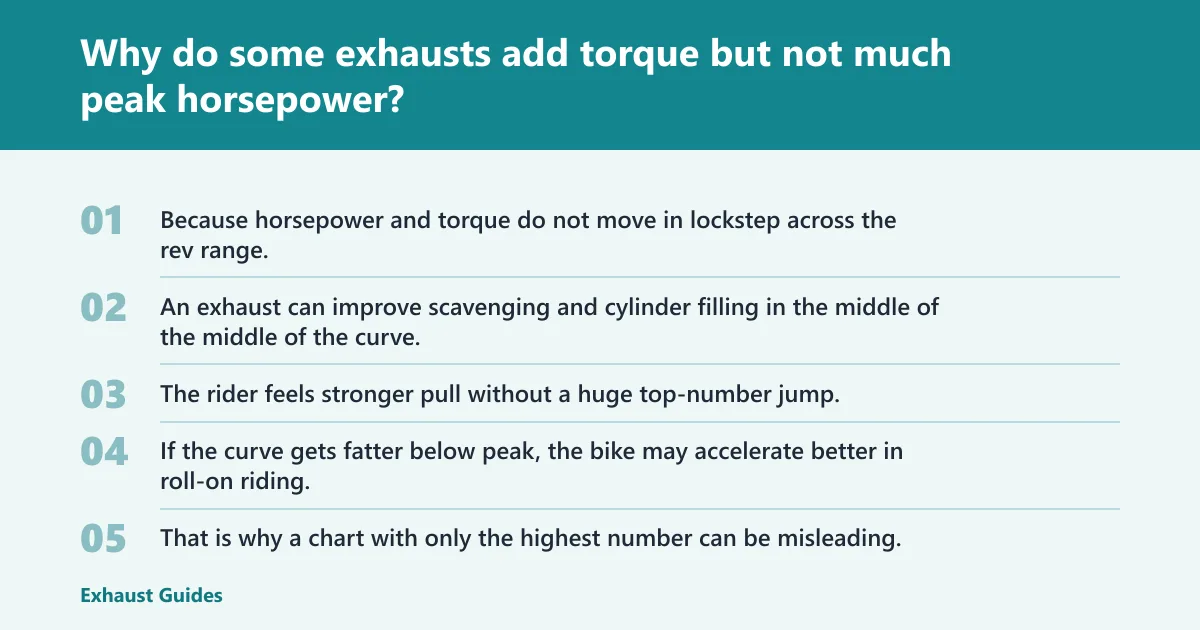
Because horsepower and torque do not move in lockstep across the rev range. An exhaust can improve scavenging and cylinder filling in the middle of the curve, which raises torque there, while the engine still reaches nearly the same peak horsepower near redline. The rider feels stronger pull without a huge top-number jump.
What the curve is telling you
If the curve gets fatter below peak, the bike may accelerate better in roll-on riding, even if the top horsepower figure changes little. That is why a chart with only the highest number can be misleading. A broader curve often matters more on the street than a small increase at maximum rpm.
A common first-timer mistake is buying an exhaust for peak horsepower alone. On a 1,000cc naked bike used for commuting, the more useful outcome may be smoother midrange torque and less weight, not a large dyno headline.
How much horsepower does a full exhaust add to a motorcycle?
A full exhaust can add several horsepower, but the real range depends on the bike. For many motorcycles, 2-6 hp is a realistic expectation. On some sportbikes, aftermarket exhausts are commonly cited at 7-10 hp overall. The more restrictive the stock exhaust and the better the fuel match, the better the odds of a real gain.
The full system matters because it changes the entire exhaust path from the engine’s exhaust valves to the tip of the muffler. That is why it offers more horsepower potential than a slip-on and why it is the setup most likely to affect the dyno curve.
How much horsepower does an exhaust add to a motorcycle?
It can add very little or a modest amount, depending on the type of exhaust and the bike. A slip-on often adds 0–2 hp, while a full system can add 2-6 hp for many motorcycles and 5-10 hp on some sportbikes. The average gain is not universal because airflow, tuning, and engine design differ widely.
If the bike already has a free-flowing stock system, the exhaust may change sound more than output. If the stock system is heavy, quiet, and restrictive, the gain potential is better.
Does exhaust add horsepower motorcycle?
Yes, but not always in a way that shows up as a large peak number. An aftermarket motorcycle exhaust can improve airflow and sometimes horsepower, yet many riders notice more torque, better response, or less weight than a dramatic top-end increase. Results depend on whether the change is a slip-on or a full system.
The wrong combination can also give back some of the expected gain. If fueling is off, the bike may feel weaker in part of the rev range even after the exhaust swap.
How much hp does an exhaust add?
For a motorcycle, the most realistic answer is often a few horsepower, not a double-digit leap. A slip-on usually changes little. A full exhaust can add more, and a tuned sportbike can land in the 7-10 hp neighborhood. Smaller bikes and heavier touring-focused bikes often see less.
The best estimate comes from your exact bike type, exhaust design, and whether the ECU map is changed to match.
Do aftermarket motorcycle exhaust increase horsepower?
Yes, some do, but the amount varies sharply by design. A full exhaust system is the part most likely to increase horsepower, while a slip-on usually brings little to no performance gain. Aftermarket systems can also reduce weight and alter the dyno curve, which may matter more than peak horsepower.
The key is to judge the exhaust by its whole effect, not by the sound alone.
Does a slip-on exhaust add horsepower on a motorcycle?
Usually only a little, if at all. A slip-on replaces the rear section of the exhaust, farthest from the engine, so it is cheaper and easier to install, but the practical expectation for engine performance is little to no improvement. Most slip-ons are bought for sound, appearance, or modest weight savings.
If the goal is horsepower, a slip-on is rarely the best place to spend the money.
Will I need a tune after installing a motorcycle exhaust?
Not always, but a tune becomes more likely with a full system or when the brand specifies remapping. If the bike runs lean, surges, or shows a flat spot after the install, fueling may need correction. A tune is about matching airflow, not chasing a dyno printout.
For a slip-on alone, many bikes do fine without changes. For a full system, the answer depends on the bike, the exhaust, and how much of the stock restriction was removed.
How much weight can a motorcycle exhaust save?
Many aftermarket exhausts are 30-40% lighter than stock, and a full system on some bikes can save approximately 10 lb. The actual savings depends on material, catalyst size, and whether the headers are replaced. Titanium and simpler construction usually save more than a heavy steel system.
Weight savings can be a useful bonus, but it should not be the only reason to buy an exhaust if horsepower is the main goal.
Are motorcycle exhaust upgrades street legal?
Not automatically. Some aftermarket systems are louder than local limits, and some remove emissions equipment that your area requires. Stock motorcycles are required to operate under 84 dB on the highway in one cited standard, but local enforcement and inspection rules vary. The safest choice is to confirm legality before ordering.
If a system is sold as race-only, treat it that way unless your local rules clearly allow it on the street.
Frequently asked questions
How much horsepower does a full exhaust add to a motorcycle?
A full exhaust often adds 2-6 hp on many motorcycles, with sportbikes sometimes cited at 7-10 hp overall. The exact result depends on displacement, stock restriction, and whether the ECU is tuned to match the new airflow. The biggest changes are often in the curve, not just at peak.
How much horsepower does an exhaust add to a motorcycle?
That depends on whether it is a slip-on or a full system. A slip-on usually adds 0–2 hp and often mostly changes sound. A full system can add more, but the gain still varies by bike type, exhaust design, and fueling setup.
Does exhaust add horsepower motorcycle?
Yes, an exhaust can add horsepower, but not every setup does it well. Full systems offer the real gain potential because they replace the exhaust from the engine to the tip. Many bikes respond with more midrange torque, while peak horsepower changes only a little.
Will I need a tune after installing a motorcycle exhaust?
You may, especially after a full exhaust. If the bike runs lean, surges, or loses smoothness, fueling is likely off enough to justify remapping. Some exhaust brands call for a tune because the new flow characteristics change the air-fuel balance across the rev range.
How much weight can a motorcycle exhaust save?
Many aftermarket systems are 30-40% lighter than stock, and a full exhaust on a Ducati Panigale can save approximately 10 lb. Slip-ons save less. Weight reduction matters most when the stock exhaust is heavy or mounted high on the bike.
Are motorcycle exhaust upgrades street legal?
Sometimes, but not always. Noise limits, catalyst rules, and local inspection standards can make a loud exhaust illegal even if it fits the bike. A system that sounds fine in a garage may still fail a roadside check or inspection station.