Catalytic Converter Cost Honda Fit
A Honda Fit catalytic converter replacement often lands in the roughly $900 to $2,400 range, with OEM parts typically on the high end and CARB-compliant units often costing more than federal fitments. A bad quote can hide a cheap noncompliant part, a failed inspection, or a much bigger bill later. This guide breaks down cost by model year, part type, labor, and emissions rules so you can compare quotes line by line.
Honda Fit catalytic converter cost overview
A fair quote comes down to four separate charges: the converter or converter assembly, labor, a diagnosis charge, and any emissions compliance requirement tied to your state. For a Honda Fit, the part price changes a lot by model year, and some years use a converter-and-manifold assembly instead of a simple bolt-on converter.
Do not accept a single all-in number without asking what is included. A quote should say whether it covers the part only, removal and install, new gaskets or hardware, a scan for P0420 or P0430, and any oxygen sensors that are being replaced at the same time.
What a fair quote should separate
- Part price: OEM Honda, EPA aftermarket, or CARB-compliant replacement.
- Labor: usually 1.0-2.0 hours for the job on a Fit, with more time if hardware is rusted.
- Diagnosis: a scan and confirmation of the fault before parts are ordered.
- Extra parts: gaskets, studs, springs, clamps, and sometimes oxygen sensors.
- Compliance: federal EPA fitment for most states, CARB-approved fitment for regulated states.
Honda Fit cost matrix by model year
The year band matters because Honda changed the exhaust layout and parts catalog over time. Some Fits use a converter-only replacement, while others use a converter integrated into the exhaust manifold. That difference changes both the part price and the labor quote.
| Model year band | Common fitment note | OEM Honda part price | EPA aftermarket part price | CARB-compliant part price | Estimated labor and diagnosis | Expected out-the-door total |
|---|---|---|---|---|---|---|
| 2007-2008 | Converter-only fitments are common; confirm exact trim and transmission | Up to $1,572.43 | $450-$1,000 | $900-$1,800 | $200-$300 labor + $100-$180 diagnosis | $750-$2,052.43 |
| 2009-2010 | Some versions use a converter/manifold assembly | $970.44; manifold assembly $1,141.33 | Varies by exact listing | Varies by approved listing | $200-$300 labor + $100-$180 diagnosis | $1,270.44-$1,621.33 before compliance-priced aftermarket options |
| 2011-2013 | Manifold-integrated versions are common on some trims | $945.78; manifold assembly $1,110.73 | Varies by exact listing | Varies by approved listing | $200-$300 labor + $100-$180 diagnosis | $1,245.78-$1,590.73 before compliance-priced aftermarket options |
| 2015-2020 | Check VIN, trim, and transmission before ordering; listings vary by exact part | $395.56 or $728.76 for different genuine Honda listings | Varies by exact listing | Varies by approved listing | $200-$300 labor + $100-$180 diagnosis | $695.56-$1,208.76 before compliance-priced aftermarket options |
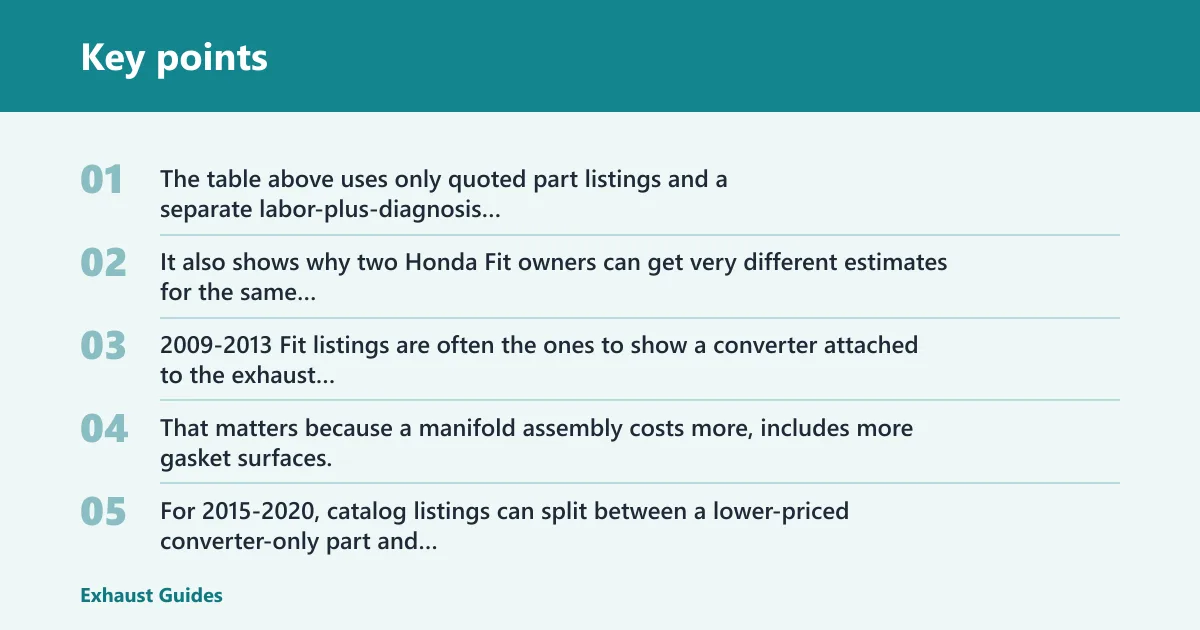
The table above uses only quoted part listings and a separate labor-plus-diagnosis allowance so you can see what each line item does to the total. It also shows why two Honda Fit owners can get very different estimates for the same warning light.
Which years commonly use converter/manifold assemblies?
2009-2013 Fit listings are often the ones to show a converter attached to the exhaust manifold rather than a simple pipe-mounted converter. That matters because a manifold assembly costs more, includes more gasket surfaces, and can take longer to remove if the studs or nuts are rusty.
For 2015-2020, catalog listings can split between a lower-priced converter-only part and a more expensive genuine Honda listing. That is why you should match the part number to your VIN instead of relying on a year alone.
Why are Honda Fit catalytic converters expensive?
Honda Fit converters are expensive because the part is emissions equipment, the fitment is specific, and some versions are built as a converter-and-manifold assembly. OEM pricing can be high, and the difference between a bolt-on converter and an integrated manifold can add several hundred dollars before labor starts.
Direct-fit versus manifold assemblies
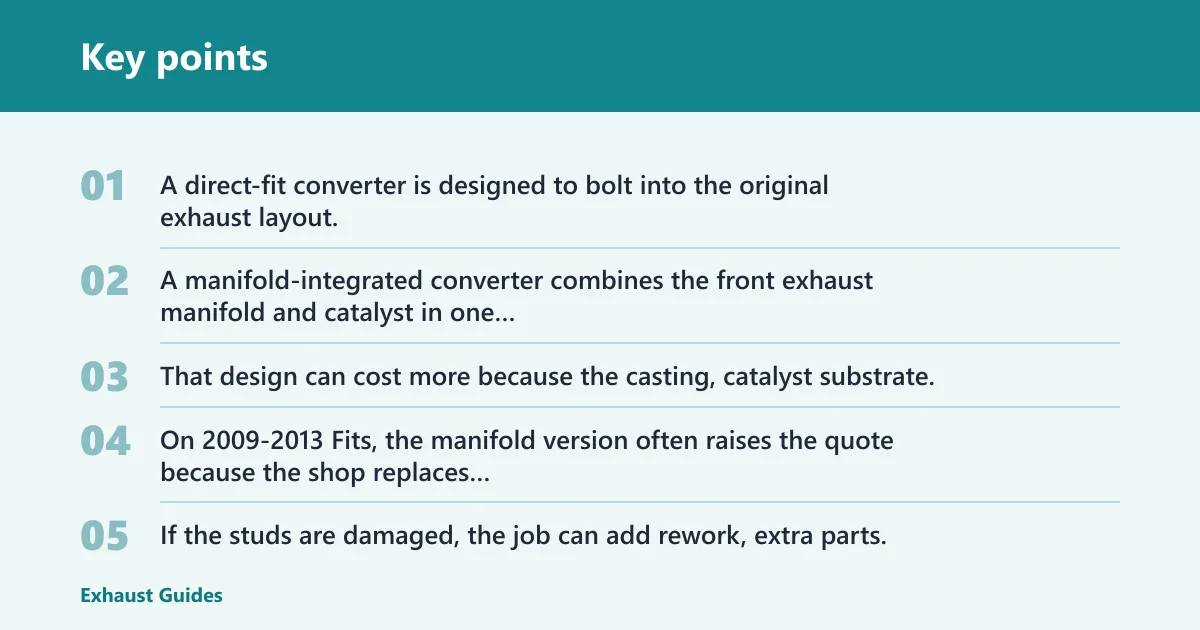
A direct-fit converter is designed to bolt into the original exhaust layout. A manifold-integrated converter combines the front exhaust manifold and catalyst in one assembly. That design can cost more because the casting, catalyst substrate, and hardware are all part of one unit.
On 2009-2013 Fits, the manifold version often raises the quote because the shop replaces a larger assembly and may need more time to free rusted fasteners. If the studs are damaged, the job can add rework, extra parts, or delays while new hardware is sourced.
OEM versus aftermarket versus CARB parts
OEM Honda parts are the safest match for fitment, but they are usually the most expensive. Federal EPA-compliant aftermarket converters can lower the parts bill in non-CARB states. CARB-compliant parts cost more because they must match California and other regulated-state rules and carry the correct approved listing for that exact vehicle application.
AHG Auto Service says OEM catalytic converters for Honda models can range from $1,000 to $4,000, while aftermarket installation can run around $200 to $300. Those figures line up with the idea that the part is usually the biggest driver of the final bill.
How emissions rules change the price
States that follow CARB rules require a CARB-approved converter on covered vehicles. In those states, the cheaper federal EPA part is not the right purchase even if it fits the pipes. That legal difference is why the same Honda Fit can have two very different replacement quotes depending on where it is registered.
In a non-CARB state, an EPA-compliant aftermarket converter may be the lower-cost path if the rest of the exhaust is sound. In a CARB state, the shop should use the approved CARB part number that matches the vehicle application.
Does your state require a CARB converter?
If your state follows California emissions rules, you need a CARB-compliant catalytic converter for the Fit. If it does not, a federal EPA-compliant aftermarket converter is usually the lower-cost option. The important point is simple: the wrong compliance type can create an inspection failure even if the part bolts on correctly.
What to verify before you buy
- Check your state’s emissions rules before ordering any part.
- Confirm the exact Honda Fit year, trim, engine, and transmission.
- Ask whether the listing is converter-only or a manifold assembly.
- Match the approved part number if your state requires CARB fitment.
- Ask the shop whether the quote includes gaskets, hardware, and a scan.
Say your 2011 Fit shows a P0420 code and you live in a CARB state. If the shop quotes a federal aftermarket converter, that lower price may not be legal for inspection. The right quote should change once the compliance rule is added.
Replacement labor and diagnosis costs
Replacement labor on a Honda Fit usually falls in the 1.0-2.0 hour window, but the bill can grow if the hardware is rusted or if the shop needs to remove a converter-manifold assembly instead of a smaller bolt-on piece. A diagnosis scan for P0420 or P0430 often adds $100-$180 before the repair begins.
What the shop usually does
- Scans the engine computer for catalyst efficiency codes.
- Checks for exhaust leaks ahead of the converter.
- Looks at oxygen sensor data and catalyst efficiency readings.
- Inspects gaskets, bolts, studs, and heat shielding.
- Replaces the converter, then clears codes and confirms operation.
Rusted fasteners can change the quote fast. A broken stud may require extra labor, drilling, or reordering hardware, and that can push the job beyond the first estimate. If the shop sees corrosion before the repair begins, ask how much of the quote is labor and how much is parts.
Can P0420 mean you do not need a new converter yet?
Yes. P0420 means the engine computer sees poor catalyst efficiency, but that code alone does not prove the converter has failed. Exhaust leaks, upstream oxygen sensor faults, and damaged wiring can trigger the same code, so it is worth diagnosing the system before buying a converter.
Common causes that can mimic converter failure
- An exhaust leak ahead of the catalyst.
- A failing upstream or downstream oxygen sensor.
- A wiring or connector fault near the exhaust.
- Engine misfires or rich-running issues that overload the catalyst.
- A converter that is still functional but no longer passes efficiency tests.
Suppose a 2008 Fit sets P0420 after a long drive, but the shop finds a cracked exhaust gasket near the manifold. Replacing the converter first would waste money if the leak is the real cause. A proper diagnosis can stop that mistake.
The practical rule is straightforward: replace the converter when diagnosis points to a failed catalyst, but keep looking when the code appears with signs of leaks, sensor faults, or other engine problems. That is the difference between a fair repair and a repeat bill.
Frequently asked questions
How much does it cost to replace a catalytic converter on a Honda Fit?
Most Honda Fit replacements fall in the $900 to $2,400 band once you include parts, labor, and a basic diagnosis, but the exact figure depends on year, compliance type, and whether the part is a converter-only piece or a manifold assembly. OEM parts usually sit at the top end.
Does a Honda Fit have a catalytic converter?
Yes. A Honda Fit uses a catalytic converter as part of the emissions system. The main difference is the design: some model years use a direct-fit converter, while others use a converter built into the exhaust manifold. That layout changes the part price and the labor quote.
What does an aftermarket Honda Fit catalytic converter cost?
An EPA-compliant aftermarket converter for a 2008 Honda Fit can cost $450-$1,000. That option is usually cheaper than OEM, but it is only the right choice in places that do not require CARB compliance. Labor and diagnosis still apply on top of the part price.
What does an OEM Honda Fit catalytic converter cost?
Genuine Honda pricing varies by year and layout. Examples include $1,572.43 for certain 2007-2008 models, $970.44 for a 2009-2010 converter, $945.78 for a 2011-2013 converter, and $395.56 or $728.76 for different 2015-2020 listings. Some years also use more expensive manifold assemblies.
Does my state require a CARB-compliant catalytic converter?
If your state follows California emissions rules, then yes, you need a CARB-compliant converter for covered vehicles. In a federal EPA state, the lower-cost EPA aftermarket option may be allowed. The key is to confirm the rule before ordering, because the wrong type can fail inspection.
How long does Honda Fit catalytic converter replacement take?
Typical labor for the 2008 Honda Fit job is 1.0-2.0 hours, and that is a good guide for many Fits when the hardware is clean. Rusted bolts, broken studs, or a manifold-integrated assembly can add time, extra parts, or a delay while the shop frees the exhaust.
Can a P0420 code mean I do not need a new converter yet?
Yes. P0420 can point to catalyst efficiency, but it can also come from an exhaust leak or an oxygen sensor fault. A scan and visual inspection are worth doing before you buy parts, because replacing the converter first can miss the real problem and repeat the repair cost.