Do Mufflers Have to Be OEM to Be Legal?
OEM mufflers are usually not required. A legal aftermarket muffler generally needs to meet the noise, emissions, and equipment rules that apply where you drive or get inspected. Ignore those rules, and you can face citations, failed inspections, or a required swap-back. This guide shows how to check the law where you drive and what markings, limits, and inspection items to verify.
Why non-OEM mufflers can pass inspection


No. In most places, a muffler does not have to be the factory part to be legal. What matters is whether the exhaust still meets local noise limits, equipment rules, and inspection standards, and whether the replacement fits the vehicle correctly without leaks or unsafe changes.
The short answer
An OEM muffler is a factory-spec replacement part built for a specific year, make, model, trim, and sometimes drivetrain layout. That makes it the easiest path for fit and inspection, but it is not automatically the only legal path. A compliant aftermarket muffler can also be legal if it does not violate local sound or equipment rules.
When OEM is optional
OEM is usually optional when the law cares about the result, not the brand. If the muffler is intact, properly mounted, and quiet enough for the local standard, an aftermarket unit may pass. Used OEM parts can also be a practical option if they are inspected for leaks and internal baffles and matched correctly, sometimes by VIN.
When exact-equivalent specs matter
Exact-equivalent specs matter when an inspection manual, dealer procedure, or emissions rule expects original-equipment fitment, routing, or noise control. That is where part shape, hanger location, inlet and outlet size, and total length start to matter as much as sound. Falcon describes OEM mufflers as “guaranteed to match your vehicle’s harmonics” and engineered for specific “backpressure and acoustics.”
What makes a muffler legal?
A muffler is legal when it meets the rules that apply where the vehicle is driven or inspected. Those rules usually come from noise ordinances, state exhaust laws, and inspection standards, not from the muffler brand itself. A loud but intact exhaust may still be legal in one place and fail in another.
Noise ordinances and exhaust sound laws
Many jurisdictions regulate exhaust sound directly. Some use a decibel limit, while others use a broader standard such as no “excessive” or “unusual” noise. The exact test may depend on street use, commercial use, classic-car status, or whether the vehicle is on public roads versus a track or off-road property.
Inspection standards and equipment rules
Inspection rules often focus on leaks, rust, cracks, missing hangers, and secure mounting. A muffler can fail if it is damaged, too loud, or obviously altered. The same source notes that a muffler can cause “failed safety inspections,” which is why visual condition matters as much as sound.
Why local rules can differ from state rules
State law may set the floor, but city and county noise ordinances can still apply. In some areas, inspectors look for the equipment that came with the vehicle class; in others, they care only about safety and sound. That is why a muffler that passes in one county can still draw a citation in another.
OEM muffler vs aftermarket muffler
OEM mufflers are built around factory fit, factory acoustics, and the car’s original exhaust layout. Aftermarket mufflers may change internal chamber design and sound level, and they can be legal if they meet the rules that apply. The difference is usually compliance risk, not legality by brand name alone.
Factory fit and vehicle-specific sizing
OEM parts are made to match the car’s original routing, hanger locations, inlet and outlet dimensions, and body length. The same source notes that mufflers can vary by “standard and sport trims, or between AWD and FWD models.” That matters because a visually similar muffler may still hang wrong, rub the underbody, or leak at the joints.
Sound control, drone, and backpressure
Aftermarket mufflers can sound deeper, sharper, or louder than stock. Some also create drone, which is unwanted cabin resonance at cruising speeds. OEM tuning also uses backpressure as part of the exhaust balance, and a bad match can change both sound and fit without making the vehicle illegal by itself.
Common aftermarket styles
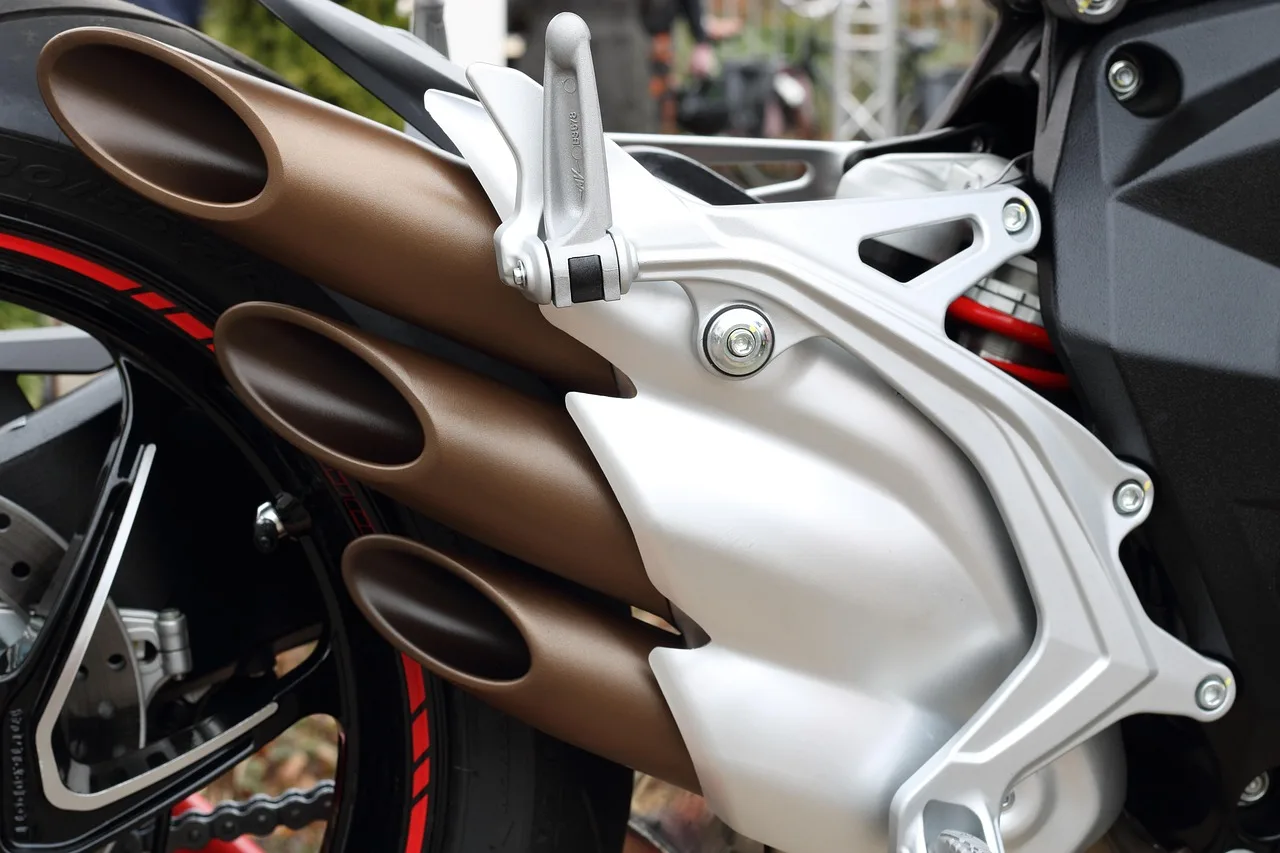
Chambered mufflers use internal passages to tune tone. Turbo mufflers tend to balance flow and sound reduction. Glasspack mufflers are usually louder and simpler inside. Straight-through mufflers are the loudest option and may not be street-legal everywhere, according to LEDaut.
Suppose a driver replaces a worn factory muffler with a straight-through unit that bolts up cleanly but makes the car much louder at idle. The part may still fit, yet it can fail a local sound rule or get flagged at inspection if the area limits exhaust volume more strictly than the state does.
When is a muffler delete illegal?
A muffler delete is often higher risk because it removes the sound-control part of the exhaust system. Some places treat that as an equipment violation on its own, while others care mainly about the resulting noise level. Open pipes are usually the riskiest setup because they leave no dedicated muffling at all.
Removed muffler vs louder muffler
Replacing a damaged muffler with a louder one is different from deleting the muffler entirely. A louder muffler may still be legal if it stays within the local rule. Removing the muffler deletes a component the vehicle was designed to use, which can lead to a violation even before sound is measured.
Open pipe risk
An open pipe can fail on multiple fronts: noise, safety inspection, and visible tampering. It can also draw attention if the rest of the exhaust suggests missing equipment. If the car still has the catalytic converter but no muffler, the legal risk depends on the local rule set and inspection method.
Street use, track use, and off-road use
Track-only or off-road use may be treated differently from street use, but that exception is location-specific. Some jurisdictions allow competition vehicles on closed courses, not on public roads. A muffler delete that is acceptable for an off-road trail rig may still fail if the vehicle is driven or parked on the street.
How do you check fitment and compliance?
Check fitment by measuring the inlet, outlet, body length, hanger positions, and exhaust routing before buying a muffler. Check compliance by matching those measurements to the vehicle’s layout and the local inspection or noise rule. A muffler that fits poorly can leak, rattle, or fail inspection even if the sound level is acceptable.
Measure inlet, outlet, and body length
Confirm pipe diameter on both ends and compare the muffler body length to the available space under the car. If the inlet or outlet is offset, make sure the offset matches the existing exhaust path. Even a small mismatch can force a bad angle or place the shell too close to suspension or heat shielding.
Match hanger positions and exhaust routing
Hangers need to land where the chassis expects them. If the hanger spacing is wrong, the muffler can hang low, strike the body, or shift under load. That becomes a compliance issue when the inspector checks for secure mounting, leaks, rust, or cracks in the exhaust path.
Check inspection and emissions records
Look at the inspection sheet, emissions rules, and any notes about tampering or required original-equipment parts. Keep the part number, packaging label, invoice, and any product documentation that lists vehicle fitment. If the vehicle is subject to emissions inspection, also confirm whether the exhaust change affects catalytic converter placement or other monitored equipment.
A common first-timer mistake is buying a muffler for a “same engine” model without checking trim or drivetrain. A 2WD and AWD version may share engine code but differ in routing or hanger location, so the part can bolt up poorly even though the car looks identical from the outside.
Muffler legality decision checklist
Use this table to match your situation to the rule that matters most. It is not a substitute for local code, but it does separate the common compliance checks by setup. The key question is whether the change is a replacement, a delete, or a wider exhaust modification.
| Situation | What to verify | Who regulates it | Common failure points | What documentation to keep |
|---|---|---|---|---|
| OEM replacement | Fitment by year, make, model, trim, and drivetrain; secure mounting; no leaks or cracks | State inspection station; local vehicle code | Wrong hanger spacing; rust; loose clamps; damaged internal baffles | Part number, VIN match note, receipt, inspection sheet |
| Aftermarket replacement | Noise limit, mount height, pipe diameter, and whether the style is legal for street use | State highway code; city noise ordinance; inspection station | Too loud; drone complaints; fitment rub; incorrect inlet or outlet size | Product spec sheet, receipt, fitment notes, inspection record |
| Muffler delete | Whether removal is banned; whether the vehicle still meets sound and equipment rules | State law; local police; inspection station | Open pipe citation; loudness; obvious tampering; failed safety inspection | Any race-use exemption paperwork, towing or transport record, inspection result |
| Open pipe | Whether public-road operation is prohibited regardless of sound level | State law; local ordinance; enforcement officer | No muffling device; excessive noise; missing exhaust support | Off-road-only proof if applicable, event entry, shop invoice for return-to-stock parts |
| Classic car | Historic-vehicle exemption, period-correct equipment rules, and annual inspection exceptions | DMV or historic-vehicle agency; local inspection program | Noncompliant modifications; wrong era parts; noise complaints | Historic registration, exemption letter, photos of exhaust configuration |
| Off-road use | Landowner or trail rules; transport requirements for street travel | Property owner, park authority, or event organizer | Driving on public roads with off-road exhaust; trail rule violations | Event rules, trail permit, trailer or transport records |
| Inspection or emissions risk | Missing catalytic converter, visible tampering, leaks, rust, cracks, or loose hangers | Emissions station; safety inspection station | No muffler, damaged resonator, cut piping, unreadable labels | Inspection report, repair invoice, before-and-after photos |
Can you pass emissions or inspection with no muffler?
Sometimes no, and often not safely. A car can fail inspection for a missing muffler, but the bigger issue is whether the exhaust has leaks, tampering, or missing equipment beyond the muffler itself. Emissions systems and safety inspections can both be affected, even if the engine runs normally.
Safety inspection failures
Safety checks usually look for rust, cracks, leaks, loose hangers, and exhaust parts that hang too low or discharge near occupied areas. A missing muffler can be a direct fail if the inspection standard requires intact exhaust equipment. Falcon’s “precision-tested, rust-inspected OEM mufflers” language shows how often condition alone can decide the result.
Noise-related inspection failures
A vehicle can fail because it is too loud even if the exhaust is complete. Noise rules may be enforced by a roadside stop, a station test, or a visual judgment under the local code. That is why a muffler delete is more likely to cause trouble than a legal aftermarket replacement with proper sound control.
Tampering concerns beyond the muffler
Inspectors may look beyond the muffler if the exhaust has been cut, re-routed, or altered near the catalytic converter or resonator. A missing resonator is not the same thing as a missing muffler, but it can still change sound and may matter under some rules. The main question is whether the system still matches the vehicle’s required equipment and emissions layout.
Frequently asked questions
Is it illegal to have no muffler?
It can be. Some places ban operating a street vehicle without a muffler, while others focus on noise level or general equipment safety. If your local rule requires an exhaust sound-control device, a no-muffler setup can lead to citations or an inspection fail even if the car runs normally.
Is it illegal to remove your muffler?
Often, yes for street use, but not everywhere. The legal issue is usually the result of removal: louder exhaust, missing equipment, or altered routing. If the vehicle is only used off-road or at a sanctioned event, different rules may apply, but public-road use is the risky part.
Are muffler deletes legal?
Sometimes, but only where the local code allows the exhaust to be that loud or allows equipment removal. A muffler delete usually raises legal risk because it removes the main sound-control device. If the vehicle must pass a safety or noise inspection, a delete is more likely to fail than a legal replacement muffler.
Are modified exhausts illegal?
Not automatically. Many modified exhausts are legal if they stay within noise rules, do not remove required equipment, and pass inspection. The problem starts when the modification deletes the muffler, changes emissions equipment, or creates visible leaks, cracks, or unsafe mounting issues.
How do I know if an aftermarket muffler will fit my car?
Check the inlet and outlet size, body length, offset, hanger positions, and whether your car uses a standard or sport trim layout. The safest match is a part listed for your exact year, make, model, and drivetrain. Used OEM parts can also work well if they are VIN-matched and inspected for internal damage.
What is the difference between a muffler and a resonator?
A muffler is the main exhaust sound-control component. A resonator is a secondary component used to cancel specific frequencies and reduce drone. Removing a resonator can change tone, but it is not the same as removing the muffler, and local rules may treat those changes differently.