How to Choose the Right Exhaust Gasket Size
Pick the exhaust gasket based on the flange opening, port shape, bolt pattern, and sealing surface, not pipe diameter alone. If the old gasket is missing, match the flange opening and bolt spacing, choose the exact style, then verify thickness. A wrong size can cause leaks, burned gaskets, noise, and repeated disassembly. This guide shows how to measure joints, identify gasket types, and pick the right size fast, with the measurements that actually matter.
What an exhaust gasket size means
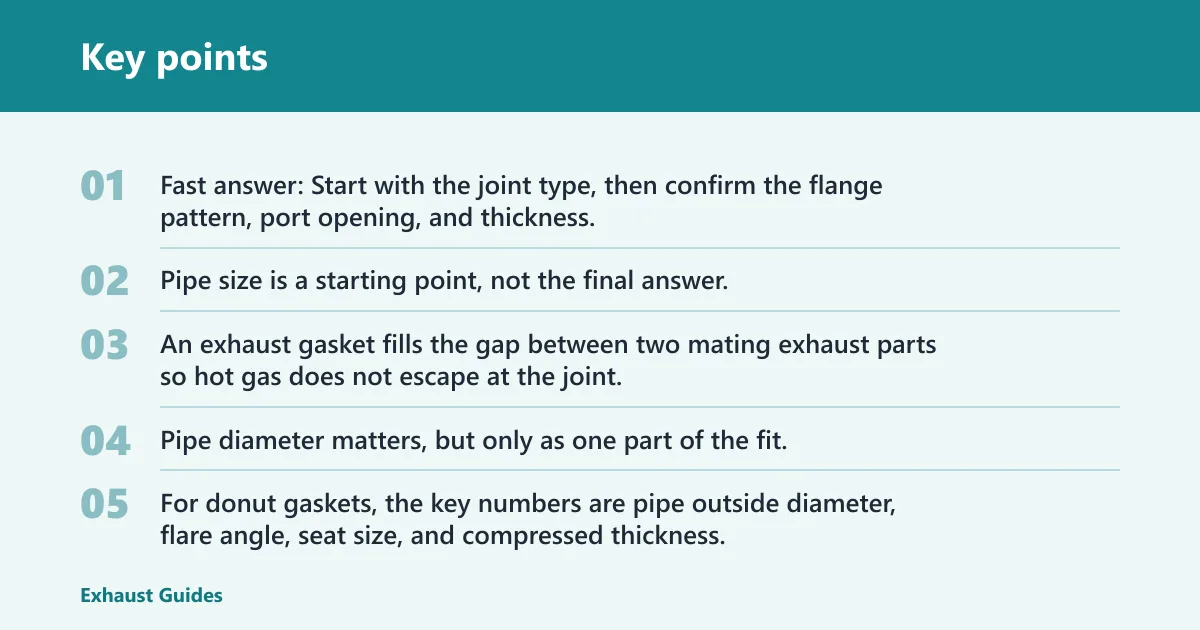
Fast answer: Start with the joint type, then confirm the flange pattern, port opening, and thickness. For a 2-inch joint, the correct part can still be a flat flange gasket, a donut gasket, or a ring-style seal depending on the bolt layout and seat shape. Pipe size is a starting point, not the final answer.
Exhaust gasket types and where they fit
An exhaust gasket fills the gap between two mating exhaust parts so hot gas does not escape at the joint. The fit can be a flat flange gasket, a donut gasket, a crush gasket, or a ring gasket, and each one uses different sizing points.
Flat flange gaskets matter most at manifold outlets, downpipes, catalytic converter flanges, and muffler joints with two, three, or four bolts. Donut gaskets are used where one pipe seats into a flare or socket, so the seat angle and compressed thickness matter as much as the pipe size.
Pipe size versus flange size
Pipe diameter matters, but only as one part of the fit. A 2-inch pipe can use different gasket categories depending on whether the joint is a 2-bolt flat flange, a 3-bolt flange, or a ball-and-socket style connection.
For flat gaskets, the important measurements are inner diameter, outer diameter, bolt-hole count, bolt-centre spacing, flange shape, and thickness. For donut gaskets, the key numbers are pipe outside diameter, flare angle, seat size, and compressed thickness.
Why seal shape changes the measurement
The same pipe can need different gaskets because the sealing shape changes the contact area. A round port in the manifold outlet may need a ring gasket, while a flat rectangular or oval flange may need a larger surface gasket that matches the bolt pattern.
Aftermarket headers and repaired flanges are the usual trouble spots. They can shift port alignment, widen the bolt spacing, or change the seating surface enough that the OEM number no longer fits cleanly.
How do I know what exhaust gasket size I need?
Start by identifying the joint type, then measure the sealing surface and bolt pattern before looking at pipe diameter. If the old gasket is intact, compare its inner diameter, outer diameter, thickness, and hole pattern to the new part. If it is damaged or gone, match the flange geometry first and use pipe size only as a cross-check.
What you need to measure first
- Digital caliper for inner diameter, outer diameter, and thickness
- Ruler or tape measure for quick flange span checks
- Thread pitch gauge for bolt identification when hardware is missing
- Feeler gauge for gap checks on warped flanges
- Marker or cardboard template to trace shape and hole positions
How to measure a flange gasket correctly
- Clean the joint face. Remove carbon and rust so the caliper and template sit flat. Scale on the flange can add enough error to send you to the wrong gasket size.
- Measure the inner opening. Record the gasket ID or port opening where exhaust gas passes through. For flat gaskets, this is usually the most important sealing dimension.
- Measure the outer edge. Note the outside diameter or outline size so the gasket covers the full sealing land without hanging over a step or groove.
- Count and space the holes. Record bolt-hole count and bolt-centre spacing. A 2-bolt, 3-bolt, and 4-bolt flange can look similar but accept different gasket layouts.
- Check thickness and surface fit. Measure the compressed or specified thickness, then confirm the flange faces are flat enough to clamp evenly. Warped surfaces can need a different gasket material or a repair before ordering.
How to measure a donut gasket correctly
- Measure the pipe outside diameter. Use the pipe OD, not the inside diameter, because donut gaskets seat around the outer surface and flare.
- Measure the flare angle. Match the cone angle or seat angle at the joint. A correct OD with the wrong angle can still leak.
- Check the seat size. Confirm the width and depth of the socket or flare where the gasket compresses.
- Confirm compressed thickness. Compare the part’s stated thickness after clamp load, since a donut that is too thick may not seat fully and one that is too thin may not seal.
How to measure a missing or damaged gasket
Trace the flange with a marker onto cardboard if the gasket is destroyed. Mark the bolt holes, the port opening, and the outside edge, then measure the trace with a ruler or caliper. If only a fragment remains, use the bolt-centre spacing and flange shape to narrow the category before you order.
Say your 2-inch pipe has a 3-bolt flange, but the old gasket is crumbled. The pipe size alone points to several possible parts, yet the bolt pattern and flange outline will narrow it to the correct flat gasket or ring style before you buy.
Exhaust gasket sizing checklist
This is the quick decision path. Use the joint type first, then the measurement points, then the mismatch symptoms to choose the right gasket category. If the numbers point in different directions, trust the flange pattern and sealing surface before the pipe label.
| Joint type | Measurement points | Common mismatch symptoms | Buy this, not that |
|---|---|---|---|
| 2-bolt flat flange | Inner diameter, outer diameter, bolt-centre spacing, flange shape, thickness | Exhaust soot at one edge, bolt holes slightly off, gasket pinched on one side | Buy a 2-bolt flange gasket; do not buy by pipe diameter alone |
| 3-bolt flange | Triangle pattern, port alignment, hole count, OD, thickness | Bolt heads bind, port opening sits off-centre, leak after warmup | Buy a 3-bolt flange gasket; do not force a 2-bolt or generic round gasket |
| 4-bolt flange | Hole count, bolt-centre spacing, sealing land width, flange shape | Edge lift, uneven crush, bolt torque changes the leak point | Buy a 4-bolt flange gasket; do not substitute a smaller pattern |
| Donut joint | Pipe OD, flare angle, seat size, compressed thickness | Whistling, soot trail, gasket slides out when tightened | Buy a donut gasket sized to the seat; do not buy a flat flange gasket |
| Crush or ring joint | Seat diameter, groove depth, installed height, port alignment | Crushes unevenly, leaves a gap, leaks after heat cycling | Buy the correct crush or ring style; do not substitute a flat sheet gasket |
Is exhaust gasket size based on the pipe diameter or flange diameter?
It depends on the joint style. Pipe diameter matters most on donut and some ring joints, while flange opening, bolt pattern, and face shape matter most on flat flange gaskets. If the pipe size and flange size conflict, the joint geometry usually wins.
When pipe diameter matters most
Use pipe outside diameter as the primary number on a donut gasket or a socket-style joint. The gasket must seat around the pipe and cone, so an inside-diameter-only guess can be wrong even when the pipe is labeled 2 inches or 63.5 mm.
When flange opening matters most
On flat exhaust flange gaskets, the opening must match the exhaust flow path and port alignment. A 2.25-inch flange may still use a gasket with a different opening if the bolt pattern and face width require it.
When seat size and flare angle matter most
For donut gaskets, the sealing happens as the cone compresses into the seat. That means compressed thickness and flare angle can matter more than a nominal pipe label. A correct OD with the wrong seat angle often leaks after a few heat cycles.
How to match the flange pattern and joint shape
Match the flange pattern before you focus on the pipe label. A gasket that fits the tube but misses the bolt holes or port location will not seal. This is where manifold outlet shape, repaired flanges, and aftermarket adapters create most of the mismatch problems.
2-bolt, 3-bolt, and 4-bolt patterns
Two-bolt flanges are common on repair sections and smaller joints. Three-bolt flanges are common on many downpipe and catalytic converter connections, and four-bolt patterns often appear where a wider seal area is needed. The hole count and bolt-centre spacing must match the flange exactly.
Oval, round, and port-aligned flanges
Oval and round flanges can look close in a catalog, but the port alignment can differ by a few millimetres. That difference matters when the manifold outlet is close to the edge of the gasket land or when the sealing surface has been resurfaced.
Manifold outlet fit and surface condition
Check the manifold outlet for pitting, warping, and carbon tracks. A rough face may need a best exhaust gasket materials choice with better conformity, while a smooth aftermarket header may call for a different thickness than the original part.
A common first-timer mistake is to match only the pipe label and ignore the bolt spacing. A 2-inch pipe on a repaired 3-bolt flange can still need a different gasket than a factory 2-inch joint because the flange face and hole layout changed.
Which gasket material should you choose?
Material choice affects sealing, heat resistance, and how much the gasket can tolerate a rough or slightly warped surface. It does not replace sizing, but it can change whether a correctly sized gasket survives the joint conditions.
Graphite
Graphite gaskets conform well to uneven faces and are common in exhaust flange and donut applications. They are a practical choice for joints with minor surface irregularities, but they can crush too far if the hardware is over-tightened.
Multi-layer steel
MLS gaskets suit flatter, cleaner surfaces and high-clamp applications such as some header manifolds. They resist heat well and hold their shape, but they need better surface finish and more accurate alignment than softer materials.
Composite
Composite gaskets are often chosen for mixed-fit repairs where the flange face is not perfect. They can seal well on moderate imperfections, though they may not tolerate extreme heat as well as MLS in every application.
Copper
Copper handles heat well and can work on certain best exhaust gaskets for diesel trucks exhaust joints, especially where thermal cycling is severe. It still needs the correct shape and thickness, and it is not a fix for a badly mismatched flange pattern.
When material choice changes the size call
If the flange is warped, pitted, or slightly off after repair, the material can affect whether you need a thicker gasket or a different style. Do not pick a softer material to cover a wrong bolt pattern; that only hides the fit problem.
What to do when the old gasket is missing or destroyed
If the old gasket is gone, use vehicle data as a starting point, then confirm the flange geometry at the car. Make, model, year, engine, and exhaust segment narrow the search, but aftermarket headers, adapters, and repaired flanges can change the final size.
Use OEM and catalog dimensions
Check the original equipment listing and any catalog that shows inner diameter, outer diameter, bolt-hole count, and thickness. If the part number is listed for the exact manifold outlet or downpipe, that is a stronger match than pipe diameter alone.
Account for mixed-fit applications
Mixed-fit systems often need extra caution because one side may be OEM and the other may be aftermarket. Measure both mating faces if the system has an adapter, a repaired flange, or a replacement header, and choose the gasket that matches the actual joint, not the original vehicle drawing.
Our picks by need
2-bolt repair flange: Aokdom 2.25-inch kit

- Includes gasket and bolts
- Stainless steel construction
- Sized for 2.25-inch flanges
This kit fits a 2.25-inch 2-bolt exhaust gasket replacement cost repair job and includes a gasket plus bolts, which helps when the old hardware is damaged. The stainless steel construction is a plus for heat and corrosion exposure, but it is tied to one flange size, so it is not a broad match for other patterns.
3-bolt graphite fit: YGQ 2.5-inch gasket

- Designed for 2.5-inch exhausts
- Matches 3-bolt flanges
- Includes two gaskets
This option is aimed at 2.5-inch 3-bolt exhausts and includes two gaskets, which can help if you need a backup during a repair. The graphite material is useful for sealing, but the fit is narrow enough that it is not the right pick for a 2-bolt or donut-style joint.
Donut joint backup: UBOG 2-inch gasket

- Graphite, ceramic, and metal build
- Fits multiple exhaust sizes
- Easy to install
This gasket is aimed at donut-style sealing and is listed for multiple exhaust sizes, which makes it worth checking when the joint is a seat-and-flare connection rather than a flat flange. The drawback is that the broad size listing still requires you to confirm pipe OD, seat size, and flare angle before ordering.
LS header replacement: Michigan Motorsports MLS gasket

- Made for LS-series engines
- Multi-layer steel construction
- OEM-style direct replacement
This MLS gasket is a direct replacement for LS-series header and manifold applications, where surface flatness and heat resistance matter. It is a focused fit for GM LS engines, so it is not a general-purpose answer for mixed-fleet or non-LS exhaust work.
Mistakes to avoid
Do not use pipe diameter as the only sizing number. A 2-inch pipe can still need a different gasket because the flange opening, bolt pattern, or seat angle changes the part.
Do not reuse a damaged gasket as your only template. A torn edge or crushed fire ring can hide the true opening and lead you to buy the wrong inner diameter or thickness.
Do not ignore material when the joint runs hot or the flange is rough. A correct shape in the wrong material can leak after a few heat cycles.
Do not force a gasket into a pattern it was not made for. If the bolts fight the holes or the port sits off-centre, stop and recheck the flange shape and bolt-centre spacing.
Frequently asked questions
What is an exhaust gasket?
An exhaust gasket is the seal between two exhaust parts such as a manifold and downpipe, or two flanges at a repair joint. It must match the port shape, bolt pattern, and surface style so hot gas stays inside the system and does not leak at the joint.
How do I measure an exhaust gasket correctly?
Use a digital caliper for inner diameter, outer diameter, and thickness, then verify bolt-hole count and bolt-centre spacing with a ruler or template. If the gasket is missing, trace the flange face and compare the outline to the replacement part before you order.
What size exhaust gasket do I need for 2-inch pipe?
Do not assume every 2-inch pipe uses the same gasket. A 2-inch pipe may take a 2-inch donut gasket, a 2-bolt flange gasket sized to the port opening, or a specific 3-bolt pattern. Check the joint style and bolt layout before buying.
Can I reuse the old gasket to match a new one?
Yes, if it is intact and not crushed or torn. Measure the old gasket’s ID, OD, hole count, and thickness, then compare it to the replacement. If the gasket is damaged, use it only as a rough guide and confirm the flange directly.
What tools do I need to measure an exhaust gasket accurately?
A digital caliper is the main tool. Add a ruler or tape measure, a thread pitch gauge for bolt identification, a feeler gauge for warped surfaces, and a marker or cardboard for tracing the flange. Those tools cover the measurements that matter most.