Best Gasket for Jeep Exhaust Headers
For a Jeep 4.0 or 4.2 header swap, the best gasket is a dead-flat, high-quality multi-layer steel or OEM-style composite gasket that matches the flange condition. If the flange is warped, machine or repair it first. Skip that step and you usually get repeat leaks, ticking, soot, and burned bolts. This guide covers gasket choice by engine, header design, and flange flatness so you can pick a seal that lasts.
Top pick for Jeep headers

- Directly compatible with Jeep Grand Cherokee exhaust manifolds
- Meets or exceeds OEM specifications for a reliable seal
- Application-specific design ensures a proper, hassle-free fit
The best starting point for most Jeep 4.0L daily drivers is a Jeep-specific composite or MLS gasket that matches the port shape and bolt pattern, with flat flange surfaces and clean hardware. If the header flange is rough, warped, or misaligned, fix that first. A better gasket will not cover a bad joint.
For stock cast manifolds and mild aftermarket replacements, a high-density fiber or composite gasket is often the easiest durable choice. For clean, flat tubular headers, MLS can be the better fit. Copper belongs in custom setups where the flange finish and service plan justify it.
Quick picks by Jeep setup
Use the setup, flange condition, and service duty to narrow the choice. Jeep owners run into repeat leaks when they buy by brand name alone instead of matching the gasket to the engine family and header flange.
- Stock cast manifolds: Composite or high-density fiber gasket, no sealant unless the maker specifically calls for it.
- Tubular headers: MLS on a dead-flat flange; composite if the flange is less than perfect.
- Rough or uneven flanges: Fix the flange first, then use a forgiving composite gasket.
- Trail rigs with repeated heat cycles: MLS or a quality composite with good bolt-hole alignment and fresh hardware.
- Older 4.2L/258 swaps: Correct engine-specific fitment first, then choose composite for serviceability or copper for a custom, maintainable setup.
Header gasket decision table
| Engine family | Header type | Flange condition | Best gasket material | Sealant yes/no | Risk of repeat blowout |
|---|---|---|---|---|---|
| 4.0L I6 | Stock cast manifold | Flat and clean | Composite or high-density fiber | No, unless the maker says so | Low |
| 4.0L I6 | Tubular header | Dead-flat flange | MLS header gasket | No | Low |
| 4.0L I6 | Tubular header | Rough or slightly uneven | Composite gasket | Usually no | Medium |
| 4.2L/258 I6 | Stock manifold or swap header | Used but sound | Composite gasket matched to port shape | No | Medium |
| 4.2L/258 I6 | Custom tubular header | Machined and flat | Copper reusable gasket | Sometimes, only if the manufacturer allows it | Medium |
| 4.0L or 4.2L | Trail rig | Heat-cycled often | MLS or heavy-duty composite | No | Medium to high if hardware is reused |
| 4.0L or 4.2L | Daily driver | Sound and consistent | Composite or MLS, chosen by flange finish | No | Low |
| 4.0L I6 | Header with warped flange | Warped or misaligned | Repair the flange first, then composite | No | High until the flange is corrected |
Which gasket material fits your Jeep?
For Jeep 4.0L and 4.2L exhaust headers, the material has to match the flange, not just the engine name. Fiber, MLS, copper, and composite all have a place, but the wrong choice can fail fast under heat cycling and vibration.
Fiber gaskets for common Jeep repairs
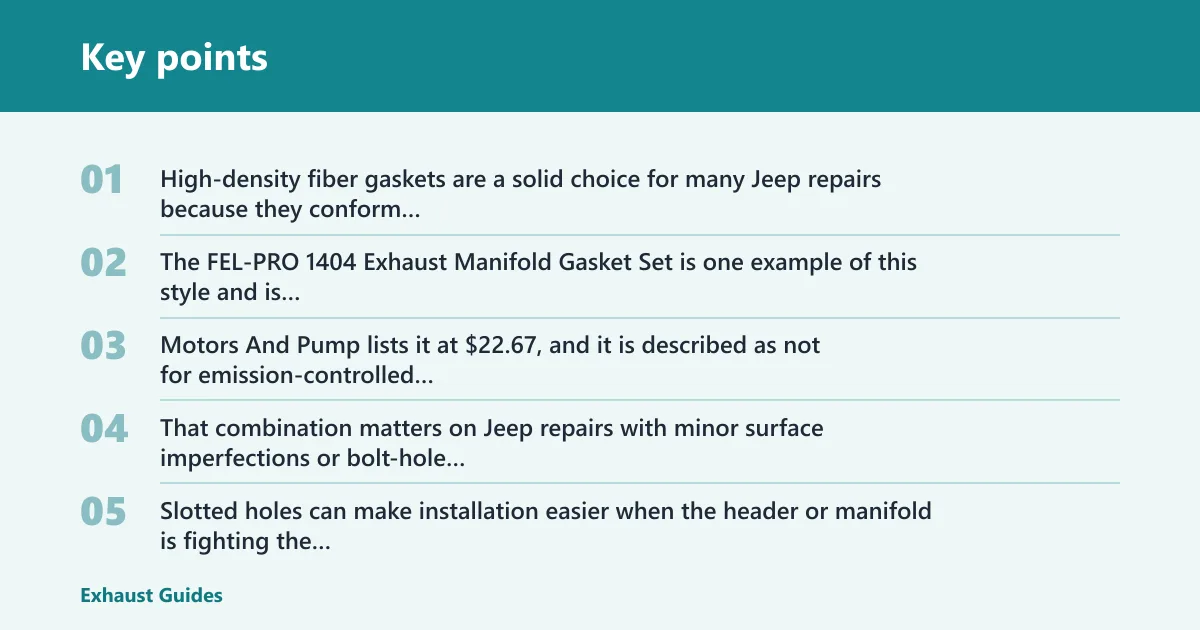
High-density fiber gaskets are a solid choice for many Jeep repairs because they conform better than metal when the flange is not perfect. The FEL-PRO 1404 Exhaust Manifold Gasket Set is one example of this style and is described as using a high-density fiber facing material, a perforated steel core, slotted bolt holes, and a nonstick coating. Motors And Pump lists it at $22.67, and it is described as not for emission-controlled vehicles.
That combination matters on Jeep repairs with minor surface imperfections or bolt-hole alignment issues. Slotted holes can make installation easier when the header or manifold is fighting the bolt pattern.
MLS gaskets for clean, flat flanges
MLS header gaskets are the better fit when the flange is flat and the ports line up correctly. The Michigan Motorsports LS MLS Header Gasket is identified as multi-layer steel and listed at $22.99, but the material lesson is the one that matters here: MLS wants a clean, stable sealing surface and does not forgive warped hardware.
On a Jeep 4.0L header swap, MLS is most attractive when the header flange is new or machined and the bolt pattern lands squarely. If the flange is rough, MLS is usually the wrong first move.
Copper gaskets for custom setups
Copper reusable header gaskets suit custom Jeep setups where the flange finish is good and future service matters. They can work well on a clean, flat joint, but they are less forgiving than composite when the surface is rough or the bolt holes are off.
Use copper only when the flange is ready for it. A copper gasket is not a cure for poor header fitment.
Composite gaskets for mixed-use Jeeps
Composite gaskets are the practical middle ground for many stock and lightly modified Jeeps. They handle real-world flange variation better than MLS and are often easier to live with on daily-driven 4.0L and 4.2L rigs that see cold starts, heat soak, and vibration.
If you want one gasket type that covers a lot of ordinary Jeep repairs, composite is the safest starting point.
Does your flange need more than a gasket?
Yes. Bolt-hole alignment, flange flatness, and surface finish can matter more than the gasket material itself. If the flange is not square, clamp load can shift around the ports and the gasket may start leaking again, often at the same cylinder.
How bolt-hole alignment changes clamp load
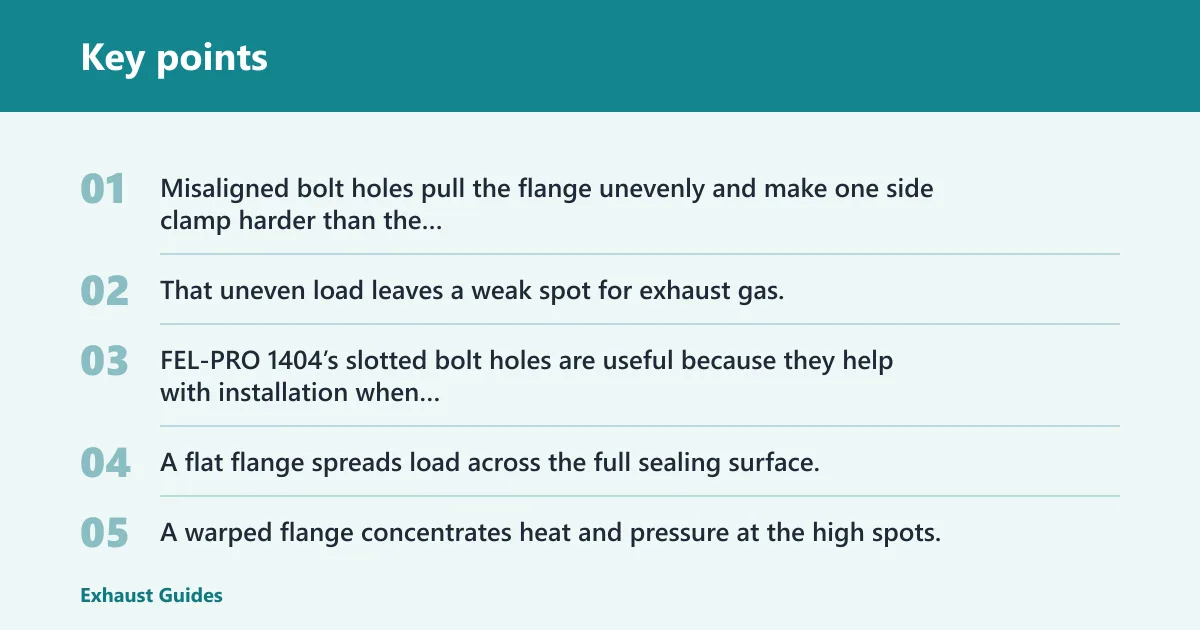
Misaligned bolt holes pull the flange unevenly and make one side clamp harder than the other. That uneven load leaves a weak spot for exhaust gas, which is how a fresh gasket can fail long before it should.
FEL-PRO 1404’s slotted bolt holes are useful because they help with installation when the hardware and flange need a little extra room to line up.
Why flange flatness matters on Jeep headers
A flat flange spreads load across the full sealing surface. A warped flange concentrates heat and pressure at the high spots, which can burn the gasket and start a leak path.
On a Jeep 4.0L tubular header, a flat flange is often the difference between a one-time repair and a repeat ticking noise a few weeks later.
What rough casting or warped tubing does to seal life
Rough casting can chew up a softer gasket face, while warped tubing changes the port-to-flange angle and distorts clamp load. Both conditions shorten seal life, especially on vehicles that heat cycle often or spend time off pavement.
Picture a TJ with a mild header swap and a rough flange. A composite gasket may buy time, but if the flange is still uneven after cleanup, the leak risk stays high.
- Match the engine family: Confirm 4.0L I6 or 4.2L/258 I6 first. Jeep header gaskets are not one-size-fits-all, and the bolt pattern and port shape have to match the engine.
- Match the header style: Stock cast manifolds and tubular headers do not load the gasket the same way. That changes whether fiber, MLS, or copper is the better buy.
- Check flange condition: Flat and clean means MLS can make sense. Rough, slightly uneven, or used flanges usually point you toward composite.
- Inspect hardware and alignment: Reused bolts, stretched hardware, and crooked bolt holes invite repeat leaks. Fresh hardware with correct alignment is part of the seal.
- Decide on sealant last: Start with the gasket maker’s instructions. Add sealant only when the product or setup calls for it, not by default.
Say your 4.0L Cherokee has a new tubular header but the flange shows light waviness near two ports. A composite gasket is the safer choice than MLS until the flange is corrected, because the softer face can tolerate small surface flaws better.
A common first-timer mistake is choosing a header gasket just because it says Jeep on the package instead of matching the header flange and port shape. A gasket sold for a 4.0L Wrangler header may not be the right match for a 4.2L swap header, even if both are “Jeep six-cylinder” parts.
Why do Jeep header gaskets fail?
Jeep header gaskets usually fail because the joint is being asked to seal around a problem, not because the gasket itself is weak. Uneven torque, reused fasteners, warped flanges, poor surface finish, heat cycling, and vibration all raise the chance of a repeat leak.
Uneven torque and reused fasteners
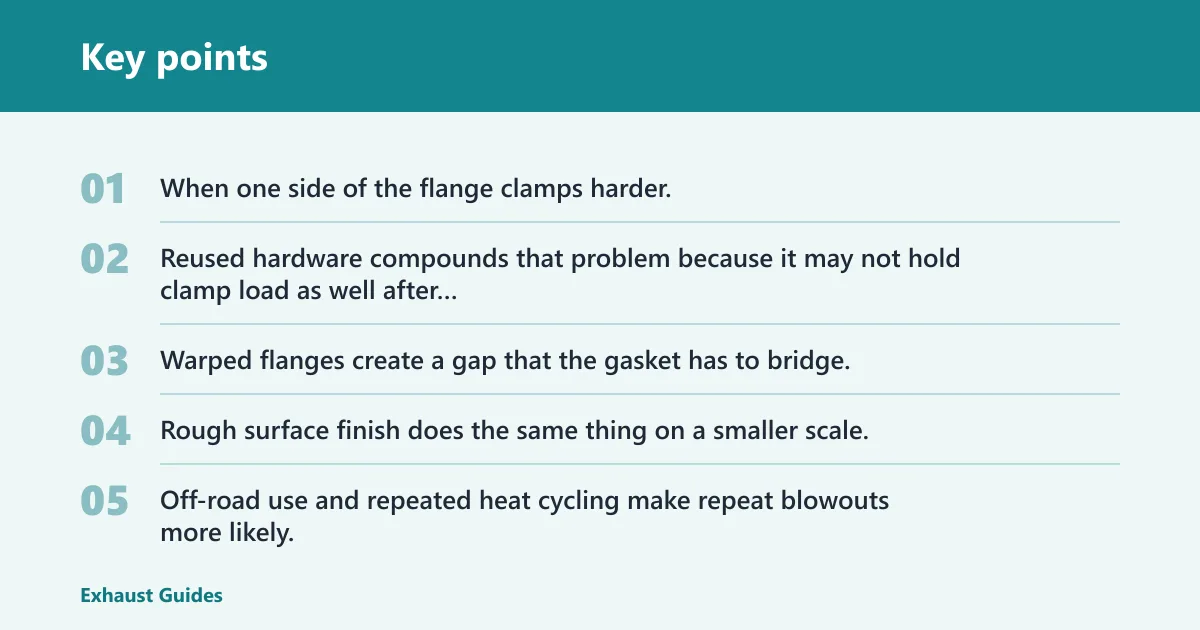
When one side of the flange clamps harder, the gasket can crush unevenly and leak at the opposite end. Reused hardware compounds that problem because it may not hold clamp load as well after repeated heat cycles.
Warped flanges and poor surface finish
Warped flanges create a gap that the gasket has to bridge. Rough surface finish does the same thing on a smaller scale, and both problems reduce how long the seal lasts.
Heat cycling, vibration, and repeat leak paths
Off-road use and repeated heat cycling make repeat blowouts more likely. The gasket moves, the hardware relaxes, and a leak path opens again near the same port.
Signs your gasket is leaking at the ports
Ticking at cold start, soot around the flange, exhaust smell under the hood, and black trails near a port are common signs. On a Jeep, the noise often shows up first under light throttle or after a cold start when metal parts are contracting differently.
What are header gaskets?
Header gaskets seal the exhaust port-to-header flange joint so exhaust gas stays in the pipe instead of escaping at the head. They have to match the port shape and bolt pattern, and they are made in fiber, MLS, copper, and composite constructions for different surface conditions and service needs.
On Jeep applications, that fitment detail matters more than a generic “Jeep” label. A gasket that seals a clean 4.0L tubular header may be the wrong choice for a 4.2L swap or a rough stock manifold.
Frequently asked questions
What is the best gasket for Jeep exhaust headers?
The best starting point for most Jeep 4.0L and 4.2L headers is a quality composite or MLS gasket matched to the flange condition. Use MLS on flat, well-machined surfaces. Use composite when the flange is less perfect. If the flange is warped, correct that before buying any gasket.
Which header gasket material is best for Jeep 4.0 or 4.2 engines?
For a Jeep 4.0 or 4.2, composite is the safest general choice, MLS is best on clean flat flanges, and copper fits custom setups with good surface finish. The engine family matters, but the flange condition matters just as much.
Do Jeep exhaust headers need sealant?
Usually no. Most header gaskets should install dry unless the gasket maker or header supplier specifically says to use sealant. Adding sealant where it is not needed can interfere with the seal or make later removal messy.
Should I use MLS, fiber, or copper header gaskets on a Jeep?
Use MLS for flat, true flanges; fiber for common repairs and slightly imperfect surfaces; copper for custom jobs where the flange is clean, flat, and serviceable. No one material fixes bad alignment or a warped header.
Why do Jeep header gaskets keep blowing out?
Repeated blowouts usually trace back to flange warp, poor bolt-hole alignment, reused hardware, uneven torque, or a rough sealing surface. Heat cycling and vibration then finish the job. The fix is usually in the joint prep, not just the gasket.
How do I know if my Jeep header gasket is leaking?
Look for cold-start ticking, exhaust soot at the flange, a sharp exhaust smell in the engine bay, and dark marks near one or more ports. A leak often gets louder under light throttle and may fade as the metal expands.
Are reusable copper header gaskets worth it on a Jeep?
They can be worth it on a custom Jeep with a flat, clean flange and a plan for periodic service. They are less forgiving than composite on rough surfaces, so they are not the best answer for every daily driver or trail rig.
Will one gasket fit all Jeep header brands?
No. Jeep header brands can differ in port shape, bolt-hole pattern, flange thickness, and header tube layout. Fitment has to be checked by engine, year, and header style before purchase.
Can I reuse an exhaust header gasket after removal?
Usually not. Once compressed and heat cycled, most exhaust header gaskets lose sealing ability or distort on removal. A reusable copper gasket is the main exception, and even then the flange condition still has to be right.