H Pipe vs Straight Pipe
Choose h pipe if you want a deeper, smoother V8 tone with some exhaust pulse balancing; choose straight pipe if maximum loudness and the simplest route under the car matter more than drone control. Pick wrong, and you can end up with harsh cabin drone, awkward fitment, or an exhaust that sounds good at idle but gets tiring on the highway. This guide compares sound, fitment, serviceability, and mild performance so you can match the layout to your car.
| Decision factor | h pipe | straight pipe | Winner |
|---|---|---|---|
| Sound character | Milder, more traditional V8 note with some bank balancing | Louder, more raw, with the least filtering between engine and exit | h pipe for most street-driven builds; straight pipe for maximum volume |
| Drone risk | Usually easier to control than a no-crossover setup, depending on mufflers | Higher risk of interior noise and resonance | h pipe |
| Fitment difficulty | Usually easier to fit than an X-pipe, but still depends on chassis space | Simpler route with fewer parts, so packaging is usually easier | straight pipe |
| Serviceability | Can be easy if you use flanged sections, but crossover adds one more piece to manage | Simple layout and fewer connections | straight pipe |
| Best-use scenario | Street cars, weekend cruisers, and builds that want a traditional V8 tone | Strip-oriented builds or cars where loudness and simplicity matter most | Depends on use case |
What each layout changes in the exhaust path
h pipe adds a crossover between the left and right exhaust banks. That crossover helps balance pressure between banks, and in a dual-exhaust system it can clean up the note without making the system feel as busy as an X-pipe. straight pipe keeps the exhaust path simple and uncoupled, with no crossover section at all.
What changes first
The first change is sound. Fitment comes next, because crossover placement has to clear the driveshaft, crossmembers, and whatever mufflers or resonators sit ahead of the rear axle. Exhaust scavenging comes after that, and its payoff depends on engine layout and how the rest of the system is built.
Where the biggest differences show up
Sound difference is immediate. Fitment difference becomes obvious during installation. On street cars, cabin resonance matters more than most owners expect.
Single pipe exhaust vs dual
Single pipe exhaust and dual exhaust are not interchangeable layouts. A single pipe system uses one exhaust path, so it is simpler and lighter, but it gives up bank separation and usually limits tuning flexibility. Dual exhaust splits flow into two banks, which is the layout where h pipes, x pipes, and other crossover choices matter most.
Why the layout matters before the crossover does
The single-versus-dual decision comes before the h-pipe-versus-straight-pipe decision. A crossover only makes sense once the system has two banks to connect.
How this affects sound and packaging
Single exhaust usually sounds more restrained and is easier to package in tight chassis spaces. Dual exhaust can sound fuller, but it also introduces more routing choices and more chances to fight underbody clearance.
How an h pipe works
h pipe is a dual-exhaust crossover design that connects both banks with a short bridge. That bridge lets pressure pulses communicate across the system, which can make the exhaust note smoother and give a small scavenging benefit.
Dual-exhaust crossover design
On a dual setup, each bank still has its own pipe, muffler path, and outlet strategy. The crossover only links the banks at one point, so the layout stays dual while adding a bit of balance.
Pressure balance between banks
The point of the crossover is pulse management. By sharing pressure between banks, an h pipe can smooth the note and help the engine evacuate cylinders a little more efficiently in some rpm ranges.
Why it usually sounds more traditional
The h pipe crosslink keeps the two banks from sounding completely isolated. That tends to produce the deeper, familiar V8 rumble people expect from a dual exhaust, especially when paired with chambered mufflers.
H pipe vs y pipe exhaust
h pipe and y pipe exhaust layouts solve different problems. An h pipe is a crossover for dual exhaust, while a y pipe merges two flows into one. The y pipe is common where the system transitions from dual branches into a single exit path, while the h pipe keeps the system dual with shared pulse balancing.
When each layout is used
Use an h pipe when you want dual exhaust to stay dual. Use a y pipe when the goal is to combine two branches into one.
Sound and flow differences
The h pipe usually keeps a more classic V8 tone, while a y pipe often sounds more blended because the banks are being joined rather than just cross-linked.
What straight pipe means in practice
straight pipe means a minimal-restriction exhaust layout with no crossover section. In practical terms, it removes one of the pieces that can calm the note or smooth pulses. The result is louder output, more raw tone, and fewer parts between the engine and the exit.
Minimal restriction and no crossover section
With no crossover, each side behaves on its own. That keeps the system simple and can make the exhaust easier to understand, route, and service.
Why the sound gets louder and more raw
No crossover means less blending of pulses. That often brings a harder edge, more interior noise, and more resonance.
Why serviceability can be simpler
Fewer parts usually means fewer joints, fewer clamps, and fewer places to fight during removal. If the goal is the simplest route under the car, straight pipe wins that part of the comparison.
How does an h pipe differ from straight pipe?
h pipe differs from straight pipe in three practical ways: it changes how the exhaust sounds, it can add a modest scavenging effect, and it adds one more packaging decision under the car. If you want a more controlled tone and some pulse balancing, the crossover helps. If you want the simplest route, straight pipe stays ahead.
Sound character and cabin resonance
An h pipe is commonly reported to sound milder than straight pipe. Straight pipe is louder and more likely to create cabin drone, especially on long highway drives or in cars with thinner interior insulation.
Say your V8 coupe runs dual exhaust with rear mufflers and you commute on the highway twice a week. A straight pipe may sound impressive at idle, then become tiring at 70 mph because resonance builds in the cabin. The h pipe is the better bet if you want to keep some character without that same noise penalty.
Exhaust scavenging and low-to-mid rpm behavior
Exhaust scavenging is the pulse-tuning effect that helps a cylinder clear exhaust gas more efficiently. The gain from an h pipe is usually modest and conditional, not a guaranteed power jump. Straight pipe can still work well, but it offers the least added scavenging help because there is no crossover to balance pulses between banks.
That matters most on builds that live in the lower and middle part of the rev range. A system that spends time pulling away from lights, cruising, and rolling through midrange acceleration can benefit from the crossover’s pulse balancing.
Fitment and removal tradeoffs
The crossover adds a packaging point that has to clear the chassis. That means driveshaft clearance, crossmember clearance, and routing all matter. Straight pipe avoids that crossover problem, but if the car already has tight underbody space, either layout may still need flanged sections or careful routing for service access.
Picture a weekend cruiser with a big rear axle, a crowded center section, and an owner who needs to drop one side for clutch work later. A straight pipe layout can be easier to separate, while an h pipe may still be the better sound choice if the installer can place the crossover without fighting the crossmember.
Straight exhaust vs h pipe
“Straight exhaust” usually means a direct, non-crossover layout with the fewest bends and restrictions possible, while an h pipe keeps the exhaust dual but links the banks. Straight exhaust is the simpler path and the loudest option, while an h pipe adds a little balance and usually a better chance of controlling drone.
How the two layouts separate purpose
Straight exhaust prioritizes simplicity and raw output. An h pipe prioritizes tone management inside a dual system.
When straight exhaust makes sense
Straight exhaust makes the most sense when packaging, weight reduction, and maximum sound take priority over comfort. That can fit track-only or short-trip use, but it usually becomes less attractive when the car spends long hours at steady highway rpm.
H pipe vs straight pipe sound and drone
h pipe is usually the quieter and more controlled choice, while straight pipe is the louder and more aggressive one. The sound split is broad enough to matter on the street, but muffler choice can move both setups a long way in either direction. Drone control is the key issue for daily use.
Tone, volume, and resonance by layout
h pipe is commonly described as more traditional and smoother. Straight pipe is the more direct, raw option, and that can be appealing if the car is built for occasional blasts instead of long cruises.
How muffler type changes the final note
Muffler choice can matter more than many owners expect. Straight-through mufflers, chambered mufflers, and turbo mufflers all change the final result. A crossover pipe changes the base note, but the muffler often decides whether the car sounds livable or tiring on a commute.
A straight pipe with aggressive mufflers is still loud. An h pipe with quieter mufflers can still be too much for a small cabin. The crossover does not override the rest of the system.
Why drone control matters on street-driven cars
Drone is the part you notice after the novelty wears off. If the car spends time at steady cruise rpm, a setup that is tolerable for ten minutes can become annoying after an hour.
H pipe vs y pipe exhaust vs straight pipe
These three layouts are often compared together because they solve different packaging and sound goals. The h pipe keeps dual exhaust with a crossover, the y pipe merges dual branches into one outlet path, and straight pipe keeps the path direct with no crossover.
Where each layout fits best
h pipe suits street V8s that want a traditional note. Y-pipe suits systems that need to merge flow into one main pipe. Straight pipe suits the loudest, simplest builds.
What to expect from the sound profile
h pipe generally lands in the middle: less raw than straight pipe, more old-school than many merged designs. Y-pipe often sounds more blended than an h pipe. Straight pipe is the loudest and least filtered of the three.
H pipe comparison table
Use this table as a short-list tool, not a universal ranking. The right answer changes with the car, the mufflers, and the way you drive it.
| Factor | h pipe | straight pipe | X-pipe | Best fit |
|---|---|---|---|---|
| Sound character | Traditional V8 tone, smoother than no crossover | Rawest and loudest of the three | Slightly more exotic and often smoother | h pipe for street tone; straight pipe for max volume |
| Drone risk | Moderate, usually easier to manage than straight pipe | Highest risk of interior noise and resonance | Often can be quieter or smoother, depending on system | h pipe or X-pipe for street use |
| Fitment difficulty | Usually easier to fit than an X-pipe | Simplest route in principle | Harder to package around driveshaft and crossmembers | straight pipe for tight packaging; h pipe if crossover is needed |
| Serviceability | Good if flanged, but crossover adds one more section | Simple removal and fewer connections | Similar complexity to h pipe, sometimes more awkward in tight spaces | straight pipe |
| Best-use scenario | Street, weekend cruiser, mixed use | Strip, short drives, loudest-possible build | Street builds that want stronger scavenging and a smoother note | Depends on the build |
Sound character
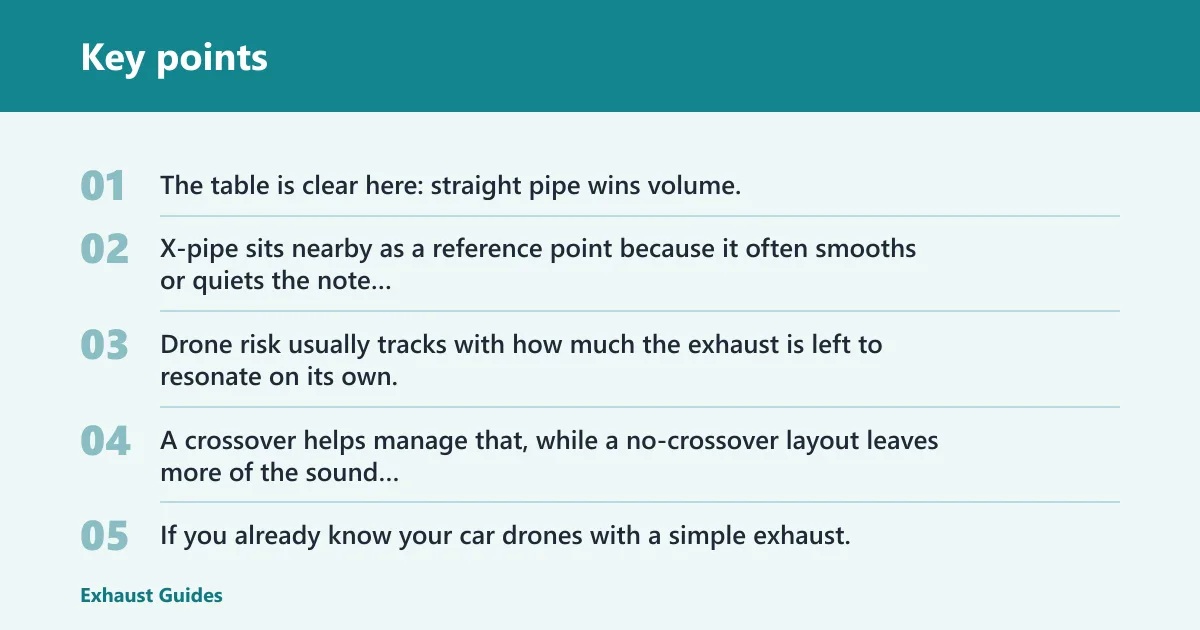
The table is clear here: straight pipe wins volume, while h pipe wins for a more traditional V8 note. X-pipe sits nearby as a reference point because it often smooths or quiets the note further, but it is not the focus of this comparison.
Drone risk
Drone risk usually tracks with how much the exhaust is left to resonate on its own. A crossover helps manage that, while a no-crossover layout leaves more of the sound energy to the cabin. If you already know your car drones with a simple exhaust, straight pipe is the risky choice.
Fitment and serviceability
Straight pipe wins here because it keeps the system simple. h pipe can still fit well, and some installers call it the easiest crossover to fit, but it still adds a crossover section that has to clear the car. X-pipe is the hardest of the three to package around driveshafts and crossmembers.
Best-use scenario
Street cars and weekend cruisers usually benefit from h pipe because the note is less harsh and the system can still be tuned with the right mufflers. Straight pipe belongs where loudness and simplicity matter more than cabin comfort, especially on track-focused or short-trip builds.
Which setup should you choose?

h pipe is the better pick if you want a milder V8 tone, some crossover effect, and a car that is easier to live with on the street. straight pipe is the better pick if you want the simplest layout and the loudest result. If fitment or cabin noise is the main concern, choose the crossover setup that matches your mufflers and chassis space.
Choose h pipe if you want a street-friendly tone
Start here if the car spends real time on public roads, especially at steady cruise. The crossover helps clean up the sound, and the layout usually gives a more traditional V8 character without the harshest resonance.
Choose straight pipe if packaging and volume matter most
Choose straight pipe if you want fewer parts, a simpler route under the car, and maximum loudness. That makes sense on a strip-focused build or on a car where service access is a priority and drone is not a deal-breaker.
Match the muffler to the layout
Do not ignore the muffler. Straight-through mufflers, chambered mufflers, and turbo mufflers can each push the final sound in a different direction. A crossover pipe changes the base note, but the muffler often decides whether the car sounds livable or tiring.
Suppose a dual-exhaust Mustang already has chambered mufflers and the owner wants less cabin buzz without losing the V8 character. An h pipe is the cleaner next step. If the same car is moved to straight pipe, the added volume may be welcome for a few drives and then too much for commuting.
Check legality before cutting out emissions parts
Legality and emissions compliance vary by location and by vehicle. If the plan removes catalytic converters or other emissions equipment, confirm local rules, inspection requirements, and owner’s-manual guidance before changing the system. Street use is where this matters most.

Frequently asked questions
H pipe vs straight pipe sound
h pipe usually sounds deeper and more controlled, while straight pipe sounds louder and more raw. The h pipe tends to keep the note closer to a traditional V8 rumble. Straight pipe can sound exciting at idle but more tiring inside the car at cruise speed.
H pipe vs straight pipe exhaust
An h pipe adds a crossover between banks, while straight pipe keeps the exhaust paths separate and simple. That means the h pipe changes tone and can add a small scavenging benefit, while straight pipe gives the least restriction and the fewest parts to manage during service.
H pipe vs x pipe exhaust
An h pipe is usually the more traditional-sounding crossover, while an X-pipe often sounds smoother and can offer better scavenging at higher rpm. The X-pipe can be harder to package around driveshafts and crossmembers, so fitment often decides the choice before sound does.
X pipe vs h pipe vs straight pipe
Use this comparison as a priority check. X-pipe leans toward better scavenging and a smoother note, h pipe leans toward a classic V8 sound and easier fitment, and straight pipe leans toward maximum loudness and simple serviceability. None is universal.
H pipe vs x pipe exhaust sound
An h pipe usually gives a deeper, more old-school tone. An X-pipe often sounds slightly more exotic and can calm the exhaust note. If your priority is traditional rumble, h pipe is the closer match. If you want a smoother high-rpm character, X-pipe usually moves in that direction.
Does an h pipe make a difference?
Yes, but the difference is modest and depends on the rest of the system. It can change the sound, alter resonance, and provide some exhaust pulse balancing between banks. The gain is usually more about feel and drivability than a dramatic power jump.
Straight pipe vs normal exhaust
A normal exhaust usually includes mufflers and other parts that reduce noise and shape the note. Straight pipe removes more of that restriction, so it is louder and simpler, but also more likely to create drone and cabin resonance. That tradeoff is the main reason it is not ideal for every street car.