Are Long Tube Headers Worth It?
Yes, if you own a naturally aspirated V8 and can add a tune; no, if you want quiet, emissions-friendly daily-driver gains. Poor fitment, tuning, and emissions compliance can erase the power gain and add cost, noise, and a check-engine light. This guide breaks down gains, tradeoffs, hidden costs, and when a cheaper exhaust mod makes more sense.
Verdict

Long tube headers are a top-tier bolt-on for naturally aspirated engines, but they are not a universal win. On stock or lightly modified builds, the return depends on engine family, local inspection rules, and whether the rest of the exhaust and calibration can support the change.
Specs at a glance
| Spec | What matters |
|---|---|
| Primary tube length | Longer primaries shift scavenging toward lower RPM; a 30 to 36 inch primary tube length is described as strongest in the 2,500 to 5,000 RPM range on a typical V8. |
| Primary tube diameter | Most street-performance V8 long tube headers use 1-3/4 to 1-7/8 inch primaries; 2-inch primary options are mentioned for higher-displacement or heavily modified engines. |
| Collector design | Merge angle and pulse combining affect how well the cylinders empty, so collector shape can change the result even when tube size looks similar. |
| Expected use | Typically used on naturally aspirated engines where scavenging can be turned into real power. |
| Tuning need | ECU calibration is often needed to recover full gains and reduce drivability or check-engine-light issues. |
| Install tradeoffs | Higher labor, gaskets, O2 extensions, heat management, ground clearance, and service access concerns can change the final cost. |
Who it
Long tube headers make the most sense for naturally aspirated V8 street cars, weekend street-and-strip builds, and owners who already plan to tune the car. They are a weaker buy for quiet commuters, mild near-stock engines, and many forced-induction setups where the same budget can do more elsewhere.
Stock exhaust manifolds are cast-iron factory parts built around cost and packaging, so they are usually more restrictive than headers. That matters when the rest of the setup can breathe well enough to use the added flow.
Say your 5.0L Coyote Mustang already has an intake, cat-back, and a tune. Long tubes fit that setup well because the engine can use the scavenging and the calibration can account for the changed exhaust flow.
Suppose your daily-driven four-cylinder only has a basic bolt-on list and needs to pass annual inspection. The same money usually does more for drivability, tire budget, or a tune-supported intake package than for long tubes.
What works
Long tube headers use long primary tubes, a collector, and tube diameter choices to change exhaust pulse timing and scavenging. They rely on exhaust scavenging to help empty the cylinders, which can improve torque where the engine spends time on the street.
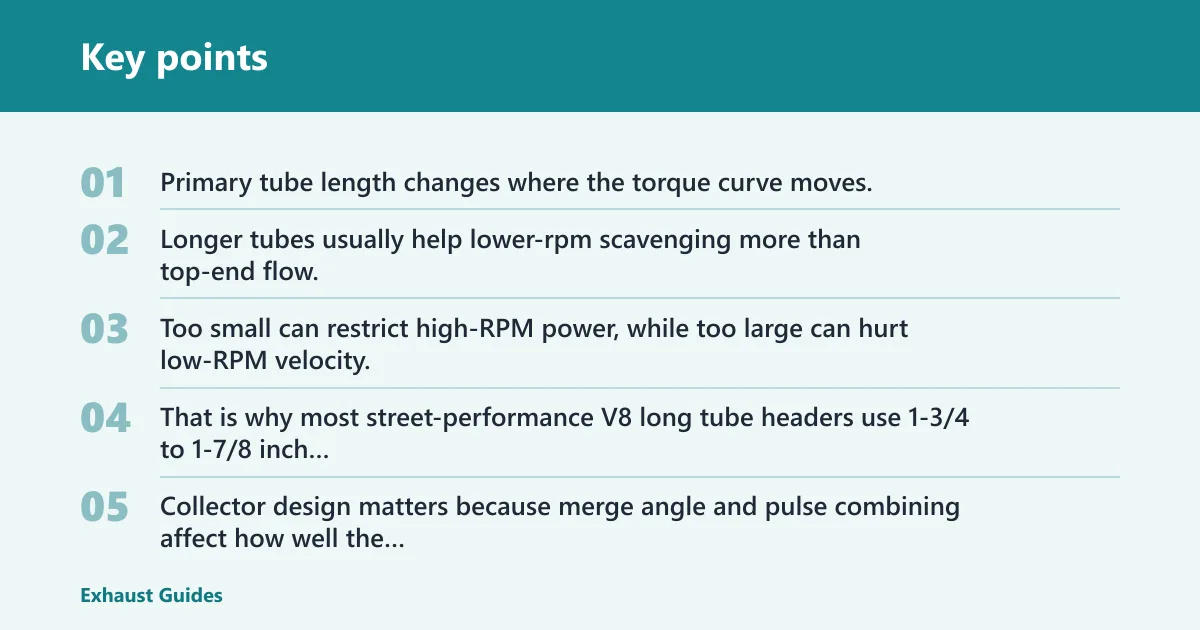
Primary tube length changes where the torque curve moves. Longer tubes usually help lower-rpm scavenging more than top-end flow, which is why a 30 to 36 inch primary tube length is commonly aimed at the 2,500 to 5,000 RPM range.
Primary tube diameter matters just as much. Too small can restrict high-RPM power, while too large can hurt low-RPM velocity. That is why most street-performance V8 long tube headers use 1-3/4 to 1-7/8 inch primaries, with 2-inch options reserved for higher-displacement or heavily modified engines.
Collector design matters because merge angle and pulse combining affect how well the cylinders empty. A good collector can make the same primary size work better, while a poor one leaves power on the table.
Dyno results should be read as wheel horsepower and torque gains that vary by platform and supporting mods. On stock or lightly modified LS-based engines, long tubes typically produce 15 to 30 wheel horsepower gains. A stock-manifold LS3 may move from 340 whp to 360 to 365 whp with long tubes and a tune, while a 5.0L Coyote is described as showing 20 to 35 wheel horsepower gains with long tube headers and a proper tune.
That is why naturally aspirated V8s are the strongest fit case, especially common LS, Coyote, and Hemi combinations. Long tube headers sit at the top of the performance ladder for naturally aspirated engines, but the return still depends on the full package.
Why a tune matters: the factory computer can compensate for the changed exhaust flow, but that adjustment may not deliver the full gain or the cleanest drivability. Calibration often becomes part of the value calculation, not an optional extra.
What long tube headers decision table
| Buyer profile | Power gain | Sound change | Install cost | Tuning need | Legality risk | Recommendation |
|---|---|---|---|---|---|---|
| Daily driver | Medium | High | High | Medium to high | Medium to high | No |
| Weekend street car | High | High | High | High | Medium | Yes |
| Naturally aspirated V8 | High | High | High | High | Medium | Yes |
| Forced-induction build | Low to medium | Medium | High | High | Medium | No |
| Emissions-checked commuter | Medium | High | High | High | High | No |
What does not?
Long tube headers are not a smart buy when the engine is mild and the rest of the package is stock. Gains on small, near-stock, or poorly matched setups are often too small to justify the extra parts, labor, and calibration cost.
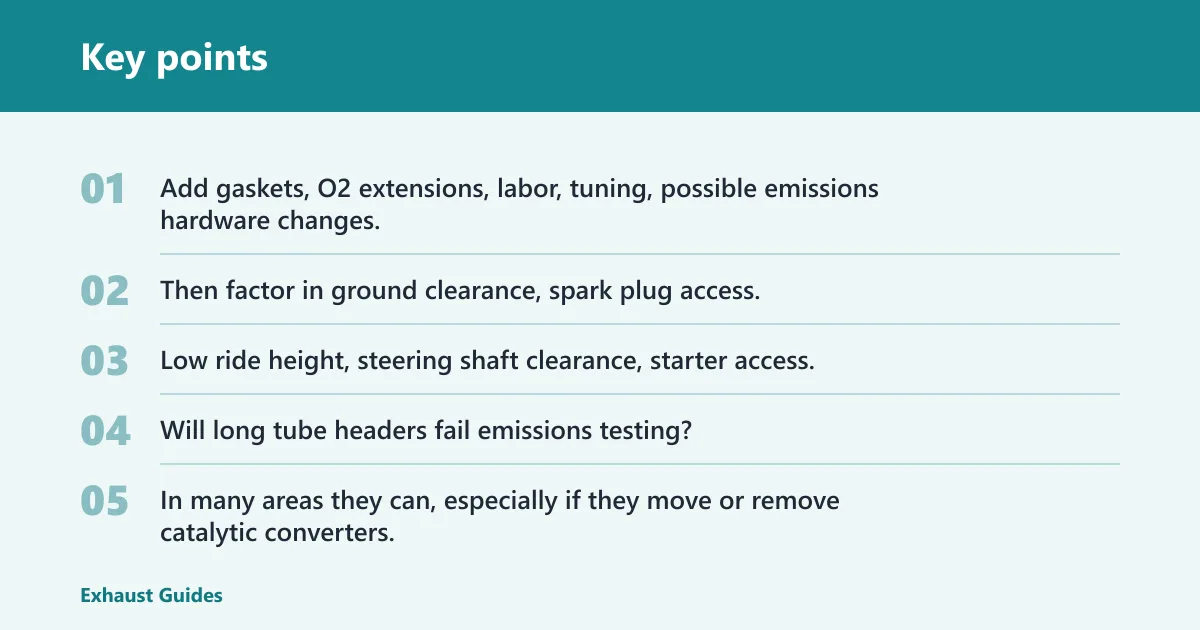
Hidden costs are where the math changes. Add gaskets, O2 extensions, labor, tuning, possible emissions hardware changes, and heat management. Then factor in ground clearance, spark plug access, and the chance that a check-engine light or inspection issue wipes out the value.
Fitment can be the real problem. Low ride height, steering shaft clearance, starter access, and spark plug access can all turn a simple exhaust upgrade into a long repair cycle.
Legality risk also matters. Will long tube headers fail emissions testing? In many areas they can, especially if they move or remove catalytic converters, trigger readiness issues, or make inspection equipment unhappy. Warranty risk is another layer, since a dealer may blame exhaust changes for drivability faults.
Are long tube headers louder than stock? Yes, and usually by enough that a commuter notices right away. That extra volume is welcome on a street car for some buyers, but it can be tiring on long drives or in neighborhoods with strict noise rules.
Alternatives
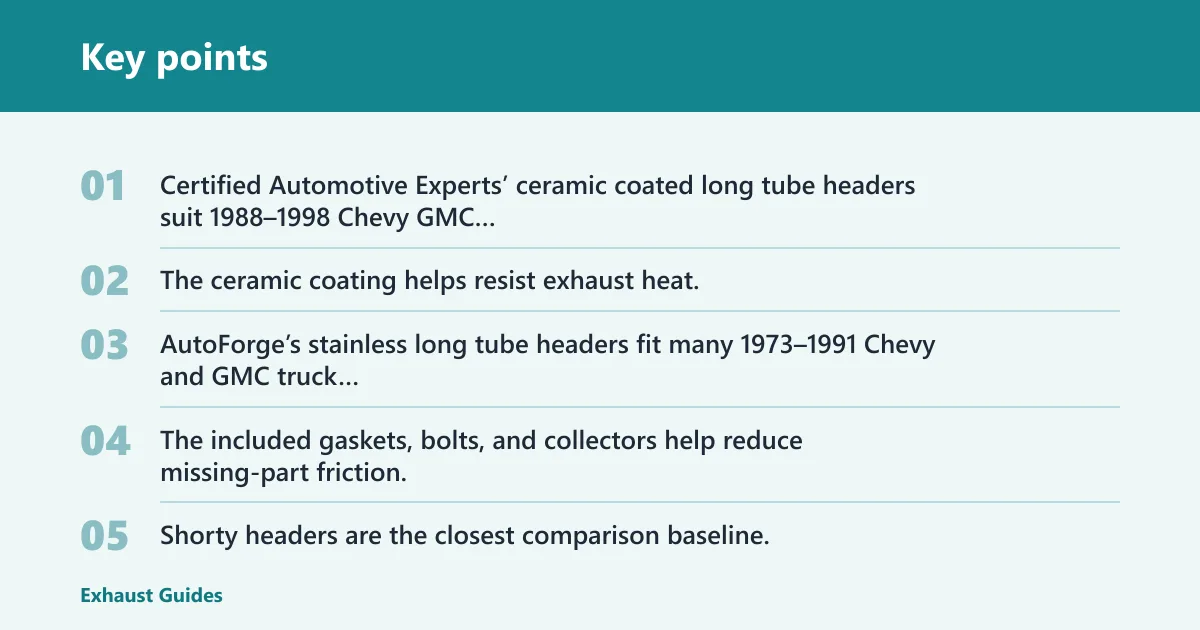

Certified Automotive Experts’ ceramic coated long tube headers suit 1988–1998 Chevy GMC 4WD trucks and SUVs with 5.0 or 5.7 engines. The ceramic coating helps resist exhaust heat, and the thick flanges and reinforced welds address sealing concerns, but the price is higher and the fit is narrow compared with a broader universal performance plan.
AutoForge’s stainless long tube headers fit many 1973–1991 Chevy and GMC truck applications with SBC engines. The included gaskets, bolts, and collectors help reduce missing-part friction, but the 1 5/8 in sizing and truck-specific fit mean the value is strongest when your build matches that layout.
Shorty headers are the closest comparison baseline. They usually give smaller gains than long tubes, but fit more easily and create less ground-clearance and service pain. If the car must stay quiet and inspection-friendly, shorties often make more sense than long tubes.
Cat-back exhaust changes sound more than power. If your main complaint is tone, that money usually buys more satisfaction per dollar than a full header swap.
Intake and tune combinations can be a better first move on many street cars. On some platforms, that route preserves emissions readiness better than long tubes while still improving response.
Cam or head upgrades may outrun headers on a budget-per-horsepower basis for a serious V8 build. If the engine already needs deeper work, long tubes are often part of the package rather than the first purchase.
Should you buy it?
Start with the budget question. If the total cost must stay near parts price only, long tubes usually fail the math because install, tuning, gaskets, and fitment hardware quickly add up. If you already planned for dyno time and supporting parts, the return improves.
- Choose long tubes if the car is a naturally aspirated V8 and you want the strongest bolt-on exhaust gain.
- Skip them if the car is a daily commuter that must stay quiet, simple, and inspection-ready.
- Prefer shorty headers if fitment, ground clearance, or emissions compliance matters more than peak power.
- Choose intake, tune, or cat-back changes first if the engine is mild and the budget is tight.
- Plan for tuning if you install long tubes and want the best drivability and power result.
Decision by platform is simpler than many sales pages suggest. LS, Coyote, and Hemi cars are the strongest candidates. Mild four-cylinders and many turbo or supercharged setups usually do not see the same value.
Decision by local rules is non-negotiable. If annual inspection checks catalysts, OBD readiness, or visual equipment, long tubes can be a bad bet even when the power gain looks attractive on paper.
Frequently asked questions
Are long tube headers better?
They are better when your goal is maximum naturally aspirated exhaust gain, especially on a V8 with a tune. They are not better for every driver, because cost, noise, installation time, and legality can outweigh the gain on a commuter or mild build.
Do long tube headers make a difference?
Yes, but the size of the difference depends on the engine and the rest of the setup. On stock or lightly modified LS-based engines, the gain is often real enough to feel. On a near-stock platform with weak supporting mods, the change can be too small to justify the expense.
How much horsepower do long tube headers add?
There is no fixed number. On stock or lightly modified LS-based engines, long tubes typically produce 15 to 30 wheel horsepower gains, while a 5.0L Coyote is described as showing 20 to 35 wheel horsepower gains with a proper tune. The final number depends on tuning and supporting parts.
Do long tube headers need a tune?
Often, yes. The factory computer can adapt somewhat, but a tune usually helps recover the best power and avoid drivability issues or a check-engine light. If you want the mod to pay off, plan the calibration before you buy the hardware.
Will long tube headers fail emissions testing?
They can. The risk rises when the setup changes catalytic converter placement, creates readiness problems, or conflicts with visual inspection rules. If your area checks OBD status or emissions hardware, verify the local rule set before buying anything.
Are long tube headers louder than stock?
Yes. They usually sound more aggressive and more present than stock manifolds, and that can be a plus on a weekend car. For a commuter, the extra volume and added drone can become the downside that erases the fun.
What other exhaust parts need to change with long tube headers?
Common supporting parts include gaskets, O2 extensions, and sometimes mid-pipes or catalytic converter pieces to match the new collector location. Heat management parts and labor time also matter. If the fit is tight, plug access and ground clearance may require additional changes too.