V-band Clamp vs Flange Connection: How to Choose
Choose a V-band clamp when you need frequent removal, tight alignment, and a reusable seal. Use a flange connection when lower cost matters more than service access. Poor measurement causes leaks, cocked joints, and broken studs. This guide shows how to size, measure, and compare both connection types for exhaust work.
| Decision factor | V-band clamp | flange connection | Winner |
|---|---|---|---|
| Serviceability | Quick release for frequent removal and refit | Slower to remove; more dependent on fastener access | V-band clamp |
| Alignment tolerance | Needs accurate mating faces and square assembly | More forgiving in simple bolted layouts, but still needs a flat joint | flange connection |
| Seal reliability under heat and vibration | Strong choice when the flange set matches and hardware is sound | Works well on stable joints, but gasketed or studded joints can loosen or weep | V-band clamp |
| Cost and hardware simplicity | Usually higher part cost and more precise fit-up | Usually lower cost and easier to source in basic formats | flange connection |
| Best fit use case | Turbo hot-side, DPF sections, racing exhaust, frequent service points | Lower-cost joints, less-frequent removal, simple exhaust repairs | V-band clamp |
V-band clamp basics, component list, and where it fits

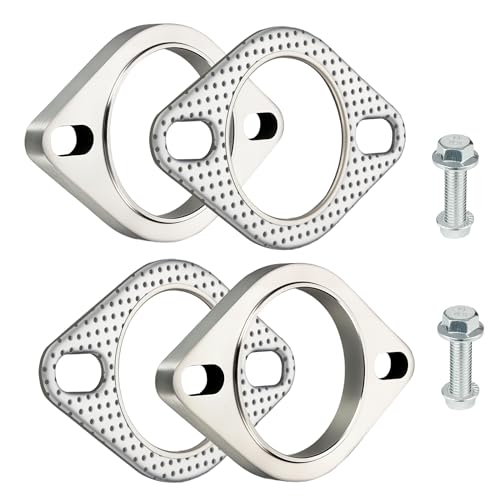

A V-band clamp is a two-piece quick-release clamp for flanged joints. It uses a band, bolts, and a mating V-band flange set to pull the faces together on turbocharger and exhaust assemblies. The appeal is service access: you can open the joint without cutting or fighting a full bolted flange stack.
Parts that matter
The clamp body is only one part of the system. You also need matching V-band flange halves, the retainer band that helps hold the faces together, and bolts in good condition. Most product tables list these pieces separately, so do not assume a clamp size alone tells you the whole story.
Where it fits best
V-band clamps are commonly used for connections that need quick assembly and disassembly, including air or liquid connections. They are also used in heavy duty truck, automotive, performance racing, marine, and generator applications. That range tells you the real value: serviceable joints where downtime matters.
Why builders choose it
For hot-side turbo plumbing, a V-band joint lets you drop a section fast. For high performance and racing exhaust, that matters because heat cycling and vibration make repeat access part of normal maintenance. The connection is useful when the joint will come apart more than once.
📊 The same table lists a flange diameter of 3.695 for that entry. Source: Topperformanceparts.
V-band flange sizing table
Use the table as a measurement check, not a guess chart. The key distinction is that nominal diameter is a product-table size basis, while flange diameter is the actual mating diameter you must match to the connection set. If those two numbers do not line up with your pipe and flange faces, the joint will not fit or seal as intended.
| Pipe OD | Flange diameter | Nominal size | Typical use case | Common mismatch symptoms |
|---|---|---|---|---|
| 3.695 | 3.695 | 3.820 | Turbocharger exhaust connection with matched V-band set | Offset faces, clamp sits high, soot trails after heat cycling |
| Matched to the flange set, not guessed from catalog name | Must match the intended connection set | Used in sizing charts as a reference basis | Performance exhaust section with frequent removal | Joint rocks, band will not pull square, bolts feel uneven |
| Measure actual tube outside diameter before welding | Check the outside of the flange face, not the tube alone | Chart size may not equal pipe OD | DPF section or serviceable race pipe | Clamp closes, but the faces do not fully seat |
How to read the chart
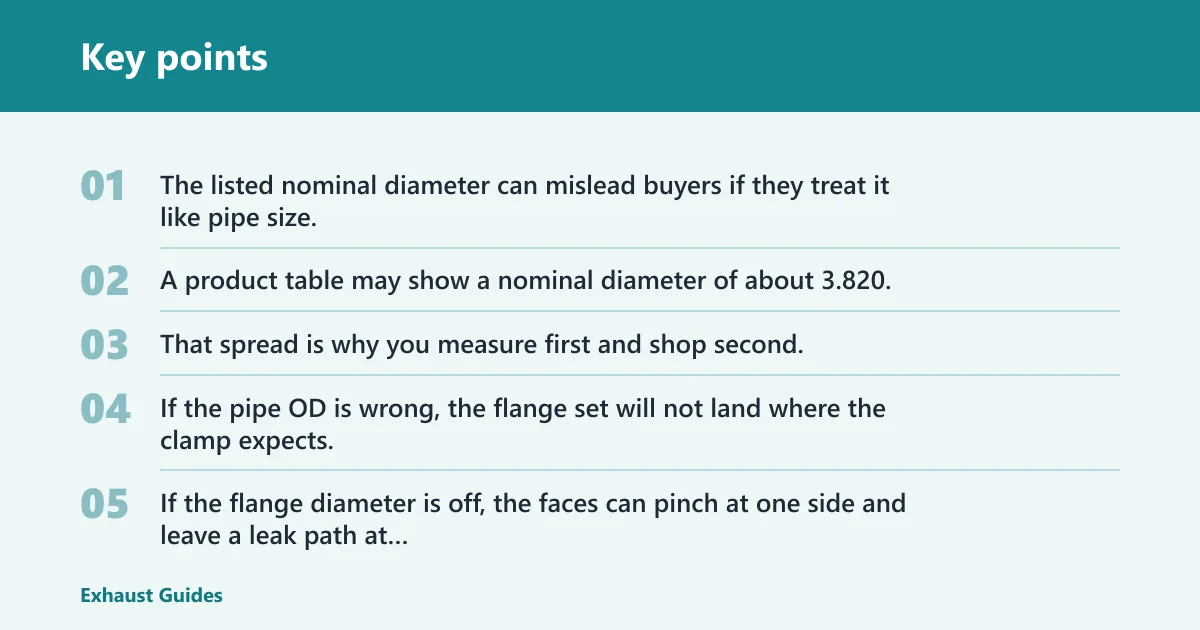
The listed nominal diameter can mislead buyers if they treat it like pipe size. A product table may show a nominal diameter of about 3.820, while the same entry lists a flange diameter of about 3.695 and a retainer band dimension of about 0.207. That spread is why you measure first and shop second.
Common mismatch symptoms
If the pipe OD is wrong, the flange set will not land where the clamp expects. If the flange diameter is off, the faces can pinch at one side and leave a leak path at the other. Common clues are soot trails, a joint that loosens after heat cycles, or a band that never pulls the flanges flush.
How do you measure a V-band flange?
Measure the pipe OD first, then measure the flange diameter separately, and check the assembled stack height before ordering. Do not use the nominal diameter as a stand-in for either number. The right clamp set depends on the pipe, the mating flange, and enough axial space for the band and bolts.
Measurement steps
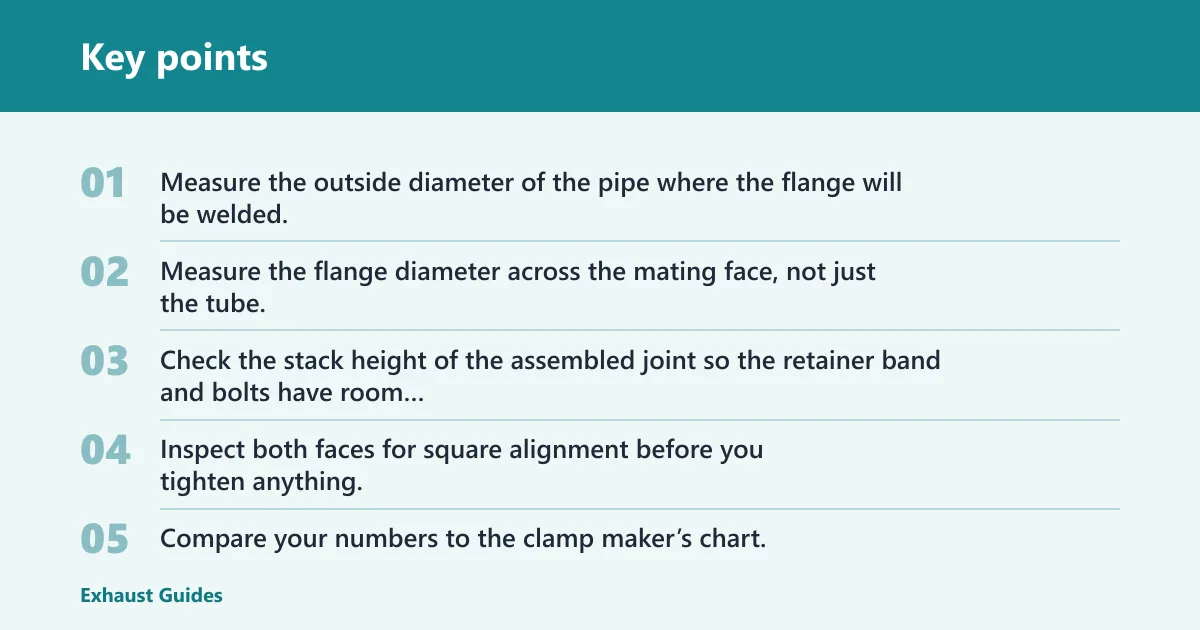
- Measure the outside diameter of the pipe where the flange will be welded.
- Measure the flange diameter across the mating face, not just the tube.
- Check the stack height of the assembled joint so the retainer band and bolts have room to seat.
- Inspect both faces for square alignment before you tighten anything.
- Compare your numbers to the clamp maker’s chart, including nominal size and flange diameter.
What stack height tells you
Stack height matters because the clamp can only pull the joint together if the assembly leaves enough room for the band geometry. Too much height can keep the faces from bottoming out; too little can leave the band mis-seated. Either problem can look like a sizing issue when it is really a fit-up issue.
Say your turbo hot-side uses a 3.695 flange diameter and the joint keeps leaving soot at one edge. The pipe may be correct, but the flange faces may be cocked by a few degrees. In that case, the clamp is not the first problem; alignment is.
V-band clamp vs flange connection
A V-band clamp wins when access and repeat service matter most. A flange connection wins when cost and simple fabrication matter more. Both can seal well, but the V-band system is more sensitive to fit-up, while a bolted flange joint often tolerates less precision in day-to-day removal and replacement.
Serviceability
V-band clamps are built for quick removal and refit. That is why they are common on turbocharger exhaust connection points, DPF sections, and other service points that come apart often. A bolted flange connection is more familiar and often cheaper, but each disassembly means more time on fasteners and gaskets.
Alignment and sealing
The V-band clamp depends on accurate flange faces, especially under heat and vibration. If one side is warped, the band can clamp the joint crooked and leave a leak path. A flange connection with a gasket can be more forgiving of light service wear, but it still fails if studs stretch or the faces are badly distorted.
Reuse and hardware condition
A V-band clamp can often be reused if the band, bolts, and mating faces are still in good condition. Heat, corrosion, and thread damage change that answer quickly. Once the hardware is bent, stretched, or pitted, the serviceable advantage drops because the clamp may no longer pull evenly.
Which connection fits your build?
Choose a V-band clamp for turbo hot-side plumbing, frequent-removal exhaust sections, high performance and racing exhaust, or any joint that must come apart often without losing alignment. Choose a flange connection when the joint is cheaper to build, removed rarely, and does not need the same quick-service access. The right pick follows service frequency first.
Common build scenarios
Turbocharger exhaust connection points usually favor the V-band clamp because service access is part of the job. DPF sections often benefit from the same choice when inspection or replacement access is limited. A lower-cost repair pipe or a simple underbody joint may be better served by a conventional bolted flange connection.
Suppose a race car exhaust section needs to drop for transmission service every few events. A V-band clamp is the cleaner choice because the joint opens and closes repeatedly. If that same section rarely comes apart and the budget is tight, a standard flange connection is easier to justify.
Reuse, bolts, and torque checks
Reuse is possible, but only when the clamp parts are still straight, the retainer band is intact, and the bolts are not stretched or corroded. Torque should follow the clamp maker’s spec, because hardware size, band design, and thread condition all change the answer. A guessed torque can distort the band or leave the joint loose.
When reuse stops making sense
If the bolts gall, threads strip, or the band shows heat damage, replacement is safer than forcing another cycle. Mixed-material assemblies can also change how the joint behaves under heat, so a stainless clamp on a mismatched flange stack still needs careful inspection. Reuse is a condition-based decision, not a default.
What to check before tightening
Confirm that the flange faces are clean, square, and matched to the pipe OD and nominal size on the chart. Make sure the retainer band seats evenly all the way around. If the joint closes unevenly, stop and recheck alignment before adding more torque.
Frequently asked questions
What is a v band clamp?
A V-band clamp is a two-piece quick-release clamp used on flanged turbocharger and exhaust joints. It works with a matching V-band flange set, a retainer band, and bolts to hold the faces together. It is chosen where repeated disassembly and reliable sealing both matter.
What is flange clamp?
People often use this phrase to mean a clamp used on a flanged joint, but in exhaust work it usually refers to the V-band clamp assembly. The important point is the mating system: clamp, flange halves, and hardware must all match. A generic clamp label is not enough for sizing.
V band clamp sizes
V-band clamp sizes are usually listed by nominal diameter, with a separate flange diameter in the product table. That separation matters because the nominal size is a chart basis, not always the same as the pipe OD. Match the flange diameter to the joint you are building.
Can v band clamps be reused?
Often, yes, if the band, bolts, and flange faces are still in good shape and the joint has not been overheated or distorted. Corrosion, stripped threads, or bent hardware make reuse unreliable. Inspect the clamp before reinstalling it, especially on hot-side turbo or racing exhaust sections.
What torque should v band bolts be tightened to
Use the clamp maker’s torque spec, not a universal number, because bolt size and clamp design vary. Hardware condition also changes the safe tightening range, especially after heat cycling or corrosion. If the joint closes unevenly, fix the fit-up before chasing more torque.