Exhaust Flange vs Clamp: Which Should You Use?
Use an exhaust flange when the joint still needs a rigid, gasketed, serviceable connection; use a clamp only when the pipe ends are sound, aligned, and meant to be joined without disassembly. Choose the wrong one and you can end up with exhaust leaks, metallic rattles, loose fasteners, or a repair that gives up after a few heat cycles. This guide compares flange repair, clamp repair, and replacement so you can match the fix to the failure mode.
| Decision factor | Exhaust flange | clamp | Winner |
|---|---|---|---|
| Sealing method | Bolted faces squeeze a gasket between machined or formed sealing surfaces. | Compression around overlapped or slip-fit pipe ends. | Exhaust flange |
| Best-fit joint type | Manifold, downpipe, and catalytic converter connections. | Slip-fit and lap joints where pipe overlap remains usable. | tie |
| Service access | Easy to separate again if the faces and hardware stay in shape. | Usually faster to install, especially in open undercar areas. | clamp |
| Repair tolerance | Can recover a usable joint if the flange is only warped or missing a gasket. | Can work only if pipe diameter, overlap, and wall condition still match the clamp. | Exhaust flange |
| Failure tolerance | Needs flat faces, intact bolt holes, and serviceable studs or bolts. | Needs sound pipe geometry and enough overlap to compress without crushing. | tie |
| Turbo and tight-space fit | Often bulkier at the joint. | V-band style clamps fit tighter spaces better. | clamp |
Exhaust flange vs clamp at a glance
The main choice is simple: an exhaust flange gives you a bolted, gasketed joint that must stay flat and serviceable, while a clamp works on pipe ends that still meet cleanly enough to compress together. If the joint geometry is damaged, the clamp does not fix that geometry. If the joint still has usable faces or overlap, either option can work, but for different reasons.
Connection type
Exhaust flanges are commonly used at manifold, downpipe, and catalytic converter connections. It is common at manifold, downpipe, and catalytic converter connections, where the two halves need repeat service and a controlled sealing load. A clamp is a compression-style connector for slip-fit or lap joints.
Sealing method
Flange joints seal by gasket compression across flat or properly formed faces. Clamp joints seal by squeezing matched pipe ends together, often with a band, U-bolt, or C-style clamp. That means flange sealing depends on face flatness and gasket condition, while clamp sealing depends on pipe condition and overlap.
Best-fit repairs
Choose the flange path when the joint still has a usable interface but needs a gasket, hardware, or face repair. Choose the clamp path when the pipe ends are still sound and the issue is a loose slip joint, a mismatched slip joint, or a temporary leak at an overlap connection.
Service access
Flange joints are usually easier to service again after repair because the bolts define the joint location. Clamps can be quicker to install and remove, but only if the pipe geometry is still right. If the pipe is ovalled, thinned, or separated too far, a clamp becomes a weak fix.
What is an exhaust flange?
An exhaust flange is a bolted joint interface that uses sealing faces and a gasket to join two exhaust sections. It is common at the manifold, downpipe, and catalytic converter locations, where the system needs a rigid connection that can be taken apart later without cutting the pipe.
Common failure modes
Flanges can warp, crack, rust, or lose their mounting hardware. Broken studs, uneven bolt loading, and a missing or damaged gasket can all create leaks even when the bolts feel tight. If the sealing faces are no longer flat enough to compress the gasket evenly, the joint stops behaving like a serviceable flange.
Why flatness matters
A flange only works well when both faces can compress the gasket evenly. A slight warp can sometimes be corrected, but once the face is badly eaten away or one side is separated from the tube, sealing pressure becomes uneven and the leak comes back after heat cycles.
What is an exhaust clamp?
Clamp repairs are often used on slip-fit or lap joints. Common forms include band clamps, U-bolt clamps, and C-style clamps. It depends on the pipe condition, the diameter match, and enough overlap to hold the joint without crushing or distorting the tubing.
Fit limits
Clamp size must match pipe diameter in inches or millimeters, and the overlap has to be long enough for the clamp to bite evenly. Wall thickness also matters. Thin, rusted, or badly oval pipe can seal poorly or deform further under clamp pressure.
How this differs from flange repair hardware
A flange repair clamp or split flange clamp is not the same thing as a regular exhaust clamp. A flange repair clamp wraps around damaged flange area and depends on remaining pipe and flange geometry being usable. A split flange clamp is two-piece repair hardware used where the original flange has failed or separated, often by diameter and flange shape. Ordinary exhaust clamps do not replace a lost sealing face.
When should you use a flange?
Use a flange when the joint still needs gasket compression and repeat service, but the basic flange geometry remains usable. That means the faces are still close to flat, the bolt pattern still holds, and the repair needs a rigid connection at a manifold, downpipe, or catalytic converter joint.
Good flange repair cases
A warped flange that is still thick enough to true up can sometimes be repaired with a new gasket and the correct bolt torque. Broken studs are also workable if the flange faces are intact and the remaining hardware can clamp evenly. A missing gasket is a simple flange issue only if the faces are still sound.
When a flange repair clamp fits
A flange repair clamp can help when the flange area is damaged but not completely unusable. It can help when the pipe section is still present and the shape still supports the hardware. It is a repair-focused solution, not a cure for severe corrosion or a missing mounting point.
When should you use a clamp?
Use a clamp when the pipe ends still overlap, the joint shape is intact, and you need a compression repair rather than a bolted gasket joint. Clamp repairs are best for slip-fit pipe, temporary leak control, dissimilar pipe sizes that still mate properly, and space-limited sections where a flange would be awkward.
Slip-fit and lap joints
Clamp repairs work best when the two pipes were meant to nest or lap. If the overlap is correct and the pipe diameter matches the clamp, the clamp can hold alignment without needing a flange face. If the joint is open too far or the pipe ends are badly out of round, the clamp choice gets weak fast.
Turbo and tight-space service
V-band clamps fit where space is tight and the joint needs uniform radial pressure. They use a V-shaped groove with a uniform sealing surface, and they are described as a secure, lightweight, easy-to-install connection. For turbo and exhaust service, that compact shape can matter more than a traditional flange.
Flange repair decision table
| Scenario | Best fix | Risk level | Required parts/tools |
|---|---|---|---|
| Warped flange | Exhaust flange | Medium | New gasket, straight edge check, correct bolts, even torque |
| Rusted flange | Exhaust flange | High | Replacement flange or flange repair clamp, gasket if applicable, penetrant, hand tools |
| Broken studs | Exhaust flange | Medium | Replacement studs or bolts, gasket, torque wrench, extractors if needed |
| Missing gasket | Exhaust flange | Low | Correct gasket matched to face and diameter, clean mating faces, torque wrench |
| Slip-fit pipe | clamp | Low | Band, U-bolt, or C-style clamp sized to pipe diameter, marker, socket set |
| Dissimilar pipe sizes | clamp | Medium | Reducer or adapter if needed, correctly sized clamp, measure pipe diameter and overlap |
| Turbo/downpipe joint | clamp | Low | V-band clamp, matching flanges, clean groove faces, even tightening |
| Repeated leak after re-torque | Exhaust flange | High | New gasket, check flange flatness, inspect for cracks or rust-through, replace hardware |
Warped flange
If the flange is only slightly warped and the sealing faces still exist, a flange repair is the right path. A clamp will not correct an uneven gasket surface. Suppose a 2.5-inch downpipe flange leaks after heat cycles and the bolts stay tight; that points to face distortion, not clamp failure.
Rusted flange
If rust has eaten into the flange face, the fix gets harder. A flange repair clamp or split flange clamp may buy time if enough material remains, but once the mounting points or sealing land are missing, a clamp-based answer becomes unreliable. At that point, replacement is safer than trying to compress damaged metal.
Broken studs
Broken studs do not automatically mean the joint needs a clamp. If the flange faces are still flat and the hole pattern is still usable, replacing the studs or bolts can restore the gasket seal. Clamp hardware becomes the wrong tool when the joint was designed as a bolted interface.
Missing gasket
A missing gasket is usually the easiest flange repair. Clean both faces, fit the correct gasket, and tighten the bolts evenly to the listed torque. A clamp is not a substitute for the gasket in a flange joint.
Slip-fit pipe
When the pipes are meant to overlap, a clamp is the direct fix. This is common in cat-back sections and other service joints where the pipe ends are still round and aligned. A flange would add unnecessary hardware if the connection was not designed for one.
Dissimilar pipe sizes
Some exhaust repairs join sections that do not share the same outside diameter. In that case, the clamp only works if the adapter, overlap, and wall thickness still support the fit. Measure the pipe diameter before choosing the clamp size, or the joint will leak or crush.
Turbo/downpipe joint
For turbo and downpipe service, a V-band clamp often makes practical sense because it provides fairly uniform radial pressure in a compact package. Flanges can be harder to fit in that space. The choice shifts toward clamp hardware when access and packaging matter more than a traditional bolted face.
Repeated leak after re-torque
If a flange keeps leaking after re-torque, stop chasing the bolts and inspect the faces. The gasket may be cooked, the flange may be warped, or the hardware may have bottomed out before enough compression was reached. That is a flange repair problem, not a clamp problem.
Choose Exhaust flange if… / Choose clamp if…
Choose Exhaust flange if the joint is designed for bolts, the faces are still usable, and you need a gasketed connection that can come apart later. Choose clamp if the pipe ends still overlap cleanly, the diameter match is correct, and the repair is a slip-fit or lap joint rather than a face-to-face joint.
Choose Exhaust flange if…
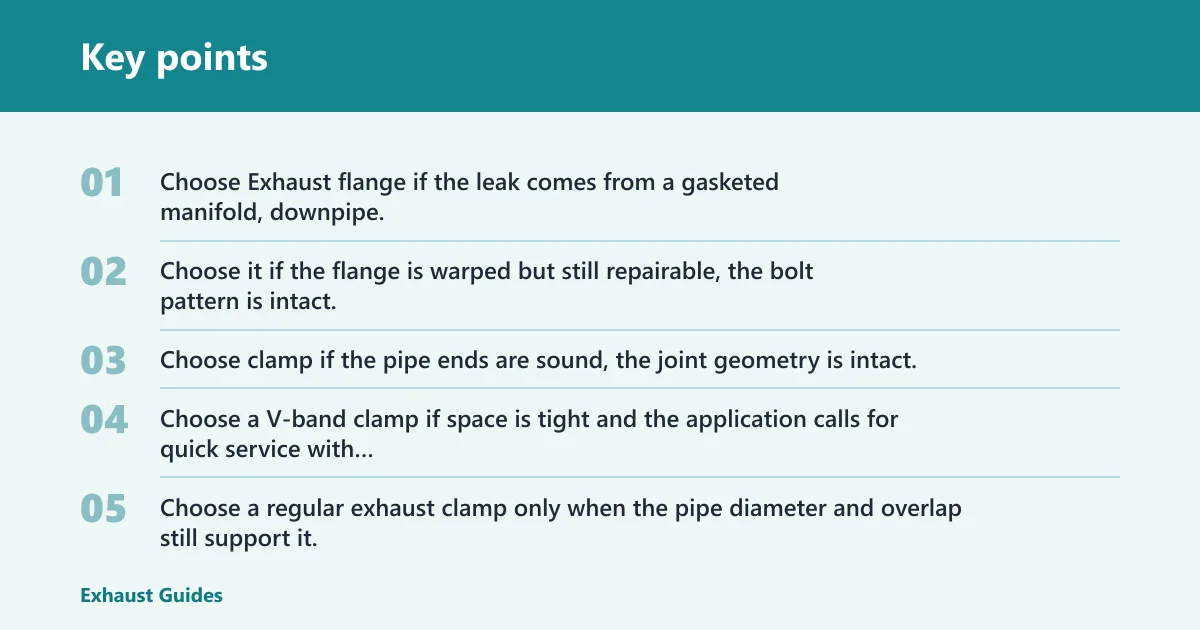
Choose Exhaust flange if the leak comes from a gasketed manifold, downpipe, or catalytic converter joint. Choose it if the flange is warped but still repairable, the bolt pattern is intact, or the repair needs a rigid joint that can be serviced again.
Choose clamp if…
Choose clamp if the pipe ends are sound, the joint geometry is intact, and the problem is a loose or mismatched overlap connection. Choose a V-band clamp if space is tight and the application calls for quick service with uniform pressure. Choose a regular exhaust clamp only when the pipe diameter and overlap still support it.
Picture a rusty 2.25-inch cat-back slip joint with a 2-inch overlap and no flange hardware. A correctly sized clamp is the practical fix. Now picture a manifold flange with a missing gasket and a face that still reads flat enough to seal; that points back to the flange path.


Frequently asked questions
What is flange clamp?
A flange repair clamp or split flange clamp is repair hardware used when the original flange has failed, separated, or become damaged but some flange geometry remains usable. It is different from a regular exhaust clamp, which is meant for slip-fit or lap joints rather than face-sealed joints.
Exhaust flange vs clamp which should I use
Use the flange when the joint needs gasket compression, flat sealing faces, and repeat service. Use the clamp when the pipe ends still overlap and the joint was meant to be compressed rather than bolted. If the flange faces are badly corroded or broken, replace the joint instead of forcing a clamp fix.
Can you clamp an exhaust flange instead of replacing it?
Only if enough flange and pipe geometry remains to support a repair-focused clamp. A flange repair clamp can help on damaged but usable flanges, but it cannot restore lost sealing faces, broken mounting points, or severe corrosion. If the joint has lost its shape, replacement is the better answer.
When should I use a flange repair clamp?
Use a flange repair clamp when the flange area is damaged but not beyond recovery, and there is still enough pipe and flange shape for the hardware to grab. It is useful when you need a temporary or repair-focused fix and the original bolted connection still has usable geometry.
What is the difference between flange clamp and v-band clamp?
A flange clamp is repair hardware for a damaged flange area, often tied to the original flange shape. A V-band clamp is a single-bolt, quick-release style connector that uses a V-shaped groove with a uniform sealing surface. V-band clamps are compact and well suited to tight turbo and exhaust service areas.