Exhaust manifold vs header: which one fits your build?
Choose an exhaust manifold for stock repair, towing, quiet daily driving, or OEM fitment; choose headers for higher-rpm performance, often with added cabin noise, underhood heat, and fitment work. Pick wrong, and you can lose low-end torque, trigger check-engine lights, or spend money twice on parts that do not match your use. This guide compares fit, cost, emissions, torque, sound, and installation so you can choose the right part for repair, daily use, towing, or performance.
Exhaust manifold vs header: the core trade-off

![A-Premium Left Side [V8 6.2L] Exhaust Manifold Kit W/Gaskets & Hardware](https://m.media-amazon.com/images/I/51Bln-+IdGL._SL500_.jpg)

The trade-off is fairly straightforward: a factory-style exhaust manifold tends to prioritize packaging, durability, and predictable emissions behavior, while a header is built more around flow. Headers can deliver a noticeable increase in horsepower and torque, especially at higher RPMs, but that gain usually comes with more heat, more noise, and more fitment questions.
| Decision factor | Exhaust manifold | header | Winner |
|---|---|---|---|
| Construction | One-piece cast design that merges each cylinder outlet into a single outlet | Individual primary tubes feed a collector | Exhaust manifold for durability and packaging |
| Performance focus | Built for stock drivability and reliability | Built to improve exhaust flow and high-RPM power | header for power |
| Fitment complexity | Usually matches OEM clearances and downstream parts | Can interfere with starter, steering shaft, mounts, or O2 sensors | Exhaust manifold |
| Noise and heat | Quiet and deep | Louder, sharper, and hotter in the engine bay | Exhaust manifold |
| Emissions readiness | Typically easiest to keep legal and inspection-friendly | Can complicate catalytic converter fitment and inspection status | Exhaust manifold |
Construction
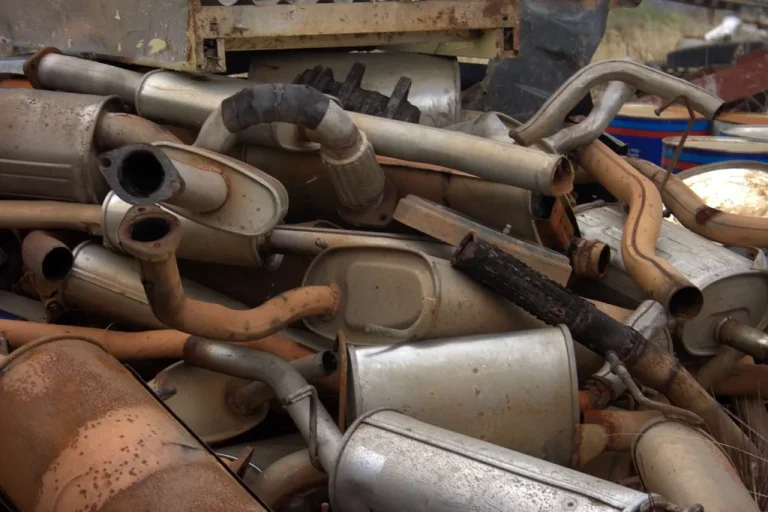
An exhaust manifold is a factory or OEM part, usually a one-piece casting that collects exhaust from the cylinders and sends it to one outlet. That design keeps cost down, stands up to heat, and fits tight engine bays without much drama. Wikipedia describes the exhaust manifold as part of the exhaust flow path from the cylinder head. (en.wikipedia.org)
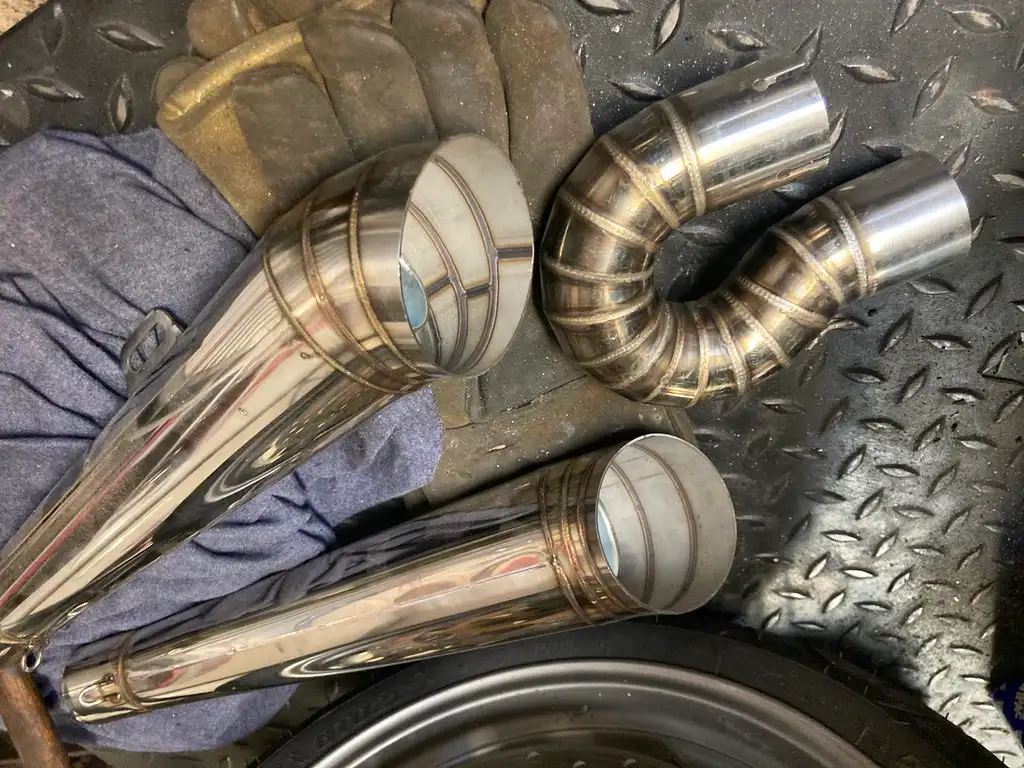
A header uses separate primary tubes, one for each cylinder, that merge in a collector. The collector location matters because it affects scavenging, downstream routing, and whether the rest of the exhaust can bolt up without drama.
Performance focus
Headers usually move exhaust better than cast manifolds, and that is why they can make more power. CarParts.com says headers usually only help on souped-up, high-performance engines, which is a useful warning for shoppers expecting easy gains on a basic commuter. F1 and F7 are the common performance claims here: more horsepower and torque, especially at higher RPMs.
The catch is that more flow does not always mean a better result for your use case. On a near-stock engine, the real-world gain may be modest, and the money may be better spent on tires, maintenance, or a tune-up first.
Fitment and daily use
Factory manifolds are usually the safer fitment choice because they are designed around OEM clearances and original emissions hardware. Headers can require more parts juggling, especially on vehicles with tight starter or steering shaft clearance. A common first-timer mistake is buying a performance header before checking every interference point.
Say your truck needs a replacement manifold after a crack near the flange. If it tows on weekdays and never leaves the emissions-tested county, the OEM part is usually the cleaner repair. The correct answer there is not “more flow”; it is getting back to dependable operation with the fewest surprises.
Which is better for a stock engine, a manifold or header?
For a stock engine, the exhaust manifold is usually the better choice because it restores OEM fit, keeps drivability predictable, and avoids paying for flow capacity the engine cannot fully use. A shorty header can make sense on a mild engine, but a header swap is often not worth the cost if the goal is simply to fix a broken part.
When the OEM manifold is the smarter repair
If the vehicle is stock, daily driven, or used for towing, the OEM manifold is usually the best repair-grade answer. It keeps the original packaging, usually works with the factory catalytic converter and O2 sensors, and avoids the tuning questions that often come with performance headers.
This matters most when the old manifold has a crack, warped flange, or broken stud. In that case, the job is repair, not modification.
When a shorty header makes sense
Shorty headers are the closer-to-factory option among aftermarket choices. They usually fit more easily than long-tube headers and are often described as taking a few hours to install. They also tend to favor lower and mid-range torque, which can suit a mild street car better than a top-end build.
That makes shorties the sensible middle ground when you want a modest upgrade without turning the car into a project. They are not the best answer for maximum horsepower, but they can be a reasonable step when the engine is near stock and you still want better flow.
When a header swap is not worth the cost
If the vehicle’s main job is commuting, hauling, or passing inspection with the least risk, a header swap may not pay back enough to justify the labor and parts changes. Headers can also create more heat and sound, which can be a downside in traffic or on long trips.
On a stock engine, the right question is not “can headers make power?” The better question is “will the gain matter in the RPM range and driving you actually use?”
Shorty header vs long-tube header
Shorty headers are the easier, lower-impact upgrade. Long-tube headers offer more high-RPM potential, but they are harder to install and are more likely to affect starter, steering, mount, and exhaust fitment. Shorties are usually the safer choice for mild street use; long-tubes are the more serious performance part.
Fitment and installation differences
Shorty headers are generally closer to the factory layout, so they are easier to package around common obstacles. Long-tube headers often need more room, and on some vehicles that can mean moving or working around the starter, steering shaft, or engine mounts. F5 says long-tube installations are described as taking about 6 to 10+ hours, which reflects that added complexity.
Where each one tends to make power
Shorty headers favor lower and mid-range torque. Long-tube headers improve exhaust flow and raise performance at high RPM, which is why they are the better pick for track use or a build that spends more time near redline. F3 gives a useful example: a long-tube setup on a Coyote 5.0L S550 Mustang GT can add 30 to 40 horsepower.
That kind of gain is real, but it is not universal. Engine design, fuel, cam timing, catalytic converter choice, and tune all matter. A header that works well on one platform may be a poor value on another.
Noise, heat, and tuning differences
Headers typically produce a louder and sharper exhaust sound. F10 puts the comparison plainly: the manifold is quiet and deep, while headers are loud and crisp. That can be welcome on a weekend car and tiring on a daily driver.
Headers can also increase underhood heat. Long-tubes often sit closer to more components and can raise the chance of heat shielding work, wire protection, or wrap decisions. An ECU tune is often recommended with performance headers, and on some combinations it may be needed to get the drivability and power the hardware is capable of delivering.
Do headers fit with the stock catalytic converter and O2 sensors?
Sometimes, but not always. Fitment depends on the header style, collector location, O2 sensor bungs, and whether the stock catalytic converter can physically and legally remain in place. A header that changes those points can create emissions risk even if the engine runs well.
Collector location and downstream exhaust routing
The collector is where the primary tubes merge, and its position shapes the rest of the exhaust layout. If the collector lands in a different spot from the factory manifold outlet, the downstream pipe, flange, or catalytic converter may no longer line up. That is why two headers can look similar on paper and fit very differently on the car.
Catalytic converter compatibility and emissions risk
Wikipedia notes that exhaust systems can include a catalytic converter to reduce air pollution. On real vehicles, header choice can affect whether the original catalyst can stay, relocate, or be replaced with an aftermarket part. In some regions or on some vehicles, that can make the difference between an inspection-ready setup and one that fails visual or readiness checks.
If emissions compliance matters, treat header fitment as a system, not a single part. A header that deletes, moves, or complicates the catalyst may be a poor choice for a commuter, even if the dyno sheet looks good.
O2 sensor placement and tune needs
O2 sensor placement matters because the ECU uses those sensors to manage fueling and monitor catalyst function. If the header changes sensor location or exhaust pulse behavior, the engine may need an ECU tune to avoid drivability issues or warning lights. That is especially common on long-tube setups.
Shorty headers are usually less disruptive, but they still deserve a compatibility check. Do not assume the stock sensors, bungs, or wiring lengths will work just because the part looks close to OEM.
Side-by-side comparison by use case
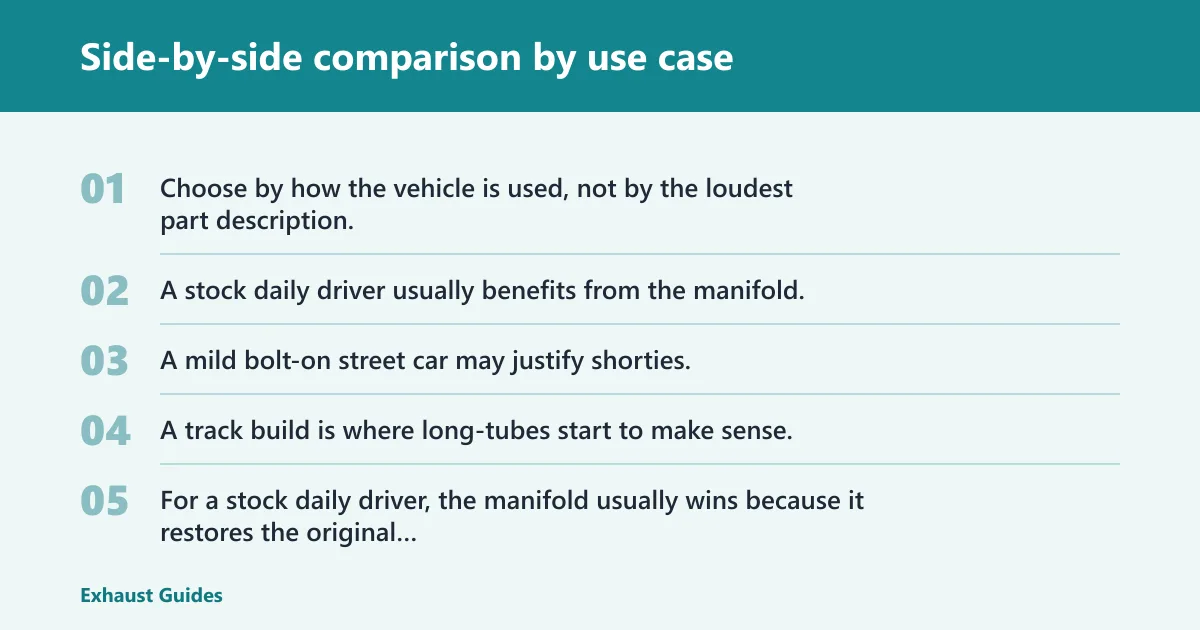
Choose by how the vehicle is used, not by the loudest part description. A stock daily driver usually benefits from the manifold. A mild bolt-on street car may justify shorties. A towing truck usually wants OEM fitment. A track build is where long-tubes start to make sense.
| Use case | Exhaust manifold | header | Winner |
|---|---|---|---|
| Stock daily driver | Best fit, quiet, predictable, easiest emissions path | Possible, but often more noise and limited payoff | Exhaust manifold |
| Towing or work truck | Best for reliability, packaging, and low-drama service | Can work, but fitment and heat concerns are common | Exhaust manifold |
| Mild bolt-on street car | Safe repair choice, little performance upside | Shorty header can add modest gain with manageable fitment | header |
| Track or high-RPM build | Usually the limiting part | Long-tube header is the stronger performance choice | header |
Stock daily driver
For a stock daily driver, the manifold usually wins because it restores the original balance of noise, emissions readiness, and fit. Headers can add sound and heat without offering enough real-world gain to justify the hassle. If the engine is otherwise healthy, the stock-style repair is the cleanest route.
Towing or work truck
Towing and work use favor the manifold because consistent torque delivery, heat control, and easy service matter more than peak horsepower. Truck exhaust piping may also use flexible metal ducting to reduce vibration transfer, which is another clue that packaging and durability matter in this segment. The wrong header can complicate maintenance in a vehicle that needs to stay on the road.
Mild bolt-on street car
A mild bolt-on car is where shorty headers can make sense. They are the compromise part: better flow than a manifold, easier fitment than long-tubes, and usually less drama with the rest of the exhaust. The gain is modest, but the installation burden is usually manageable.
Track or high-RPM build
For track use or a high-RPM build, the header is the better tool. Long-tubes improve exhaust flow at the engine speeds where the extra airflow matters most, and that is where the horsepower and torque gains become easier to justify. The cost in install complexity is part of the deal.
Do headers add horsepower on a daily driver?
Sometimes, but the gain is often small enough that a daily driver may never feel it in normal traffic. Headers can deliver a noticeable increase in horsepower and torque, especially at higher RPMs, but CarParts.com’s note is worth keeping in mind: they usually help most on souped-up, high-performance engines. On a commuter, the money often buys more noise than speed.
If the car rarely sees high RPM, the improvement may sit outside your normal driving range. That is why the better question is not whether headers make power, but whether they make power where you drive.
Do headers make the exhaust louder?
Yes. Headers typically produce a louder and sharper exhaust sound than a cast manifold. F10 sums it up well: the manifold is quiet and deep, while headers are loud and crisp. That change can be appealing on a weekend car and annoying on a long commute.
Sound changes are not always a benefit. If the vehicle already has a sporty exhaust, headers may push it past what feels comfortable inside the cabin.
Do headers cause more heat in the engine bay?
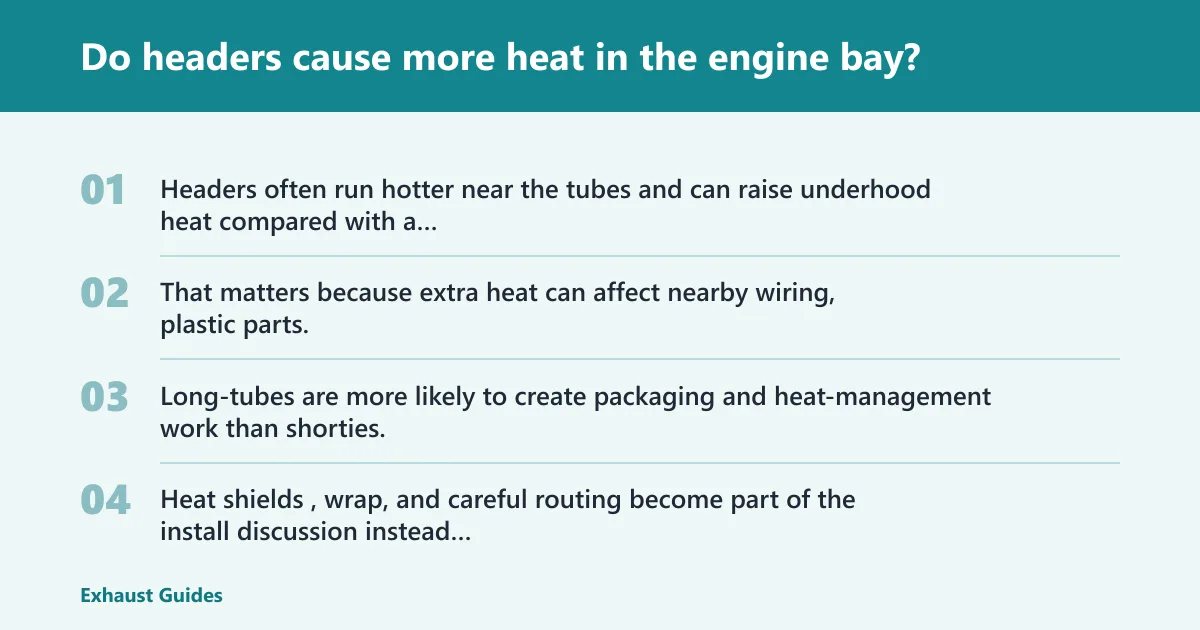
They can. Headers often run hotter near the tubes and can raise underhood heat compared with a cast manifold. That matters because extra heat can affect nearby wiring, plastic parts, and service access, especially on tight engine bays.
Long-tubes are more likely to create packaging and heat-management work than shorties. Heat shields, wrap, and careful routing become part of the install discussion instead of afterthoughts.
Choose Exhaust manifold if… / Choose header if…
Choose the exhaust manifold if your priority is repair-grade reliability, stock fitment, towing, quieter daily driving, or emissions-friendly maintenance. Choose the header if your goal is performance, especially at higher RPM, and you are willing to accept more heat, more noise, possible ECU tuning, and extra fitment work.
Choose exhaust manifold if…
Choose the manifold if the vehicle is stock, if the failed part is a cracked original manifold, if the car or truck must pass inspection with minimal risk, or if you want the simplest path back to factory behavior. It is also the better answer when starter, steering, or catalytic converter clearance is already tight.
Choose header if…
Choose a header if the engine has supporting mods, the build targets higher-RPM power, or the vehicle is a project where installation time and tuning are acceptable costs. Shorty headers fit mild street goals better. Long-tube headers belong on builds that can use the extra flow and do not need the easiest service path.
- Identify the goal: repair, daily use, towing, mild street gain, or track power.
- Check emissions rules for your region and whether catalytic converter changes are allowed.
- Inspect clearance around the starter, steering shaft, motor mounts, and O2 sensors.
- Confirm whether the stock catalytic converter will bolt up to the collector and downstream piping.
- Plan for an ECU tune if the header changes airflow, sensor placement, or drivability.
- Compare install time and parts cost against the horsepower gain you can actually use.
Decision matrix: choose the right part for your use case
Use this as a practical filter. If more than one line points to the same answer, that is usually the correct answer.
| Vehicle goal | Budget | Emissions tolerance | Install complexity | Expected gain | Recommended choice |
|---|---|---|---|---|---|
| Repair a broken factory exhaust on a stock car | Low to moderate | Low tolerance for risk | Low | Restore OEM operation | Exhaust manifold |
| Quiet towing or work use | Moderate | Low tolerance for legal issues | Low | Reliability more than power | Exhaust manifold |
| Mild bolt-on street car | Moderate | Moderate | Moderate | Modest torque and response | Shorty header |
| Track build or high-RPM engine | Moderate to high | Higher tolerance for off-road use | High | Best top-end power | Long-tube header |
| Daily driver in a strict inspection area | Moderate | Very low tolerance for emissions risk | Low | Small gain not worth hassle | Exhaust manifold |
Frequently asked questions
What is the difference between an exhaust manifold and a header?
An exhaust manifold is usually a cast, one-piece OEM part that collects exhaust from all cylinders into a single outlet. A header uses separate primary tubes that merge in a collector. The manifold favors durability, packaging, and predictable emissions behavior, while the header favors airflow and higher-rpm power.
Which is better for a stock engine, a manifold or header?
For a stock engine, the manifold is usually better because it restores factory fit and keeps the car close to original emissions and noise levels. A shorty header can be a mild upgrade, but the gain is usually limited on a near-stock engine and may not justify the extra cost or work.
Do headers add horsepower on a daily driver?
They can, but the gain on a daily driver is often smaller than people expect. Headers can deliver a noticeable increase in horsepower and torque, especially at higher RPMs, yet many daily drivers spend most of their time outside that range. The result can be more noise than useful power.
Are shorty headers better than long-tube headers?
Neither is universally better. Shorty headers are easier to fit, usually install faster, and favor lower and mid-range torque. Long-tube headers are the stronger choice for high-RPM power, but they usually take more time to install and are more likely to require clearance work and tuning.
Will headers fit with the stock catalytic converter?
Sometimes, but fitment depends on the header design, collector position, and O2 sensor layout. Some setups work with the stock catalytic converter; others require different piping or a different catalyst arrangement. If emissions compliance matters, verify compatibility before buying parts.
Which choice is better for emissions and daily driving?
The exhaust manifold is usually the better choice for emissions and daily driving because it keeps the vehicle closest to OEM behavior. Headers can complicate catalytic converter fitment, O2 sensor placement, and inspection readiness. If you want the fewest surprises, the manifold is the safer daily-use answer.