How to Check If a Catalytic Converter Is Stolen
Check the underside first: if the catalytic converter is missing and you can see a cut exhaust pipe, it is likely stolen; if the converter is still there, a loud exhaust leak or damaged flex pipe is more likely. Ignoring it can leave you with an unsafe exhaust leak, a failed emissions test, and a repair bill that grows if you keep driving. This guide shows how to confirm theft fast, document it for police and insurance, and decide what to do next.
What you need before you inspect
You do not need special tools to spot many theft clues, but you do need light, a safe way to view the underside, and a phone camera. On low-clearance cars, a vehicle jack or ramps may be needed to see the exhaust clearly. If you cannot get a safe view, stop and book a professional inspection.
- Phone or camera with flash
- Work light or flashlight
- Wheel chocks
- Vehicle jack and jack stands, or ramps, if the car sits low
- Gloves
- Paper and pen for notes
How do you confirm a stolen catalytic converter?
Confirm theft by checking for a missing converter, fresh cut pipe ends, hanging exhaust sections, and damaged sensor wiring under the car. A loud exhaust, fumes, or a check engine light can support the case, but they do not prove theft by themselves. The key question is whether the converter is gone or the exhaust is broken elsewhere.
Theft or not?
| Symptom | What it usually means | What to inspect next |
|---|---|---|
| Loud exhaust at startup | The converter may be missing, which can create a very loud exhaust noise. | Look for an empty gap or cut pipe under the car. |
| Exhaust fumes in the cabin | Exhaust may be leaking from an open section or damaged joint. | Check for missing pipe sections and damaged hangers. |
| Check engine light | The ECU may activate a check engine light after converter removal, but it is not proof by itself. | Read the code after the undercar inspection. |
| Hanging exhaust pipe | The converter or a nearby section may have been cut free. | Look for fresh cuts and broken hangers. |
| Visible cut marks | The exhaust may have been cut open during theft. | Compare both sides of the cut for fresh metal. |
| Missing sensor wiring | Oxygen sensor leads may have been cut or torn away. | Check both upstream and downstream sensor locations. |
| Low clearance access | The converter may be hard to see from the ground. | Use a vehicle jack or ramps to inspect safely. |
| Vehicle still drives | The car may still run even with the converter gone, but the exhaust system is compromised. | Do not assume it is only a sensor issue; inspect underneath. |
| Hybrid vehicle | Some hybrids are targeted because they can keep the engine off part of the time, which can hide a theft until startup. | Inspect at the converter location instead of relying on sound alone. |
| Truck or SUV | Higher ground clearance can make undercar access easier, but the converter may sit farther back than expected. | Trace the exhaust from the engine toward the middle of the vehicle. |
| Broken flex pipe | This can sound dramatic and may trigger a light, but it is not the same as a missing converter. | Look for the converter body and scan the flexible section for splits. |
| Rusted joint | Corrosion can separate exhaust parts and mimic theft damage. | Check whether the converter itself is still present and intact. |
Say your sedan starts with a sharp roar and the cabin smells like exhaust, but the converter housing is still visible under the car. That points away from theft and toward a leak at a joint or flex pipe. The next check is for split tubing, rust flakes, or a broken clamp, not a police report first.
How to inspect underneath the car
Use a safe viewing method before you go under the vehicle. If the car sits low, raise it only with a vehicle jack on level ground and support it properly, or use ramps. Never rely on the jack alone. If you cannot see the exhaust clearly, do not crawl underneath.
Park on level ground. Set the parking brake and chock the wheels. This keeps the car from rolling while you inspect the exhaust line.
Raise only if needed. Use a vehicle jack if the car sits low, then secure it with jack stands or use ramps. You need enough room to view the converter area without forcing your body under an unstable car.
Trace the exhaust path. Start near the engine and follow the pipe toward the center and rear. On many vehicles, the converter is near the front or underbody, with oxygen sensors before and after it.
Photograph all damage. Take wide and close shots of the gap, cut edges, sensor wires, and any hanging parts. These photos help police, insurance, and the repair shop verify what is missing.
Picture a crossover with enough clearance to slide a phone under the side skirt. If the converter is gone, the photo will usually show a clean gap where the canister should be, plus cut ends or missing sensor leads. A broken flex pipe, by contrast, often leaves the converter body in place.
What should you do after theft is confirmed?
Once you have confirmed the converter is missing, contact the authorities first. A law enforcement report helps document the theft for insurance and creates an official record for the incident. Then call your insurer and a repair shop for an estimate, and arrange towing if the exhaust is unsafe or scraping.
If catalytic converter stolen log
Use this as a reusable template before you call police, insurance, or the shop:
Evidence log
Date/time: __________________________
Location: ___________________________
Vehicle make/model/year: ____________
Mileage: ____________________________
Report number: _______________________

Photos taken:
[ ] Front of vehicle
[ ] Side of vehicle
[ ] Under the car
[ ] Cut pipe ends
[ ] Sensor wires
[ ] Hanging exhaust parts

Damage notes:
Cut locations: _______________________
Sensor damage: _______________________
Can the car be driven safely? ________
Shop questions:
- Is the converter missing, or is this a broken exhaust part?
- Are upstream and downstream oxygen sensors damaged?
- Are brackets, clamps, or hangers also missing?
- Does the car need a tow?
How much is a stolen catalytic converter worth? To a thief, often very little compared with the repair cost. One report says thieves can get anywhere from $50 to $300 for cats, while a replacement for the owner may be far higher. That gap is why the part is targeted for its high price.
What mechanics confirm
A professional inspection can separate theft from a broken flex pipe, failed manifold, or rusted joint. It also tells you whether the oxygen sensors were damaged, whether the exhaust is safe to drive, and whether you need only a converter or the converter plus sensors, clamps, and pipe sections.
- Ask for the exact missing part name and location.
- Request a line-item estimate for parts, sensors, labor, and towing.
- Ask whether the vehicle can be driven short-term or needs a tow.
Common mistakes
Do not treat a check engine light as proof of theft. It may come on after converter removal, but it can also appear with sensor faults, exhaust leaks, or unrelated engine problems. Use the undercar inspection to confirm the missing part first.
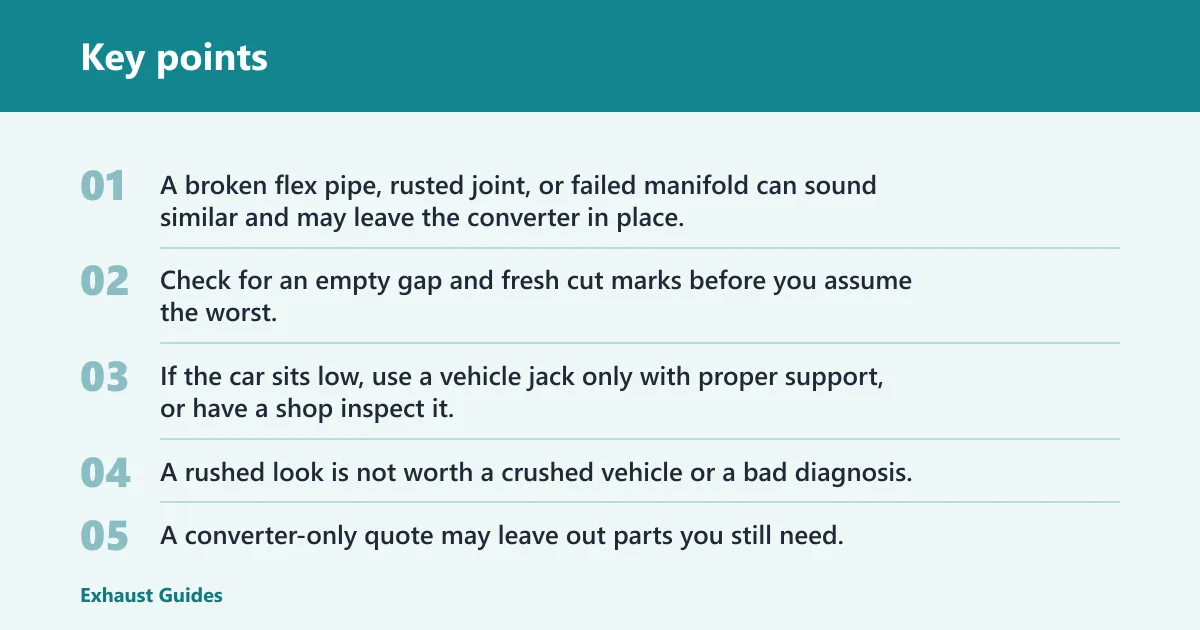
Do not mistake every loud exhaust for theft. A broken flex pipe, rusted joint, or failed manifold can sound similar and may leave the converter in place. Check for an empty gap and fresh cut marks before you assume the worst.
Do not crawl under an unstable car. If the car sits low, use a vehicle jack only with proper support, or have a shop inspect it. A rushed look is not worth a crushed vehicle or a bad diagnosis.
Do not skip the sensors. Upstream and downstream oxygen sensors can be stolen or damaged during the theft, and their wiring can change the repair bill. A converter-only quote may leave out parts you still need.
Frequently asked questions
What happens if catalytic converter is stolen
The exhaust usually gets much louder, and the car may smell like fumes inside the cabin. The ECU may activate a check engine light, but the real confirmation comes from the underside: an empty gap, cut pipe ends, or damaged sensor wiring where the converter used to sit.
How much is a stolen catalytic converter?
Thieves may get anywhere from $50 to $300 for cats, but that is not what you pay to fix the car. The owner’s cost is usually driven by the replacement part, sensor damage, labor, and whether the vehicle needs towing.
How much does it cost to replace a stolen catalytic converter?
Costs vary by vehicle and parts choice. An OEM converter usually costs more than an aftermarket one, and the bill can rise if upstream or downstream oxygen sensors, brackets, or exhaust sections are also damaged. Add labor and towing if the car cannot be driven safely.
Can I drive with a catalytic converter stolen?
Only if you must move it a short distance to a safe place, and even then the exhaust may be very loud or leak fumes. If the pipe is hanging or scraping, do not drive it. Call for a tow and a repair shop estimate instead.
Should I call police if my catalytic converter was stolen?
Yes. After you confirm the theft, contact the authorities first. A law enforcement report helps document the incident for insurance and can support wider theft investigations if there is a pattern in your area.
How do mechanics confirm catalytic converter theft?
They inspect the exhaust path, check for an empty gap, compare the cut edges, and look at oxygen sensor wiring and mounting points. They also check for lookalike failures such as a broken flex pipe, rusted joint, or failed manifold before they quote a repair.
What does a stolen catalytic converter look like under the car?
It often looks like a missing section of exhaust with open pipe ends where the converter should be. You may also see fresh cut marks, hanging pipes, or torn sensor leads. If the converter shell is still present, the problem is more likely a different exhaust failure.