How to Diagnose Exhaust Ticking Noise on Cold Start
On a cold start, a sharp tick that rises with rpm and then fades as the exhaust heats up often points to a leak, while a valvetrain tick usually sounds more mechanical and stays closer to the top of the engine. A quick check sequence helps: confirm the oil level, note where the sound is loudest, listen for whether it fades or persists as the engine warms, watch for an exhaust smell or check engine light, and then use a stethoscope to narrow the source. Misreading the noise can lead to unnecessary diagnostics or let a small leak grow into a cracked manifold or burned gasket.
Why the tick happens on cold start


A brief tick after startup can be normal if it disappears quickly. Cold metal, oil that has drained down overnight, and parts that have not fully expanded can all make a sharp noise for a few seconds. Timing matters more than volume.
Exhaust manifold ticking is often louder when the engine is cold. As the manifold heats, the metal expands and a small gap may shrink, which can make the noise fade. Hydraulic lifters can also tick after an overnight soak until oil pressure reaches the upper valvetrain and refills them.
How duration changes the diagnosis
A noise that stops in a few seconds points in a different direction than one that lingers after warm-up. Normal engine ticking is usually steady in rhythm and does not grow louder over time. Abnormal ticking often points toward reduced lubrication, valve train noise, or a component that is not sealing correctly.
Picture a sedan that ticks for about 8 seconds after an overnight start, then goes quiet. That pattern leans toward temporary oil distribution delay or a brief lifter tick. Now picture the same car ticking for several minutes, with the sound still sharp after the temperature gauge moves up. That pattern deserves a closer look.
Check oil level first
Check the engine oil dipstick before assuming the noise is exhaust-related. Low oil can cause valvetrain noise because components are not getting enough lubrication, and incorrect viscosity can change cold-start sound. The top of the engine is often the last area to quiet down, so valvetrain noise can show up there first.
If the oil level is low, top it off with the correct viscosity for the engine and recheck the start-up sound later. If the level is correct and the tick still appears only cold, the diagnosis moves away from a simple oil issue and toward the exhaust or valvetrain.
-
Park on level ground.
Let the vehicle sit overnight or long enough for a true cold start. A warm restart can hide the pattern because metal expansion and oil pressure already changed the sound. -
Check the dipstick first.
Pull the dipstick before any deeper inspection. If the level is low, correct that before judging the tick, because low oil can create a similar startup noise. -
Start the engine cold.
Listen for how fast the noise begins, where it seems loudest, and whether it fades within roughly 30 to 90 seconds. A brief tick that disappears quickly is often less concerning than a noise that stays steady or grows. -
Note the sound location.
Stand near the wheel well, firewall, and top of the engine in turn. A source near the exhaust side points more toward a leak, while a top-of-engine tick points more toward lifters or injector noise. -
Watch the warm-up change.
Keep listening as the engine warms. A tick that fades as the exhaust heats and seals can fit a manifold leak, while a tick that stays near the valve cover after warm-up leans toward valvetrain noise.
Cold-start tick decision table
| Sound behavior | Most likely source | Next check |
|---|---|---|
| Disappears in 5-10 seconds | Temporary oil distribution delay or brief lifter tick | Check oil level and note whether it returns on the next cold start |
| Loudest at the wheel well or firewall | Exhaust manifold leak | Listen around the manifold area for a sharper exhaust pulse |
| Changes with RPM | Exhaust leak or valvetrain tick | Compare whether the sound tracks engine speed from idle to a light rev |
| Persists warm | More likely wear, oil delivery issue, or a larger leak | Book a diagnosis instead of waiting for it to clear |
| Accompanied by exhaust smell | Exhaust manifold leak | Inspect for a cracked manifold, gasket leak, or broken stud |
| Only present after overnight soak | Hydraulic lifter bleed-down or a cold exhaust leak | See whether the tick fades as oil pressure returns or heat builds |
| Stays near the top of the engine | Hydraulic lifters or injector noise | Use a stethoscope to separate top-end noise from exhaust noise |
| Has a metallic rattle instead of a sharp tick | Heat shield or loose exhaust hardware | Check shields and brackets before assuming a manifold leak |
How to tell exhaust leak from engine tick
Location, duration, and warm-up behavior separate most exhaust ticks from engine ticks. An exhaust leak is often sharp, loudest near the manifold or firewall, and more obvious when cold. A top-end engine tick usually stays higher on the engine and does not move around with heat in the same way.
Sound location at the wheel well or firewall
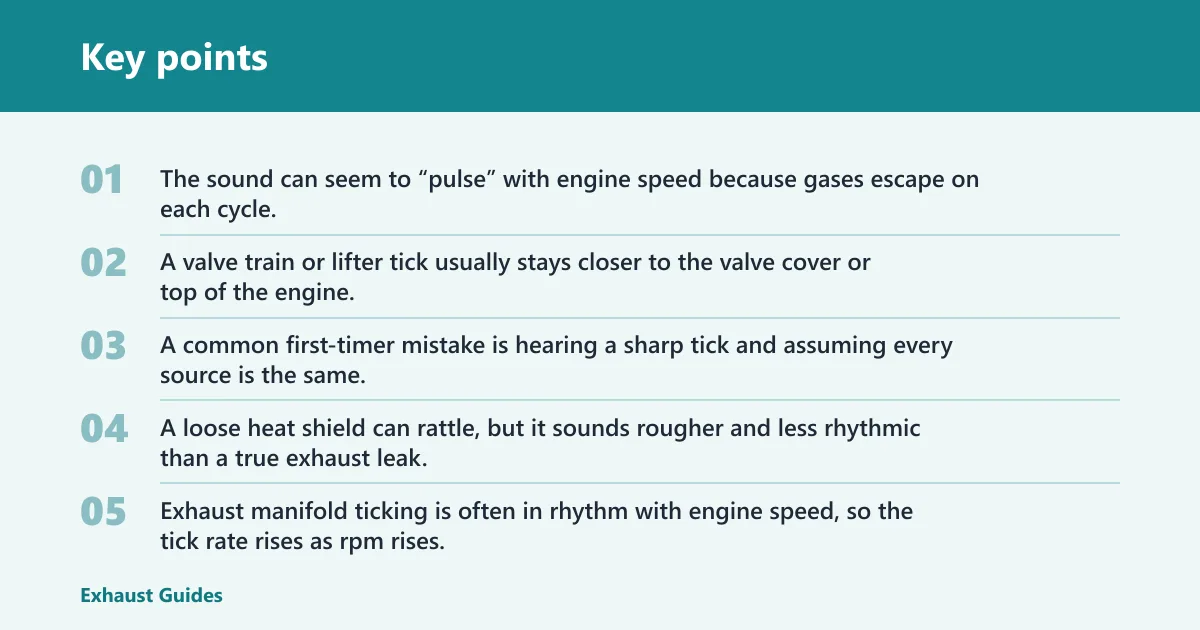
An exhaust manifold leak often sounds strongest near the wheel well, rear of the engine bay, or firewall, depending on engine layout. The sound can seem to “pulse” with engine speed because gases escape on each cycle. A valve train or lifter tick usually stays closer to the valve cover or top of the engine.
A common first-timer mistake is hearing a sharp tick and assuming every source is the same. A direct-injection injector can make a steady clicking sound too, but it usually stays near the injector rail and does not fade with exhaust heat. A loose heat shield can rattle, but it sounds rougher and less rhythmic than a true exhaust leak.
Change with rpm
Exhaust manifold ticking is often in rhythm with engine speed, so the tick rate rises as rpm rises. That does not prove the manifold is the only issue, but it helps separate exhaust noise from a random rattle. A steady tick that matches rpm is more suspicious than a noise that stays unchanged.
Warm-up behavior and exhaust smell
A leak often quiets as metal expands and closes the gap. That is why a cracked manifold, broken stud, or gasket leak can sound worst on a cold start and soften later. If the noise comes with strange smells, weak acceleration, poor fuel economy, or a check engine light, the odds of an exhaust leak rise.
Suppose a pickup starts with a sharp tick near the firewall and the smell of exhaust reaches the cab at idle. If the sound fades after a minute but returns on the next cold start, that pattern fits an exhaust leak more closely than a pure valvetrain problem. When the sound is strongest near the exhaust side, the exhaust leak path becomes more likely than a top-end tick.
Exhaust manifold leak sources
Exhaust manifold leaks do not all fail the same way. A gasket leak, cracked manifold, or broken bolt or stud can each make the same sharp cold-start tick, but the failure pattern changes how it behaves as the engine warms. Broken manifold studs can make gases seep around the manifold rather than through the exhaust system.
Broken bolt or stud
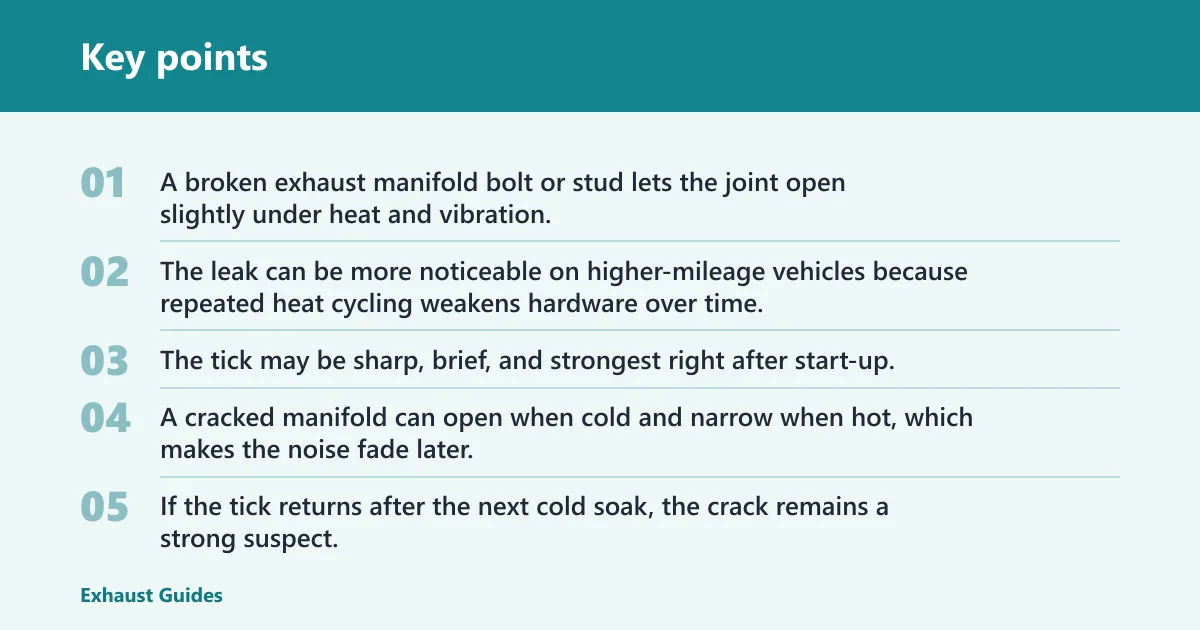
A broken exhaust manifold bolt or stud lets the joint open slightly under heat and vibration. The leak can be more noticeable on higher-mileage vehicles because repeated heat cycling weakens hardware over time. The tick may be sharp, brief, and strongest right after start-up.
Cracked manifold
A cracked manifold can open when cold and narrow when hot, which makes the noise fade later. This fault can be harder to find by ear alone because the crack may close enough to quiet down before a full inspection begins. If the tick returns after the next cold soak, the crack remains a strong suspect.
Manifold gasket leak
A gasket leak often sounds like a crisp puffing tick at the flange. It can worsen with cold starts because the gasket has not fully expanded and sealed yet. If the sound stays near one cylinder runner or flange area, a gasket is worth checking before deeper engine work.
What to check before booking diagnosis
Before booking diagnosis, use careful listening, check the oil, and look for symptoms that travel with the noise. An engine stethoscope helps localize ticking source and separate top-end engine noise from exhaust manifold noise. That can save time when the problem is a simple oil issue, a lifter noise, or an exhaust leak that needs inspection.
Use a stethoscope or careful listening
An engine stethoscope lets you compare the valve cover, intake area, and exhaust-side hardware with more precision than ear alone. If the tick is loudest at the manifold or firewall, the exhaust side climbs higher on the list. If it is loudest at the top of the engine, valvetrain noise becomes more likely.
-
Listen at three zones.
Compare the top of the engine, the exhaust side, and the wheel well or firewall. A leak often concentrates in one area, while a top-end tick stays near the valve cover. -
Check for added symptoms.
Look for exhaust smell, poor fuel economy, weak acceleration, or a check engine light. Those symptoms fit an exhaust manifold leak better than a short normal tick. -
Rule out false positives.
If the sound is a steady injector click or a loose heat shield rattle, the fix is different. A stethoscope or careful listening helps separate those from a true exhaust tick. -
Schedule diagnosis if it stays.
If the noise persists warm, grows louder, or returns every cold start with symptoms, book an inspection. A small leak can turn into a burned gasket or more hardware damage.
Look for check engine light and fuel smell
A check engine light does not prove an exhaust leak, but it adds weight when paired with smell or weak acceleration. Exhaust leaks can also affect fuel economy if the engine management reacts to the leak or related sensor readings. If these symptoms show up together, diagnosis is justified sooner rather than later.
Spot false positives like injector noise or heat shield rattle
Direct-injection injector noise can sound like a fast click, especially at idle, but it usually stays consistent and near the engine. Heat shield rattle is more metallic and loose, often changing with bumps or certain rpm ranges. Hydraulic lifters can tick after an overnight soak, and a brief cold-start tick from lifters can be normal if it quiets once oil pressure returns.
Frequently asked questions
Why does my car make a ticking noise on cold start?
Cold-start ticking often comes from two broad groups: exhaust leaks and engine top-end noise. An exhaust manifold leak is usually louder when cold and may fade as the metal heats and seals. Hydraulic lifters can also tick briefly after an overnight soak until oil pressure reaches them.
How can I tell if the ticking is from the exhaust manifold or the engine?
Use sound location, rpm change, and warm-up behavior. Exhaust manifold noise is often loudest near the wheel well or firewall and can fade as the engine warms. Engine tick usually stays near the top of the engine, while a stethoscope helps pinpoint the source more precisely.
Is a brief tick after startup normal?
Yes, a brief tick that disappears quickly can be normal. On startup, oil pressure may take several seconds to reach upper valvetrain components, so a short tick can come from temporary oil distribution delay. A tick that persists warm or grows louder is less normal.
How long can ticking last before it is a problem?
A tick that lasts only a few seconds and fades on its own is less concerning than one that continues after warm-up. If the noise is still present after the engine has started to heat up, or if it returns on every cold start with the same sharp pattern, it deserves diagnosis. Duration alone is not the only factor, but a tick that keeps going is more likely to need attention.
Can low oil mimic an exhaust leak?
Yes. Low oil can create startup ticking that sounds similar to an exhaust leak at first because the valvetrain can be noisy before lubrication reaches the upper engine. If the noise changes after the oil is corrected, that points away from exhaust and toward lubrication-related noise.
Can an exhaust leak get louder when warm?
It can change either way depending on the fault. Many exhaust leaks are loudest cold and then soften as the metal expands and the gap narrows. If the leak worsens when warm instead of quieting, that can suggest a different issue or a larger leak that is opening as parts heat and move.
When should I book diagnosis?
Book diagnosis if the tick persists warm, returns on every cold start, gets louder over time, or comes with exhaust smell, poor fuel economy, weak acceleration, or a check engine light. Those signs make a simple brief tick less likely and raise the odds of an exhaust leak, lifter issue, or another fault that should not be ignored.
What does an exhaust manifold leak sound like when the engine is cold?
It often sounds like a sharp, repetitive tick that speeds up with rpm. The noise is usually louder on a cold start and may fade as the exhaust heats and the metal expands. Broken studs, cracked manifolds, and gasket leaks can all produce that pattern.
What symptoms usually come with an exhaust leak tick?
Common symptoms include strange smells, poor fuel economy, a check engine light, and weak acceleration. Those signs make an exhaust leak more likely, especially when the tick is loudest cold and quieter after warm-up. A smell near the cabin is a strong reason to inspect sooner.
What should I check first when I hear ticking on startup?
Check the engine oil dipstick first. Low oil can cause ticking from reduced lubrication, and wrong viscosity can change cold-start noise. If the oil level is correct, the next best step is to localize the sound and note whether it fades quickly.