
Do All Atoms Have Resonance Structures Simple Answer
Many students learning about chemical bonding wonder, “Do all atoms have resonance structures? Simple Answer”. This question can seem tricky at first because resonance isn’t something every single atom or molecule shows.

As an Amazon Associate I earn from qualifying purchases.
It’s a special concept that helps us describe certain chemical bonds more accurately. If you’ve been scratching your head about this, don’t worry! We’ll break it down in a super simple, step-by-step way, so you’ll know exactly when and why resonance happens.
Get ready to see how easy it can be to spot resonance structures.
Understanding Resonance Structures
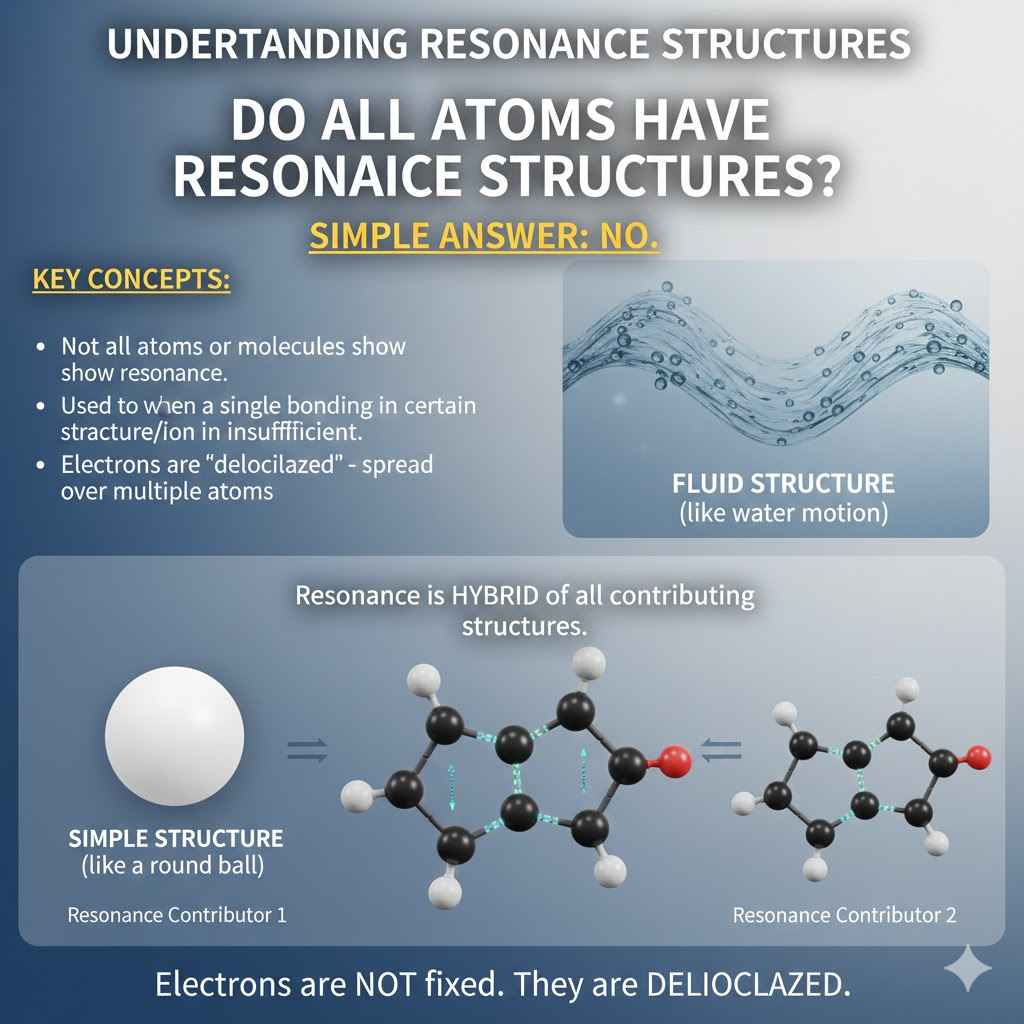
Let’s get straight to the point: Do All Atoms Have Resonance Structures? Simple Answer is no, not all atoms or molecules show resonance. Resonance is a concept used in chemistry to describe the bonding in certain molecules or polyatomic ions.
When a single Lewis structure cannot fully explain the bonding and electron distribution in a molecule, resonance becomes important.
Think of it like this. Imagine you have a perfectly round ball. You can describe it easily.
But what if you have something a bit more fluid, like water? You can draw it in a few ways, but it’s always in motion. Resonance is similar.
It’s a way chemists show that electrons in some molecules are not fixed in one place. They are spread out, or delocalized, over several atoms.
So, the key idea is that resonance occurs when there are multiple valid Lewis structures that can be drawn for a single molecule or ion. These different drawings are called resonance structures or resonance contributors. They are not actual, separate molecules that flip back and forth.
Instead, they are representations of the true structure, which is a hybrid of all the contributing resonance structures.
Why Do Some Molecules Need Resonance Structures?
Molecules need resonance structures when a single Lewis structure doesn’t quite capture the reality of the electron distribution. Electrons are always trying to find the most stable arrangement, which usually means being as far apart as possible while still being attracted to the nuclei. In some cases, this means electrons are shared between more than two atoms, or they can be moved around to achieve a more stable state.
For example, consider the nitrate ion (NO3-). If you draw a Lewis structure for it, you might end up with one oxygen atom double-bonded to the nitrogen, and the other two oxygen atoms single-bonded. However, experiments show that all three nitrogen-oxygen bonds are actually the same length and strength.
This means the double bond isn’t fixed on one oxygen; the electrons are shared equally among all three. Resonance structures help us show this equal sharing.
The concept of resonance is crucial because it explains observed properties like bond lengths, bond strengths, and the stability of certain molecules. Molecules with resonance are generally more stable than they would be if their electrons were localized in a single Lewis structure.
What Makes a Molecule Exhibit Resonance?
Several conditions need to be met for a molecule or ion to exhibit resonance:
- Multiple Valid Lewis Structures: You must be able to draw at least two different, but equally valid, Lewis structures for the molecule or ion. “Valid” here means that they follow the octet rule (for most common elements) and have the correct total number of valence electrons.
- Delocalized Electrons: Resonance occurs when electrons (usually pi electrons or lone pairs) can be moved to different positions within the molecule. This often happens when there’s a pi bond next to an atom with a lone pair or an empty p orbital.
- Atom Connectivity Remains the Same: The positions of the atoms themselves do not change between resonance structures. Only the placement of electrons (double bonds, triple bonds, lone pairs) and formal charges are different.
A helpful way to think about this is the presence of alternating single and multiple bonds, or a multiple bond adjacent to an atom with a lone pair or an empty orbital. This arrangement allows electrons to “flow” and be delocalized.
Identifying Resonance Structures Step-by-Step
Let’s walk through how to identify if a molecule has resonance structures. This process involves drawing Lewis structures.
Step 1: Count Total Valence Electrons
Sum up the valence electrons from all atoms in the molecule or ion. For ions, add electrons for negative charges and subtract for positive charges.
Step 2: Determine the Central Atom
Usually, the least electronegative atom is the central atom, with hydrogen always being terminal. For molecules with only two atoms, they are bonded together.
Step 3: Draw a Skeletal Structure
Connect the atoms with single bonds. This forms the basic skeleton of the molecule.
Step 4: Distribute Remaining Electrons
Place the remaining valence electrons as lone pairs on the terminal atoms first to satisfy their octets. Then, place any leftover electrons on the central atom.
Step 5: Form Multiple Bonds to Satisfy Octets
If the central atom does not have an octet, move lone pairs from terminal atoms to form double or triple bonds with the central atom. Check if all atoms (except hydrogen) now have an octet.
Step 6: Check for Resonance
Once you have a valid Lewis structure, look for places where electrons can be moved. Can a lone pair form a double bond? Can a double bond move to become a single bond and a lone pair elsewhere?
If you can move electrons to create a different, but equally valid, Lewis structure while keeping the atom connectivity the same, then the molecule exhibits resonance.
A key indicator is the presence of pi bonds next to atoms that have lone pairs or empty orbitals. The movement of pi electrons or lone pairs is what creates different resonance structures.
Examples of Molecules with and without Resonance
Molecules with Resonance
Let’s look at some common examples:
Ozone (O3)
Ozone has three oxygen atoms. When you draw its Lewis structure, you’ll find two possible structures where one oxygen is double-bonded to the central oxygen, and the other is single-bonded. The actual structure is a hybrid where all bonds are intermediate between single and double bonds.
Structure 1: O=O-O
Structure 2: O-O=O
The double bond and single bond positions are interchangeable, showing resonance.
Benzene (C6H6)
Benzene is a classic example. It’s a hexagonal ring of six carbon atoms, each bonded to one hydrogen. The carbon-carbon bonds in benzene are all identical and have a length in between that of a single and a double bond.
This is because the pi electrons are delocalized around the entire ring, leading to two major resonance structures (often depicted as a hexagon with a circle inside).
Structure 1: Alternating double and single bonds in the ring.
Structure 2: Alternating double and single bonds shifted by one position.
Carbonate Ion (CO3^2-)
Similar to nitrate, the carbonate ion has three oxygen atoms bonded to a central carbon. All three carbon-oxygen bonds are identical, indicating delocalization. There are three equivalent resonance structures, each with one double bond and two single bonds, distributed among the three oxygen atoms.
Molecules without Resonance
Now, let’s consider molecules that do not exhibit resonance. These are typically molecules where a single Lewis structure adequately describes the bonding and electron distribution.
Methane (CH4)
Methane has one central carbon atom bonded to four hydrogen atoms. The Lewis structure is straightforward, with four single bonds. There are no lone pairs on the carbon, and no pi bonds that can be moved.
Its structure is stable and well-defined by this single Lewis structure.
Water (H2O)
Water has one oxygen atom bonded to two hydrogen atoms, with two lone pairs on the oxygen. This is a simple molecule where a single Lewis structure fully explains the bonding. There are no alternative ways to arrange the electrons that would lead to a different, equally valid Lewis structure.
Carbon Dioxide (CO2)
Carbon dioxide has a central carbon atom double-bonded to two oxygen atoms. While it has double bonds, these bonds are fixed. Moving electrons would violate the octet rule for one of the atoms or result in an unstable arrangement.
The two C=O double bonds are correctly represented by a single Lewis structure.
The Role of Formal Charge in Resonance
Formal charge is a way to track electrons in a Lewis structure and helps in determining the best Lewis structure. When assessing resonance, the most significant resonance structures are those with:
- The fewest formal charges.
- Negative formal charges on the most electronegative atoms.
- Positive formal charges on the least electronegative atoms.
While all valid Lewis structures contribute to the resonance hybrid, those with more favorable formal charge distributions contribute more significantly. Resonance helps to delocalize these formal charges over multiple atoms, leading to a more stable overall structure.
Resonance and Stability
One of the main reasons resonance is important is its effect on molecular stability. Molecules that exhibit resonance are generally more stable than their hypothetical non-resonant counterparts. This extra stability is called resonance energy or delocalization energy.
The delocalization of electrons over a larger area lowers the overall potential energy of the molecule. Imagine trying to hold many small pebbles versus one large, smooth stone; the large stone is easier to manage. Similarly, spreading electrons out reduces their electron-electron repulsion and increases their attraction to multiple nuclei, making the molecule more stable.
Common Misconceptions about Resonance
It’s easy to misunderstand resonance. Here are some common pitfalls to avoid:
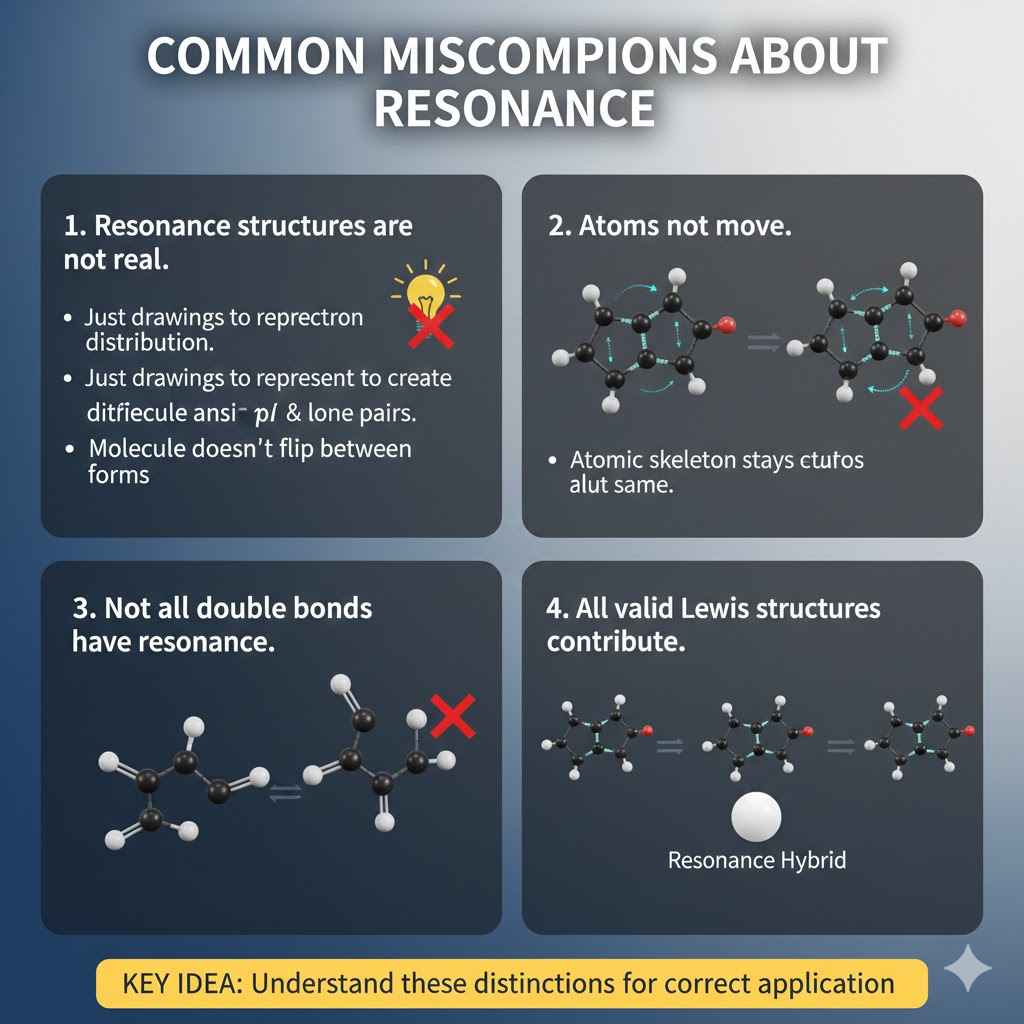
- Resonance structures are not real. They are just drawings chemists use to represent a complex electron distribution. The molecule does not flip between resonance forms.
- Atoms do not move. Only electrons (pi electrons and lone pairs) are shown to move between resonance structures. The atomic skeleton remains the same.
- Not all molecules with double bonds have resonance. Resonance requires the possibility of delocalizing electrons to create different, valid Lewis structures.
- All valid Lewis structures contribute. While some may contribute more than others, every valid resonance structure plays a role in describing the true hybrid structure.
Understanding these distinctions is key to correctly applying the concept of resonance.
Frequently Asked Questions
Question: Do all atoms exhibit resonance structures?
Answer: No, not all atoms or molecules exhibit resonance structures. Resonance occurs when a single Lewis structure cannot accurately describe the electron distribution, and multiple valid Lewis structures can be drawn.
Question: What is the main purpose of drawing resonance structures?
Answer: The main purpose is to represent molecules or ions where electrons are delocalized over several atoms. This provides a more accurate picture of bonding, bond lengths, and stability than a single Lewis structure can.
Question: How can I tell if a molecule has resonance?
Answer: You can tell if a molecule has resonance by drawing its Lewis structure and checking if you can move electrons (lone pairs or pi electrons) to create another valid Lewis structure with the same atom connectivity but different electron placement.
Question: Are resonance structures always equivalent?
Answer: No, resonance structures are not always equivalent. Some resonance structures may contribute more to the overall hybrid structure than others, especially if they have more favorable formal charges or more stable electron arrangements.
Question: Does resonance make a molecule more stable?
Answer: Yes, molecules that exhibit resonance are generally more stable than they would be without resonance. This extra stability is known as resonance energy or delocalization energy.
Final Thoughts
So, to answer the question: Do All Atoms Have Resonance Structures? Simple Answer is no. Resonance is a specific chemical phenomenon that happens when a single Lewis structure isn’t enough.
It’s all about electrons spreading out. By drawing different possible structures, we get a better idea of how a molecule really looks and behaves. This helps us understand why some molecules are more stable.
Keep practicing drawing Lewis structures, and you’ll get better at spotting when resonance is at play.
Related pick: Check today's price on Amazon