Exhaust Gasket Sealant vs Gasket Paste: What’s the Difference
Byline:
Use Exhaust Gasket Sealant only where the service manual allows it on a gasketed joint. Use Gasket Paste for low-pressure sealing or slip joints, and do not treat them as the same product. Wrong choice can cause leaks, burned gaskets, broken studs, and repeat repairs. This guide compares both by manifold, flange, and slip-joint use, plus the failure modes that decide which one belongs.
| Decision factor | Exhaust Gasket Sealant | Gasket Paste | Winner |
|---|---|---|---|
| Best joint type | Better when the joint is designed for a liquid or paste-style sealant and the temperature rating matches the location. | Better for slip joints and some assembly-aid uses where movement and vibration matter more than bolt preload. | Tie |
| How it behaves | Can cure into a flexible layer, but some RTV products can ash, harden, or blow out under exhaust heat. | Often spreads as a thicker compound and may cure to a flexible layer, which helps fill minor irregularities. | Gasket Paste |
| Fit with dry-installed MLS or graphite gaskets | Usually not the right answer on a modern dry-designed manifold or flange gasket unless the maker explicitly allows it. | Also usually wrong when the gasket is meant to crush and seal dry. | Tie |
| Failure risk after heat cycling | Can fail by ash-out, squeeze-out, or loss of adhesion if the joint runs hotter than the product can handle. | Can fail by being squeezed out of the joint, collecting debris, or masking a surface problem that returns after heating. | Exhaust Gasket Sealant |
Sealant vs paste: the core difference
Exhaust gasket sealant is a product category, not one chemistry. It can be a liquid or paste-style sealant, including high-temperature RTV, flange sealant, or copper spray, and the temperature rating matters more than the label on the tube.
Gasket paste is a thicker, spreadable sealing compound used in some exhaust repairs and assembly work. Firegum and Gun Gum are commonly cited examples of exhaust repair products. The key difference is how each product cures and how the joint moves after heating.
In practice, the joint design decides the product. A manifold joint, a flange joint, and a slip joint fail in different ways, so one material cannot solve all three.
Exhaust joint decision table
| Joint type | Gasket material | Acceptable product type | Red-flag misuse | Likely failure mode after heat cycling |
|---|---|---|---|---|
| Exhaust manifold to cylinder head | Dry-installed MLS or graphite gasket | Usually no product; follow the manual. A thin aid only if the manufacturer allows it. | Smearing paste across the gasket face as a cure for clamp loss or a warped head. | Leak return, burned gasket, or false seal that fails as the metal expands and contracts. |
| Header flange | Graphite, MLS, or composite gasket | Dry install first; sealant only if the product and joint design call for it. | Using paste to hide uneven clamping or a flange that is no longer flat. | Squeeze-out, edge blowout, or repeat leak where the flange is not clamping evenly. |
| Slip joint | Overlap connection, often clamped | Paste or sealant is often more appropriate here than on a bolted flange. | Trying to use a dry gasket where the joint is meant to move and absorb vibration. | Seepage, vibration breakup, or a joint that opens as the pipes move against each other. |
Why heat cycling changes the result
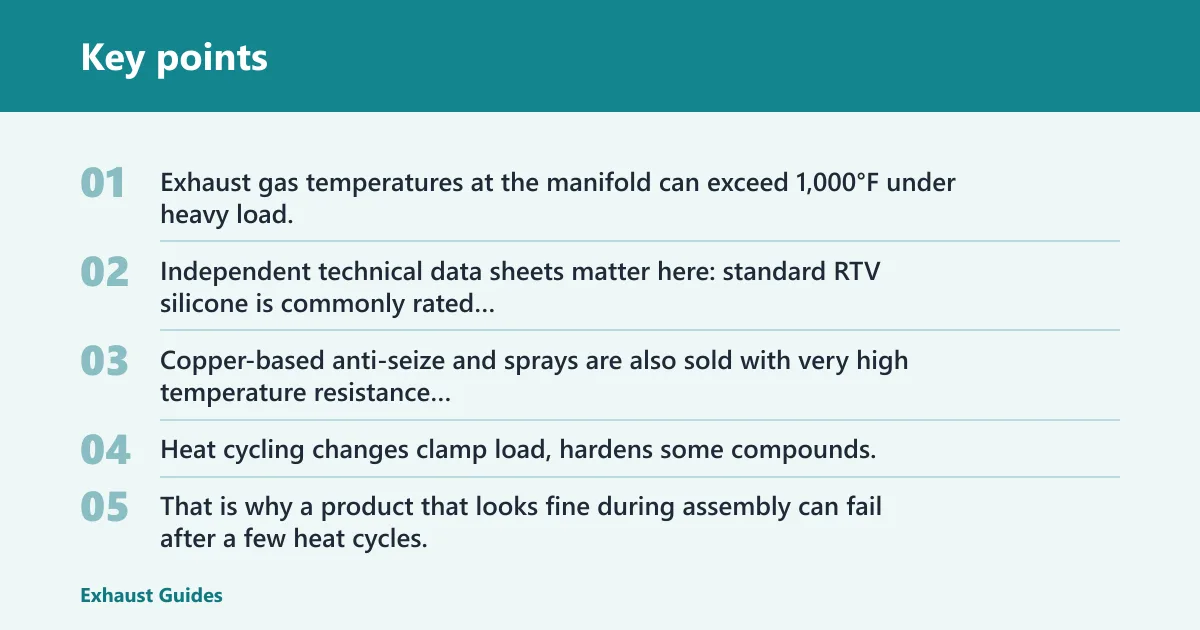
Exhaust gas temperatures at the manifold can exceed 1,000°F under heavy load, so the product choice has to survive repeated heating and cooling. Independent technical data sheets matter here: standard RTV silicone is commonly rated to about 400°F continuous service, while premium high-temp RTV products are often listed higher, usually with intermittent-use limits that vary by manufacturer. Copper-based anti-seize and sprays are also sold with very high temperature resistance in technical literature, but that does not make them a cure for a bad joint.
Heat cycling changes clamp load, hardens some compounds, and can turn a temporary seal into debris inside the joint. That is why a product that looks fine during assembly can fail after a few heat cycles.
How sealants fail under heat
High-temperature RTV silicone can ash, harden, or blow out when the joint runs beyond its useful range. That failure is common when someone uses a general-purpose sealant where the metal sees direct exhaust heat.
Sealants can also squeeze out if the flange is uneven or the gasket crushes too far during tightening. When that happens, the leak often returns after the first hot-cold cycle.
How paste fails under heat
Paste can be a useful temporary aid, but it is still vulnerable to movement, vibration, and loss of clamp load. If the joint was meant to seal dry, paste may only hide the problem until the next drive cycle.
A common first-timer mistake is to keep adding more paste after a repeat leak. That usually increases the chance of squeeze-out, not a lasting seal.
What heat means for product selection
Temperature rating is the first filter. If the joint sits at manifold-level heat, the manufacturer’s published data sheet has to support that environment; otherwise the product choice is wrong before installation starts.
Copper spray can help with minor imperfections because it acts more like a micro-filler or coating than a true gasket replacement. It is an aid, not a fix for warped metal.
Which exhaust joint are you fixing?
The joint type should decide the product, not the other way around. Exhaust manifold, header flange, and slip joint repairs fail for different mechanical reasons, so the right material changes with location.
Manifold-to-head joints
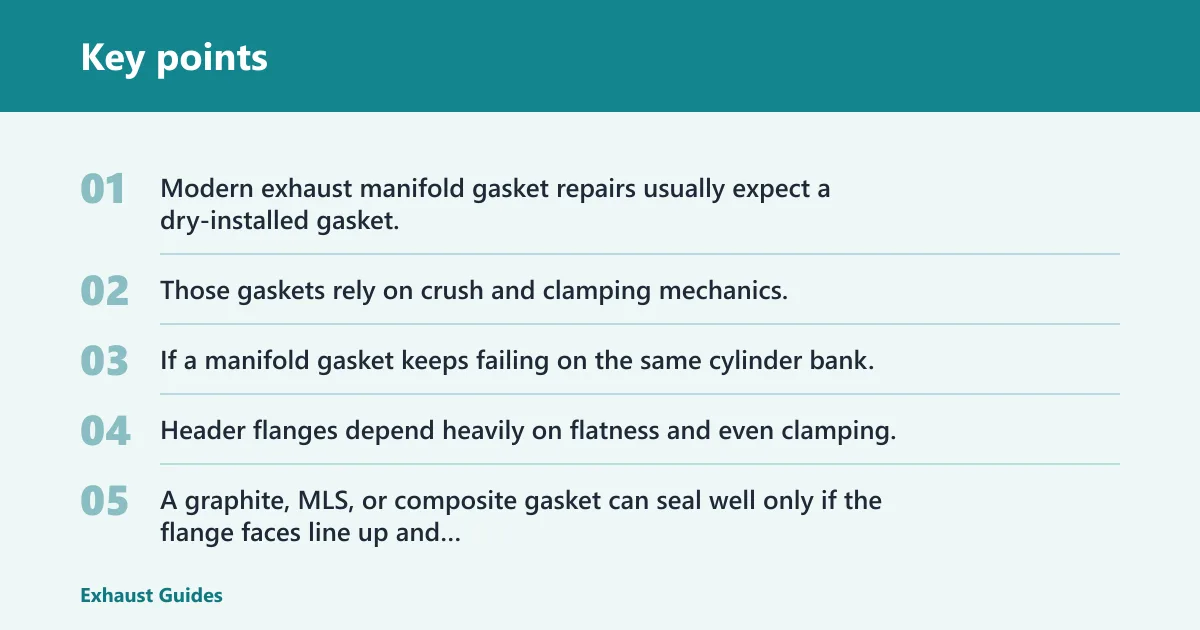
Modern exhaust manifold gasket repairs usually expect a dry-installed gasket, especially with MLS and graphite types. Those gaskets rely on crush and clamping mechanics, and they are standard for dry installation in many applications.
If a manifold gasket keeps failing on the same cylinder bank, the usual causes are clamp loss, an uneven face, or a warped surface rather than a shortage of paste.
Header flange joints
Header flanges depend heavily on flatness and even clamping. A graphite, MLS, or composite gasket can seal well only if the flange faces line up and the bolts pull evenly.
Header joints are where people most often reach for paste too early. If the flange is not flat, more product usually buys time, not a real repair.
Slip joints
Slip joints are the most common place where paste or sealant can make sense. The overlap design allows movement and vibration, so a spreadable compound can help fill the interface without fighting the joint’s motion.
Say your exhaust uses a clamped slip fit behind the resonator and you see a soot line at the overlap. That is a better use case for paste than a manifold face, because the joint is built to move slightly.
Do exhaust gaskets need sealant?
Usually no, if the gasket is an MLS or graphite part designed for dry installation. Modern exhaust gaskets are often made to seal by crush alone, and adding paste can interfere with that clamp action instead of helping it.
A thin aid may help only when the manufacturer allows it and the surface imperfection is minor. If the flange or head is warped, sealant is the wrong tool.
- Clean both faces until old carbon, rust, and residue are gone.
- Check the flange or head for flatness before assembly.
- Match the product to the joint type and temperature range.
- Install the gasket dry unless the service information says otherwise.
- Recheck for clamp loss after the first heat cycle if the procedure allows a retorque.
Use a product only where the joint design supports it. If the gasket is meant to crush dry, paste can create crush interference and leave the fasteners doing the wrong job.
Choose Exhaust Gasket Sealant if… / Choose Gasket Paste if…
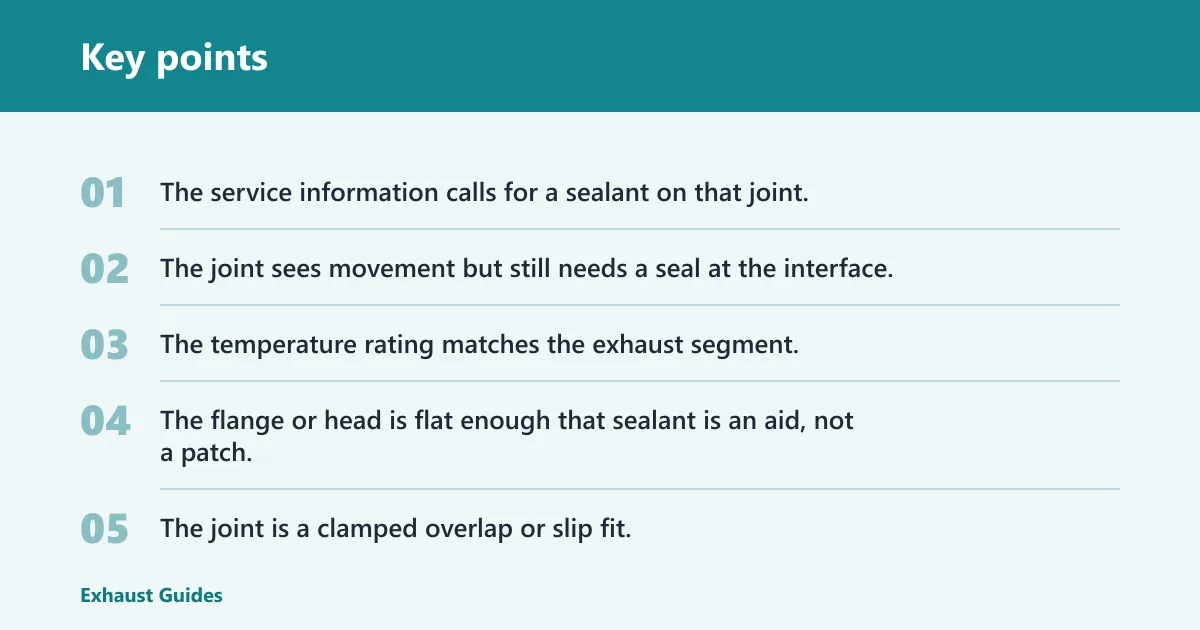
Choose exhaust Gasket sealant if…
Use Exhaust Gasket Sealant when the joint calls for a liquid or paste-style sealant and the product’s heat rating fits the location. It is the better pick for a gasketed joint only when the manufacturer allows a sealant, the surfaces are sound, and the failure is about minor imperfection rather than major distortion.
- The service information calls for a sealant on that joint.
- The joint sees movement but still needs a seal at the interface.
- The temperature rating matches the exhaust segment.
- The flange or head is flat enough that sealant is an aid, not a patch.
Choose gasket paste if…
Use Gasket Paste when the repair is a slip joint or the product specifically calls for assembly aid or temporary sealing. It fits better where overlap, vibration, and clamp-style retention matter more than a dry crush gasket.
- The joint is a clamped overlap or slip fit.
- The product label names exhaust assembly or temporary sealing.
- You need a spreadable compound for minor surface irregularities.
- You are not substituting paste for a dry-designed manifold gasket.
Skip both when the joint uses a dry-designed MLS or graphite gasket and the metal surfaces are in acceptable shape. That is the clearest sign the repair should focus on flatness, clamping, and the correct gasket, not extra material.


What to do about warped or pitted flanges
A warped or pitted exhaust flange often needs machining or replacement rather than more sealant. Once the surface stops clamping evenly, any product becomes a short-lived workaround.
Picture a header flange that has a soot trail on one corner and a dull, pitted sealing face. A bead of paste may quiet the leak for a short time, then the leak returns after heat cycling because the flange still cannot clamp evenly.
Surface prep before reassembly
Clean the sealing face to bare metal or the cleanest safe finish for the part. Remove old residue, carbon, and loose rust so the gasket can sit flat.
Check bolt holes, studs, and fasteners too. A sealant cannot compensate for a stud that will not hold clamp load.
When machining or replacement is the real fix
If the flange is visibly warped, deeply pitted, or repeatedly leaking in the same spot, repair the metal first. Replacing the flange or machining the face usually solves the root problem more reliably than increasing the amount of product.
That rule matters most on manifold and header joints, where the thermal load is high and clamp loss shows up fast.
How to stop an exhaust gasket from blowing out again
Start by finding the failure mode. A blown-out gasket often points to uneven clamping, the wrong gasket material, a warped face, or a sealant that cannot survive the heat at that location.
If the part keeps leaking after a correct reinstall, replace the gasket, inspect the flange flatness, and verify that the joint type is still appropriate for the repair method. Do not keep stacking paste on a dry-designed gasket.
Is copper spray a better choice than paste for exhaust joints?
Copper spray is better treated as an aid than as a full repair. It can help with minor surface imperfections, and published technical data for copper-based coatings generally places them well above ordinary RTV in temperature resistance, but it still cannot fix warped metal or poor clamping.
Use copper spray when the joint needs a light coating to help sealing, not when the flange is pitted, the gasket is wrong, or the joint is moving too much for a coating to hold. Paste is more useful on some slip joints; copper spray is less of a fill material and more of a helper layer.
Frequently asked questions
What is the difference between exhaust gasket sealant and gasket paste?
Exhaust gasket sealant is the broader category, which can include liquid or paste-style products such as high-temp RTV, flange sealant, or copper spray. Gasket paste is the thicker, spreadable type used for some exhaust repairs and slip joints. The right choice depends on the joint, heat, and movement.
Do exhaust gaskets need sealant or should they be installed dry?
Most modern MLS and graphite exhaust gaskets are meant for dry installation. Use sealant only when the service information allows it or when the product is specifically meant for that joint.
Can I use gasket paste on an exhaust manifold gasket?
Usually no. Many manifold joints are designed for a dry gasket, and paste can interfere with clamp load or fail under heat cycling.
Is exhaust sealant the same as firegum or gun gum paste?
No. Firegum and Gun Gum are exhaust repair pastes, while exhaust sealant is a broader category that can include RTV, flange sealant, and sprays.
What temperature can exhaust gasket sealant handle?
It depends on the chemistry and the manufacturer’s data sheet. Standard RTV is commonly around 400°F continuous, while higher-temp RTV formulations may be rated higher on an intermittent basis.
Will paste fix a warped or pitted exhaust flange?
Not permanently. A warped or pitted flange usually needs machining or replacement.
Which exhaust joints need paste versus a physical gasket?
Slip joints are the clearest use case for paste. Manifold and header flange joints usually need a physical gasket and proper clamping.