Resonator vs Muffler Sound
A muffler usually drops overall loudness more, while a resonator mainly trims rasp and drone. For the biggest sound change, start with the muffler. Pick the wrong part and you can end up with a car that is still loud, but now boomy, tinny, or tiring on the highway. This guide compares resonator vs muffler sound by volume, rasp, drone, and cabin comfort so you can predict the result before you modify.
| Factor | resonator | muffler sound | Winner |
|---|---|---|---|
| Overall volume | Usually changes volume less; mainly targets certain frequencies | Usually drops loudness the most; often the final silencing part | muffler sound |
| Rasp and harshness | Strong at reducing harsh, raspy high-frequency tones | Can smooth tone, but often with a broader volume drop | resonator |
| Drone | Often better at reducing low-frequency cabin resonance | Can help, but not always tuned as precisely for that frequency band | resonator |
| Cabin comfort | Usually better if the complaint is steady-speed boom or buzz | Better when the main issue is plain loudness, not just drone | resonator |
| Best first move for a louder car | Good if the goal is cleaner tone with modest change | Best if the goal is a clear jump in volume | muffler sound |
What changes in exhaust sound?
The main sound traits are volume, tone, rasp, and drone. A resonator generally changes tone more than loudness, while a muffler generally changes loudness more than tone. That difference matters because a car can be louder without sounding better.
Where the resonator and muffler sit
A resonator is installed between the catalytic converter and the muffler. In many layouts, the catalytic converter comes first, then the resonator, then the muffler. The resonator is the more frequency-specific part; the muffler is usually the final sound-control component.
That placement explains the sound split. The resonator works on certain frequencies before they reach the muffler, while the muffler handles the overall exhaust note as it exits the system.
Volume, rasp, drone, and cabin comfort
Volume is simple loudness. Rasp is that sharp, buzzy edge in the exhaust note. Drone is low-frequency cabin resonance, and it usually shows up most at steady highway speed. Cabin comfort depends heavily on how much of that drone and harshness stays inside.
A straight pipe design removes much of that control, so it can bring more noise, more rasp, and more drone. That is why delete discussions often sound exciting on paper and tiring on the road.
Resonator muffler sound matrix
This matrix turns the tradeoff into a quick read. Scores use a 1 to 5 scale, where 1 is low effect and 5 is strong effect on that trait. The notes show how each choice tends to behave in 4-cylinder, V6, and V8 applications.
| Option | Volume | Rasp | Drone | Cabin comfort |
|---|---|---|---|---|
| Resonator delete | 2 | 4 | 4 | 2 |
| Muffler delete | 5 | 3 | 4 | 1 |
| Resonator install | 1 | 4 | 4 | 5 |
| Muffler upgrade | 3 | 3 | 2 | 4 |
| Option | 4-cylinder notes | V6 notes | V8 notes |
|---|---|---|---|
| Resonator delete | Often adds more rasp than satisfaction; can sound thin | Can wake the note up, but may add a metallic edge | Usually less risky than on a 4-cylinder, but drone can rise |
| Muffler delete | Usually the harshest result; loud and buzzy is common | Often louder with a fuller note, but highway boom can appear | Often the biggest jump in volume and presence |
| Resonator install | Often helps remove buzz and clean up cruise sound | Useful for smoothing a raspy midrange | Can trim boom without muting the deeper note too much |
| Muffler upgrade | Usually the best path if the car is too loud already | Can deepen the note and reduce harsh volume | Good when you want restraint without losing character |
What the matrix means in practice
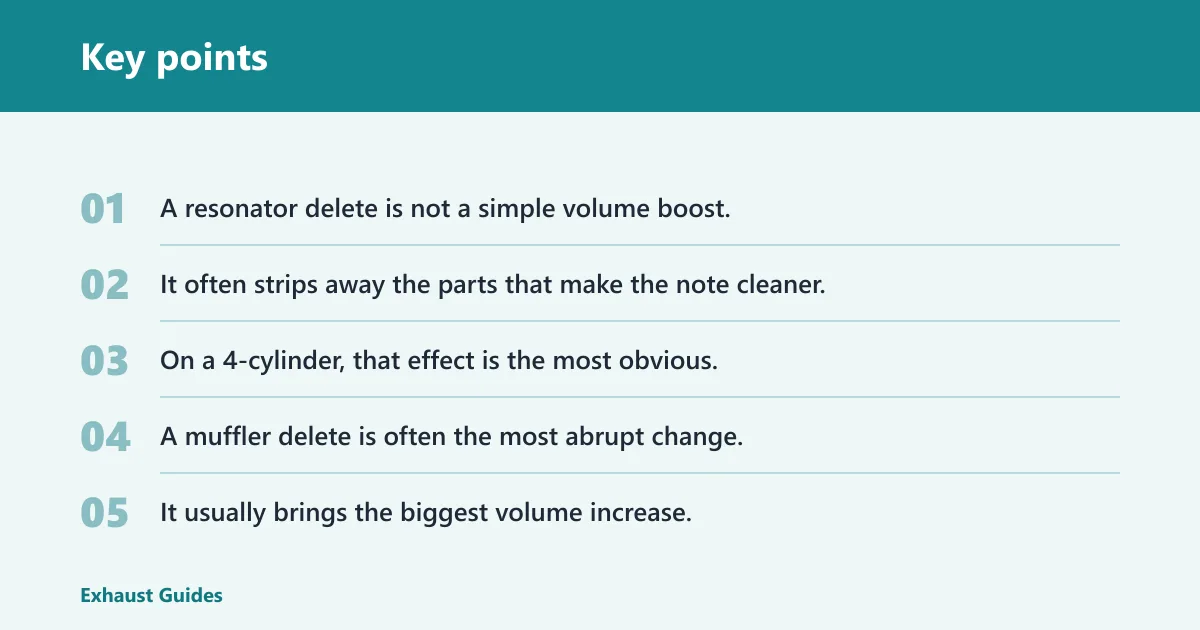
A resonator delete is not a simple volume boost. It often strips away the parts that make the note cleaner, which is why it can sound worse even when the car is not dramatically louder. On a 4-cylinder, that effect is the most obvious.
A muffler delete is often the most abrupt change. It usually brings the biggest volume increase, but it also raises the chance of drone and cabin fatigue. On a V8, that may be part of the goal; on a small-displacement four-cylinder, it often reads as harsh rather than aggressive.
Resonator install and muffler upgrade are the comfort moves. One targets unpleasant frequencies, and the other usually reduces the overall loudness and smooths the exit note. If you want less noise without turning the car into a whisper, that pair is the safer path.
Scenario notes by engine type
On a 4-cylinder, the exhaust often has more high-frequency edge. That means a resonator usually earns its keep by trimming buzz and rasp before the sound reaches the cabin. A muffler change still matters, but it is the more obvious loudness lever.
On a V6, the tradeoff gets more balanced. A resonator can clean up the note without flattening it, while a muffler change can decide whether the car sounds refined or too subdued. On a V8, both parts can matter, but a muffler delete usually changes the room-filling volume more than the note character alone.
How does a resonator change sound?
A resonator changes sound by targeting specific frequencies rather than lowering all exhaust noise. It is usually there to cancel certain tones before they reach the muffler, and Walker describes it as having less baffling than a muffler. That is why it often cuts harshness before it cuts loudness.
Frequency tuning and wave cancellation
Exhaust sound is made of different frequencies, including high-frequency rasp and low-frequency boom. A resonator is tuned to cancel selected sound waves through destructive interference, which means certain tones cancel each other out. The result is a cleaner note, not simply a quieter one.
Walker says resonators help quiet exhaust by canceling certain sound frequencies before they reach the muffler. Walker also says resonators don’t lower sound volume. Those two statements fit together: the part is more about filtering tone than muting the whole system.
Why rasp drops before volume does
Rasp sits in the sharp, high-frequency part of the exhaust note, so it is easier to target than overall loudness. A resonator is built for that job. If the complaint is that the car sounds tinny, buzzy, or metallic at certain rpm, the resonator is often the part doing the most useful work.
That is also why a resonator can make a car sound better while barely changing how far you hear it from outside. The note gets smoother first. The decibel-style loudness change may be modest.
When a resonator delete sounds worse
A resonator delete sounds worse when the system already has a lean, sharp character. That is common on smaller engines and on straight pipe designs with little baffling. In those cases, deleting the resonator can expose rasp and drone without giving the deeper tone people expected.
Say your 4-cylinder coupe already has a high-pitched buzz at 2,200 rpm on the freeway. Pulling the resonator may make the note louder, but it can also add a hollow, metallic edge that shows up every time you hold a steady speed.
How does a muffler change sound?
A muffler changes sound by reducing overall exhaust volume. The same source describes mufflers as using tubes, partitions, baffling, and fiberglass. That design lets the muffler absorb and redirect sound across a broader range, which is why it usually has a larger effect on loudness than a resonator.
Chambers, baffles, and packing
Mufflers rely on chambers, baffles, and packing material to interrupt sound waves and soften the exit note. The same source says mufflers lower the volume of engine sounds as they exit the exhaust system. They can also shape tone, but their main job is broader silencing.
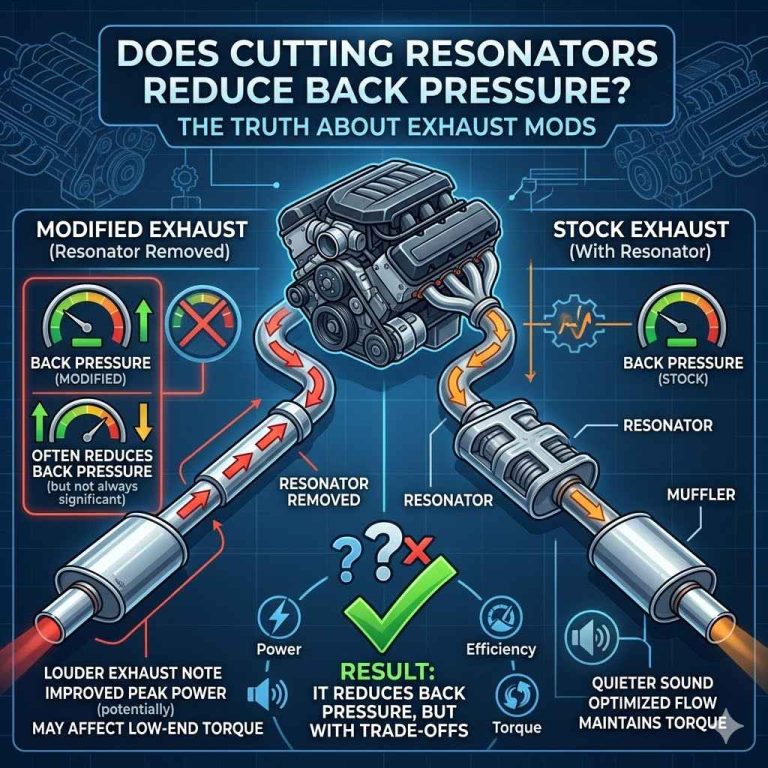
Because of that design, mufflers can create more backpressure than a resonator, depending on how restrictive the internal layout is. That is why muffler choice is often tied to both sound and flow. The sound result and the airflow result are not always identical.
How mufflers affect loudness and tone
A muffler can make the car deeper, softer, or simply quieter. It can also shift the exhaust note away from sharpness, but it usually does that while reducing total volume too. That is the key difference from a resonator, which usually changes the character first.
The same source says some vehicles have a muffler and no resonator, while some have both. That split tells you how central the muffler is in the system. In many setups, it is the last stop before the tailpipe.
Why muffler deletes often add the most volume
A muffler delete removes the main sound-reduction part from the rear of the system. The result is usually the biggest jump in loudness, especially at startup and under throttle. It can sound aggressive, but it can also turn boomy fast.
What happens next depends on the engine. A V8 may gain the kind of presence some drivers want. A 4-cylinder may gain more rasp and drone than useful tone.
What happens to sound if I delete the resonator?
Deleting the resonator usually makes the car a little louder, but the bigger change is tone. You can expect more rasp, more raw edge, and a higher chance of drone at steady speed. It is often the wrong move if the complaint is highway boom or a thin, metallic sound.
Cold start may sound sharper. Throttle tip-in can become louder and more abrupt. Cruise is where the difference often becomes annoying, because low-frequency cabin resonance shows up when the engine holds a steady rpm band.
What happens to sound if I delete the muffler?
Deleting the muffler often gives the largest jump in volume. It also raises the chance of a coarse, tiring note, especially if the car already has little sound control elsewhere. If you want a dramatic change, this is the louder move; if you want refinement, it is usually the riskier one.
On many cars, a muffler delete brings more cabin noise than a resonator delete. It can also make the exhaust sound less controlled on cold start and under light throttle. The result may feel exciting for a short drive and tiring over a long one.
Choose resonator if… / Choose muffler sound if…
Choose resonator if your main complaint is rasp, buzz, or drone and you want the note to sound cleaner without a major loudness jump. Choose muffler sound if you want a bigger volume change, a louder startup, or a more obvious shift in presence. For daily driving, the resonator usually wins on comfort; for a clearly louder exhaust, the muffler usually wins.
Choose resonator if…
- You like the current volume but hate the sharp edge in the note.
- The car drones at steady highway speed.
- You drive a 4-cylinder or a V6 that sounds thin under load.
- You want a cleaner tone with less cabin fatigue.
Choose muffler sound if…
- You want the biggest overall volume increase.
- You are unhappy with how quiet the car sounds from outside.
- You want a more obvious exhaust note on acceleration and startup.
- You accept the risk of more drone and a harsher cabin feel.
Suppose a V6 sedan sounds fine around town but booms at 75 mph in top gear. A resonator change is the smarter first step because it aims at the frequency that usually causes the complaint. A muffler delete would likely solve the wrong problem while making the car louder everywhere.

Frequently asked questions
Resonator vs muffler difference
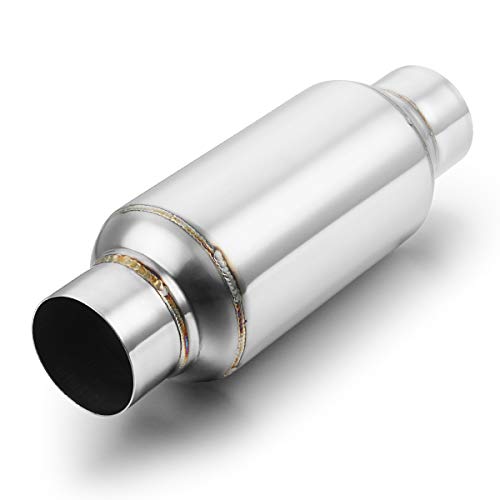
The resonator mainly targets certain exhaust frequencies, especially harsh or raspy tones. The muffler mainly reduces overall volume. In many systems, the resonator sits upstream of the muffler, and the muffler is the final sound-control part. That makes them different tools for different sound problems.
Resonator vs muffler
If you want less rasp and less drone, start with the resonator. If you want less loudness, start with the muffler. The resonator often changes tone more than volume, while the muffler usually changes volume more than tone. The better part depends on which trait bothers you most.
How does a resonator affect exhaust sound?
A resonator reduces harsh, raspy high-frequency tones by canceling certain sound waves before they reach the muffler. It usually has little effect on performance and less effect on volume than a muffler. The sound becomes cleaner, especially at cruise and in the midrange.
Resonator vs muffler delete sound
A resonator delete usually adds rasp and some drone, but the volume change may be modest. A muffler delete usually brings a much larger volume jump and often a bigger cabin-noise penalty. If you want aggressive sound, the muffler delete is the bigger step, but it is also the rougher one.
Will a resonator make my car quieter?
Not always in the way most drivers mean. A resonator often makes the car sound cleaner and less harsh, but Walker says resonators don’t lower sound volume. If the goal is lower overall loudness, a muffler is usually the part that does more of that work.
Does a muffler or resonator reduce drone more?
The resonator often reduces drone more, especially when the complaint is a specific low-frequency cabin resonance at highway speed. A muffler can also help, but it is usually better at lowering overall loudness. If the sound is booming rather than sharp, a muffler change may still be useful.
Can I run a muffler without a resonator?
Yes, many vehicles are built that way from the factory. The same source says some vehicles have a muffler and no resonator. The result depends on the engine and pipe layout, but it often means the muffler is carrying more of the sound-control burden by itself.