How to Tell If Your Catalytic Converter Is Failing
A failing catalytic converter may show a P0420 code, a rotten-egg smell, power loss above about 2,500 rpm, or a glowing converter; confirm by checking for exhaust restriction and upstream engine faults before replacing it. Ignore those clues, and you can spend hundreds on the wrong part while the real fault stays. This guide gives you a symptom-by-symptom path for the converter, oxygen sensors, and other engine or exhaust problems.
What a failing catalytic converter looks like
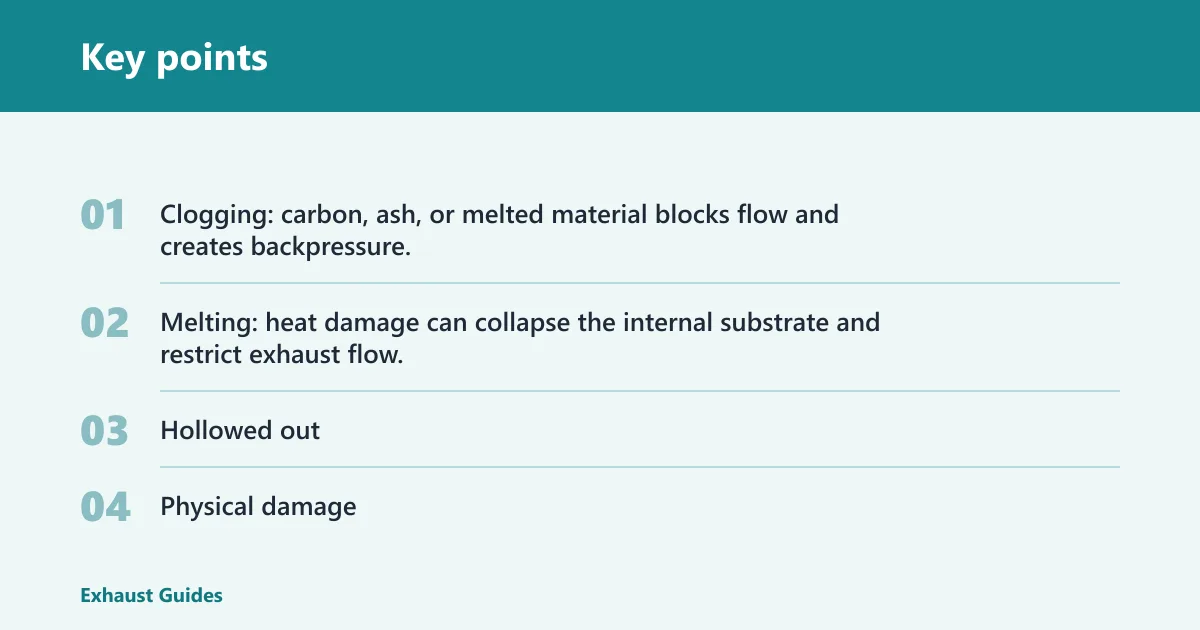


The catalytic converter is part of the exhaust system. It cuts harmful pollutants and toxic gases by using platinum, palladium, and rhodium to treat hot exhaust. When it works, the converter stays in the background. When it fails, it can clog, melt, hollow out, or suffer physical damage.
A missing converter usually causes a very loud exhaust noise. A restricted or damaged one can also reduce power and trigger a check engine light. That warning light is common, but it is not proof of converter failure on its own.
Common failure modes
- Clogging: carbon, ash, or melted material blocks flow and creates backpressure.
- Melting: heat damage can collapse the internal substrate and restrict exhaust flow.
- Hollowed out: the substrate may be removed or broken apart, which can leave the shell intact but the converter ineffective.
- Physical damage: dents, cracks, impact damage, or a loose internal brick can all change how the converter works.
Misfires can damage converters by sending unburned fuel into the exhaust. Oil or antifreeze contamination can coat the substrate and reduce function. Faulty oxygen sensors can also send wrong signals and hurt converter performance, while exhaust leaks can change gas flow and temperature enough to create false clues.
Catalytic converter diagnosis matrix
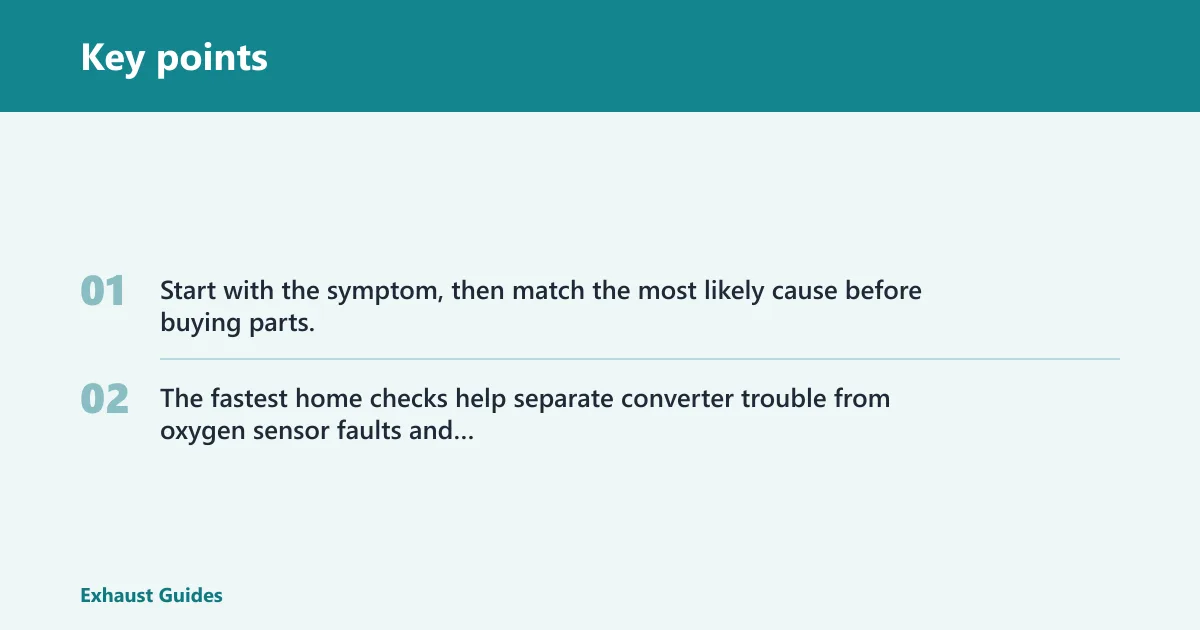
Use this table as a triage tool. Start with the symptom, then match the most likely cause before buying parts. The fastest home checks help separate converter trouble from oxygen sensor faults and broader engine problems.
| Symptom | Likely cause | Quick at-home check | When to stop DIY and inspect professionally |
|---|---|---|---|
| Check engine light | Emissions-system fault, often P0420 or P0430, but not proof of converter failure | Read OBD-II codes first; note any misfire, fuel trim, or O2 sensor codes alongside it | Stop if multiple codes point to misfires, fuel delivery, or exhaust leaks |
| P0420 or P0430 code | Catalyst-efficiency problem, failed O2 sensor, or exhaust leak | Compare upstream and downstream O2 sensor behavior and check for leaks | Stop if sensor data is erratic or the exhaust has obvious leaks |
| Rotten egg smell | Converter running too hot, contaminated substrate, or rich engine running condition | Check for recent misfires, fuel odor, or signs of oil burning | Stop if the smell appears with smoke, overheating, or a flashing check engine light |
| Loss of power | Clogged converter, exhaust restriction, or engine problem upstream | Notice whether power drops more above 2,500 rpm | Stop if the engine also misfires, stalls, or runs rough under load |
| Rough idle | Misfire, vacuum leak, fuel issue, or converter contamination from engine faults | Look for other symptoms first; a converter alone rarely causes rough idle by itself | Stop if idle quality changes with fuel trims, misfire codes, or intake leaks |
| Rattling under the car | Loose or broken substrate, or missing heat shield or anti-theft hardware | Tap the shell gently when cool; listen for loose internal pieces | Stop if the rattle comes with a loud exhaust leak or visible damage |
| Temperature difference | Normal functioning converter usually has a hotter outlet than inlet; no change can mean inefficiency or restriction | Use an infrared thermometer on the inlet and outlet after a steady drive | Stop if temperature readings are inconsistent, or the exhaust is leaking |
| Failed emissions test | Converter inefficiency, sensor fault, or engine running problem | Check readiness monitors and stored codes before retesting | Stop if the vehicle fails both OBD-II and tailpipe checks |
Look at how the symptom behaves. A clogged converter usually shows up as poor acceleration, especially as engine speed rises. A hollowed-out or physically damaged converter more often brings a rattling sound, a loud exhaust, or emissions failure. A check engine light on its own does not separate those cases.
Use this decision path
- Read the OBD-II codes.
- Check whether the engine has misfire, fuel trim, or O2 sensor codes too.
- Look for an exhaust leak, damaged piping, or missing converter hardware.
- Test converter temperature if the basic checks do not explain the fault.
- Use a backpressure test or vacuum gauge if restriction still looks likely.
If the symptom points to a non-exhaust problem, stop and inspect that first. A converter can be damaged by the engine, but it is rarely the first thing to blame.
How to tell if it is bad or the O2 sensor
The upstream and downstream oxygen sensors watch exhaust conditions before and after the converter. Modern cars use oxygen sensors before and after the converter to measure efficiency. That means a bad sensor can mimic converter failure, and a converter problem can look like a sensor problem.
The upstream sensor should respond quickly to mixture changes. The downstream sensor should show a steadier pattern if the converter is storing and cleaning exhaust gases properly. If both sensor signals behave oddly, the issue may be sensor wiring, an exhaust leak, or an engine fault rather than the converter itself.
A common mistake is blaming the catalytic converter when a loose gas cap or a small exhaust leak is actually triggering the check-engine light. Suppose a 4-cylinder sedan has a check engine light, rough idle, and two misfire codes. The engine problem comes first. Fixing the converter before the misfire would likely waste money and leave the real fault untouched.
Clues that point away from the converter
- Multiple misfire codes appear with the catalyst code.
- The exhaust leaks before the converter.
- The upstream O2 sensor switches erratically or has wiring damage.
- The engine burns oil or coolant.
- The fault returns immediately after clearing codes, with no change in exhaust behavior.
If you can remove an O2 sensor as a diagnostic check for a clogged cat, that points toward restriction. But use that only as part of a broader diagnosis, because sensor removal alone does not prove converter failure.
How do you check a catalytic converter at home?
Start with a scan tool, then inspect what you can see and hear. Home checks can separate obvious damage from likely restriction, but they cannot replace a full exhaust and engine diagnosis when the clues are mixed.
Check the basics first
- Read the OBD-II codes and freeze-frame data.
- Look under the car for dents, missing heat shields, fresh impact marks, or broken hangers.
- Inspect for exhaust leaks around the manifold, flex pipe, flanges, and welds.
- Check whether the converter shell is discolored or glowing after a drive.
- Listen for loose internal material when the exhaust is cool.
How to tell if a catalytic converter is bad by looking at it comes down to obvious damage, not shine or dirt. A dented shell, missing sections, melted pipe, or visible tampering matters. An intact outer case does not guarantee the substrate inside is still doing its job.
How to tell if your catalytic converter is bad at home often starts with smell, sound, and scan data. A rotten egg odor, a rattle from below, and a P0420 or P0430 code together are stronger clues than any one item by itself.
Temperature, backpressure, and vacuum tests
How to tell if a catalytic converter is bad by temperature is one of the most useful home checks. Use an infrared thermometer on the inlet and outlet of the converter after a steady drive. On a functioning converter, the outlet is usually hotter than the inlet after a steady drive.
If the inlet is hotter than the outlet, or the temperatures are nearly the same, the converter may be inefficient or restricted. A very large temperature split can also happen when the converter is overheating from a rich condition or misfire, so pair this test with code data and engine checks.
Infrared thermometer check
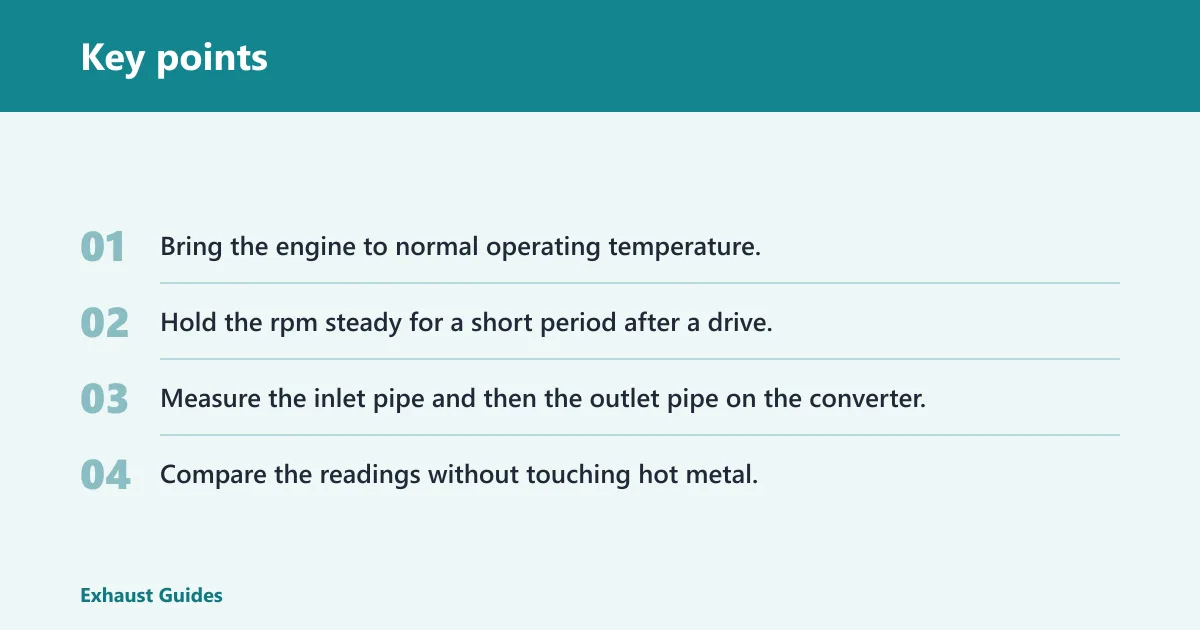
- Bring the engine to normal operating temperature.
- Hold the rpm steady for a short period after a drive.
- Measure the inlet pipe and then the outlet pipe on the converter.
- Compare the readings without touching hot metal.
Say your SUV has a P0420 code and poor acceleration above highway speed. If the inlet reads 280°F and the outlet reads 310°F after a steady run, that pattern supports normal converter activity more than a hard restriction. If the outlet is cooler than the inlet, look closer at the converter, the sensors, and any exhaust leak.
Backpressure test
A backpressure test uses a pressure gauge and helps diagnose restriction. You remove or tap into the exhaust ahead of the converter, then read pressure at idle and under load. High pressure suggests a blocked or melted converter, but only after you rule out major exhaust leaks and engine misfire.
Backpressure rises when exhaust gas cannot pass through the converter easily. That can reduce power and response and can stall the car at idle in severe cases.
Vacuum gauge test
A vacuum gauge can also hint at restriction. At idle, vacuum should be stable. During an RPM sweep, a restricted exhaust often shows vacuum dropping and failing to recover normally as engine speed rises. That pattern supports an exhaust blockage more than an O2 sensor fault.
If the vacuum drop comes with rough idle, misfires, or fuel trim problems, the engine likely needs attention before the converter does. Exhaust restriction is only one possible cause of that reading.
What happens when a catalytic converter fails?
When a catalytic converter fails, the engine can lose power, the exhaust can smell like sulfur, and emissions can rise. The converter may clog and create backpressure, or it may break apart and rattle. A missing converter usually produces a much louder exhaust note and can also trigger a check engine light.
The bigger risk is continuing to drive while the engine is still running rich, misfiring, or leaking oil or coolant into the exhaust. Those conditions can damage a new converter too. If the fault is upstream, replacing the converter without fixing the cause is only a short-term repair.
Picture a compact car that fails an emissions inspection and also shows a P0430 code. If the downstream O2 sensor is working and the exhaust has no leaks, the converter is a stronger suspect. If the car also has misfire data and a fuel smell from the tailpipe, the engine problem may be the part that needs first attention.
A bad converter can cause failed emissions tests on either OBD-II or tailpipe-based inspections. If the readiness monitors are incomplete or the catalyst monitor will not set, the car may fail even before the tailpipe reading is taken.
Frequently asked questions
How to tell if your catalytic converter is bad at home
At home, start with the codes, then check for dents, leaks, heat damage, and a rattling substrate. Use an infrared thermometer if you can, since the outlet should usually be hotter than the inlet when the converter is working normally.
How to tell if a catalytic converter is bad by temperature
Use an infrared thermometer on the inlet and outlet after the engine is warm. A functioning converter usually has a hotter outlet than inlet. If the readings are reversed or nearly equal, look for restriction, poor catalyst efficiency, or an exhaust leak before replacing parts.
How to tell if catalytic converter is bad or o2 sensor
If the upstream and downstream O2 sensor signals are suspicious, the sensor may be the real issue. A converter fault often appears as a steady efficiency code, while an O2 sensor fault may come with erratic readings, wiring damage, or codes that involve the sensor circuit itself.
How do you know if your catalytic converter is failing?
You know it is failing when the symptoms line up: a catalyst-efficiency code, power loss, smell, or a temperature pattern that does not fit a healthy converter. If the rest of the exhaust and engine checks do not support that pattern, the converter is only a suspect, not a verdict.