
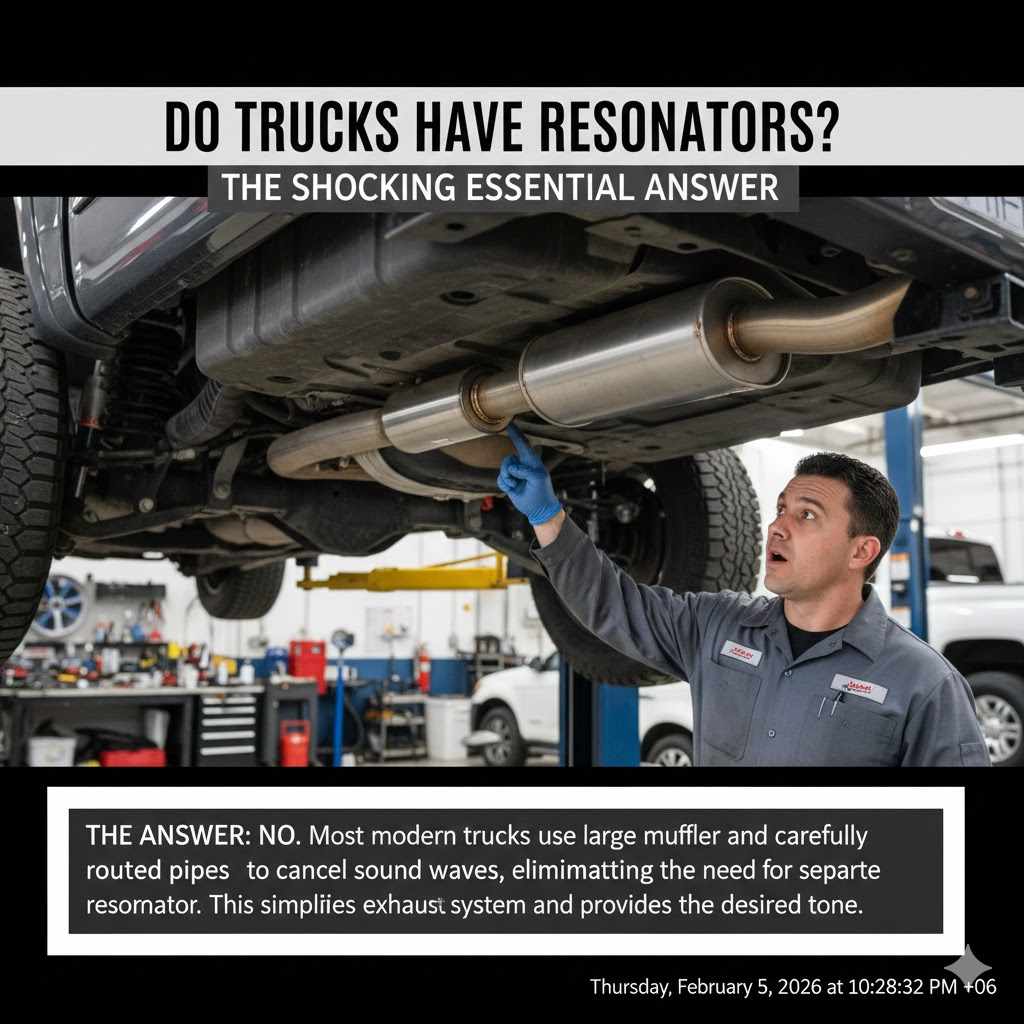
Do Trucks Have Resonators? The Shocking Essential Answer
Yes, many modern trucks have resonators straight from the factory. They are not designed to quiet the truck like a muffler, but to cancel out specific, annoying sound frequencies—often called “drone”—that occur at cruising speeds. This makes the ride quieter and more comfortable inside the cabin.
Have you ever been driving your truck down the highway and heard a constant, annoying hum? That low-pitched buzzing sound that seems to vibrate through the whole cabin can be frustrating. Many people think this is just “truck noise,” but it’s often something an exhaust part is designed to fix. This is where the resonator comes in.
You might have heard about resonators, or maybe you’ve seen them mentioned in online forums. It can be confusing. Is it a muffler? Does it make your truck louder or quieter? In this guide, I’ll walk you through everything you need to know. We’ll clear up the confusion and show you exactly what a resonator does for your truck.
First, What Exactly Is a Resonator?
Think of a resonator as a sound-tuning tool for your truck’s exhaust. Its main job isn’t to make your truck quiet—that’s the muffler’s role. Instead, a resonator targets and cancels out very specific, unpleasant sound waves. It’s an echo chamber designed to eliminate exhaust drone.
Here’s a simple way to picture it:
Imagine you’re in a big, empty room and you shout. You hear an echo. A resonator works a bit like that, but in reverse. It captures the annoying sound waves from your engine and bounces them around inside its chamber. These sound waves crash into each other and cancel themselves out before they can exit the tailpipe and reach your ears.
So, while a muffler reduces the overall volume of your exhaust, a resonator refines the tone. It gets rid of the irritating hum, leaving you with a cleaner, smoother exhaust note.

Resonator vs. Muffler: Clearing Up the Confusion
This is one of the most common points of confusion for truck owners. Many people use the terms “resonator” and “muffler” interchangeably, but they do very different jobs. Understanding the difference is key to understanding your exhaust system.
Let’s break it down in a simple table:
| Feature | Resonator | Muffler |
|---|---|---|
| Primary Job | Tunes the exhaust tone. Cancels specific frequencies (drone). | Reduces the overall exhaust volume. Makes the engine quieter. |
| How It Works | Acts as an echo chamber to cancel out sound waves. | Uses baffles, chambers, and sound-absorbing material to silence noise. |
| Typical Shape | Usually a simple, straight, round, or oval-shaped can. | Often a larger, more complex box or oval shape. |
| Location | Typically located in the middle of the exhaust system, before the muffler. | Usually located toward the rear of the vehicle, before the tailpipe. |
Think of it like a sound system. The muffler is the volume knob—it turns the sound down. The resonator is the equalizer—it adjusts the bass and treble to get rid of static and distortion, making the music sound better. Both are important for achieving a pleasant sound, and they work together as a team in your truck’s exhaust system.
So, Do Most Trucks Come with Resonators from the Factory?
Yes, a growing number of modern trucks come equipped with resonators right from the manufacturer. You might be surprised to learn that your truck probably already has one, especially if it was built in the last 10-15 years.
Why do manufacturers install them?
It all comes down to driver comfort. Truck buyers today expect a powerful vehicle that is also comfortable and quiet for daily driving and long road trips. The V6 and V8 engines popular in trucks are powerful, but they naturally produce a low-frequency drone at cruising speeds (typically between 1,500 and 2,500 RPM).
This drone can cause headaches and fatigue on long drives. To solve this, automakers install resonators specifically tuned to cancel out the problem frequencies of that particular engine. It’s a simple, effective way to make the cabin a much more pleasant place to be.
However, not every truck will have one. Here’s a general guide:
- Luxury & High-Trim Trucks: Almost always have resonators. Models like the Ford F-150 Platinum, Ram 1500 Limited, or GMC Sierra Denali prioritize a quiet, luxurious ride.
- Standard & Mid-Trim Trucks: Very likely to have them. Manufacturers know that most people use their trucks as daily drivers.
- Base Model & Work Trucks: It’s a mixed bag. Some may have them, while others designed for pure utility might skip them to save on costs.
- Older Trucks: Trucks from the early 2000s or older are less likely to have factory-installed resonators, as cabin comfort wasn’t as high a priority then.
Why Would You Remove a Resonator? (The “Resonator Delete”)
A “resonator delete” is a popular and relatively cheap modification among truck enthusiasts. It involves cutting the resonator out of the exhaust system and welding a straight pipe in its place. People do this for one main reason: sound.
Pros of Removing a Resonator:
- A Louder, More Aggressive Sound: Removing the resonator unleashes more of the raw engine sound. It will make your exhaust louder and can give it a more aggressive, throaty tone, especially during acceleration.
- Inexpensive Modification: Compared to a full cat-back exhaust system, a resonator delete is very affordable. An exhaust shop can typically do the job for a reasonable price.
- Simple and Reversible: It’s a straightforward job for any muffler shop, and if you don’t like the sound, you can always have the resonator (or an aftermarket one) welded back in.
Cons of Removing a Resonator:
- The Return of the Drone: This is the biggest drawback. That annoying highway drone the factory worked so hard to eliminate will likely come back, and it might be even worse with an aftermarket muffler.
- It Can Sound Raspy: Sometimes, removing the resonator doesn’t result in a deep, clean rumble. Instead, you might get a raspy or tinny sound that many people find unpleasant.
- May Not Be the Sound You Want: A resonator delete makes things louder, but not always better. If you’re looking for a specific high-quality tone, simply removing a part might not get you there.
Why Would You Add an Aftermarket Resonator?
While some people remove resonators, others add them. This is especially common after installing an aftermarket exhaust system. You might spend a lot of money on a new performance muffler hoping for a great sound, only to be disappointed by an overwhelming drone on the highway.
This is the perfect scenario to add a resonator. An aftermarket resonator can be installed into your existing exhaust system to “clean up” the sound.
Benefits of Adding a Resonator:
- Eliminate Exhaust Drone: This is the number one reason. If your loud new exhaust is giving you a headache on long trips, a well-chosen resonator can eliminate that drone entirely.
- Refine Your Exhaust Tone: It can smooth out raspiness and create a deeper, cleaner, and more refined sound without sacrificing much volume.
- The Best of Both Worlds: You get the loud, aggressive sound you want when you step on the gas, but a comfortable, drone-free ride when you’re cruising.
Companies like MagnaFlow, Flowmaster, and Vibrant Performance make high-quality universal resonators that an exhaust shop can easily weld into your system to perfect the sound.
How to Check if Your Truck Has a Resonator: A Simple 3-Step Guide
Curious if your truck has a resonator? You don’t need to be a mechanic to find out. With a little bit of caution, you can easily check for yourself. Just follow these simple steps.
- Safety First!
Park your truck on a flat, level surface and engage the parking brake. Make sure the engine has been off for at least an hour—exhaust components get extremely hot and can cause severe burns. It’s always a good idea to wear gloves and safety glasses. - Get Under Your Truck and Locate the Exhaust Pipe
Carefully look underneath your truck. You’ll see a long metal pipe running from the engine area all the way to the back bumper. This is your exhaust system. You’ll be looking for three main components along this pipe. - Identify the Parts
Start from the front of the truck (near the engine) and work your way back. Here’s what to look for:- Catalytic Converter(s): These are usually located closest to the engine. They often look like wide, slightly flattened ovals and may have metal heat shields around them. Their job is to clean the exhaust gases, a crucial part of your vehicle’s emissions system. According to the Environmental Protection Agency (EPA), controlling these emissions is vital for public health.
- The Resonator: If your truck has one, it will typically be the next component in line after the catalytic converter. Look for a small, simple-looking cylinder or oval. It will look like a miniature muffler—just a straight can that the pipe runs through.
- The Muffler: This is almost always the largest “box” in the system, located toward the rear of the truck, usually just before the rear axle. It will be noticeably bigger and bulkier than the resonator.
If you see a small, can-shaped part between your catalytic converter and your large muffler, you’ve found your resonator! If the pipe runs straight from the catalytic converter to the muffler with nothing in between, then your truck doesn’t have one.
Does a Resonator Affect Performance or Fuel Economy?
This is a common question, and the answer is simple: for most drivers, a resonator has virtually no noticeable effect on performance or fuel economy.
Here’s why:
Impact on Performance
Factory resonators are designed to be as free-flowing as possible. They are essentially a straight pipe housed inside a chamber designed to cancel sound waves. They create very little backpressure, which is the force that can restrict an engine’s ability to “exhale” exhaust gases.
Removing a resonator might technically reduce backpressure by a tiny, almost immeasurable amount. You might see a gain of 1-2 horsepower on a dynamometer, but you will never feel that difference in real-world driving. A resonator delete is a sound modification, not a performance one.
Impact on Fuel Economy
Similarly, a resonator has no meaningful impact on your truck’s miles per gallon (MPG). The exhaust system is not a primary factor in fuel efficiency. Your driving habits, tire pressure, and vehicle maintenance have a much greater effect on how much fuel you use.
In fact, some people report slightly worse fuel economy after a resonator delete, but it’s not because of the part itself. It’s because the new, louder sound encourages them to accelerate more aggressively to hear the engine roar! For tips on maximizing your mileage, resources like FuelEconomy.gov offer great advice on efficient driving habits.

Frequently Asked Questions (FAQ)
1. Is it legal to remove a truck’s resonator?
In most places, yes. The resonator is not an emissions control device like the catalytic converter. It is a sound-tuning device. As long as your vehicle still meets local noise ordinances after the removal, you should be fine. However, it’s always a good idea to check your specific state and local regulations on vehicle noise.
2. Will a resonator delete void my truck’s warranty?
It can potentially void the warranty on your exhaust system. Under the Magnuson-Moss Warranty Act, a dealer cannot void your entire vehicle warranty for an aftermarket modification unless they can prove that the modification caused the failure of another part. So, if your engine or transmission fails, they can’t blame it on the resonator delete. But if you have an issue with your muffler or tailpipe, they could deny the claim.
3. How much does a resonator delete cost?
A resonator delete is one of the more affordable exhaust modifications. Typically, a muffler shop will charge between $50 and $150 for the job. The cost depends on the labor rates in your area and the type of pipe they use to replace the resonator.
4. Can I add a resonator to any exhaust system?
Absolutely. A good exhaust shop can weld an aftermarket resonator into almost any stock or aftermarket exhaust system. This is a very common solution for people who love the volume of their new exhaust but hate the drone it created.
5. What’s the difference between exhaust “drone” and a good exhaust sound?
This is a great question! A good exhaust sound is typically what you hear when you are accelerating—a deep, pleasing rumble or roar. Exhaust drone is different. It’s a low-frequency, monotonous hum that happens at a constant cruising speed, like when you’re driving on the highway. It’s the sound that vibrates through the cabin and becomes tiring over time.
6. Should I remove my resonator or my muffler to make my truck louder?
If you want a significant increase in volume, removing the muffler (a “muffler delete”) will make your truck much louder than a resonator delete. However, a muffler delete can be extremely loud, often unpleasantly so, and may attract unwanted attention. A resonator delete offers a more modest increase in volume and aggression while keeping the muffler to control the overall sound level.
7. Will my truck pass inspection without a resonator?
In most states, yes. Vehicle inspections typically focus on safety and emissions. Since the resonator is neither, its absence usually won’t cause you to fail an inspection. The one exception would be if your state has a specific noise level test, and the resonator delete pushes your truck over the legal decibel limit.
Conclusion: The Final Word on Truck Resonators
So, do trucks have resonators? The answer is a clear yes for many modern pickups. They are the unsung heroes of your exhaust system, working silently to give you a more pleasant and comfortable ride by eliminating that annoying highway drone.
Understanding what a resonator does is the first step toward making smart decisions about your truck’s sound. It’s not a muffler, and it has a very specific job: to tune the tone of your exhaust, not just turn down the volume. Whether you’re thinking about removing one for a more aggressive sound or adding one to tame a droney aftermarket system, you now have the knowledge to choose what’s right for you.
Your truck’s exhaust is more than just a pipe—it’s a system that can be tuned to perfectly match your preferences. Now you’re equipped to get the exact sound you’re looking for, combining power with comfort for the perfect driving experience.


