Do 2 Stroke Have Exhaust and Intake Valves? A Genius Answer
No, most 2-stroke engines do not have traditional intake and exhaust valves like those found in 4-stroke engines. Instead of complex, mechanically-driven poppet valves, they use simple openings called ‘ports’ in the cylinder wall. The piston itself acts as a sliding valve, covering and uncovering these ports to control the flow of fuel, air, and exhaust.
If you’ve ever found yourself scratching your head, wondering about the inner workings of a 2-stroke engine, you’re not alone. The question of valves is one of the most common points of confusion for new enthusiasts. It seems like every engine should have them, right? They let the good stuff in and the bad stuff out. But the 2-stroke engine plays by a different, beautifully simple set of rules.
Don’t worry, this isn’t some complex engineering lecture. I’m here to break it down in a way that anyone can understand. We’ll look at why 2-strokes are different, how their clever design works without traditional valves, and what that means for performance and maintenance. By the end of this guide, you’ll see the genius behind the 2-stroke’s simplicity.
The Fundamental Difference: 2-Stroke vs. 4-Stroke Engines
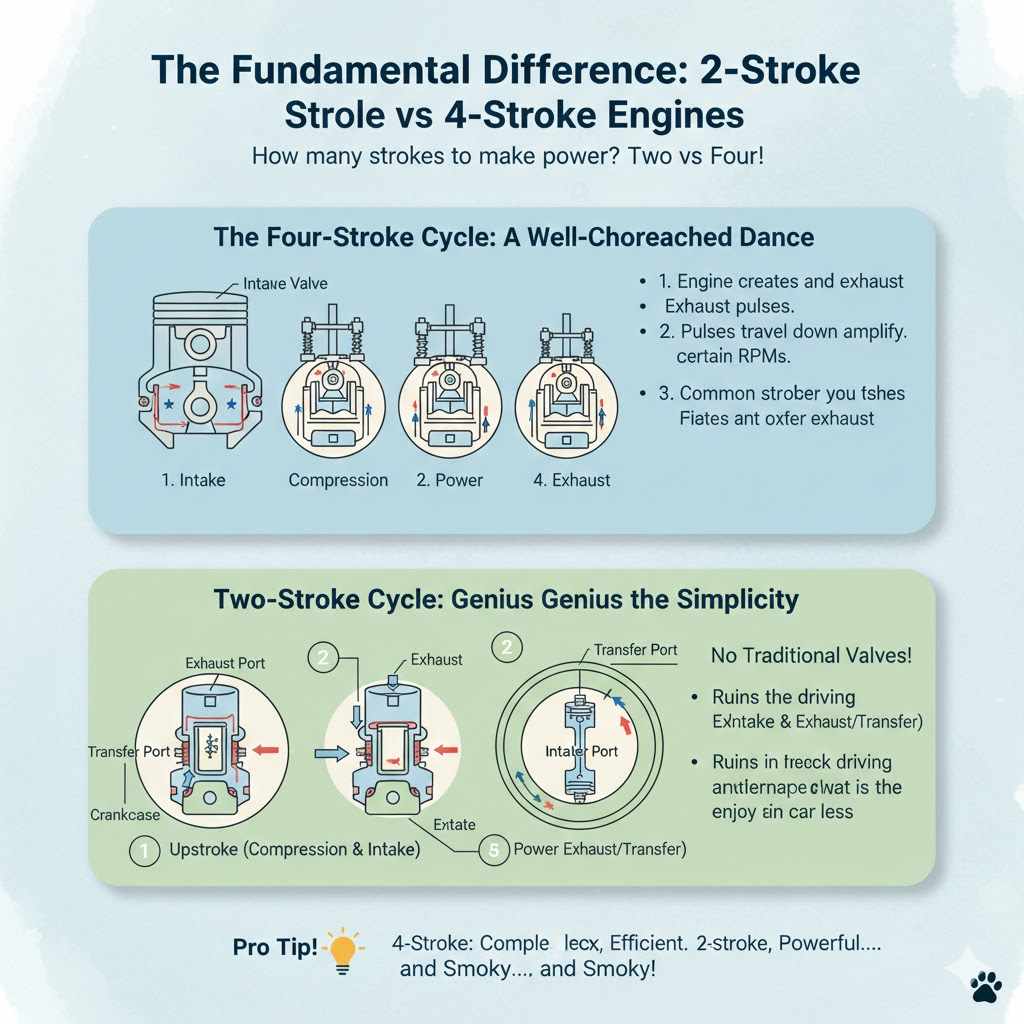
Before we can understand why 2-stroke engines don’t need valves, we need a quick refresher on how they differ from their 4-stroke cousins, which are found in most modern cars. It all comes down to how many piston movements (strokes) it takes to complete one power cycle.
The Four-Stroke Cycle: A Well-Choreographed Dance
A 4-stroke engine, like the one in your car, is a busy place. It takes four strokes of the piston to create power:
- Intake Stroke: The piston moves down, and the intake valve opens to suck in a mixture of air and fuel.
- Compression Stroke: The intake valve closes, and the piston moves up, squeezing the air-fuel mixture.
- Power (or Combustion) Stroke: A spark plug ignites the mixture, pushing the piston down with great force. This is what creates power!
- Exhaust Stroke: The piston moves back up, and the exhaust valve opens to push the burnt gases out.
Notice the key players here: the intake and exhaust valves. They are opened and closed by a complex system of cams, lifters, and springs, all timed perfectly. It’s effective but involves many moving parts.
The Two-Stroke Cycle: Genius in Simplicity
A 2-stroke engine accomplishes the same goal in just two strokes. It combines steps to get the job done faster and with fewer parts.
- Upstroke (Compression & Intake): As the piston moves up, it compresses the air-fuel mixture in the combustion chamber. At the same time, its upward movement creates a vacuum in the crankcase below, which pulls a fresh air-fuel charge into the crankcase.
- Downstroke (Power & Exhaust/Transfer): The spark plug ignites the mixture, pushing the piston down. As the piston travels downward, it first uncovers the exhaust port, letting burnt gases escape. A split second later, it uncovers the transfer ports, allowing the fresh charge from the crankcase to rush into the cylinder, pushing out the remaining exhaust.
The magic is that there are no traditional valves. The engine doesn’t need them! The job of controlling the flow of gases is handled entirely by the piston’s position as it moves past openings in the cylinder wall.
The Real MVP: The Piston as a Sliding Valve
So, if there are no valves, how does anything get in or out? The genius of the 2-stroke design is that the piston itself performs the duties of the valves. Think of the piston not just as a plunger that gets pushed by explosions, but as a master gatekeeper.
As the piston slides up and down inside the cylinder, the edges of its skirt (the side wall of the piston) systematically cover and uncover the ports. It’s a simple, elegant solution that eliminates the need for a camshaft, lifters, pushrods, rockers, and poppet valves. This is the main reason 2-stroke engines are so lightweight and can produce so much power for their size.
Meet the Ports: The Unsung Heroes of the 2-Stroke
Instead of valves, a 2-stroke engine has three main types of openings, or “ports,” cut directly into the cylinder wall. Their size, shape, and position are critical to the engine’s performance.
- Exhaust Port: This is the first port the piston uncovers on its way down. It’s the exit door for hot, burnt exhaust gases. The moment it opens, the high-pressure gases from combustion begin to rush out.
- Intake Port: This port connects the carburetor to the engine’s crankcase (the area below the piston). When the piston moves up, it creates a vacuum that pulls the air-fuel mixture through the intake port into the crankcase.
- Transfer Port(s): These are the secret passages. They connect the crankcase to the combustion chamber. After the exhaust port opens, the piston continues down and uncovers these ports. The pressurized air-fuel mixture that was waiting in the crankcase then “transfers” up into the cylinder, pushing out the last of the old exhaust and refilling the chamber for the next power stroke.
This entire process, known as loop scavenging, is a beautifully timed sequence of events that happens thousands of times per minute, all without a single traditional valve.
2-Stroke Ports vs. 4-Stroke Valves: A Head-to-Head Comparison
To really see the difference, let’s compare the two systems side-by-side. This will help you understand the trade-offs that come with the 2-stroke’s simple design.
| Feature | 2-Stroke Port System | 4-Stroke Valve System |
|---|---|---|
| Complexity | Extremely simple. No moving parts other than the piston. | Very complex. Involves camshaft, lifters, pushrods, rocker arms, valves, and springs. |
| Moving Parts | Minimal (piston, connecting rod, crankshaft). | Many (all of the above, plus the entire valvetrain). |
| Maintenance | Simpler. No valve adjustments or timing belt/chain changes. | More complex. Requires periodic valve adjustments and timing belt/chain replacement. |
| Power Delivery | Power stroke on every revolution, leading to high power-to-weight ratio. Can feel “peaky.” | Power stroke every two revolutions. Smoother, more linear power delivery. |
| Efficiency | Less efficient. Some unburnt fuel can escape through the exhaust port during scavenging. | More efficient. The dedicated intake and exhaust strokes provide better control over fuel. |
| Emissions | Higher emissions due to unburnt fuel and burning lubrication oil. | Lower emissions, as controlled by precise valve timing and a separate lubrication system. |
What About Exceptions? Reed Valves and Power Valves
Now, while it’s true that most 2-strokes don’t have poppet valves, some use clever additions to improve performance. It’s important to know these are not the same as the valves in your car’s engine.
Reed Valves: The Simple One-Way Door
Many 2-stroke engines have a “reed valve” on the intake port. This isn’t a mechanical valve driven by a camshaft. Instead, it’s a very simple one-way flap made of thin metal or carbon fiber.
- How it works: When the piston moves up, the vacuum in the crankcase sucks the reed valve open, letting the air-fuel mix in. When the piston moves down and starts to pressurize the crankcase, the pressure pushes the reed valve shut.
- The benefit: It prevents the air-fuel mixture from being pushed back out the carburetor. This “automatic” valve action helps the engine run more efficiently and produce better power, especially at lower RPMs.
Power Valves: The Performance Tuner
You might hear about “power valves” on high-performance 2-stroke engines, especially on dirt bikes. Again, these are not intake or exhaust valves. A power valve is a movable device located inside the exhaust port.
- How it works: At low RPMs, the power valve partially closes or lowers the top of the exhaust port. This helps the engine produce more torque. As the engine revs higher, the valve opens up, effectively raising the port height. This allows the engine to breathe better and produce more horsepower at high RPMs.
- The benefit: It gives the engine a much broader, more usable powerband. It’s like having two different engine tunes in one, optimized for both low-end grunt and top-end speed. To dive deeper into the physics, educational resources like HowStuffWorks offer fantastic animated explanations of these engine cycles.
Pros and Cons of the 2-Stroke’s Valveless Design
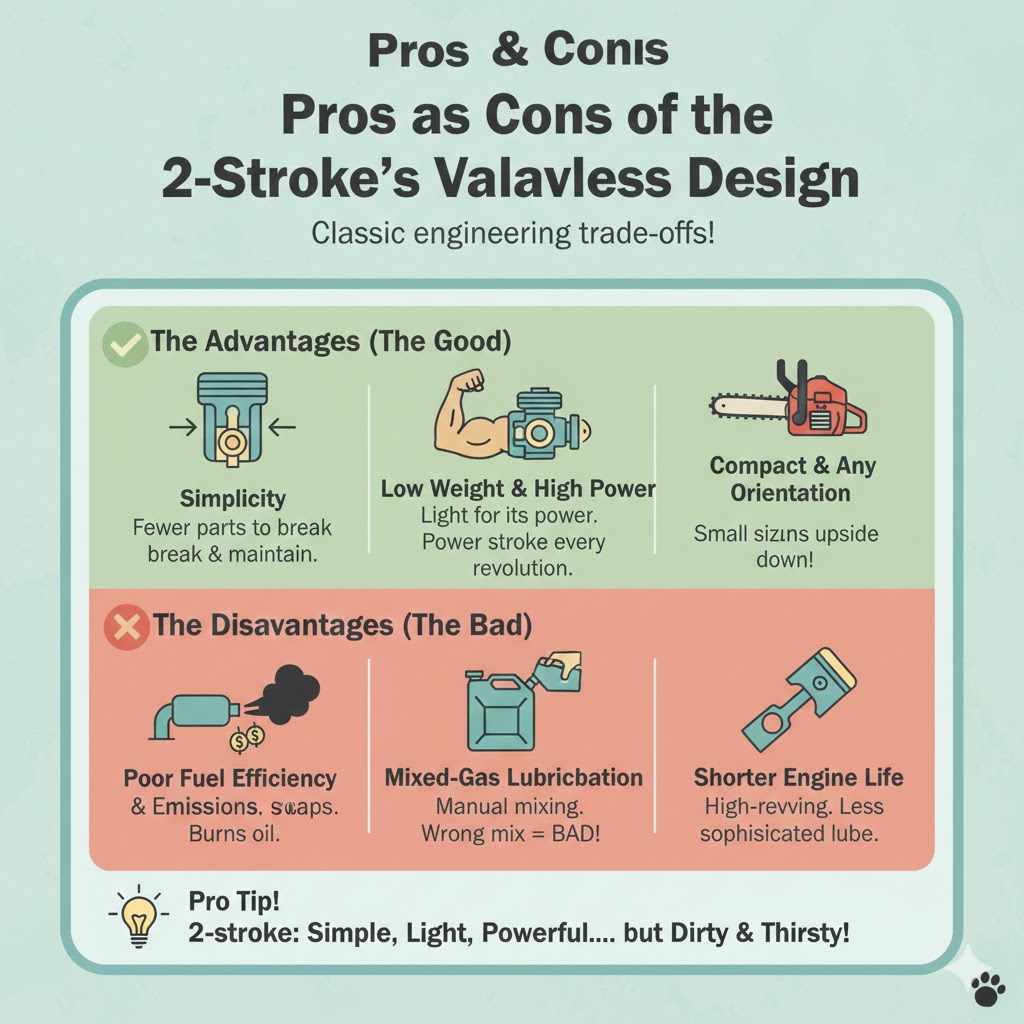
The decision to use ports instead of valves is a classic engineering trade-off. It brings some amazing advantages but also some notable disadvantages.
The Advantages (The Good)
- Simplicity: With far fewer moving parts, there is less to break, manufacture, and maintain.
- Low Weight: The absence of a valvetrain makes 2-stroke engines incredibly light for the power they produce.
- High Power-to-Weight Ratio: A power stroke on every crankshaft revolution means a 2-stroke engine can, in theory, produce twice the power of a 4-stroke of the same size.
- Compact Size: Fewer parts mean a smaller overall package.
- Can Operate in Any Orientation: Since the crankcase lubrication is mixed with the fuel, you can turn a 2-stroke engine upside down and it will keep running (which is why they are perfect for things like chainsaws).
The Disadvantages (The Bad)
- Poor Fuel Efficiency: During the scavenging process where fresh mix pushes out exhaust, some unburnt fuel inevitably escapes out the exhaust port.
- Higher Emissions: This lost fuel, combined with the fact that lubrication oil is burnt along with the gas, leads to significantly higher hydrocarbon emissions.
- Mixed-Gas Lubrication: You have to mix special oil with the gasoline. This can be inconvenient, and incorrect mixing can quickly destroy the engine.
- Shorter Engine Life: The high-revving nature and less sophisticated lubrication system generally lead to a shorter lifespan for components like pistons and rings compared to a 4-stroke.
- Narrow Powerband: Basic 2-stroke engines tend to produce power in a very specific, high RPM range, although power valves have helped this significantly.
Frequently Asked Questions (FAQ)
Why don’t 2-stroke engines need traditional valves?
They use a simpler, more elegant system. The piston’s movement up and down the cylinder covers and uncovers openings called ports. This action controls the flow of the air-fuel mixture and exhaust gases, eliminating the need for a complex and heavy valvetrain.
What are reed valves in a 2-stroke engine?
A reed valve is a simple, one-way flap, usually on the intake port. It’s not mechanically driven. It opens automatically from crankcase vacuum to let the fuel mix in and closes from crankcase pressure to prevent it from spitting back out. It improves efficiency and power delivery.
Are 2-stroke engines less efficient than 4-stroke engines?
Yes, generally they are. Because the exhaust and intake ports are open at the same time for a brief moment, some fresh, unburnt fuel mixture escapes with the exhaust. A 4-stroke engine has dedicated strokes for intake and exhaust, so this overlap doesn’t happen, making it more fuel-efficient.
What is a “power valve” on a high-performance 2-stroke?
A power valve is a device that changes the size or timing of the exhaust port as the engine’s RPM changes. It gives the engine strong low-end torque without sacrificing high-RPM horsepower, creating a much wider and more user-friendly powerband.
Can you see the ports in a 2-stroke engine?
Yes! If you remove the cylinder head and cylinder from the engine block, you can look inside the cylinder barrel and see the openings for the exhaust, intake, and transfer ports cut directly into the cylinder wall. Their size and shape are crucial for performance.
Why do 2-stroke engines have that distinct “ring-ding-ding” sound?
That iconic sound comes from the engine firing on every single revolution of the crankshaft, unlike a 4-stroke which fires every other revolution. This rapid-fire combustion process, combined with the design of the expansion chamber exhaust pipe, creates the high-pitched, buzzy sound that is unique to 2-strokes.
Bringing It All Home: You’re Now a 2-Stroke Expert!
So, do 2-stroke engines have exhaust and intake valves? The genius answer is no—they have something far simpler and, in many ways, more clever. By using the piston as a sliding valve to manage a system of ports, the 2-stroke engine eliminates a huge amount of complexity, weight, and mechanical drag.
This design is what makes 2-stroke engines the champions of power-to-weight, perfect for everything from dirt bikes and jet skis to leaf blowers and chainsaws. While they may be less efficient and produce more emissions than their 4-stroke counterparts, their raw simplicity and potent power delivery are a testament to brilliant engineering.
The next time you hear that unmistakable buzz of a 2-stroke engine, you won’t just hear the noise—you’ll understand the elegant, valveless dance happening inside. You now have the knowledge to appreciate one of the most ingenious and fundamental designs in the world of engines.