Does 2014 Toyota Rav4 LE Have 2 Oxygen Sensors? Best Tips
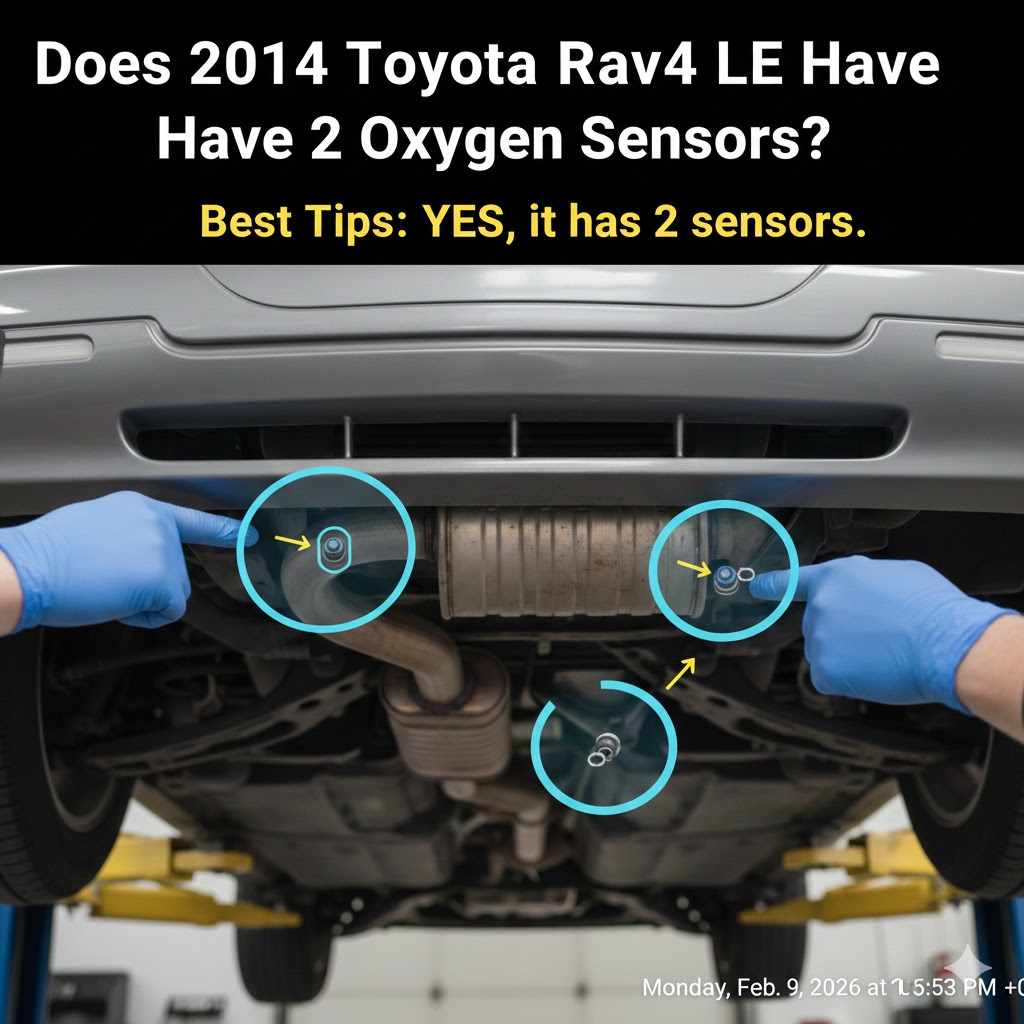
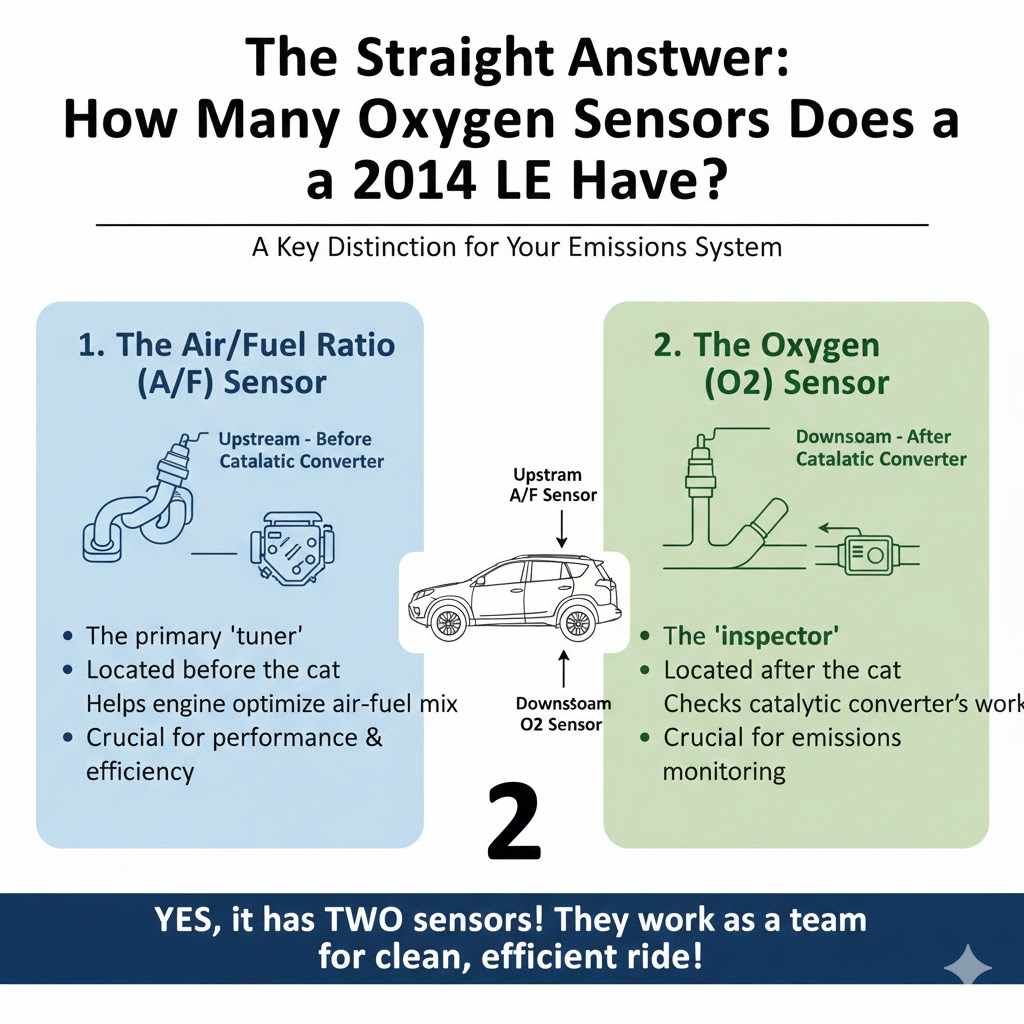
Yes, your 2014 Toyota Rav4 LE has two primary oxygen sensors. It uses one upstream sensor (an Air/Fuel Ratio Sensor) located before the catalytic converter and one downstream sensor (a traditional Oxygen Sensor) located after it. These sensors work together to manage fuel efficiency and monitor your vehicle’s emissions.
Is your 2014 Toyota Rav4’s check engine light glowing on the dashboard? Are you noticing a dip in your gas mileage? If so, you might be dealing with a faulty oxygen sensor. It’s a common issue, but one that often comes with a lot of confusion. How many sensors are there? Where are they? Can you fix it yourself? It can feel overwhelming, especially if you’re new to working on your car.
Don’t worry, you’ve come to the right place. I’m Monowar Shohag, and I’m here to make your car’s exhaust system easy to understand. In this guide, we’ll walk through everything you need to know about the oxygen sensors in your 2014 Rav4 LE. We’ll find out exactly how many it has, what they do, and how you can handle any issues like a pro. Let’s get you back on the road with confidence.
The Straight Answer: How Many Oxygen Sensors Does a 2014 Rav4 LE Have?
Let’s clear this up right away. The standard 2014 Toyota Rav4 LE, equipped with the 2.5-liter 4-cylinder engine, has two main sensors that monitor your exhaust. While they are often both called “oxygen sensors,” they are technically a bit different and have distinct jobs. Here’s the breakdown:
- One Air/Fuel Ratio (A/F) Sensor: This is the upstream sensor, located on the exhaust manifold before the catalytic converter. Think of it as the primary “tuner” for your engine.
- One Oxygen (O2) Sensor: This is the downstream sensor, located after the catalytic converter. Its job is to be the “inspector” that checks the converter’s work.
So, when you hear someone ask if it has two oxygen sensors, the answer is a confident “yes.” These two work as a team. The A/F sensor helps the engine run perfectly, and the O2 sensor ensures the emissions system is cleaning the exhaust as it should. Understanding this distinction is the first step to troubleshooting any sensor-related problem.
What Are Oxygen Sensors and Why Do They Matter?
Imagine you’re trying to bake a cake. You need the perfect ratio of flour, sugar, and eggs. Too much or too little of anything, and the cake is ruined. Your car’s engine works in a similar way, needing the perfect ratio of air and fuel to run efficiently. This is where the oxygen sensors come in.
Oxygen sensors are small electronic devices that live in your exhaust system. Their one and only job is to measure the amount of unburned oxygen in the exhaust gas coming from your engine. They act like tiny chemists, constantly analyzing the exhaust and sending that information back to your car’s main computer, the Engine Control Unit (ECU).
Why is this so important? The ECU uses this data to make real-time adjustments to the air-fuel mixture.
- If there’s too much oxygen (a “lean” mixture), the ECU adds more fuel.
- If there’s not enough oxygen (a “rich” mixture), the ECU reduces the amount of fuel.
This constant balancing act ensures your 2014 Rav4 achieves three critical goals:
- Maximum Fuel Efficiency: By burning fuel perfectly, your engine wastes less gas, saving you money at the pump.
- Optimal Engine Performance: A correct air-fuel ratio means smooth acceleration, stable idling, and reliable power.
- Reduced Harmful Emissions: Efficient combustion minimizes pollutants like carbon monoxide and nitrogen oxides, which is better for the environment and helps you pass emissions tests.
In short, these small sensors are unsung heroes, working behind the scenes to keep your Toyota running cleanly, efficiently, and smoothly.
Upstream vs. Downstream: What’s the Difference?
Knowing you have two sensors is great, but understanding their different roles is even better. The terms “upstream” and “downstream” refer to their location relative to the catalytic converter—the part of your exhaust that cleans up harmful gases.
The Upstream Sensor (Air/Fuel Ratio Sensor)
Also known as “Sensor 1” or the A/F sensor, this is the master controller. It sits before the catalytic converter, right where the hot exhaust gases exit the engine. Its position allows it to get an instant reading of the air-fuel mixture. It sends rapid, precise signals to the ECU, which uses this information to fine-tune the fuel injectors. This sensor is crucial for engine performance and fuel economy.
The Downstream Sensor (Oxygen Sensor)
This is “Sensor 2.” It sits after the catalytic converter. Its job isn’t to control the engine’s fuel mixture. Instead, it’s a quality-control inspector. It measures the oxygen levels in the exhaust after the converter has done its job. The reading from the downstream sensor should be very stable and different from the upstream sensor’s reading. If the readings are too similar, it tells the ECU that the catalytic converter is not working correctly, which will trigger a check engine light.
Here’s a simple table to help you remember the difference:
| Feature | Upstream Sensor (A/F Sensor) | Downstream Sensor (O2 Sensor) |
|---|---|---|
| Location | Before the catalytic converter | After the catalytic converter |
| Primary Job | Controls the engine’s air-fuel mixture | Monitors the catalytic converter’s efficiency |
| Also Known As | Sensor 1, Front Sensor | Sensor 2, Rear Sensor |
| Impact on Performance | Directly affects fuel economy and engine power | Primarily for emissions monitoring; does not affect fuel trim |
| Signal Type | Sends a variable signal for precise adjustments | Sends a slower, more stable signal |
Common Signs of a Failing Oxygen Sensor in Your Rav4
Oxygen sensors don’t last forever. Over time, they can get clogged with carbon, oil, or coolant, or simply wear out. When one starts to fail, your Rav4 will usually give you some clear warning signs. Here’s what to look out for:
- The Check Engine Light Comes On: This is the most common sign. An OBD-II scanner will likely show error codes related to the oxygen sensors. Common codes include P0135 (Sensor 1 Heater Circuit), P0141 (Sensor 2 Heater Circuit), or P0420 (Catalyst System Efficiency Below Threshold).
- Worse Gas Mileage: If the upstream A/F sensor is failing, it can send incorrect information to the ECU. This often causes the engine to run rich, meaning it uses more fuel than necessary. If you notice you’re filling up your tank more often, a bad sensor could be the culprit.
- Rough Idle or Engine Misfires: An incorrect air-fuel mixture can cause your engine to run rough, especially when idling at a stoplight. In some cases, it can even lead to engine misfires, which you might feel as a shudder or hesitation.
- Sluggish Performance: Does your Rav4 feel slow or hesitant when you accelerate? A failing sensor can disrupt the delicate balance your engine needs for smooth power delivery, making your vehicle feel sluggish.
- Failed Emissions Test: The primary purpose of the O2 sensor system is to manage emissions. If a sensor is bad, your car will likely produce more pollutants, leading to a failed state emissions inspection.
If you experience any of these symptoms, it’s a good idea to have your sensors checked. Ignoring them can lead to more expensive problems down the road, including damage to your catalytic converter—a very costly repair.
Locating the Oxygen Sensors on Your 2014 Toyota Rav4 LE
Ready to find these sensors yourself? It’s easier than you think. You just need to know where to look. Before you start, make sure your car is parked on a flat, level surface and that the engine is completely cool. The exhaust system gets extremely hot!
Tools You’ll Need:
- Flashlight
- Safety glasses
- Mechanic’s gloves
- Jack and jack stands (for the downstream sensor)
Finding the Upstream Sensor (Sensor 1)
- Open the hood of your Rav4.
- Stand at the front of the vehicle and look at the engine. The upstream A/F sensor is located on the exhaust manifold.
- The exhaust manifold is the large, cast-iron or steel assembly that collects exhaust gases from the engine cylinders. On your 2.5L engine, it is typically at the front of the engine, facing the radiator.
- Scan the manifold for a small, spark-plug-like device with a wire coming out of it. That’s your upstream A/F sensor. You can easily trace the wire to its electrical connector.
Finding the Downstream Sensor (Sensor 2)
- The downstream sensor is located underneath the vehicle. You will likely need to safely lift the front of the car with a jack and secure it with jack stands. For your safety, always follow proper vehicle lifting procedures. The National Highway Traffic Safety Administration (NHTSA) offers excellent guidelines on vehicle safety maintenance.
- Slide under the car from the front. Look for the exhaust pipe running from the engine toward the back of the car.
- Follow the pipe until you find the catalytic converter. It’s a larger, somewhat oval-shaped component in the exhaust pipe.
- The downstream O2 sensor is screwed into the exhaust pipe just after the catalytic converter. Just like the upstream sensor, it will look like a spark plug with an electrical wire attached.
Now that you know where they are, you’re one step closer to diagnosing or replacing them yourself!
A Beginner’s Guide to Replacing an Oxygen Sensor
Replacing an oxygen sensor is a very achievable DIY project for a beginner. With the right tools and a little patience, you can save a significant amount of money on labor costs. Here is a simplified, step-by-step guide to get you started.
Step 1: Gather Your Tools and Parts
You’ll need the correct replacement sensor for your 2014 Rav4 LE (either upstream or downstream). You will also need:
- A new oxygen sensor (make sure it’s the right one for the location)
- An oxygen sensor socket (this special socket has a slit for the wire)
- A ratchet and possibly an extension
- Penetrating oil (like PB Blaster or WD-40)
- Anti-seize compound (most new sensors come with it pre-applied)
- Safety glasses and gloves
Step 2: Prepare Your Vehicle
Safety is everything. Park on a level surface, engage the parking brake, and let the exhaust cool down completely. Disconnect the negative terminal of your car battery to prevent any electrical shorts and to help reset the ECU later.
Step 3: Locate and Disconnect the Old Sensor
Find the sensor you are replacing (upstream or downstream). Before trying to unscrew it, first disconnect the electrical connector. This prevents you from twisting and damaging the wires. The connector will have a small plastic tab you need to press to release it.
Step 4: Remove the Old Sensor
Exhaust components can be rusty and tight. Spray some penetrating oil on the base of the sensor where it threads into the exhaust pipe and let it soak for 10-15 minutes. This will make removal much easier. Place the O2 sensor socket over the sensor, attach your ratchet, and turn it counter-clockwise to loosen it. It might take some force to break it free.
Step 5: Install the New Sensor
Check if your new sensor has anti-seize compound on the threads. If not, apply a small amount, being careful not to get any on the sensor tip. Gently thread the new sensor in by hand to avoid cross-threading. Once it’s hand-tight, use the socket and ratchet to tighten it until it is snug. Do not over-tighten; check the new sensor’s packaging for torque specifications if you have a torque wrench.
Step 6: Reconnect and Finish Up
Plug the electrical connector back in until it clicks securely. Reconnect your car battery’s negative terminal. If you used jack stands, carefully lower your vehicle back to the ground. Start the engine. The check engine light may still be on, but it should turn off by itself after a few driving cycles. You can also use an OBD-II scanner to clear the codes immediately.
Choosing the Right Oxygen Sensor for Your Rav4
When it comes time to buy a replacement, you’ll find two main options: OEM (Original Equipment Manufacturer) and aftermarket. Making the right choice is important for ensuring your Rav4 runs properly.
OEM vs. Aftermarket Sensors
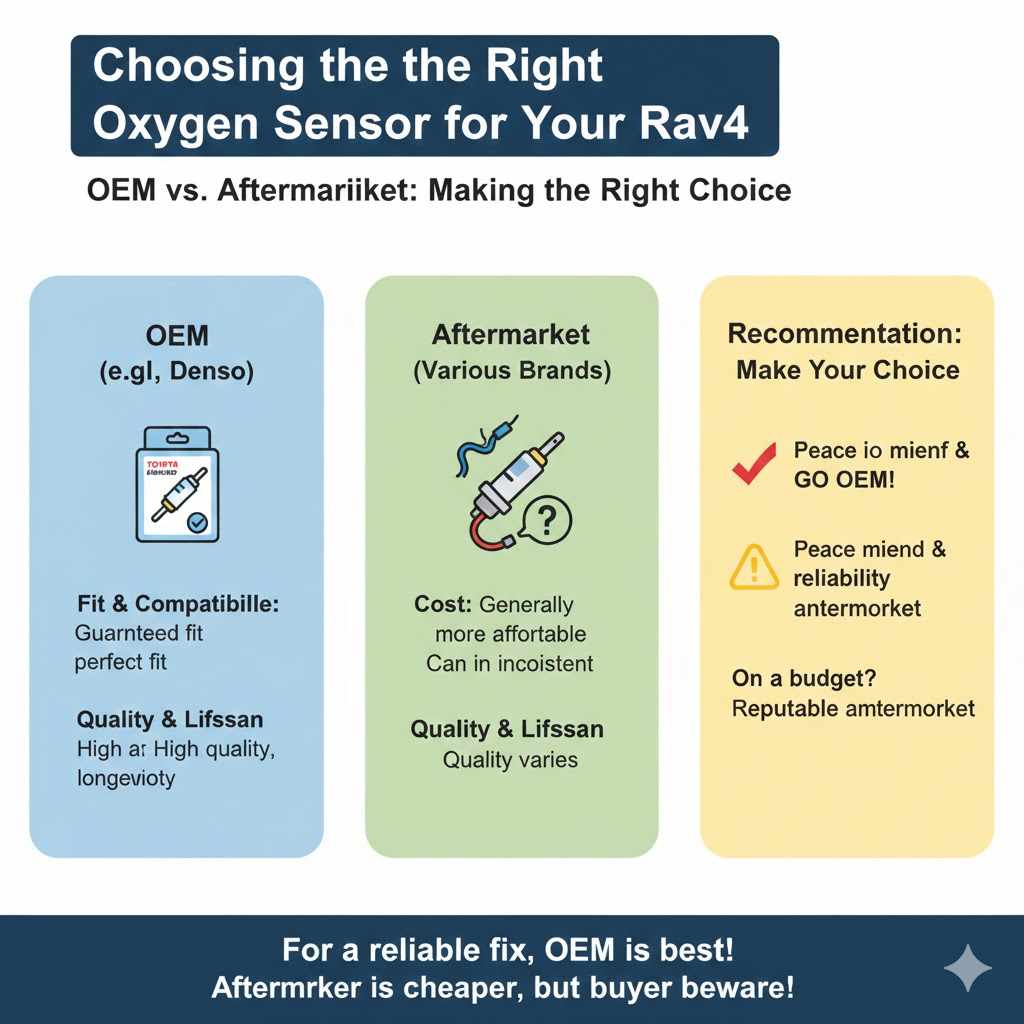
OEM sensors are made by the same company that supplied the original parts to Toyota. For your 2014 Rav4, this is typically Denso. They are guaranteed to fit and function exactly like the original.
Aftermarket sensors are made by other companies. They are often cheaper, but the quality and fit can vary. Some are excellent, while others can cause compatibility issues.
Here’s a comparison to help you decide:
| Factor | OEM (e.g., Denso) | Aftermarket (Various Brands) |
|---|---|---|
| Cost | Higher price | Generally more affordable |
| Fit & Compatibility | Guaranteed perfect fit and function | Fit can sometimes be inconsistent; may require wire splicing |
| Quality & Lifespan | High quality, designed for longevity | Quality can range from excellent to poor |
| Recommendation | Best choice for peace of mind and reliability | A good option if you’re on a budget, but stick to reputable brands |
For a critical component like an A/F or O2 sensor, I strongly recommend sticking with an OEM brand like Denso. The extra cost is often worth the assurance that the part will work correctly with your Toyota’s sensitive computer system, preventing future headaches.
Frequently Asked Questions (FAQ)
1. How much does it cost to replace an oxygen sensor on a 2014 Rav4?
The cost can vary. If you do it yourself, you’ll pay for the part, which can range from $50 to $150 depending on the brand and whether it’s the upstream or downstream sensor. If you take it to a mechanic, the total cost including labor will likely be between $200 and $400 per sensor.
2. Can I drive my Rav4 with a bad oxygen sensor?
You can, but it’s not recommended for long. Driving with a faulty sensor will cause poor fuel economy and increased emissions. In the long run, it can lead to more serious damage, especially to the expensive catalytic converter.
3. What’s the difference between an O2 sensor and an A/F sensor?
They are both types of oxygen sensors, but an Air/Fuel (A/F) Ratio Sensor is a more advanced, wideband sensor. It provides a more precise and rapid reading of the air-fuel mixture, allowing for finer engine control. Your Rav4 uses an A/F sensor upstream (before the cat) and a traditional O2 sensor downstream (after the cat).
4. How long do oxygen sensors last?
Modern oxygen sensors are designed to last for a long time, often up to 100,000 miles or more. However, they can fail earlier due to contamination from a poorly running engine (e.g., burning oil or coolant).
5. Do I need a special tool to replace an O2 sensor?
Yes, it’s highly recommended to use an O2 sensor socket. This tool is designed with a slot down the side to accommodate the sensor’s wire. While you might be able to use a standard deep socket or a wrench in some cases, the special socket makes the job much easier and safer for the sensor and its wiring.
6. Should I replace both sensors at the same time?
Not necessarily. Oxygen sensors don’t always fail at the same time. It’s best to use an OBD-II scanner to identify which specific sensor has failed and replace only that one. If your car has very high mileage (well over 100,000 miles) and one sensor fails, replacing them in pairs might be a good preventative measure, but it’s not required.
7. What does “Bank 1 Sensor 1” mean?
This is standard terminology used by OBD-II scanners. “Bank 1” refers to the side of the engine that contains cylinder #1. Since your 2014 Rav4 has a 4-cylinder engine, it only has one bank. “Sensor 1” refers to the upstream sensor (before the catalytic converter). So, “Bank 1 Sensor 1” is the upstream A/F sensor. “Bank 1 Sensor 2” is the downstream O2 sensor.
Conclusion: Taking Control of Your Rav4’s Health
And there you have it. Your 2014 Toyota Rav4 LE is equipped with two essential exhaust sensors—an upstream A/F sensor and a downstream O2 sensor—that are vital for its health and efficiency. Understanding what they do, where they are, and how to spot the signs of failure puts you in the driver’s seat of your car’s maintenance.
That check engine light doesn’t have to be a source of stress anymore. Whether you decide to tackle the replacement yourself or simply have a more informed conversation with your mechanic, you now have the knowledge to handle the situation with confidence. Keeping these sensors in good shape means a happier engine, better fuel economy, and a healthier planet. Happy driving!