o2 Sensor Downstream Right vs Left
Downstream O2 sensor left/right matters only if your vehicle catalog lists it that way. On many V engines, the real identifier is bank 1 or bank 2, and downstream means the oxygen sensor after the catalytic converter. Ordering the wrong one can mean an unusable connector, the wrong lead length, or a return delay. This guide shows how to map left/right, bank numbers, and connector shape so you buy the correct downstream sensor.
| Decision factor | o2 sensor downstream right | left | Winner |
|---|---|---|---|
| Catalog labeling | May mean driver-side rear sensor on some vehicles, but some catalogs use it only as a position label. | May mean driver-side or passenger-side rear sensor depending on the platform and catalog notes. | tie |
| Fitment certainty | Better when the listing matches the exact bank, connector, and wire length. | Better when the listing matches the exact bank, connector, and wire length. | tie |
| Risk of confusion | Higher if the vehicle uses bank labels more than side labels. | Higher if the vehicle uses bank labels more than side labels. | tie |
| Best use case | Choose this when the catalog and OEM note both name the right-side downstream sensor. | Choose this when the catalog and OEM note both name the left-side downstream sensor. | depends on vehicle |
Downstream O2 sensor basics
Downstream means the oxygen sensor after the catalytic converter. It is commonly called Sensor 2, and its job is to help the engine computer monitor catalyst efficiency rather than control fuel mixture. Upstream means before the catalytic converter, and it is commonly Sensor 1.
That difference matters because upstream and downstream sensors are not chosen by the same logic. A downstream part may be wired, heated, or calibrated for a different role than an upstream part, even if the threads look the same. VehicleRuns says Sensor 1 is typically the upstream sensor, Sensor 2 is typically the downstream sensor, and downstream sensors sit after the catalytic converter.
Why the catalytic converter matters
The converter changes exhaust gases before they reach the downstream sensor. That location lets the control module compare upstream and downstream readings to judge catalyst performance. DENSO says downstream typically means after the catalyst, and upstream typically means before the catalyst.
A downstream sensor can physically screw in and still be wrong for the job if the connector, wire routing, or signal type does not match. A part that installs in the bung is not automatically the correct electrical match.
What do right and left mean?
Right and left usually refer to the vehicle’s driver side and passenger side, but that does not always map neatly to bank numbers. The same source says left typically means the driver’s left and right typically means the driver’s right. On some V engines, the downstream label matters less than the bank and connector details.
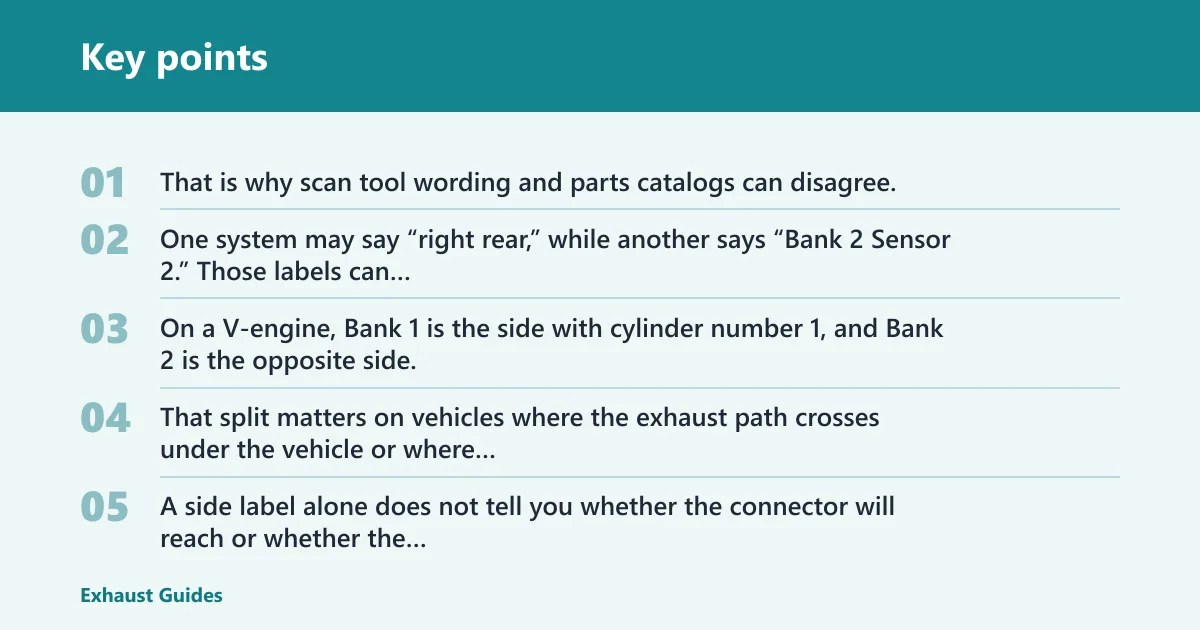
That is why scan tool wording and parts catalogs can disagree. One system may say “right rear,” while another says “Bank 2 Sensor 2.” Those labels can point to the same sensor on one platform and different parts on another.
Driver side versus passenger side
Left and right are body-side labels. Bank 1 and Bank 2 are engine-side labels. On a V-engine, Bank 1 is the side with cylinder number 1, and Bank 2 is the opposite side.
That split matters on vehicles where the exhaust path crosses under the vehicle or where the rear sensors sit at different wire lengths. A side label alone does not tell you whether the connector will reach or whether the plug keying matches.
When side labels map to banks
Some catalogs may use side labels as shorthand for a bank-specific downstream sensor. In those cases, “left rear” or “right rear” can point to a true fitment difference, not just a naming preference. The OEM note is the tie-breaker.
Use the side label only after you confirm the bank, sensor position, and connector shape. If the listing does not state the bank, assume the side label may be incomplete.
How do you match the correct sensor?
Start with the code label, then confirm the physical location, connector shape, and wire length before you order. That order matters because a code like B1S2 or B2S2 gives you the sensor position, but it does not always tell you whether the catalog uses side naming or bank naming. The safest match is the one that aligns with the vehicle lookup and OEM notes.
Step-by-step check
- Read the scanner code or service label and note whether it says B1S2, B2S2, left rear, or right rear.
- Confirm whether the sensor is after the catalytic converter.
- Check the connector shape against the original plug.
- Compare wire length and routing to the old sensor.
- Verify any OEM notes about bank side, heater circuit, or model-year split.
Suppose a scan tool shows B2S2, but the parts listing only says “rear left.” That may still be correct on one engine layout and wrong on another. If the bank number, plug keying, or lead length differs, do not rely on the rear-left wording alone.
A common first-timer mistake is treating the thread size as the whole fitment story. The bung may accept the sensor, but the lead may strain, the connector may not latch, or the signal type may not match what the control module expects.
Downstream sensor fitment table
This table turns the common labels into a practical check list. Use it to separate naming from fitment before you click “buy.”
| Code label | Physical location | Likely catalog meaning | Verification checks |
|---|---|---|---|
| B1S2 | After the catalytic converter on bank 1 | Bank 1 downstream sensor; may be labeled rear left or rear right depending on vehicle layout | Connector shape, wire length, bank side, OEM notes |
| B2S2 | After the catalytic converter on bank 2 | Bank 2 downstream sensor; may be labeled rear left or rear right depending on vehicle layout | Connector shape, wire length, bank side, OEM notes |
| left rear | After the catalytic converter on the left side | Side-based downstream label used by some catalogs | Bank side, connector shape, wire length, OEM notes |
| right rear | After the catalytic converter on the right side | Side-based downstream label used by some catalogs | Bank side, connector shape, wire length, OEM notes |
The key point is that the same physical sensor can carry different labels in different systems. A bank label is often more precise on V engines, while a left/right label can be enough on platforms where the catalog maps it cleanly.
When are left and right interchangeable?
Left and right downstream sensors can be interchangeable if the wire and connector match. That is the clearest general rule. If the sensor body, plug, heater circuit, and wire reach all match the vehicle, the side label may be only a catalog shortcut rather than a hard fitment boundary.
| Situation | Interchangeable? | Why |
|---|---|---|
| Connector shape and wire length match, and the catalog note says the sides cross-reference | Often yes | The part matches the physical and catalog requirements. |
| OEM notes list one downstream sensor for both sides on a platform | Often yes | The manufacturer treats the parts as a shared fitment. |
| Connector keying differs or wire length differs | No | The sensor may reach the bung but fail at the plug or route poorly. |
| Calibration or heater requirements differ by bank or side | No | The physical fit can still be wrong for the control module. |
Common interchange cases
Interchange is most common when the platform uses the same downstream sensor body on both sides and only the listing language changes. In those cases, the catalog note, not the side name, decides the match. A direct-fit listing is the safer choice because it comes with the correct connector and wiring.
Cases where they are not interchangeable
They are not interchangeable when the connector keying differs, the lead length is different, or the OEM note assigns a unique part to one bank. That is also where a wrong downstream sensor can install physically but still create a new fault code. The threads can fit while the electrical match fails.
Picture a two-bank engine where the right-side rear sensor uses a longer pigtail to reach around the transmission tunnel. The left-side part may screw in on the right side, but the lead may sit under tension or the plug may not reach the bracket cleanly. That is a fitment miss even though the threads match.
Upstream vs downstream O2 sensor location
Upstream sensors sit before the catalytic converter and are used for fuel control. Downstream sensors sit after the catalytic converter and are used for catalyst monitoring. That is the core location difference, and it applies before you sort out left, right, bank 1, or bank 2.
Narrowband versus wideband
Regular O2 sensors output a voltage between 0.1 and 0.9 volts. Wideband sensors output a wider range, from 0 to 5 volts. Those are different sensor families, so a wideband or AFR sensor is not interchangeable with an older narrowband oxygen sensor.
The same source says wideband or air-fuel ratio sensors are used on many newer vehicles. If your vehicle calls for that type, do not substitute a standard narrowband downstream sensor just because the connector shape looks close.
Heated sensor requirements
Most modern oxygen sensors are heated, which means they contain a heater circuit. That heater must match the vehicle’s electrical requirements. If the heater circuit differs, the part can fit the bung and still be the wrong sensor for the system.
Direct-fit oxygen sensors are usually the safer DIY choice because the connector and wiring are already matched. Universal oxygen sensors can work on some vehicles, but they may require splicing the original connector, and that raises the fitment risk.
How to verify before replacement
Use the scan label, then verify the connector, wiring, and bank side against the vehicle lookup. If the part is listed as direct-fit, confirm the plug and lead length before you install it. If it is universal, confirm whether the original connector must be transferred and whether that is allowed for your application.
- Confirm whether the scanner says B1S2, B2S2, left rear, or right rear.
- Match that label to after-catalyst placement.
- Compare the plug shape and lock tab to the old sensor.
- Check whether the wire length reaches the factory clip points without tension.
- Read OEM notes for heater type, bank assignment, and side-specific fitment.
How to check downstream O2 sensor? Start with the scan label, then inspect the physical sensor location and the wiring path. A downstream check is not only about whether the sensor reads after the converter; it is also about whether the replacement part matches the vehicle’s exact side and connector requirements.
How to replace downstream O2 sensor? Follow the vehicle manual, let the exhaust cool, and avoid damaging the connector or wiring. If you must lift the vehicle, follow the vehicle/product manual, never work under a vehicle held only by a jack, never exceed the vehicle’s rated roof/hitch/tow limit, keep items out of airbag zones and the driver’s view, and check local laws.
Choose o2 sensor downstream right if…
Choose o2 sensor downstream right if your vehicle lookup, OEM note, and connector match all point to the right-side downstream sensor. It is the better pick when the listing names the right rear position directly and the lead length or plug orientation is specific to that side.
Choose left if…
Choose left if the catalog, scan label, and OEM note identify the left-side downstream sensor for your vehicle. That is the right call when the left-side part is the one that matches the bank assignment, connector shape, and wire routing on your platform.
The winning label is the one that matches the vehicle, not the one that sounds more generic. On a platform where left and right are cross-referenced, either side may be correct. On a platform with a true side-specific lead or calibration, only one of them is right.

- Aims to fix engine light issues
- Built for durability and long life
- Includes a 1-year guarantee period
Frequently asked questions
Which o2 sensor is downstream?
The downstream oxygen sensor is the one after the catalytic converter. It is commonly called Sensor 2 and is usually used to monitor catalyst efficiency. If your scan tool or parts catalog gives a bank number, confirm that the downstream sensor is the after-converter one for that bank before ordering.
O2 sensor downstream vs upstream
Downstream means after the catalytic converter, and upstream means before it. Upstream sensors are commonly Sensor 1 and are used for fuel control. Downstream sensors are commonly Sensor 2 and are used for catalyst monitoring, so the two positions are not interchangeable by name alone.
Upstream vs downstream o2 sensor location: upstream sensors sit
Upstream sensors sit in the exhaust stream before the catalytic converter. Downstream sensors sit after the catalytic converter. If a parts listing only says front or rear, verify that “front” means upstream and “rear” means downstream for your exact vehicle, because catalog language can vary by platform.
Downstream o2 sensor front or rear
On most vehicles, the downstream sensor is the rear one because it is after the catalytic converter. That said, front and rear labels should still be checked against the bank number and connector notes. Some platforms use rear-left or rear-right wording rather than a simple front/rear split.
Which o2 sensor is upstream and downstream?
Sensor 1 is typically upstream, and Sensor 2 is typically downstream. That is the common naming pattern, but vehicle labels can still vary. Use the vehicle’s bank assignment, side label, and OEM notes to confirm whether Sensor 2 is the left or right downstream sensor on your engine.