Best Cat Converter Cleaners for Mild Soot (2026): we compared
Fix the cause first, then try one on-car cleaning for mild soot contamination. If the converter is melted, cracked, rattling, or still clogged after one try, replacement is the fix. Bad cleaning can overheat the converter, damage oxygen sensors, or start a fire.
This guide is part of our Catalytic converter guide series.
What you’ll need before you touch the exhaust
- OBD-II scanner for reading stored and pending trouble codes
- Gloves and eye protection
- Good ventilation and an open workspace
- Fuel additive labeled for catalytic converter or emissions-system cleaning
- Vehicle service information or code definitions
- Flashlight and inspection mirror
📊 Modern OEM catalytic converters are designed to last roughly 10 years. Source: How To Clean A Catalytic Converter.
OBD-II scanner: best for confirming the fault

- Reads and clears error codes
- Supports all OBD2 protocols for 1996+
- Compact design with sturdy cable
An OBD-II scanner is the first tool to use. It plugs into the port under the dashboard and reads check-engine problems before you touch the exhaust. It is the best fit for drivers who need to separate a catalyst code from misfire, fuel-trim, or oxygen-sensor faults.
What stands out is simple code reading and clearing on 1996+ vehicles. The drawback is also simple: it cannot tell you whether the converter is physically melted, so you still need a visual check and symptom review.
Fuel additive: best for mild contamination

- Protects converter from soot clogging
- Cleans injection system and combustion chamber
- Suitable for all gasoline engines with converters
This cleaner is for a converter that looks intact and is showing mild soot loading rather than hard failure. It fits the narrow case where you want a low-risk, on-car attempt after the engine checks out and the codes point to efficiency loss, not breakage.
Its main strength is that it is meant to clean the injection system and combustion chamber along with the converter path. The drawback is inconsistency; fuel additives can help some mild cases, but they do not fix melted substrate, broken honeycomb, or upstream faults that keep loading the converter.
What you’ll need before using a sensor-port tool

- Durable chrome vanadium forged steel construction
- Wire gate prevents harness damage
- Includes thread chasers for M12 and M18
This socket set is for diagnosis or replacement work on oxygen sensors, not for routine converter cleaning. It is useful if you need to inspect an upstream or downstream sensor, check wiring, or remove a sensor for proper replacement.
The wire gate helps protect the wiring, and the thread chasers help with damaged threads. The drawback is that it is a removal tool, so it is the wrong choice if you are trying to avoid taking sensors out in the first place.
Spray cleaner: best for a narrow, on-car attempt

- Foam cleans carbon from micro-chambers
- Solvent-free formula protects O2 sensors
- Includes flexible hose for sensor-port application
This spray is aimed at carbon in the converter and exhaust path when the system is still structurally intact. It may suit a careful DIYer who wants a cleaner that includes a hose for sensor-port application and claims a solvent-free formula.
The drawback is that spray-and-foam methods still depend on access, correct application, and a converter that is not damaged. If the substrate is melted, broken, or heavily restricted, no spray will restore it.
How to tell whether cleaning is worth trying
Cleaning is worth trying only when the converter looks intact, the engine runs normally, and the code pattern points to mild efficiency loss rather than a broken part. A check engine light and P0420 do not prove the converter is clogged. P0420 means Catalyst System Efficiency Below Threshold. (thedrive.com)
Use an OBD-II scanner first, because it reads stored and pending codes through the under-dash port and can show whether the converter code appears alone or with misfire, fuel-trim, or oxygen-sensor faults. That code mix matters more than the light itself.
Quick triage checklist
- Read stored and pending codes.
- Check whether P0420 appears by itself or with misfire, fuel-trim, or oxygen-sensor codes.
- Inspect the converter body for dents, scrapes, or heat discoloration.
- Listen for rattling when the exhaust cools.
- Stop if the housing is red-hot, the substrate sounds loose, or the car has severe power loss.
What the catalytic converter does and why cleaning is not the first step
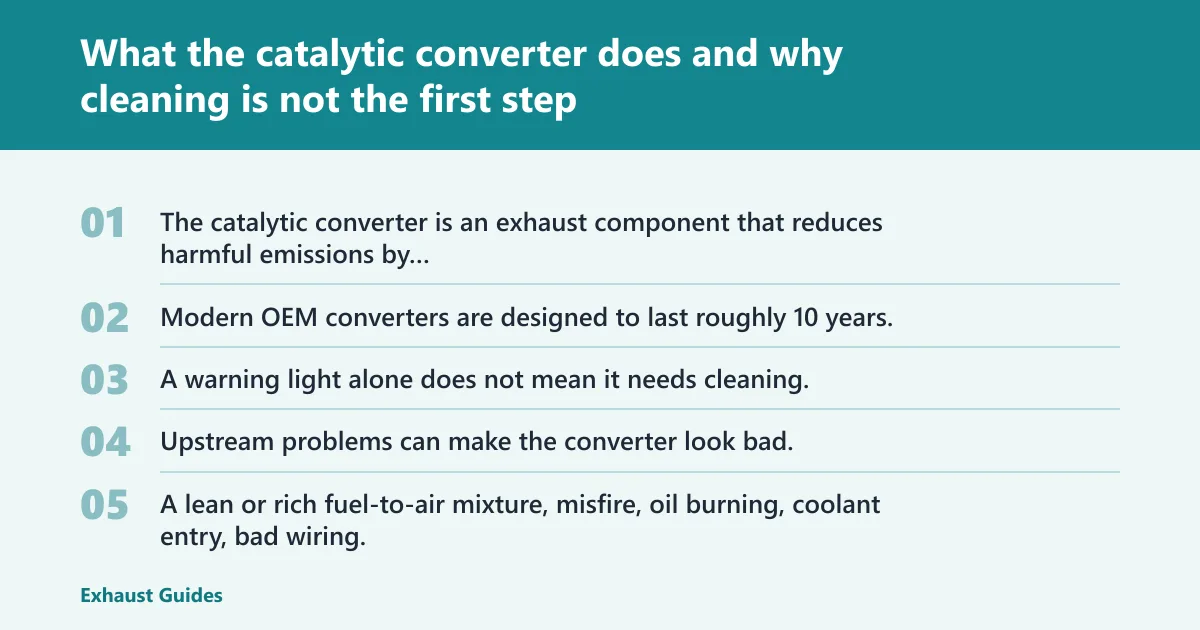
The catalytic converter is an exhaust component that reduces harmful emissions by catalyzing reactions in the exhaust stream. Modern OEM converters are designed to last roughly 10 years, and the article life figure is about 100,000 miles. A warning light alone does not mean it needs cleaning.
Upstream problems can make the converter look bad. A lean or rich fuel-to-air mixture, misfire, oil burning, coolant entry, bad wiring, or a failed oxygen sensor can all overload or fool the converter. Fix those first, or any cleaning attempt is wasted.
How to clean a catalytic converter safely
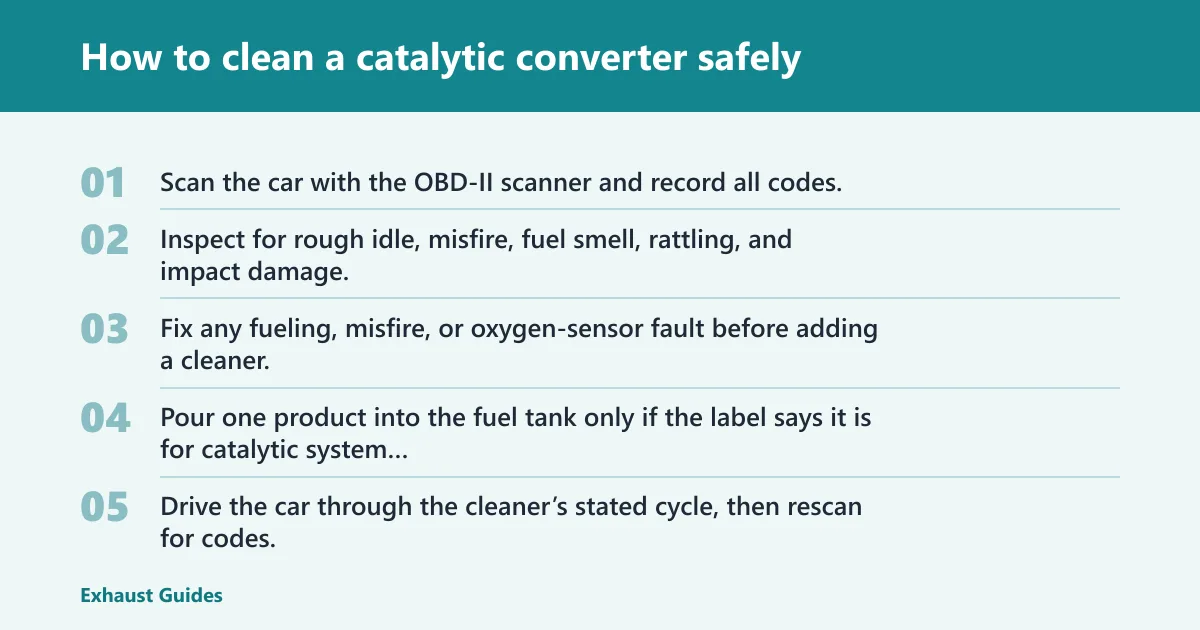
The safest method is limited and on-car: confirm the codes, rule out major engine faults, then try one fuel-tank additive if the converter is structurally sound. Avoid harsh soaking and avoid opening the exhaust unless diagnosis requires it. The goal is mild contamination control, not restoration of a damaged part.
- Scan the car with the OBD-II scanner and record all codes.
- Inspect for rough idle, misfire, fuel smell, rattling, and impact damage.
- Fix any fueling, misfire, or oxygen-sensor fault before adding a cleaner.
- Pour one product into the fuel tank only if the label says it is for catalytic system cleaning.
- Drive the car through the cleaner’s stated cycle, then rescan for codes.
If that didn’t work, try this next
If the code returns after one additive cycle, stop repeating cleaners. Move to upstream diagnosis: scan live fuel trims, inspect oxygen-sensor wiring and connectors, and check for misfire history or oil consumption. A second bottle will not fix a converter that is overheated or physically collapsed.
Say your sedan has P0420, no rough running, and no rattle. That is the narrow case where one additive cycle may be reasonable. Suppose a pickup has P0420 plus P0302 and a sulfur smell after towing uphill. That pattern points to a misfire or fueling problem first, not a converter that needs more cleaner.
Decision checklist: when to clean, when to stop

| Symptom pattern | Likely cause | Safe at-home action | Stop-sign condition |
|---|---|---|---|
| P0420 only, no rough running | Mild efficiency loss or sensor drift | Scan, inspect, then try one fuel-tank cleaner | Do not clean again if the code returns after one cycle |
| P0420 with misfire or fuel-trim codes | Upstream engine fault loading the converter | Fix ignition, fuel, or vacuum issue first | Do not clean until the engine fault is resolved |
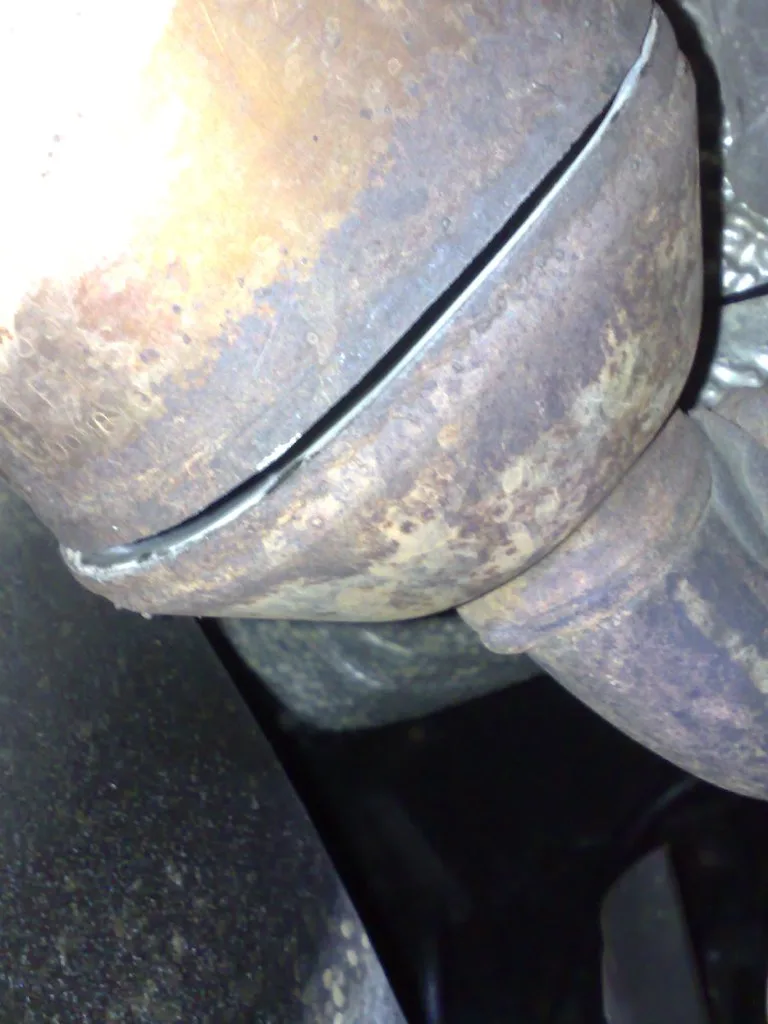
| Rattle, metallic debris sound, or dented shell | Broken substrate or physical damage | Inspect and plan replacement | Do not use cleaners; damage is not cleanable |
| Very hot housing, poor acceleration, burning smell | Severe restriction or melted substrate | Stop driving if power is dropping fast | Do not keep running it; diagnose or replace |
Do catalytic converter cleaners actually work?
Sometimes, but only in narrow cases. Fuel-tank additives can help dissolve or loosen light carbon contamination in the converter path, oxygen sensors, injectors, and combustion chamber. Results are inconsistent across vehicles, and they do not repair broken honeycomb, melted substrate, or heavy restriction.
That is why root-cause repair matters more than the bottle. If the engine is running rich, misfiring, or burning oil, the cleaner may give brief relief and then the code returns. One clean cycle is reasonable. Repeating bottles is not a fix.
If that didn’t work, try this next
After one cleaner cycle, rescan the car and check driveability. If P0420 persists with healthy fuel trims and no misfire, the converter may be worn out. If the car still runs rough, chase the engine fault with code-specific diagnosis rather than more cleaning.
What not to do when cleaning a catalytic converter
Do not use soap and water. Do not use lacquer thinner. Do not pressure wash the converter. Do not spray cleaner into oxygen-sensor ports or electrical connectors. Those methods can leave residue, contaminate sensors, or create fire risk.
Also do not work on a hot exhaust. Exhaust parts can stay dangerously hot long after shutdown. Keep ventilation open, keep flammables away, and stop immediately if the converter is glowing, rattling, or showing obvious physical damage.
When should you replace a catalytic converter instead of cleaning it?
Replace it when the substrate is melted, cracked, broken, or rattling, when the shell is physically damaged, or when P0420 comes back after the upstream engine issue is fixed and one limited cleaning attempt has failed. Cleaning cannot repair internal collapse.
Replacement is also the right answer when the converter has been repeatedly loaded by oil consumption, coolant burning, or chronic misfires. In those cases, a cleaner may briefly mask the symptom while the root cause keeps destroying the new part.
Common mistakes
One common mistake is treating a check engine light as proof the converter is clogged. Another is buying cleaner before scanning codes. A third is ignoring oxygen-sensor faults, which can mimic converter failure and send you after the wrong part.
A final mistake is using a hotter, harsher method because the first try failed. If the converter is already overheated or damaged, more chemistry or more pressure can make the problem worse.
Prevention: Fix misfires, oil burning, or rich-running problems quickly so the converter is not exposed to repeated heat and contamination.
What causes a catalytic converter to get clogged
Clogging usually starts upstream. Excess fuel from a rich mixture, unburned fuel from misfires, oil ash from engine wear, coolant contamination from internal leaks, or sensor faults that distort mixture control can all load the converter until it loses efficiency or plugs.
Physical damage can do the same job fast. Speed bumps, debris, off-road strikes, or road hazards can crack the substrate or shift the internal honeycomb. Once that happens, cleaning does nothing useful.
Can a clogged catalytic converter be fixed at home
Yes, but only in the mild case. A DIY cleanup is limited to diagnosis, one careful additive attempt, and fixing upstream faults. If the converter is melted, rattling, or physically damaged, home cleaning is the wrong path and replacement is the real fix.
If you want the safest home approach, scan first, repair first, then try one cleaner cycle. If the code remains and the car still feels restricted, stop there. More aggressive methods are not safer; they are usually wasteful.
Frequently asked questions
what’s the best way to clean a catalytic converter
Start with an OBD-II scan, fix any misfire or fueling fault, then try one fuel-tank additive if the converter is intact. If P0420 returns after that single attempt, move to diagnosis or replacement instead of repeating cleaners or using harsh solvents.
is there a way to clean out your catalytic converter
Yes, but only mild contamination is a candidate. A fuel additive is the least invasive option because it stays inside the fuel system and exhaust path during normal operation. It will not restore a melted or broken converter, so inspection comes first.
are catalytic converter cleaners safe for sensors
They are safer than spraying chemicals directly at a sensor, but no cleaner is risk-free. Keep it to one product, use the label directions, and avoid contaminating connectors or ports. If the downstream or upstream sensor is suspect, scan and test it separately.
when should you replace a catalytic converter instead of cleaning it
Replace it when the substrate is melted, broken, or rattling, when the shell is dented from impact, or when P0420 persists after upstream repairs and one limited cleaning cycle. Those cases point to damage or chronic contamination, not removable soot.
can a clogged catalytic converter be fixed at home
Only sometimes. Home repair is reasonable for diagnosis, a single additive attempt, and fixing the engine fault that caused the contamination. If acceleration stays poor, the housing gets very hot, or the converter rattles, stop driving and plan replacement.
what can you use to clean your catalytic converter
Use only a fuel-tank cleaner labeled for catalytic system or emissions-system cleaning. Do not use soap, water, lacquer thinner, brake cleaner, oven cleaner, or pressure washing. Those methods are unsafe or ineffective and can damage sensors or the converter itself.