What Does an Oxygen Sensor Do in a Car?
An oxygen sensor measures leftover oxygen in exhaust gas, then the engine computer uses that signal to add or subtract fuel in closed loop after warm-up. If it fails or reads wrong, you can get poor fuel mileage, rough idle, higher tailpipe emissions, and catalytic-converter damage. This article explains how upstream and downstream sensors differ, how fuel-trim correction works, and the symptoms that point to a bad sensor.
Oxygen sensor feedback loop and placement
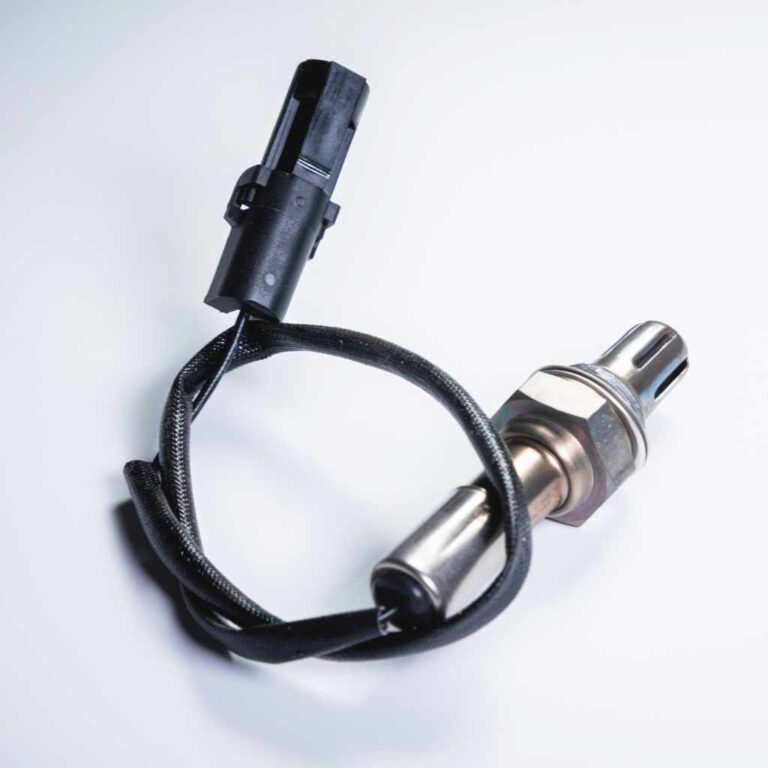
An oxygen sensor reads the oxygen content in exhaust gas and sends that signal to the engine control unit, often called the ECU or PCM. The computer uses that feedback to correct fueling. It does not measure fuel directly. It measures what remains after combustion, then helps the engine move closer to the target air-fuel ratio.
How the feedback loop works
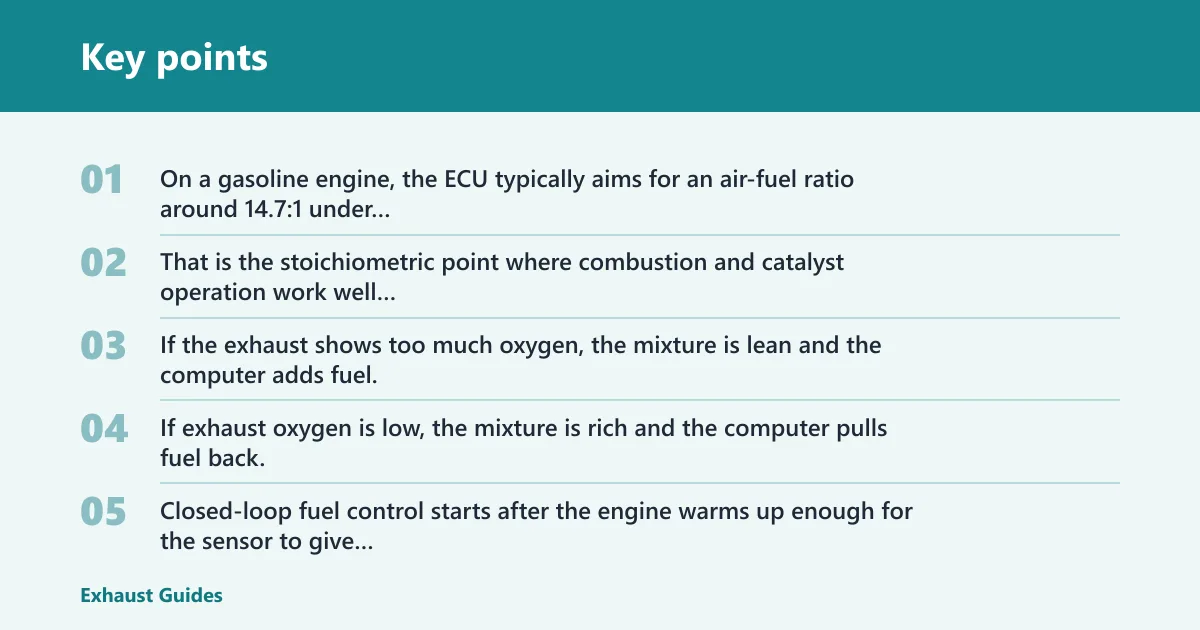
On a gasoline engine, the ECU typically aims for an air-fuel ratio around 14.7:1 under normal operating conditions. That is the stoichiometric point where combustion and catalyst operation work well together. If the exhaust shows too much oxygen, the mixture is lean and the computer adds fuel. If exhaust oxygen is low, the mixture is rich and the computer pulls fuel back.
This is closed-loop fuel control. Closed-loop fuel control starts after the engine warms up enough for the sensor to give useful data. Until then, the ECU relies more on preset values and other inputs. That is why heater-circuit problems can matter at cold start.
Upstream versus downstream sensors
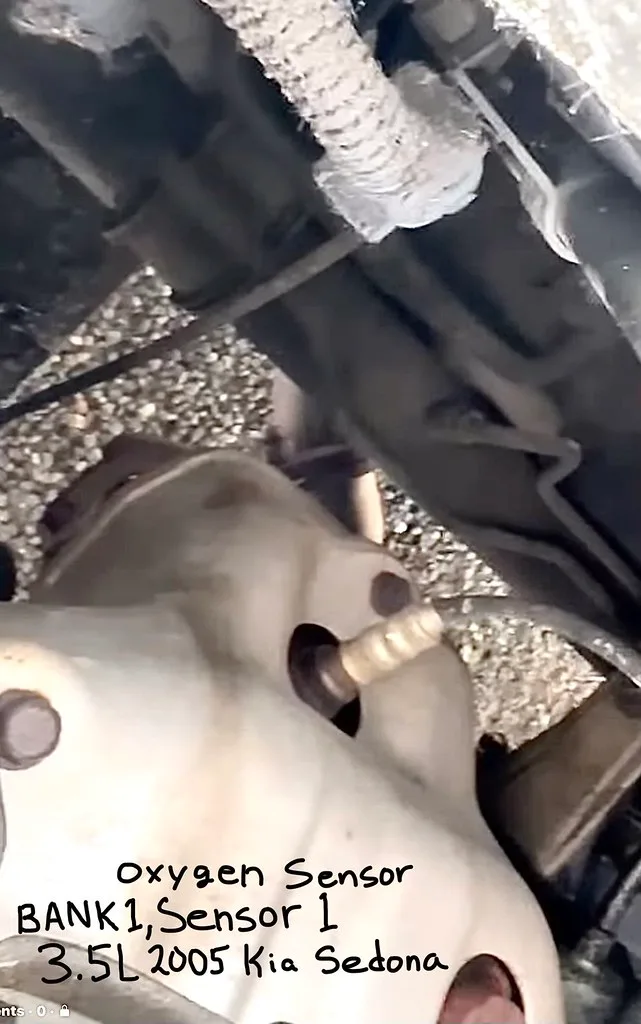
The upstream oxygen sensor is located before the catalytic converter. It is the main fuel-trim sensor and the one that matters most for mixture control. The downstream oxygen sensor is located after the catalytic converter. It mainly monitors catalyst efficiency and usually does not control fuel trim directly.
That difference matters when you diagnose a fault. A bad upstream sensor can change fueling. A bad downstream sensor can set catalyst-efficiency codes without causing the same fuel-trim changes.
How does an oxygen sensor work in a car?
An oxygen sensor works by comparing oxygen levels in the exhaust stream with a reference inside the sensor. The ECU reads that signal as voltage or a related data stream, then trims fuel accordingly. On a warmed-up engine, the signal changes quickly as the mixture moves richer or leaner, and the computer keeps adjusting.
Why the signal matters
That signal is the computer’s feedback. Without it, the ECU has less information about what actually burned in the cylinders. Fueling can still happen, but it is less exact. The result can be a richer or leaner mixture than intended, especially during steady cruising and light throttle.
Say your 2.4-liter four-cylinder starts fine but idles unevenly after the first few minutes of driving. If the upstream sensor is slow to respond, the ECU may swing fueling too far in either direction before it settles. A vacuum leak or dirty mass air flow sensor can create a similar pattern, which is why code scanning and basic checks come first.
When does the heater circuit matter?
The heater circuit matters during warm-up, when the sensor is still too cool to give accurate feedback. Heated oxygen sensors use an internal heater to reach operating temperature faster. That shortens the time before closed-loop control begins and helps the ECU correct fueling sooner after a cold start.
Cold-start behavior
If the heater circuit fails, the sensor may stay cold longer than it should. The ECU can remain in open loop for too long, or it may receive a weak signal when the engine first starts. That can cause rough cold idle, delayed fuel correction, and a check engine light with heater-circuit codes.
Common heater-related signs
Cold-start symptoms often show up before the engine is fully warm. You may notice a brief stumble, longer crank-to-idle recovery, or a richer smell in the first minute or two. Those symptoms do not prove the sensor is bad by themselves, but they fit a heater or wiring problem.
Oxygen sensor decision table
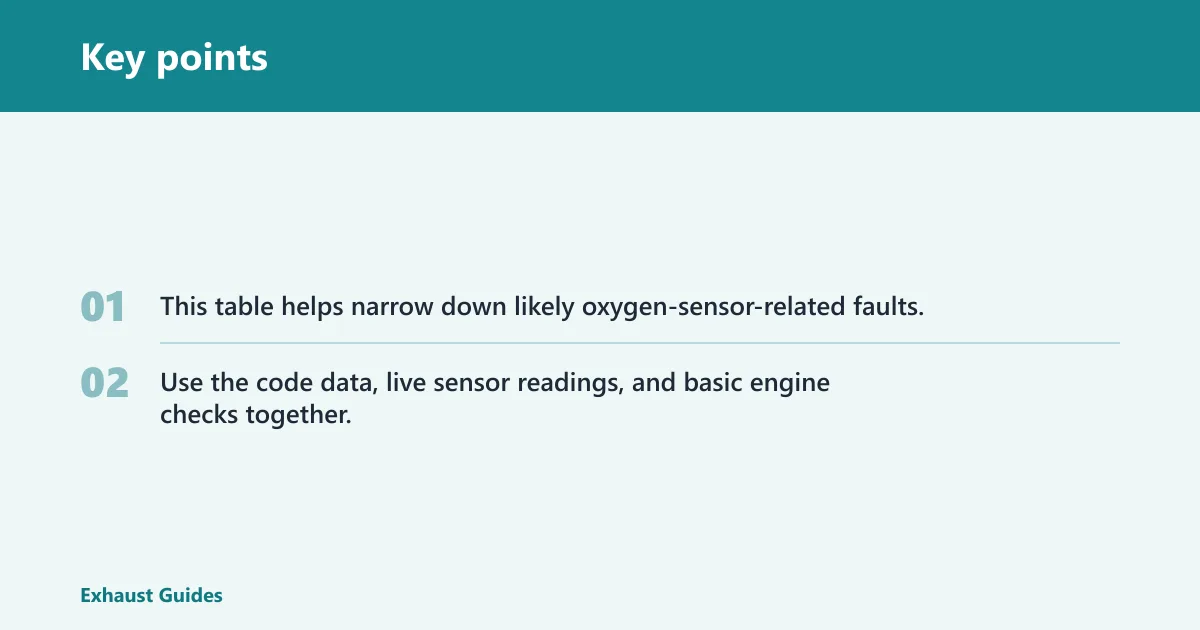
This table helps narrow down likely oxygen-sensor-related faults. It does not replace a scan tool. Use the code data, live sensor readings, and basic engine checks together.
| Symptom | Likely oxygen-sensor-related cause | What to check next |
|---|---|---|
| Rough idle | Upstream sensor signal is slow or biased rich/lean | Scan for fuel-trim and sensor codes; inspect vacuum hoses, intake boots, and gasket leaks |
| Poor fuel economy | Sensor reads lean all the time, so the ECU adds extra fuel | Look at short- and long-term fuel trims; inspect for exhaust leaks ahead of the sensor |
| Black smoke | Upstream sensor is stuck lean or the circuit is faulty, allowing excess fuel | Check injector leaks, fuel pressure, and live O2 activity before replacing the sensor |
| Sulfur smell | Prolonged rich operation from a bad sensor signal or fuel-control fault | Check mixture codes, fuel trim, and catalytic-converter temperature concerns |
| Hesitation | Fuel trim swings too far because the sensor response is slow | Inspect the upstream sensor data, MAF readings, and intake leaks |
| Failed emissions | Incorrect fuel control or catalyst-efficiency fault linked to sensor data | Read stored DTCs and confirm which sensor is implicated |
| Check engine light with O2 code | Sensor, heater, or circuit fault | Confirm with a scan tool before replacing parts |
| Long cold idle before normal running | Heater circuit not bringing the sensor online fast enough | Check heater power, ground, fuse, and connector condition |
| Fuel smell after warm-up | Mixture is staying rich because feedback is delayed or wrong | Check upstream sensor response and look for leaking injectors |
| Downstream sensor code only | Rear sensor or catalyst-monitor circuit issue, not usually fuel trim | Check the catalytic converter, wiring, and rear sensor signal |
| Intermittent stumble on cruise | Sensor signal drops out briefly, or the circuit has a wiring fault | Wiggle-test connectors, inspect harness routing, and review live data |
| Heater-circuit symptoms | Open heater element, blown fuse, or poor ground | Test heater resistance and circuit power with a scan tool or meter |
What happens when the sensor fails?
When an oxygen sensor fails, the ECU loses accurate exhaust feedback and may fuel the engine too rich or too lean. A bad sensor can trigger the check engine light and diagnostic trouble codes, but a code alone does not prove the sensor is the only problem. Fuel, air, and wiring faults can point the same way.
Common driving symptoms
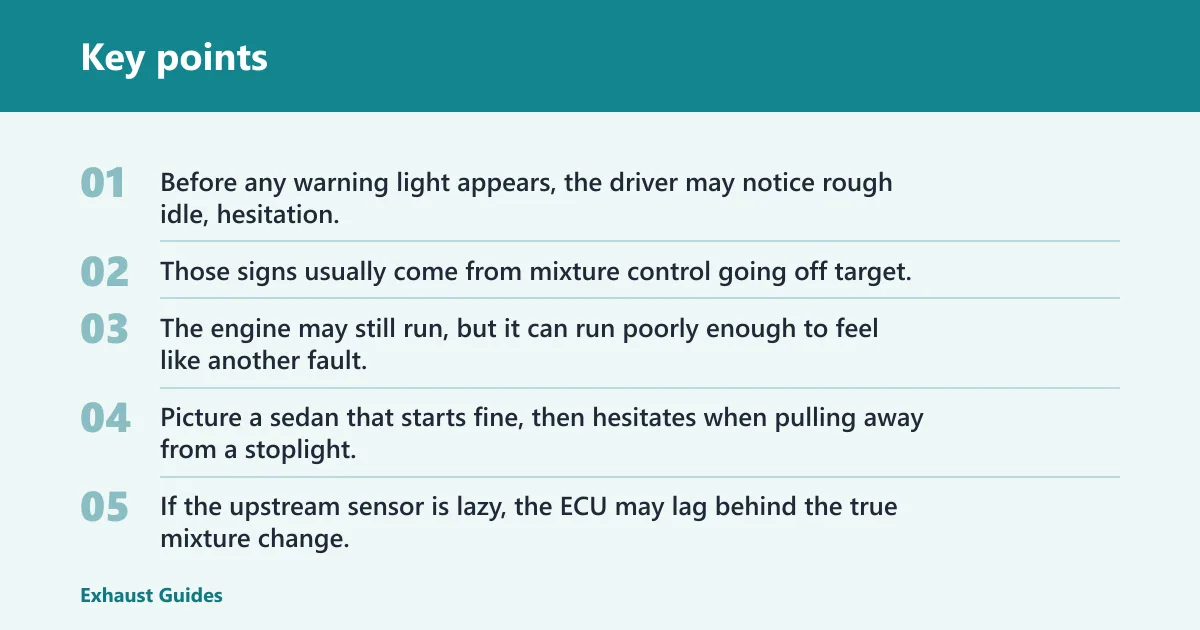
Before any warning light appears, the driver may notice rough idle, hesitation, poor fuel mileage, black smoke, or a sulfur smell. Those signs usually come from mixture control going off target. The engine may still run, but it can run poorly enough to feel like another fault.
Picture a sedan that starts fine, then hesitates when pulling away from a stoplight. If the upstream sensor is lazy, the ECU may lag behind the true mixture change. But a vacuum leak, dirty MAF sensor, or injector problem can create nearly the same hesitation. That is why diagnosis should not stop at the first code.
Why the catalytic converter matters
The catalytic converter works best when the air-fuel mixture stays close to target. Prolonged rich running can overheat or damage it. A bad upstream sensor can contribute to that condition because the ECU may keep adding fuel when it should not. The downstream sensor then may show poor catalyst performance as a result.
What codes usually mean
Common oxygen-sensor-related diagnostic trouble codes include sensor, heater, and mixture faults. The exact code matters. An upstream sensor code points you toward fuel trim control, while a downstream code more often points toward catalyst monitoring. Use a scan tool to confirm the stored code and review live data before replacing anything.
Is an oxygen sensor important in a car?
Yes. It is important because it gives the ECU the feedback needed for closed-loop fueling. Without that feedback, the engine can still run, but not as accurately. That can hurt fuel economy, drivability, emissions control, and in some cases the catalytic converter. It is a control sensor, not a direct emissions device by itself.
Why it is easy to confuse with other faults
Oxygen-sensor symptoms overlap with vacuum leaks, MAF issues, injector faults, and exhaust leaks. Those problems can all alter what the sensor sees or what the ECU does with its signal. If the upstream sensor is blamed too quickly, the real fault can stay hidden. Scan data and a basic engine inspection reduce that risk.
Frequently asked questions
What does an oxygen sensor do in a car?
An oxygen sensor measures exhaust oxygen and sends that information to the ECU or PCM. The computer uses the signal to adjust fueling in closed loop. That keeps the air-fuel mixture near target once the engine is warm enough for reliable feedback.
What does an O2 sensor do in a car?
An O2 sensor does the same job as an oxygen sensor. It reports exhaust oxygen content so the engine computer can add or subtract fuel. The upstream sensor mainly controls fuel trim, while the downstream sensor mainly checks catalytic-converter efficiency.
What is the oxygen sensor in a car for?
It is there to give the engine computer real-time exhaust feedback. That feedback helps the ECU correct rich or lean running instead of guessing. The result is better control of mixture, which supports drivability, fuel economy, and emissions control when the system is working properly.
What happens when an oxygen sensor goes bad?
A bad oxygen sensor can mislead the ECU, which may then run the engine too rich or too lean. That can cause rough idle, hesitation, poor mileage, black smoke, sulfur smell, or emissions failure. It can also set a check engine light and diagnostic trouble codes.
Can a bad oxygen sensor affect gas mileage?
Yes. If the upstream sensor reports the wrong mixture, the ECU may add more fuel than the engine needs. That extra fuel lowers gas mileage. Before replacing the sensor, check for codes, fuel trims, vacuum leaks, and exhaust leaks that can create the same symptom.
Can a bad oxygen sensor cause a check engine light?
Yes. Sensor, heater, and mixture faults can all turn on the check engine light. The light does not prove the sensor itself is bad. A scan tool is needed to read the stored diagnostic trouble code and confirm whether the fault is in the sensor, circuit, or engine system around it.