3 Best Exhaust Upgrades for DIY Installers: We Compared
For most DIY installers, a direct-fit cat-back or axle-back is the best exhaust upgrade because it keeps cutting, welding, and fitment risk low; choose universal pipe or muffler parts only if you can cut, weld, and measure accurately. Poor fitment can mean exhaust leaks, drone, rattles, and wasted money. This guide compares bolt-on and universal exhaust upgrades by install difficulty, required tools, fitment risk, and sound-versus-performance tradeoffs.
Quick comparison
| Product | Badge | Best for | Price | ||
|---|---|---|---|---|---|
 | Cat-Back Exhaust SystemaFe Power | Our pick | aFe Power cat-back exhaust system · full system | $2,115.58 Price as of 21 Oct 2026 | View |
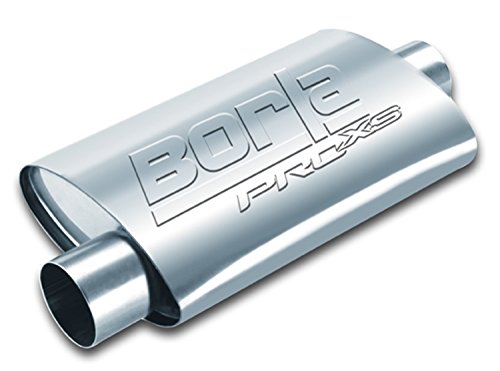 | BORLA 40359 ProXS Universal Performance Muffler 3" OffsetBorla | Pair with it | BORLA ProXS universal muffler · 3" offset inlet / 3" center outlet | $128.99 Price as of 21 Oct 2026 | View |
 | Flowmaster 53070 70 Series Chambered MufflerFlowmaster | Budget pick | Flowmaster 70 Series chambered muffler · 3" inlet/outlet | $249.95 Price as of 21 Oct 2026 | View |
The easiest installs are usually axle-back kits and direct-fit cat-backs because they use factory-style hangers and fewer fabrication steps. Universal piping, cutouts, and active valves can work well, but they are among the most likely to need cutting, clearance checks, and welding or tight slip-fit work.
How we chose
The main filter was install complexity. A good first-time DIY choice should cut the number of cuts, welds, and alignment points you have to manage.
Fitment tolerance mattered next. Pipe diameter, hanger count, flange style, and available clearance decide whether a part bolts in cleanly or turns into a trial-and-error job.
Leak risk and welding needs came after that. Slip-fit parts can work, but only if clamps, joints, and hanger positions line up without forcing the system into a bind.
Sound change versus performance change also mattered. Some upgrades aim at tone, while others suit flow and restriction control better.
Best cat-back exhaust: best for bolt-on full-system upgrades
This is the best fit for DIY buyers who want a full-system upgrade without turning the job into custom fabrication. A cat-back replaces the exhaust from the catalytic converter back, so it is a common DIY path when you want a cleaner bolt-on install and you want to preserve emissions-control devices.
Based on the published product details, this aFe Power system is a complete bolt-on cat-back. That matters because the install usually depends more on basic hand tools, hanger alignment, and clamp sealing than on cutting and welding.
The tradeoff is cost and size. Full cat-backs are usually the biggest purchase in this group, and they can be awkward to fit in tight garages or on vehicles with rusty hardware.
What to check before buying
Check pipe diameter, rear muffler placement, hanger count, and whether the kit matches your chassis year range exactly. Even a bolt-on system can bind if the mid-pipe angle or rear axle clearance is off.
Expect sound and flow changes together. That is the appeal here, but it also means more drone risk than a mild axle-back on some vehicles.
Best axle-back exhaust: best for easier sound upgrades
An axle-back replaces only the rear exhaust section, so it is usually easier to install than a full system. For a daily driver, that often means fewer bolts, fewer alignment points, and less chance of disturbing the front half of the exhaust.
This is the safer pick when sound matters more than performance. If you want a deeper note without opening the rest of the system, axle-back kits are often the least complicated path.
When axle-back is enough
Choose axle-back if your factory front pipe and catalytic converter sections are in good shape, and you mainly want a different tone. It is also a sensible choice when you do not want to touch emissions-control devices or chase larger pipe diameter changes.
Common fitment issues still apply: hanger spacing, tip alignment, bumper cutout clearance, and rear suspension travel. A kit can be “easy” and still sit crooked if the tips or hangers are off.
Best universal mandrel-bent piping kit: best for custom fabrication
Universal mandrel-bent piping is the right choice when a direct-fit kit does not exist or when you want a custom layout. Mandrel bends keep the tube diameter through the curve, which helps reduce restriction and keeps flow more consistent than crush-bent pipe.
For DIY buyers, the main choice is between 8-piece and 16-piece layouts. A 16-piece kit gives you more bend options and more ways to route around suspension, crossmembers, and fuel tank clearances; an 8-piece kit is simpler and usually better for short, straightforward builds.
How diameter and bend layout change the job
Universal kits commonly appear in about 2-inch, 2.5-inch, and 3-inch sizes. The DNA Motoring kit is a 16-piece 2.5-inch set with four straight pipes, four 90-degree pipes, four 45-degree pipes, and four 180-degree U-bends. The YOLANDO lineup includes 16-gauge mild steel and 3-inch tubing, while another 2.5-inch mild steel version is an 8-piece set.
A 2-inch kit suits smaller engines or tighter packaging. A 2.5-inch kit is a common middle ground. A 3-inch kit makes more sense when the rest of the system and engine setup support the larger diameter, because bigger is not always better for a mild street car.
Slip-fit or weld?
Slip-fit assembly makes sense when you want adjustability and you do not want to weld every joint. That said, slip-fit joints need clean cuts, good clamps, and enough overlap to seal without forcing the pipe off-axis.
Welding is the better call when the routing is tight, the hangers do not line up cleanly, or the vehicle needs a permanent custom build. If the system depends on several stacked adapters, leak risk goes up fast.
Best exhaust cutout and active valve option: best for adjustable sound
An exhaust cutout is a niche option, not a first pick for most DIY installs. An electric valve with remote control can change the sound profile on demand, but it only makes sense if you have space for the body, clear routing for the valve, and a plan for sealing the joint.
Active exhaust kits offer a similar idea with valves or adjustable flow, and they are aimed at sound customization with some performance-and-sound positioning. They are worth considering only after you verify fitment, because the hardware can interfere with heat shields, crossmembers, or rear suspension travel.
What can go wrong?
Leak risk is higher than with a simple axle-back, especially if the valve body sits near a flange or a short straight section. Noise can also become less predictable if the valve location changes the tone at cruise speed.
A common first-timer mistake is buying a cutout based on sound alone and discovering there is no safe place to mount the valve before the axle. Measure first, then buy.
Exhaust upgrade decision matrix
Use this table to match the part to the job instead of picking by sound clip alone. The best choice is the one that fits your tools, your clearance, and your tolerance for sealing work the first time.
| Goal | Install difficulty | Tools required | Likely sound change | Likely performance change | Leak risk | Best-fit upgrade type |
|---|---|---|---|---|---|---|
| Deeper tone with minimal fabrication | Easy | Socket set, jack stands, penetrating oil, torque wrench | Moderate | Small or none on a stock vehicle | Low if hardware is new and hangers line up | Axle-back |
| Full bolt-on change from catalytic converter back | Easy to moderate | Socket set, breaker bar, jack stands, hanger pliers, torque wrench | Moderate to strong | Possible flow gain | Low to moderate | Cat-back |
| Custom route around tight chassis parts | Moderate to hard | Cutoff tool, saw, welder or quality clamps, measuring tape, marker | Depends on muffler and diameter | Depends on diameter and bend quality | Moderate to high if joints are rushed | Universal piping |
| Change tone on demand | Hard | Cutting tools, wiring tools, drilling tools, sealants, clearance gauges | Variable | Usually secondary to sound control | Moderate | Cutout |
| Adjustable sound with valve control | Hard | Fitment tools, wiring tools, clamps or welding gear, clearance gauges | Variable | Possible, but product-specific | Moderate | Active exhaust kit |
| Just improve the rear look | Easy | Socket set, trim tool, measuring tape | None | None | Low | Tips |
| Pre-install measurement | What to check | Why it matters |
|---|---|---|
| Pipe diameter | Measure the existing pipe and match the kit size | Prevents reducer mismatches and flow loss |
| Hanger count | Count factory hangers and compare to the kit | Helps the system sit level and keeps weight off the joints |
| Available clearance | Check axle, tank, shield, and bumper space | Stops contact, rattles, and heat shield interference |
| Flange style | Confirm lap joint, slip fit, or flange pattern | Determines whether the kit bolts in or needs adapters |
| Welding required | Decide whether every joint can seal with clamps alone | Shows whether the job stays bolt-on or becomes fabrication |
Which one should you buy?
For a daily driver with minimal wrenching, start with an axle-back or a direct-fit cat-back. Those options usually keep the install cleaner and the fitment risk lower than a universal build.
For a budget street build on older hardware, universal piping or a universal muffler can make sense if the diameter is right and the chassis has enough room for bends. Stainless steel resists corrosion and lasts longer, but mild steel is lighter and more affordable, while aluminized steel is a common budget street choice.
For winter or rust-belt use, prioritize corrosion resistance and hardware condition before sound. Rusty hangers, seized bolts, and thin old flanges are what turn a simple install into a repair job.
For truck or towing use, keep an eye on resonance and ground clearance. A mild axle-back or a well-matched cat-back is usually safer than a loud, large-diameter universal setup that was chosen for tone alone.
Suppose your car has a 2.5-inch factory rear pipe, four hangers, and little room near the axle. A direct-fit axle-back is the safer buy than a universal kit, because the smaller number of cuts and welds lowers the odds of a crooked tip or a leak at the first clamp.
Start with your goal. If you want sound first, look at axle-back systems, mufflers, or a cat-back with a mild tone. If you want fabrication freedom, choose universal mandrel-bent piping and plan the cuts before you buy parts.
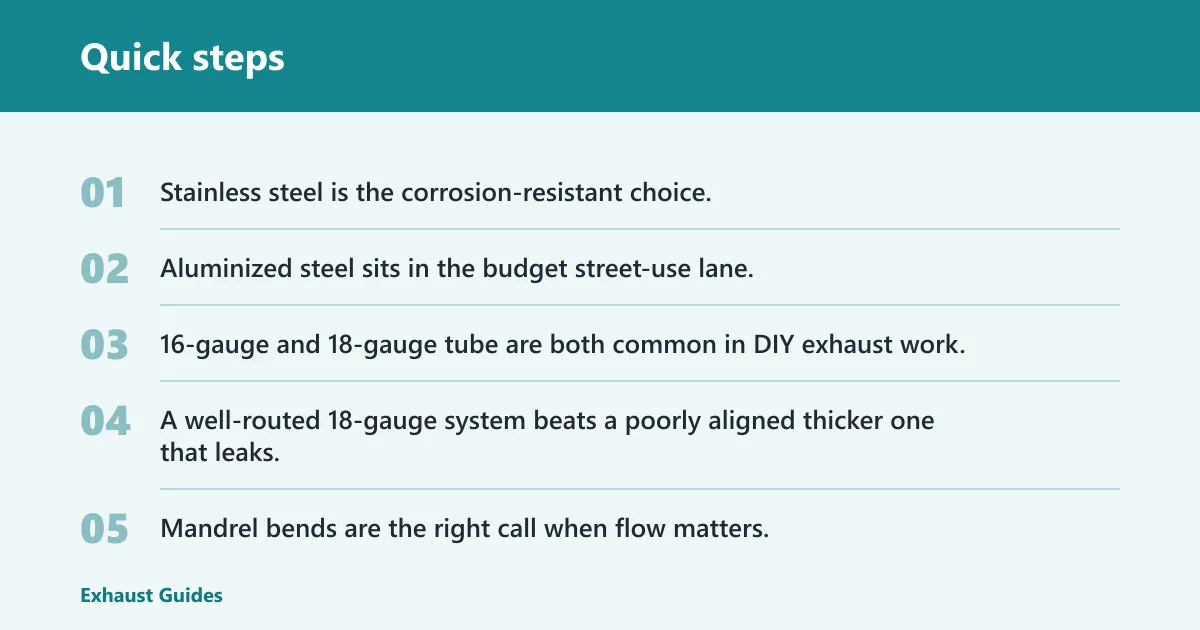
Then match the material to the car’s life. Stainless steel is the corrosion-resistant choice. Mild steel costs less. Aluminized steel sits in the budget street-use lane, where price matters and extreme rust protection is less important.
Wall thickness matters too. 16-gauge and 18-gauge tube are both common in DIY exhaust work, but the build quality and fit are more important than wall thickness alone. A well-routed 18-gauge system beats a poorly aligned thicker one that leaks.
Mandrel bends are the right call when flow matters. Straight sections, 45-degree bends, 90-degree bends, and 180-degree U-bends let you route around the chassis while keeping diameter more consistent through turns.
Installation hardware is not an afterthought. Clamps, bolts, nuts, and hangers need to match the system, and welding is sometimes not required if the kit is truly slip-fit and the joints are cut square.
Picture a winter car with one rusty rear hanger and a muffler that already drips condensate from a bad seam. A shiny new axle-back will not fix bad flange surfaces or torn rubber hangers, so the better move is to replace the worn hardware at the same time.
How to upgrade exhaust starts with a fitment check, not a sound clip. Measure diameter, count hangers, check clearance, and confirm flange style before ordering. That order saves time and reduces the chance of buying a part that needs surprise cutting or returns.
Frequently asked questions
Will a new exhaust improve performance?
Sometimes, but not always. A new exhaust can improve flow, throttle response, or sound depending on the design, pipe diameter, and the engine setup. A stock daily driver may gain little beyond tone, while a better-matched cat-back or mandrel-bent custom system can make more sense on a performance build.
How do you make exhaust sound better?
If sound is the goal, start with the muffler style before changing the whole system. Axle-back kits, universal mufflers, and some cat-back systems can deepen tone without requiring major fabrication. Avoid chasing sound with a pipe size that is too large for the engine, since that can add drone and reduce drivability.
How do you get higher from car exhaust?
Do not do that. Exhaust fumes are dangerous and can cause severe injury or death, especially in an enclosed space. If the real goal is more sound or performance, choose a legal exhaust upgrade and keep the cabin sealed, the tailpipe clear, and the vehicle outdoors during any running checks.