How Often Do Exhaust Manifolds Crack? Essential Facts
Exhaust manifolds typically crack after prolonged exposure to high heat cycles, often taking 100,000 to 150,000 miles or several years of heavy use to fail, though driving habits and engine design significantly impact this lifespan. Early symptoms include loud exhaust leaks or noticeable drops in engine performance.

As an Amazon Associate I earn from qualifying purchases.
Welcome! Dealing with engine issues can feel overwhelming, especially when you hear strange noises coming from under your car. The exhaust manifold is a crucial, hardworking part that manages hot gases leaving your engine. When it cracks, it can cause irritating noise, poor fuel economy, and even engine problems.
You might be wondering, “How often do exhaust manifolds crack?” It’s a fair question! The answer isn’t a simple number, as many things affect this part’s life. But don’t worry; as your trusted automotive guide, I’m here to simplify this for you. We will break down exactly what causes these cracks, what signs to look for, and what a realistic lifespan looks like for your specific vehicle.
We are going to cover the lifespan, the common reasons for failure, and what you need to know before visiting the repair shop. Let’s take the mystery out of your exhaust system!
Understanding the Exhaust Manifold: Your Engine’s First Line of Defense
Before we talk about cracking, let’s quickly understand what this part does. Think of the exhaust manifold as the very first piece of piping attached directly to your engine cylinders. Its job is simple but vital: collect the hot, burnt gases from each cylinder and channel them safely into the rest of the exhaust system (like the catalytic converter and muffler).
Because it sits right next to the engine, it handles extreme heat—often hundreds of degrees Fahrenheit. This constant heating up (when you drive) and cooling down (when you stop) is called “thermal cycling.” This cycling is the main enemy of the manifold material.
How Often Do Exhaust Manifolds Crack? The Realistic Lifespan
This is the core question! There is no set factory recall schedule for manifold failure because it depends heavily on how you drive, the quality of the part, and the engine itself. However, we can provide some general expectations based on years of automotive repair experience.
General Mileage and Age Expectations
For most modern vehicles using cast iron manifolds (which is very common), you can generally expect them to last a long time—often beyond the typical ownership period. Here are some general guidelines:
- Typical Lifespan: Many manifolds last between 100,000 and 150,000 miles.
- Timeframe: This often translates to 8 to 12 years of regular service.
- Premium/Heavy Duty: Some heavy-duty trucks or vehicles driven gently might see manifolds last well over 200,000 miles.
The “It Depends” Factor: Why Some Crack Sooner
If your neighbor’s car went 200,000 miles without issue, but yours cracked at 80,000 miles, why the difference? It usually comes down to operational stress. Think about it like this: a marathon runner’s shoes wear out faster than a casual walker’s.
1. Driving Habits and Load
Constant high-stress driving puts immense thermal load on the manifold.
- Towing/Hauling: Regularly towing heavy loads forces the engine to work harder, leading to higher exhaust gas temperatures.
- Aggressive Driving: Frequent hard acceleration and high RPMs generate more heat, stressing the metal more often.
- Idling: Ironically, excessive idling can also cause issues. While the engine isn’t hot, the slow cooling cycle can sometimes stress the metal differently than continuous running.
2. Engine Design and Material
Not all manifolds are created equal. The material used by the manufacturer plays a huge role in its durability.
| Manifold Material | Pros | Cons | Common Use |
|---|---|---|---|
| Cast Iron | Very durable, resists warping, good heat retention. | Heavy, can rust/corrode over decades. | Most standard passenger cars. |
| Stainless Steel | Lighter, excellent resistance to corrosion, better flow potential. | Can warp under extreme, rapid heat cycles if not high-quality. | Performance upgrades, some modern engines. |
| Tubular (Headers) | Optimized flow, lighter weight. | More susceptible to cracking from improper installation or tuning issues. | Aftermarket performance builds. |
If your vehicle has an original equipment manufacturer (OEM) cast iron manifold, it is designed to last the life of the vehicle under normal conditions. Failures outside that 100k-150k window are often due to external factors, not simply age.
The Role of External Environment
Where you drive matters significantly. A car driven in snowy, salted roads up north will experience corrosion much faster than a car driven in a dry, temperate climate. Rust accelerates the thinning of the metal, making it brittle and prone to cracking under the strain of thermal cycling.
For more technical data on material strength under thermal stress, you can review research papers from engineering sources, such as those found on platforms like the National Center for Biotechnology Information (NCBI), which often detail the material science behind high-temperature engine components.

The Top 5 Reasons Exhaust Manifolds Crack (Beyond Just Age)
If you want to understand why your manifold might fail prematurely, you need to look beyond the odometer reading. Here are the most common triggers that accelerate manifold failure:
1. Overheating and Extreme Heat Cycles
This is the number one killer. When the engine runs hotter than designed, the metal expands too much, too fast. When it cools down, that rapid contraction puts massive stress on the material, leading to hairline fractures that eventually grow.
Causes of Overheating:
- Faulty cooling system (low coolant, bad water pump).
- Leaning air/fuel mixture (too much air, not enough fuel), which burns hotter.
- Blown head gasket allowing combustion gases into the cooling system.
2. Loose or Damaged Mounting Bolts
The manifold is held to the cylinder head by several bolts. If these bolts loosen over time (due to vibration or uneven heating), the seal between the manifold and the engine block is compromised.
A leak allows exhaust gases to escape directly onto the manifold itself or the surrounding components. This localized, uneven heating can create hot spots, causing the manifold to crack near the mounting flange.
3. Improper Installation or Reassembly
If the manifold has been replaced before, improper torque (tightness) when installing the new bolts is a common cause of early failure. Bolts must be tightened in a specific pattern and to a precise specification (torque setting) provided by the manufacturer. Overtightening can stretch or break the bolts immediately, while undertightening leads to leaks and uneven stress, as mentioned above.
4. Poor Engine Tuning (Running Rich or Lean)
An engine that is tuned incorrectly runs inefficiently. A “lean” condition (too much air, not enough fuel) makes the combustion burn hotter. A “rich” condition (too much fuel) can cause unburnt fuel to ignite further down the exhaust line, creating excessive heat spikes.
Modern vehicles rely on the Oxygen (O2) sensors to keep the fuel mixture perfect. If these sensors fail or the computer (ECU) malfunctions, the wrong mixture can slowly cook the manifold.
5. Corrosion and Rust
Especially in damp climates or areas where salt is used on roads, external corrosion eats away at the metal. Once the outer wall thins, the manifold is much less structurally sound and cannot handle the internal pressures and thermal expansion caused by normal operation.
Recognizing the Warning Signs: How to Tell If Your Manifold Has Cracked
The good news is that a cracked exhaust manifold rarely fails without giving you some warning signs. Catching these early can save you from more costly engine damage down the line. Here are the most common symptoms a beginner driver should watch for:
Sound: The Ticking or Tapping Noise
This is often the first and most noticeable symptom. When a crack occurs, especially near the engine ports, the high-pressure exhaust gas rushes out of the small opening with every exhaust stroke. This creates a ticking or tapping sound that matches the engine RPM.
Key Observation: The ticking sound is usually loudest when the engine is cold. As the engine heats up, the metal expands, sometimes temporarily sealing the small crack, which makes the noise quiet down or disappear completely. This fluctuating noise is a huge red flag.
Smell: The Smell of Exhaust Fumes in the Cabin
If the leak is bad enough, or if the crack is located under the car where the manifold connects to the downpipe, exhaust fumes—which contain dangerous carbon monoxide—can leak into the cabin. This is a serious safety issue.
Safety First: If you smell exhaust inside your car, pull over safely, turn off the engine, and do not drive it again until it has been inspected. Carbon monoxide is colorless and odorless until it reaches dangerous levels.
Performance Issues
Since the manifold is critical for efficiently pulling gases out of the cylinder, a leak disrupts this process. This disruption affects how the engine breathes.
- Reduced Engine Power: The car might feel sluggish, especially when accelerating.
- Poor Fuel Economy: The engine computer might try to compensate for the lost exhaust pressure, leading to inefficient fuel burn.
- Rough Idling: The inconsistent exhaust flow can lead to a shaky or rough idle.
Visual Clues: Soot Staining
If you look closely at your engine bay (when the engine is cool!), look at the manifold itself. If there is a crack or a leaky gasket, you will often see black soot or carbon residue staining the outside of the metal right where the exhaust gas is escaping.
DIY Check: Simple Steps You Can Take Today
You don’t need a fancy garage to check for basic leaks. Here is a simple, safe check you can perform:
- Visual Inspection (Cold Engine): Park the car and let it cool completely. Open the hood and visually inspect the manifold runners for any obvious black marks, cracks, or broken bolts.
- Listen Test (Warm Engine): Start the car and let it idle. Listen carefully for ticking noises. Gently revving the engine slightly can sometimes make a leak louder. (Remember: Be careful around moving belts and hot components!)
- Paper Test (Advanced Tip): If you suspect a leak but can’t hear it clearly, take a piece of thin paper or cardboard and carefully wave it near suspected leak points (around the bolt areas) while the engine is idling. If the paper is sucked toward the manifold or pushed away erratically, you have a leak source.
Manifold Replacement: What Does a Repair Entail?
When a crack is confirmed, the manifold usually needs replacement rather than repair, especially on cast iron units. Welding a cast iron manifold is difficult, expensive, and often fails again quickly due to the repeated heat stress.
The Replacement Process Overview
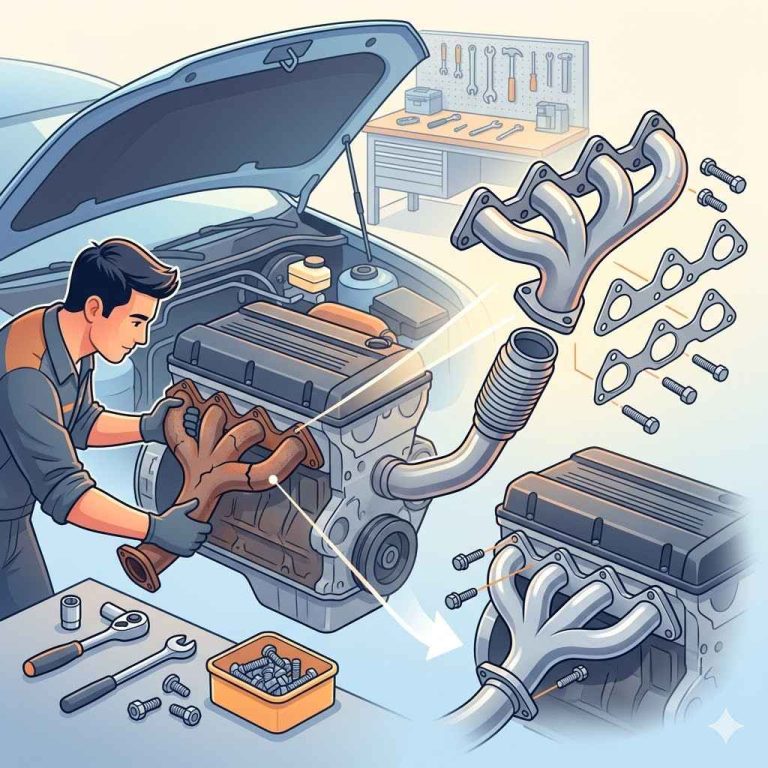
Replacing an exhaust manifold is a moderate to difficult DIY job, often best left to experienced mechanics due to the risk of breaking bolts stuck in the engine head. Here is the general workflow a professional follows:
| Step # | Action | Critical Consideration for Beginners |
|---|---|---|
| 1 | Safety & Access | Disconnect the battery. Raise and secure the vehicle safely (jack stands are mandatory). Remove any surrounding components blocking access (e.g., heat shields, sensors). |
| 2 | Unplug Connections | Carefully disconnect the oxygen (O2) sensors plugged into the manifold or exhaust pipe. These are expensive if broken! |
| 3 | Remove Old Manifold | Attempt to loosen the manifold flange nuts/bolts. This is where things often go wrong. Heat and rust frequently seize these bolts, causing them to snap off. |
| 4 | Address Broken Bolts | If bolts break, they must be carefully drilled out and the threads chased (cleaned) before the new manifold can be installed. This requires specialized tools. |
| 5 | Install New Manifold | Install the new gasket (always use a new one!). Bolt the new manifold onto the head using the factory torque specifications and pattern. |
The Biggest Hurdle: Broken Bolts
The metal of the manifold and the bolts holding it are subjected to vastly different temperatures and materials (manifold vs. cylinder head). This difference causes expansion and contraction that seizes the threads over time. If a bolt snaps flush with the head, drilling it out without damaging the head’s delicate threads is a high-skill task. Damage here can lead to costly cylinder head removal.
Repair vs. Replacement Cost Comparison
When you are quoted a price, understanding what you are paying for is key. The cost difference between repair and replacement often favors immediate replacement for long-term reliability.
- Minor Weld Repair (Rarely Recommended): $150 – $300. Good only for very small, surface cracks on easily accessible, thick cast iron.
- Full Manifold Replacement (Parts Only): $75 – $250 for a standard OEM-quality manifold. Performance stainless steel can be $400+.
- Labor (Standard Replacement): $300 – $700, depending on vehicle access and bolt condition.
- Labor (If Bolts Break): Can add $200 – $500+ if significant time is needed for bolt extraction and thread repair.
Because of the high labor cost associated with extracting seized bolts, many shops prefer to quote replacement immediately, as the risk of spending hours extracting bolts only to still need a replacement is high.
Preventative Maintenance: How to Make Your Manifold Last Longer
Since we know that thermal cycling and overheating are the main culprits, preventative maintenance focuses on protecting the engine’s temperature and ensuring the manifold hardware stays tight.
Tip 1: Maintain a Healthy Cooling System
This is your primary defense against excessive heat.
- Check coolant levels regularly.
- Flush and replace coolant according to your owner’s manual schedule (usually every 30,000 to 60,000 miles).
- If your temperature gauge creeps up, address the cooling system immediately—don’t wait for a crack to form.
Tip 2: Keep Your Engine Tuned and Running Cleanly
Ensure your vehicle is getting the correct fuel mixture. A properly running engine operates at its designed thermal efficiency.
- Replace old spark plugs on time.
- Ensure air filters are clean so the engine doesn’t run too lean due to airflow restrictions.
- If your Check Engine Light comes on, diagnose the cause quickly, especially if it relates to O2 sensors or misfires.
Tip 3: Check Hardware Periodically
If you are comfortable performing basic checks, you can ask your mechanic to check the torque on the manifold mounting bolts during routine oil changes. This is especially important if you notice very light ticking noise that disappears quickly when warm.
For more detailed maintenance schedules on engine components, consult official resources like those provided by the U.S. Department of Energy, which offer general efficiency and maintenance guidelines for vehicle owners.
Upgrading to Performance Headers: A Different Set of Rules
Many enthusiasts look to replace the restrictive stock manifold with aftermarket headers (which are usually stainless steel and designed for better flow). While these can improve performance, they introduce new failure modes.
Pros and Cons of Aftermarket Headers
| Feature | Stock Manifold | Aftermarket Headers |
|---|---|---|
| Durability Focus | Thermal resistance and longevity. | Flow efficiency and maximizing horsepower. |
| Cracking Risk | Low, usually due to age or severe overheating. | Higher, especially if installed on a stock engine without proper tuning adjustments. |
| Heat Management | Thick cast iron retains heat well. | Thinner metal radiates heat faster; ceramic coating recommended. |
If you upgrade to headers, you must ensure your engine is properly tuned for the change in exhaust flow. An improperly tuned car with performance headers is much more likely to run excessively hot and crack the new, often thinner, steel tubes.

Frequently Asked Questions (FAQ) About Exhaust Manifolds
Q1: Can I ignore a small ticking sound from my exhaust manifold?
A: No, you should not ignore it. A small tick means a leak is present. If ignored, the leak will usually get bigger as the metal fatigues, leading to louder noise, reduced performance, and potentially allowing dangerous exhaust gases into the cabin.
Q2: How long does it take a mechanic to replace an exhaust manifold?
A: For an easy-to-access manifold, labor can range from 2 to 4 hours. However, if the bolts are rusted or broken off in the cylinder head, the job can easily extend to 6 to 10 hours or more to safely extract the broken bolts.
Q3: What is the difference between a manifold leak and a gasket leak?
A: The manifold is the heavy metal component attached to the engine. The gasket sits between the manifold and the engine head. A gasket leak is often easier and cheaper to fix than a cracked manifold, as you only replace the small gasket, not the entire heavy casting.
Q4: Will exhaust leaks affect my O2 sensor readings?
A: Yes. If the leak is before the oxygen sensor (which is common), the sensor will draw in extra ambient air instead of just exhaust gas. This fools the sensor into thinking the engine is running lean, causing the car’s computer to dump extra fuel, worsening fuel economy.
Q5: Is it safe to drive with a cracked exhaust manifold?
A: It is generally not safe long-term, and definitely not safe if fumes are entering the cabin. While the car might run, you risk causing further damage to components near the leak due to excessive heat, and you risk carbon monoxide poisoning if the leak is severe enough to enter the passenger compartment.
Q6: Can cold weather cause an exhaust manifold to crack?
A: Cold weather itself doesn’t cause the crack, but the rapid change in temperature does. Starting a car in freezing weather and immediately driving it hard subjects the cold metal to intense heat very quickly, drastically increasing thermal shock and the chances of cracking.
Conclusion: Taking Control of Your Exhaust Health
Understanding “how often do exhaust manifolds crack” boils down to understanding stress. In short, expect them to last well over 100,000 miles if your engine runs cool and is properly maintained. When failures occur earlier, it’s almost always due to a secondary issue—be it overheating, a loose bolt, or poor engine tuning—that accelerates the natural thermal cycling process.
As a car owner, your best defense is proactive care. Listen for that telltale ticking, keep an eye on your temperature gauge, and ensure your cooling system is always in top shape. By focusing on these basic maintenance checkpoints, you can significantly extend the life of your exhaust manifold, save money on premature replacements, and keep your ride running safely and efficiently for years to come. You now have the essential facts to confidently monitor this critical part of your engine!
Related pick: Check today's price on Amazon