Exhaust Manifold Gasket vs Donut Gasket Differences
Choose the seal by joint geometry, not the label: a flat two-bolt or multi-bolt flange needs a flat manifold gasket, while a ball-and-socket or tapered slip joint needs a donut gasket. Using the wrong seal usually causes leaks, noise, exhaust odor, and a return trip with the same parts. This guide shows how to identify the joint, match the seal type, and avoid buying the wrong exhaust gasket.
| Decision factor | manifold gasket | donut gasket | Winner |
|---|---|---|---|
| Joint geometry | Flat clamped flange at the manifold-to-cylinder-head joint | Conical ring that compresses into a tapered seat | Depends on joint shape |
| Pipe movement | Best where movement is limited and clamp load must stay even | Better where the pipe needs slight angle change or slip at the connection | donut gasket |
| Heat and fatigue at the seal | Built for sustained exhaust heat near the head | Handles heat too, but usually sees more motion at the connection | manifold gasket |
| Typical service fit | Cast-iron manifold to cylinder head, flat flange, fixed bolt spacing | Pipe-to-manifold or pipe-to-pipe flange with tapered seat | Depends on layout |
| Reuse after disassembly | Usually replaced once removed | May not reseal after removal or crush set | manifold gasket |
What is the difference between an exhaust manifold gasket and a donut gasket?
The difference starts with the joint, not the part name. A manifold gasket typically seals a flat manifold-to-cylinder-head flange, while a donut gasket usually seals a conical or tapered exhaust connection and compresses into a seat. If the shape does not match, the seal will not hold clamping load well.
That matters because exhaust flange flatness, bolt spacing, and pipe angle control how the joint seals. A flat flange needs even preload across the face. A tapered joint needs a ring that can crush into the cone and tolerate a little movement.
Flat flange vs tapered seat
A flat flange relies on a gasket spread across a broad mating surface. A donut gasket works differently: it concentrates seal force into the taper and the metal seat around it. Those are not interchangeable designs.
Manifold-to-head sealing vs exhaust connection sealing
The manifold gasket seals hot exhaust gas at the cylinder head. A donut gasket usually seals a pipe-to-manifold or pipe-to-pipe connection farther downstream. The name on the box matters less than the geometry under the bolts.
Why the part name is less useful than the joint shape
Two vehicles can both have “exhaust gaskets,” but one may need a flat graphite or MLS sheet while the other needs a crush ring. If you buy by catalog label alone, you can end up with the wrong thickness, the wrong seat angle, or a part that will not center under clamping load.
How to identify the exhaust joint
Start by looking at the mating faces. A flat, machined, or clean cast surface points toward a manifold gasket. A cone-shaped seat, ball-style connection, or slip joint with a ring groove points toward a donut gasket.
Check the bolt pattern too. Bolt spacing and flange shape help identify the seal type before you order parts. If the pipe can pivot slightly at the joint, that motion usually points away from a flat manifold gasket and toward a donut-style seal.
- Look for a flat sealing face at the joint.
- Look for a tapered or conical seat inside the flange.
- Check whether the pipe can move or swivel slightly.
- Measure bolt spacing and compare the flange shape.
- Match the seal to the joint, not to the vehicle name alone.
Picture a two-bolt flange on a rust-belt truck where the pipe meets the manifold at an angle. If the flange face is flat and the bolts pull squarely, that points to a manifold gasket. If the connection has a taper that centers a ring, that points to a donut gasket even though both sit in the exhaust path.
Which exhaust seal do I need?
The right seal depends on joint type, flange shape, pipe movement, vehicle layout, and the symptoms at the joint. Use the table below to match what you see on the car to the seal that belongs there.
| Joint type | Flange shape | Pipe movement | Common vehicle layout | Typical symptoms | Recommended seal type |
|---|---|---|---|---|---|
| Manifold to cylinder head | Flat clamped face | Very little movement | Cast-iron manifold bolted to the head | Ticking on cold start, odor near the engine bay, soot at the head joint | manifold gasket |
| Pipe to manifold with taper | Conical or tapered seat | Some angle change or slip | Front pipe connection on many exhaust systems | Puffing sound under load, soot around the flange, smell in the cabin or bay | donut gasket |
| Pipe to pipe with tapered flange | Tapered or ball-style seat | Moderate movement | Sectioned exhaust connection | Leak sound that changes with engine load | donut gasket |
| Flat flange with aligned pipes | Flat face, even bolt pull | Minimal movement | Joined sections with a flat seal face | Soot around the perimeter if preload is lost | manifold gasket |
What each seal type does
Exhaust manifold gasket
This gasket seals the manifold-to-cylinder-head joint. It must withstand sustained combustion temperatures, and exhaust heat can climb to over 1,200°F in seconds. In naturally aspirated engines, exhaust pulse pressures rarely exceed 60 psi, which is why flat sealing and stable clamp load matter so much there.
Common materials often include graphite, multilayer steel, and copper-core styles. Graphite gaskets conform better to rough cast-iron surfaces. MLS gaskets use spring-like recovery to handle thermal movement where the joint sees repeated expansion and contraction.
Donut gasket
A donut gasket is a ring-style seal that compresses into a tapered exhaust seat. It is common at flanged connections where the pipe angle matters and where the joint may move slightly during heat cycling. That is why it is chosen by seat shape, not by generic exhaust size claims.
Collector gasket
A collector gasket seals the collector end of a header system, which is a different job from a manifold-to-head seal. It belongs where several header tubes meet into one outlet, not where a stock manifold bolts to the cylinder head.
Band clamp
A band clamp joins aligned pipes and depends on close fit between the pipe ends. It is a clamp-based joint, not a crush-ring or flat manifold seal. Use it when the system is designed for a clamped pipe connection rather than a gasketed flange.
When does a manifold gasket fit best?
A manifold gasket fits best at the head joint where the flange is flat, the bolt spacing matches the manifold, and the connection must seal hot exhaust gas with steady preload. Cast-iron surfaces often pair well with graphite because the material conforms to rougher faces.
Heat cycling is the main stressor here. Repeated expansion and contraction reduces clamp load over time, especially near the manifold. Loose bolts, warped flanges, and thermal fatigue are common reasons a seal loses preload and starts leaking.
Suppose a V6 shows a cold-start tick on the passenger side and soot at the head-to-manifold seam. If the flange face is flat and the bolts are evenly spaced, the correct repair path is a manifold gasket, not a donut seal.
Leak progression often starts small. A slight seep can turn into a stronger puffing sound under acceleration as the joint loses clamp load. A blown exhaust manifold gasket can also let toxic carbon monoxide enter the cabin.
When should you use a donut gasket?
Use a donut gasket when the joint has a tapered seat and the pipe is meant to compress into that cone. This is common at pipe-to-manifold or pipe-to-pipe flanges where the connection is designed to allow some movement without opening the seal.
Donut gaskets fail when the taper is damaged, the flange is warped, or the pipe no longer centers correctly in the seat. Removal can crush or distort the ring, so reusing one after taking the pipe apart is risky and often a bad bet.
A common first-timer mistake is swapping in a flat gasket because the parts catalog only says “exhaust gasket.” If the flange is tapered, the flat part may bolt up but still leak. The noise can sound like a manifold leak, especially under load.
Heat cycling still matters here, but the bigger issue is motion at the connection. Repeated expansion and contraction can loosen preload and let the ring lose its crush. If the flange face is not flat enough to hold torque, the seal will fail early.
Choose manifold gasket if… / Choose donut gasket if…
Choose manifold gasket if the joint is flat, the seal sits between the cylinder head and the manifold, the flange needs even clamping load, and the surface is rough cast iron or a similar rigid face.
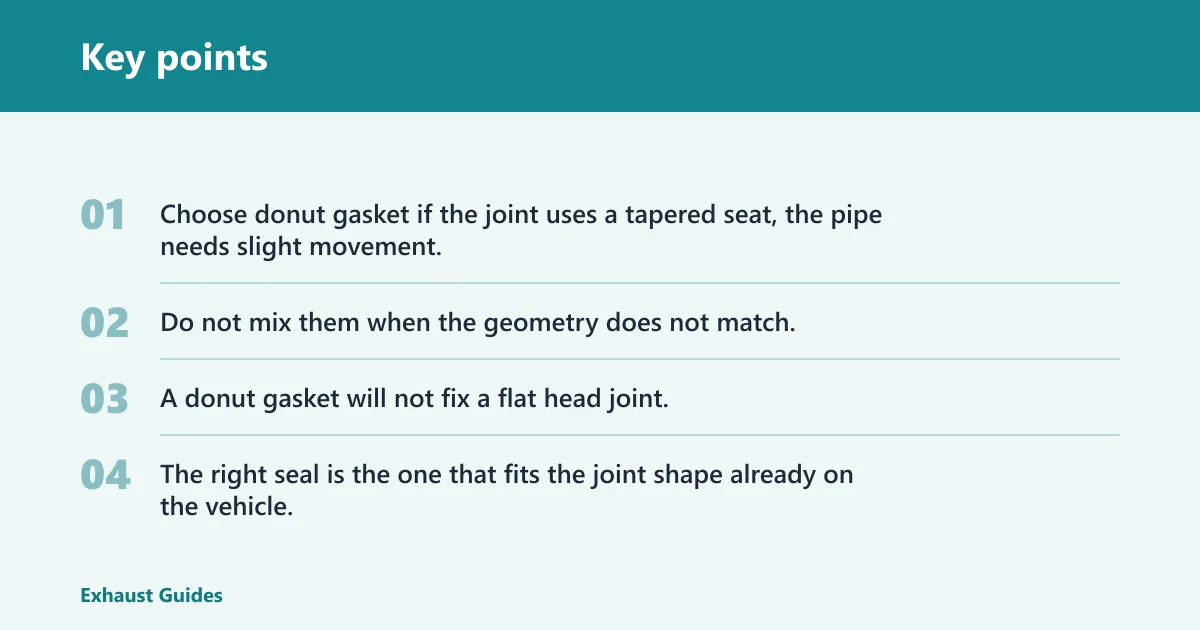
Choose donut gasket if the joint uses a tapered seat, the pipe needs slight movement, the connection is pipe-to-manifold or pipe-to-pipe, and the flange shape centers a crush ring rather than a flat sheet.
Do not mix them when the geometry does not match. A donut gasket will not fix a flat head joint, and a manifold gasket will not seal a tapered flange correctly. The right seal is the one that fits the joint shape already on the vehicle.

- Multi-layer steel seal
- Includes bolts and washers
- Fits LS-series engines
What symptoms does a leaking exhaust manifold gasket cause?
A leaking manifold gasket commonly causes a ticking noise on cold start, exhaust odor in the engine bay or cabin, soot around the head joint, and a loss of low-end torque. The noise often appears first because the leak is easiest to hear before the metal fully heats and expands.
The symptom list is useful, but it is not enough by itself. A donut leak can create a similar puffing sound under acceleration, so check the joint shape before you blame the manifold gasket. Sound tells you there is a leak; geometry tells you which seal failed.
What causes an exhaust donut gasket to fail?
Donut gasket failure usually comes from worn or distorted mating surfaces, lost clamping load, or a joint that no longer centers correctly in the taper. Heat cycling can also fatigue the seal as the pipe expands and contracts against the seat.
Corrosion and rust are common because the ring sits at a connection that sees water, road salt, and repeated thermal movement. If the flange is warped or the bolts are loose, the ring cannot stay compressed evenly. That leads to soot at the joint and a leak that may worsen under throttle.
Can I reuse a donut gasket after removing the exhaust pipe?
Sometimes a donut gasket can be reinstalled, but it should not be treated as reusable by default. Once removed, the ring may crush, harden, or lose the shape needed to seal the taper again. If the joint leaks after reassembly, replacement is the safer move.
If you remove the pipe, inspect the taper, the flange face, and the ring itself. Deep grooves, flattening, or carbon tracks mean the seal has already taken a set. In that case, reusing it often costs more time than replacing it once.
How do I know if my car uses a manifold gasket or a donut gasket?
Look at the joint, not the parts listing first. A flat flange with even bolt pull usually means a manifold gasket. A tapered seat, ball-style connection, or slip joint usually means a donut gasket. Bolt spacing and flange shape are the quickest clues.
Catalog categories can still help, but they are not enough on their own. Some parts sites list exhaust manifold gaskets under engine gaskets, while other exhaust suppliers group flanges, clamps, flex pipes, and accessories together. That grouping does not tell you which seal fits your exact joint.
Can a bad manifold gasket sound like an exhaust leak under acceleration?
Yes. A leaking manifold gasket can sound like a ticking or puffing exhaust leak, and that noise often gets sharper under acceleration when exhaust flow and pulse pressure rise. That said, a donut seal can make a similar sound, so the joint must be inspected before the repair is chosen.
Acceleration noise often points to a leak that opens wider as load changes. If you hear it near the head, inspect the manifold flange, the bolts, and the surface for soot. If the sound is farther down the pipe and the joint is tapered, the donut seal is the likely suspect.
Frequently asked questions
When should I use a gasket instead of a donut seal on the exhaust?
Use a flat gasket when the joint is flat, clamped, and built for a sheet-style seal. Use a donut seal when the flange has a tapered seat and the pipe is meant to compress into it. The joint geometry decides the part, not the product category name.