Performance Exhaust Manifolds vs Headers for Street Use
For street use, choose headers only if you need top-end power and can accept more noise, heat, cost, and fitment work. A quality performance manifold usually gives better drivability per dollar. Pick the wrong part and you can add drone, cracked pipes, slow warm-up, and little real gain where you drive most. This guide explains where headers help, when manifolds are the smarter buy, and how to choose by engine, emissions rules, and budget.
| Decision factor | Performance exhaust manifolds | headers for street use | Winner |
|---|---|---|---|
| Daily drivability | Quiet, compact, and usually easiest to live with | Can improve response, but often adds more noise and heat | Performance exhaust manifolds |
| Power potential | Good on a near-stock engine, with smaller gains | Usually better flow and stronger gains, especially with the right runner length | headers for street use |
| Installation effort | Usually simpler, with less drama around fitment | More bolts, tighter access, and more support parts to manage | Performance exhaust manifolds |
| Emissions compliance | Easier to keep factory-style cat and sensor placement | Can keep cats on some designs, but legality depends on the exact part and state | Performance exhaust manifolds |
| Total cost stack | Lower when you include gaskets, hardware, tuning, and labor | Higher once you add gaskets, hardware, O2 changes, possible mid-pipe work, and tuning | Performance exhaust manifolds |
How exhaust design affects daily driving
On the street, the better part is the one that matches your engine state, emissions rules, and how often you care about refinement. Performance exhaust manifolds usually win for commute duty, while headers for street use start to pay off when the engine has enough airflow demand to use the extra scavenging and lower restriction.
What each part does in the exhaust path
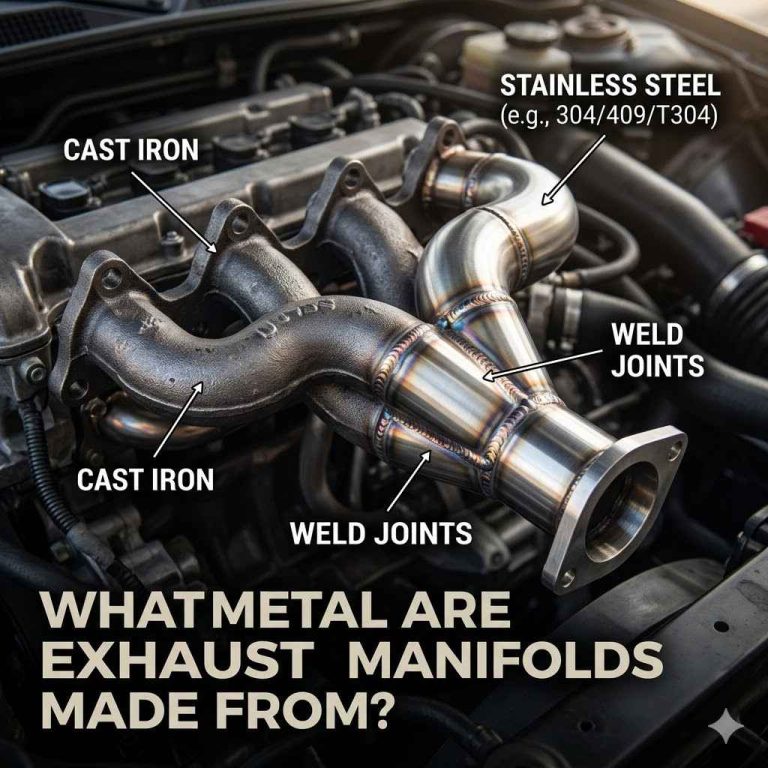
An exhaust manifold is the factory-style piece that gathers exhaust from each cylinder into one outlet. Most stock manifolds are made from cast iron or cast stainless steel, which helps durability, compact packaging, and emissions compliance.
Headers use individual tubular runners instead of a dense cast passage. That layout is built to improve exhaust flow and reduce backpressure, and it can help scavenging when runner length and collector design match the engine.
Why street use changes the tradeoff
A street car often spends most of its time below peak rpm. That matters because a gain that only shows up near redline is less useful than a part that keeps low-speed torque, warm-up behavior, and cabin comfort intact.
Suppose a mostly stock 5.0-liter V8 gets shorty headers, but the rest of the exhaust stays restrictive. The car may feel a little freer, yet the downstream bottleneck can cap the payoff. The part choice should match the whole system, not just the first flange after the cylinder head.
Where flow gains stop mattering as much
Headers are not magic once the rest of the exhaust becomes the limiter. If the catalytic converter, mid-pipe, or mufflers are the tightest point, the cylinder head may see less benefit than the marketing suggests.
That is why street buyers should treat header claims as a system question. The engine size, cam timing, and downstream restriction decide whether the extra flow turns into usable power or just more noise and more installation work.
Street-use decision matrix
The right pick changes with engine state. A stock commuter, a bolt-on weekend car, and a cammed street build do not need the same part, and they do not tolerate the same tradeoffs.
| Engine state | Desired outcome | Part choice | Required supporting mods | Likely tradeoffs |
|---|---|---|---|---|
| Stock | Torque, legality, budget | Performance exhaust manifolds | Factory cat and sensors; no tune unless the OEM system is disturbed | Smaller power gain than headers, but quieter and easier to live with |
| Stock | Sound and mild response | Short-tube headers | Gaskets, hardware, possible O2 extensions; tune often recommended on EFI cars | Modest gains and more install work; emissions fit depends on the design |
| Bolt-on | Torque with a little more top end | Short-tube headers | Cat retention, sensor placement check, possible tune, and mid-pipe compatibility | Better flow than manifolds, but not the biggest step up |
| Bolt-on | Upper-rpm power and stronger exhaust note | Long-tube headers | Matching mid-pipe, O2 sensor relocation may be required, tune likely | More heat, more fitment work, and more emissions risk |
| Cammed | Midrange and upper-rpm power | Long-tube headers | Tune, compatible cats or legal off-road setup, and exhaust matched to collector size | Best power payoff, but the most compromise in daily use |
Stock engine: torque, legality, and budget
On a stock engine, performance exhaust manifolds are usually the smarter buy. They keep the system quiet, compact, and easier to certify, and they avoid paying for runner length and collector design that the engine may not fully use.
The common mistake is buying long-tubes for a near-stock commuter because peak horsepower sounds tempting. The car may feel harsher, the install may cost more, and the street gain can be modest once the downstream exhaust and calibration are left alone.
Bolt-on engine: when short-tubes make sense
Short-tube headers are often considered the middle ground between manifolds and long-tubes. They are easier to fit than long-tubes, often keep closer to the factory exhaust layout, and can give a modest gain without turning the car into a project.
That makes them a reasonable choice when the engine already has intake, exhaust, or calibration work and you want a little more response without the packaging penalties of long-tubes. They still need the rest of the system checked for sensor placement and exhaust leaks.
Cammed engine: when long-tubes earn their keep
Long-tube headers usually make the most sense once the engine can use more airflow. They typically offer stronger power gains, especially in the midrange and upper rpm, where runner length and scavenging can do real work.
That does not make them ideal for every street build. If the car sees traffic, steep driveways, or emissions checks, the extra gain has to be worth the fitment and compliance burden.
Do headers make more power?
Yes, headers generally make more power than exhaust manifolds because they improve exhaust flow and scavenging. The size of the gain depends on engine state, downstream restriction, and whether the part is short-tube or long-tube, so the benefit on a street car can range from modest to noticeable.
Exhaust flow, scavenging, and usable power
Scavenging is the pulse-tuning effect that helps pull exhaust gases out of a cylinder as the next pulse moves through the header. When runner length and collector shape are matched, the engine can fill the cylinder more efficiently on the next intake stroke.
That is where headers can help street drivability, not only peak numbers. Better cylinder emptying can improve torque and throttle response in the range you actually use, provided the rest of the exhaust is not choking the system.
Backpressure claims that need context
Backpressure is often used carelessly in sales talk. Exhaust systems do need some velocity and tuning, but excessive restriction costs efficiency. Headers are designed to reduce that restriction, not to eliminate every bit of resistance at any cost.
The useful question is whether the factory manifold is the bottleneck. On a mild engine, the answer is sometimes no. On a cammed or higher-flow setup, the stock manifold can become the part holding the system back.
Why engine state changes the result
Headers show their best gains when the cylinder heads, cam timing, and exhaust can all move more air. A mostly stock engine often sees less return because the rest of the combination was built around the manifold’s limits.
That is why a performance manifold can be the better dollar-per-driveability move. It leaves more money for tires, brakes, or a tune that may matter more than chasing a few extra peak horsepower numbers.
Short-tube vs long-tube headers
Short-tube headers are the street-friendly compromise. Long-tube headers are the stronger performance choice, but they ask more from the car’s packaging, exhaust routing, and emissions setup.
Power delivery and rpm range
Short-tube headers usually deliver modest gains and often fit with the factory downpipe. That makes them useful when you want a little more flow without changing the car’s whole exhaust path.
Long-tube headers typically offer stronger power gains, especially in the midrange and upper rpm. That can feel better on a spirited street car, but the added benefit often shows up where daily commuting spends less time.
Fitment, ground clearance, and heat
Short-tube headers are easier to fit, which matters on cars with tight steering shafts, crossmembers, or chassis bracing. They are also less likely to hang low enough to scrape on speed bumps or steep driveways.
Long-tubes add more installation difficulty and more heat near nearby components. They can also create more ground-clearance issues, especially on lowered cars or platforms with narrow tunnels.
Mid-pipe and O2 sensor implications
Headers may keep the catalytic converter in the stock place, move it, or require a different mid-pipe depending on the design. For long-tube headers, O2 sensor relocation may be required, and that is one reason the install is rarely plug-and-play.
That extra hardware affects more than labor time. It can also change how the ECU reads exhaust flow, which is why tuning or calibration often becomes part of the job on modern fuel-injected engines.
Will headers hurt street manners?
They can. Long-tube headers are often reported to be more likely to hurt low-speed smoothness, increase cabin noise, and add heat-related hassle, especially on a mostly stock street engine. Short-tube headers are generally less likely to cause that kind of compromise, but they still change the car’s character.
Low-end torque on mostly stock engines
On a stock or near-stock engine, long-tubes can shift the powerband upward. That can make the car feel softer off the line if the rest of the setup does not support the change.
Short-tubes are less likely to do that because they stay closer to the factory exhaust layout. They are still a compromise, but they usually preserve more of the low-speed feel that daily drivers need.
Noise, drone, and cabin comfort
Headers often make the exhaust louder, and the tone usually gets sharper. Long-tubes often deepen the note and can increase drone if the rest of the exhaust is not tuned for it.
That matters on commute duty. A car that sounds exciting for five minutes may become tiring on a 30-minute highway drive, especially if the mid-pipe and mufflers were chosen around peak flow instead of cabin comfort.
Heat soak, leaks, and cracking risks
Header installations put more heat in the engine bay than a compact cast manifold. That can affect nearby wiring, hoses, and starter components if heat shielding is not handled well.
Leaks and cracking are often reported as more common concerns with tubular headers than with a cast manifold. Thin tubes, repeated heat cycles, and poor gasket sealing can turn a performance upgrade into a maintenance problem.
Exhaust-manifold spec checklist
If you are leaning toward a manifold, the details still matter. The right piece should match the engine’s exhaust ports, outlet path, and emissions equipment without creating a bottleneck that the rest of the build cannot tolerate.
Material, runner shape, and outlet design
Most stock manifolds are cast iron or cast stainless steel, and that matters because those materials handle heat and daily use well. They are compact, durable, and built for cost efficiency as much as airflow.
Runner shape is the main performance limiter. A cleaner outlet and smoother internal path can help, but a manifold still gives up some flow compared with a tubular header.
Catalytic converter location and emissions fit
For street legality, cat location is not a side issue. Some headers keep the catalytic converter in a stock-like position, while others move it or remove it from legal use in emissions-controlled areas.
Sensor location matters too. If the O2 sensors end up in the wrong place, the ECU may not read the exhaust correctly, and drivability can suffer even if the part bolts on.
Why OEM-style manifolds stay popular
OEM-style manifolds remain common because they are quiet, easy to package, and friendly to emissions hardware. They are also the safer choice when the car has to pass inspection, start cleanly in cold weather, and stay low-maintenance.
For many street cars, that is enough. The goal is not maximum flow on paper. It is a car that feels good to drive every day without extra hassle.
Choose Performance exhaust manifolds if… / Choose headers for street use if…
Choose Performance exhaust manifolds if you drive the car every day, want the quietest and easiest fit, need to keep emissions compliance simple, or are working with a stock engine that does not need extra upper-rpm airflow.
Choose headers for street use if the engine is already modified, you want stronger midrange or upper-rpm power, you can budget for gaskets, hardware, O2 work, and tuning, and you are willing to accept more heat, sound, and installation effort.


Frequently asked questions
Are headers worth it for a daily driver?
Sometimes, but only when the car has enough supporting mods to use the extra flow. For a mostly stock daily driver, a good manifold often gives a better mix of quiet operation, fitment, and cost. If you value easy living more than peak power, manifolds usually win.
Do headers make more power than exhaust manifolds on the street?
Generally yes, because headers improve exhaust flow and scavenging. The size of the gain depends on engine state, downstream restriction, and header type. On a near-stock street car, the difference may be modest. On a cammed build, the gain is usually more meaningful.
Will long-tube headers hurt low-end torque?
They can on a mostly stock engine, because the powerband may move upward. That does not always mean less total torque everywhere, but it can feel softer at lower rpm if the rest of the setup is not matched. Short-tubes are less likely to create that tradeoff.
Are shorty headers better for street use than long-tubes?
For many street cars, yes. Short-tube headers are easier to fit, usually keep closer to the factory layout, and offer modest gains without the full packaging penalty of long-tubes. Long-tubes make more power, but they demand more space, more supporting parts, and more compliance checks.
Will I need a tune after installing headers?
Often, yes on modern fuel-injected cars, especially with long-tubes. The ECU may need calibration for air-fuel ratio, sensor placement, and drivability. Even if the engine runs, a tune can help avoid warning lights, odd fuel trims, or rough part-throttle behavior.
Are headers street legal in California?
It depends on the exact part and whether it keeps the catalytic converter and emissions hardware in a certified configuration. Many long-tube setups are not street-legal in emissions-controlled areas unless they carry the right certification and preserve the required layout. Check the exact application before buying.
What are the install drawbacks of headers vs manifolds?
Headers usually need more labor, tighter access, and more supporting parts. You may need new gaskets, hardware, O2 extensions, a different mid-pipe, and a tune. Manifolds are simpler to fit, more compact, and less likely to create heat or ground-clearance problems.