Aftermarket Exhaust Manifold Fitment vs OEM Comparison
OEM exhaust manifolds usually fit with the least guesswork; aftermarket is worth it only when the part number, flange shape, heat shield mounts, and sensor bosses match your engine code exactly, because one bad fit can erase any savings after labor. Poor fit can turn a cheaper manifold into a higher total repair bill through rework, new gaskets, broken studs, or a second install. This guide compares OEM and aftermarket manifolds by fitment risk, total install cost, and the cases where paying more up front is cheaper overall.
| Decision factor | Aftermarket exhaust manifold fitment | OEM | Winner |
|---|---|---|---|
| Initial part price | Often lower, especially for direct-replacement budget parts | Usually higher because the vehicle maker supplies the original-spec part | Aftermarket exhaust manifold fitment |
| Flange flatness and port alignment | Varies by brand; quality parts may still need tweaks if tolerances are off | Matched to factory specs | OEM |
| Hardware and gasket compatibility | May omit studs, nuts, or shield mounts; thread match is not guaranteed | Best match for factory gaskets, studs, and catalytic converter connections | OEM |
| Repeat-labor risk | Higher when holes, outlet angle, or casting quality are off | Lower because OEM parts are designed to fit without adjustments | OEM |
| Best use case | Budget repair, older vehicle, or direct-fit replacement from a known brand | Late-model daily driver, emissions-sensitive repair, or first-time fix | Tie |
Factory specs vs third-party tolerances
The main trade-off is simple: OEM buys predictability, while aftermarket buys price flexibility. That only helps if the replacement matches flange shape, port layout, and outlet connection closely enough to avoid rework.
Why factory specs reduce install risk
OEM parts are made by the vehicle manufacturer and built to the same dimensions the engine left the factory with. That matters at the cylinder head flange, where a flat sealing surface and correct bolt-hole accuracy help the gasket seal without stressing studs.
OEM also tends to align better with factory gaskets, studs, and catalytic converter interfaces. For a daily driver, that usually means fewer surprises during torque-up and a lower chance of a repeat teardown.
Where aftermarket tolerances vary
Aftermarket parts are made by third-party companies and can vary in quality, price, and compatibility. A quality aftermarket part may still require installation tweaks if tolerances are off, while budget aftermarket options can need filing, drilling, or hammering to make them work.
That spread is why two manifolds with the same engine listing can behave very differently. A direct-fit replacement can be fine; a performance-oriented design may change runner shape, outlet angle, or sensor placement enough that it is not a simple swap.
What an exhaust manifold does
The exhaust manifold collects exhaust from the engine’s cylinders and routes it away from the head. When it seals poorly, common warning signs can include ticking on startup, exhaust smell, soot, and sometimes a check engine light.
Why replacement quality affects drivability
A manifold leak is not only noisy. It can affect how the engine sounds, how the exhaust system seals downstream, and whether the vehicle passes an inspection where leak checks matter.
Fitment mistakes also create mechanical damage. Broken studs, blown gaskets, and warped flanges often turn one repair into two.
OEM exhaust manifold: where it usually wins
OEM usually wins on fit, compatibility, and first-time installation confidence. It is the factory-original benchmark, and that makes it the safer pick when you want the part to match the head, gasket, studs, and catalytic converter connection points without adjustment.
Flange and port alignment with the cylinder head
The cylinder head flange must sit flat against the head, with ports centered over the exhaust openings. OEM parts are built for that geometry, so the sealing surface and bolt-hole location usually line up without filing or slotting.
Factory gasket, stud, and catalytic converter compatibility
OEM is the easiest route when you want to reuse factory-style gaskets, studs, and hardware patterns. It also gives the best odds of matching the catalytic converter interface, which matters for leak prevention and emissions-related fitment.
That compatibility reduces torque sensitivity too. If the holes, flange thickness, or outlet angle are off, studs can bind or pull unevenly and create a leak at the joint.
Noise control and drivability baseline
OEM also tends to preserve the factory noise-control and drivability baseline. For a stock daily driver, that matters more than headline material claims, because most replacement manifolds do little to no horsepower gain.
Aftermarket exhaust manifold: what changes
Aftermarket manifolds split into two broad groups: direct-replacement parts and upgraded designs. The first aims to copy factory fit; the second may change flow, runner shape, or material in ways that can improve durability or serviceability, but not always fit on the first try.
Direct-replacement vs upgraded designs
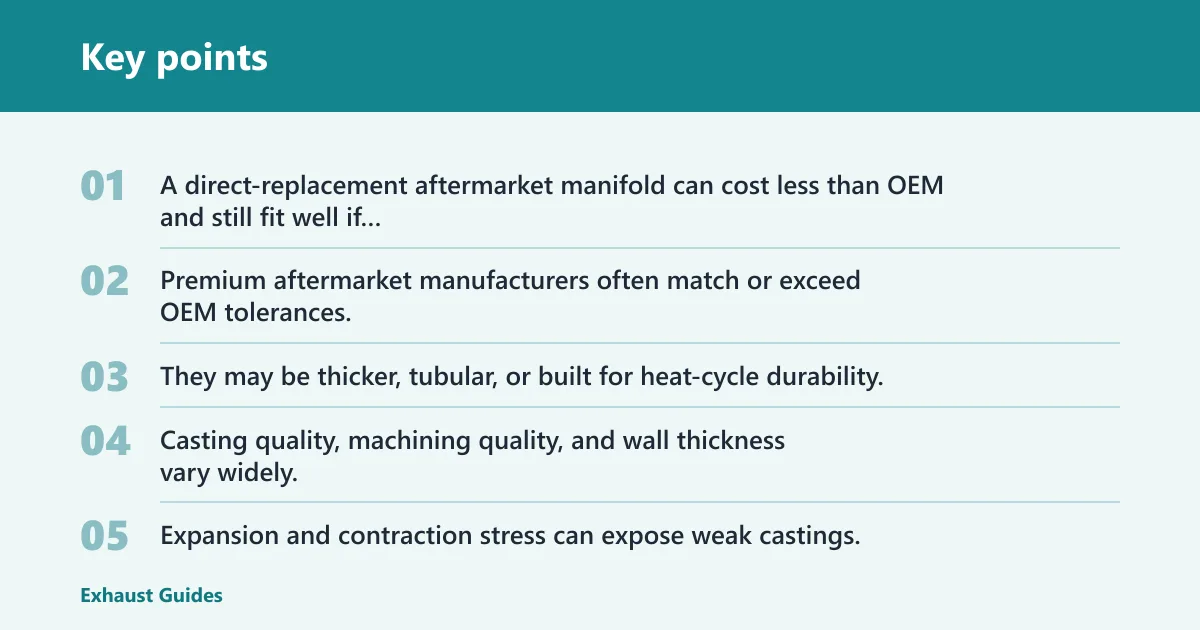
A direct-replacement aftermarket manifold can cost less than OEM and still fit well if the brand holds tight tolerances. Premium aftermarket manufacturers often match or exceed OEM tolerances.
Upgraded designs are different. They may be thicker, tubular, or built for heat-cycle durability, but they can shift hardware locations or outlet alignment enough to demand more careful checking.
Price spread and material quality variability
Price does not tell you enough by itself. Casting quality, machining quality, and wall thickness vary widely, so a lower price can come with rough surfaces, poor flange flatness, or a warped sealing face that needs machining.
Heat cycling matters here. Expansion and contraction stress can expose weak castings, and a part that looks fine on the bench can crack or warp earlier once it starts seeing repeated thermal swings.
When aftermarket can fit well
Aftermarket fit can be excellent when the listing matches the exact engine code and the part includes the right heat shield mounts, sensor bosses, and outlet geometry. In that case, the savings can be real.
If a 12-year-old work truck needs a manifold and the OEM piece is backordered, a direct-fit aftermarket manifold may be the practical fallback. A direct-fit aftermarket unit with matching stud holes and a correct catalytic converter flange can get the truck back on the road without the delay.
Fitment risk matrix
This matrix scores the practical failure points that matter during installation. It focuses on the surfaces and interfaces that cause repeat labor when they are wrong.
| Fitment check | Aftermarket exhaust manifold fitment | OEM | Winner |
|---|---|---|---|
| Flange flatness | Variable; budget castings may warp or arrive rough | Factory-matched sealing surface | OEM |
| Port alignment | Can be correct on direct-fit parts, but less consistent overall | Matches factory exhaust ports | OEM |
| Bolt-hole accuracy | Sometimes needs filing or drilling on cheaper parts | Set to factory location | OEM |
| Hardware completeness | May ship without studs, nuts, or shields | Usually aligns with factory hardware plan | OEM |
| Emissions confidence | Depends on vehicle and market; direct-fit is safer than performance designs | Higher confidence for inspection and factory-style connection points | OEM |
Think of this as a repeat-labor filter. If a manifold misses on any one of those checks, the savings on the invoice can disappear after the second install, gasket replacement, and damaged hardware.
Common bad-buy scenario
A common first-timer mistake is buying the cheapest casting, then discovering the flange is not flat enough to seal. The repair then needs new gaskets, possibly new studs, and sometimes machining before the job can finish.
If the bolt holes are about 2 mm off and the outlet sits crooked at the catalytic converter flange, the final torque can pull the gasket sideways. Even if the manifold bolts in partway, the final torque can pull the gasket sideways and create a leak within days.
Will an aftermarket exhaust manifold fit without modification?
Sometimes yes, but only if the part is a true direct-replacement and the exact engine, head, outlet, and sensor-boss layout match. When a listing is vague, the risk rises fast; a quality aftermarket part may still require installation tweaks if tolerances are off.
Cylinder head flange checks
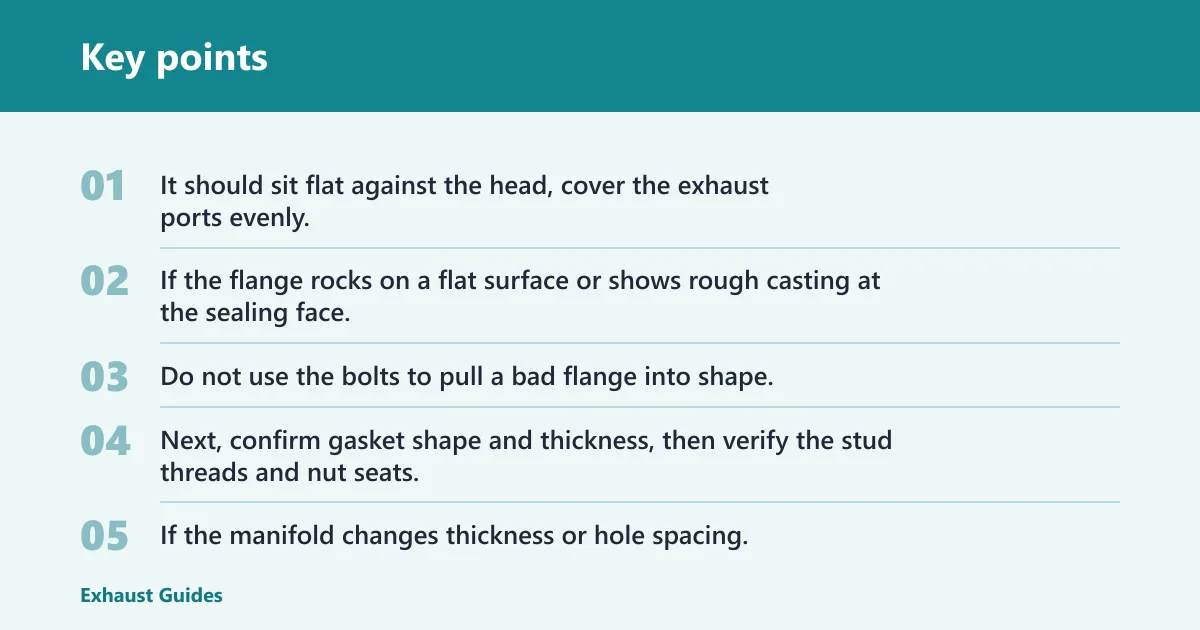
Start with the flange. It should sit flat against the head, cover the exhaust ports evenly, and line up with the bolt holes before any force is applied.
If the flange rocks on a flat surface or shows rough casting at the sealing face, plan for machining or a return. Do not use the bolts to pull a bad flange into shape.
Gasket and stud compatibility checks
Next, confirm gasket shape and thickness, then verify the stud threads and nut seats. If the manifold changes thickness or hole spacing, the factory gasket may not seal correctly and reuse becomes risky.
Stud breakage is a real cost driver. A tight or misaligned bolt pattern can snap old studs during removal or installation, and that turns a simple replacement into hardware replacement plus more labor.
Catalytic converter interface checks
Finally, check the outlet connection to the catalytic converter or front pipe. The flange angle, hole spacing, and sealing surface must match the downstream pipe or the repair can leak even if the head side looks perfect.
That check matters for emissions too. A leak near the outlet can create inspection problems, even on a part that otherwise seems to fit.
Choose OEM if… / Choose aftermarket exhaust manifold fitment if…
Choose OEM when the vehicle is a late-model daily driver, emissions testing is strict, the old studs are fragile, or you want the highest chance of a one-and-done repair. Choose aftermarket exhaust manifold fitment when the part is a verified direct replacement, the vehicle is older, or the repair budget needs to absorb the full labor and hardware picture.
Choose OEM
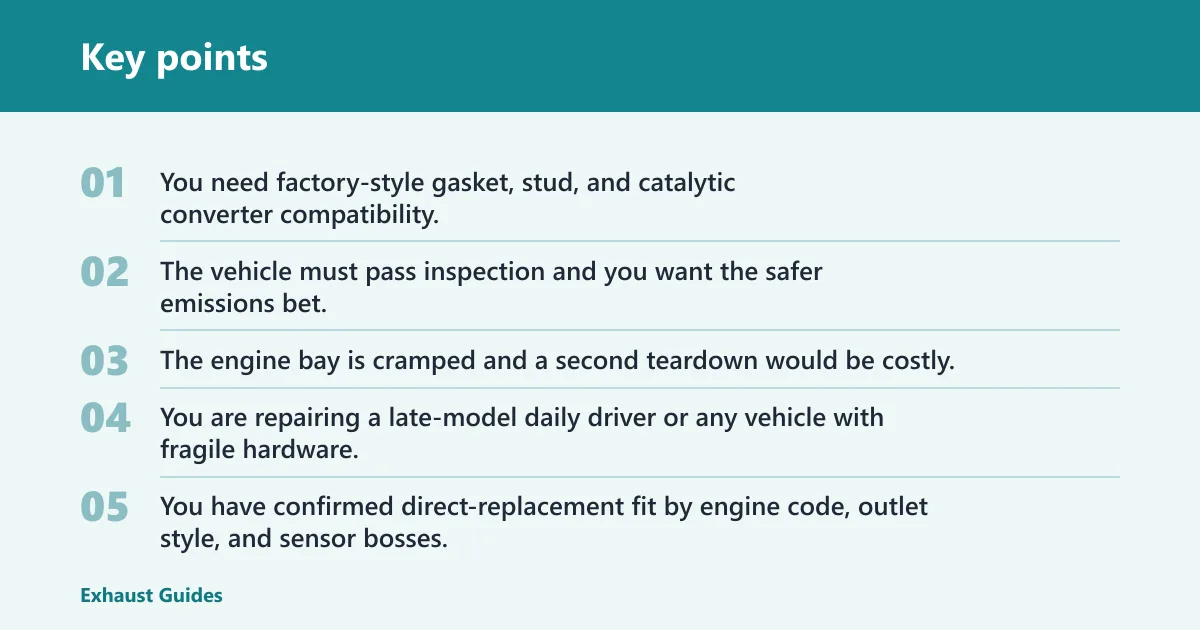
- You need factory-style gasket, stud, and catalytic converter compatibility.
- The vehicle must pass inspection and you want the safer emissions bet.
- The engine bay is cramped and a second teardown would be costly.
- You are repairing a late-model daily driver or any vehicle with fragile hardware.
Choose aftermarket exhaust manifold fitment
- You have confirmed direct-replacement fit by engine code, outlet style, and sensor bosses.
- The vehicle is older and the repair goal is function, not factory originality.
- You can absorb a possible gasket, stud, or machining add-on without blowing the budget.
- The brand has a reputation for tight tolerances and includes the needed hardware.


Aftermarket exhaust manifold fitment vs OEM checklist
Sticker price is only the first line item. For a manifold, total cost means the part, any new gasket, studs or nuts, possible machining, and the extra labor if fitment misses the mark.
| Cost item | Include it? | Why it matters |
|---|---|---|
| Replacement manifold | Yes | Base part price sets the starting point |
| Exhaust manifold gasket | Yes, unless the service data clearly allows reuse | Sealing loss can cause blowout or repeat leaks |
| Mounting studs and hardware | Yes | Broken or missing hardware is common enough to budget for |
| Machining or surface correction | Yes, if flange flatness is uncertain | Warp or rough casting can prevent a seal |
| Repeat labor | Yes | A second install can cost more than the part difference |
- Confirm the exact engine code, model year, and outlet style.
- Check whether the manifold is OEM, direct-replacement aftermarket, or performance-oriented.
- Verify gasket shape, stud count, sensor-boss locations, and heat shield mounts.
- Inspect flange flatness and bolt-hole location before installation.
- Replace damaged studs and any gasket that has been heat-cycled or blown out.
- Add machining and repeat labor to the cost comparison if fitment is uncertain.
Frequently asked questions
Is an aftermarket exhaust manifold as good as OEM?
Sometimes, but only in the direct-replacement tier and only from a brand with tight tolerances. OEM still has the edge on fit confidence, while aftermarket quality varies widely. For a stock daily driver, the main question is whether the part seals and aligns without extra work.
What fitment problems happen with cheap exhaust manifolds?
Cheap manifolds often bring flange flatness issues, poor port alignment, off-center bolt holes, missing hardware, and rough cast surfaces. Those problems can cause gasket leaks, broken studs, and repeat labor, which is why the cheapest invoice is not always the cheapest repair.
Can an aftermarket manifold reuse factory gaskets, studs, and hardware?
It can, but only if the manifold matches factory thickness, hole spacing, and sealing geometry. Reuse is risky when the flange is warped, the port shape differs, or the old gasket was already heat-damaged. New gaskets and hardware are often the safer choice.
Do aftermarket exhaust manifolds affect emissions compliance?
They can, depending on the vehicle and the market. A direct-fit replacement is usually safer than a performance design, but inspection risk rises if the catalytic converter interface, outlet angle, or sensor boss layout changes. OEM remains the conservative choice for emissions-sensitive repairs.
What signs show my exhaust manifold is cracked or warped?
Common signs include startup ticking, exhaust smell near the engine bay, visible soot around the flange, and a check engine light. A warped or cracked manifold can leak only when hot, because heat cycling opens the defect as the metal expands and contracts.
When should I choose OEM over aftermarket for an exhaust manifold?
Choose OEM when fitment matters more than price, especially on late-model daily drivers, inspection-sensitive vehicles, or jobs with hard-to-reach studs. OEM is also the safer bet when you want the manifold to work with factory gaskets, studs, and catalytic converter connections without surprises.