

Are BBK Headers Legal In California? Proven Truth
No, most aftermarket BBK Headers are generally not legal for street use in California if they do not have an Executive Order (E.O.) number from the California Air Resources Board (CARB). Street-legal parts must be emissions-compliant. Check for the E.O. number first to ensure your upgrade is legal.

BBK
BBK Performance 1515 1-5/8" Shorty Tuned Length…
- Package quantity: 1
- Product type: AUTO PART
- Package dimensions: 51.308 cm x 23.368 cm x 27.177 cm
As an Amazon Associate I earn from qualifying purchases.
Upgrading your car’s exhaust system, especially with performance headers like those from BBK, can be exciting. You might be looking for better sound or more horsepower. However, when you live or drive in California, one big question always pops up: Are these parts legal? Dealing with California’s strict emission laws can feel confusing and frustrating when you just want to upgrade your ride. Don’t worry! As your trusted automotive guide, I will break down the rules clearly. We will look at exactly what makes a BBK header legal or illegal in the Golden State so you can upgrade confidently. Let’s dive into the proven truth about BBK headers and California compliance.
Understanding California’s Strict Emissions Rules
California has the toughest vehicle emission standards in the United States. This is managed by the California Air Resources Board, or CARB. Their main goal is to keep the air clean. For car parts, this means any replacement component that affects emissions—like exhaust headers—must be specifically tested and approved.
What is CARB and Why Does It Matter for Headers?
CARB certification ensures that aftermarket parts do not increase pollution beyond legal limits. When you buy a performance part, its legality in California hinges almost entirely on one thing: an Executive Order (E.O.) number.
Think of the E.O. number as a VIP pass. If a header has this number, it means CARB has reviewed the product and confirmed it meets all necessary emission standards for on-road use in California.
If a BBK header does not have an E.O. number, it is considered “50-State Legal” only in states that do not follow California standards. For California streets, it is technically illegal for installation or use.
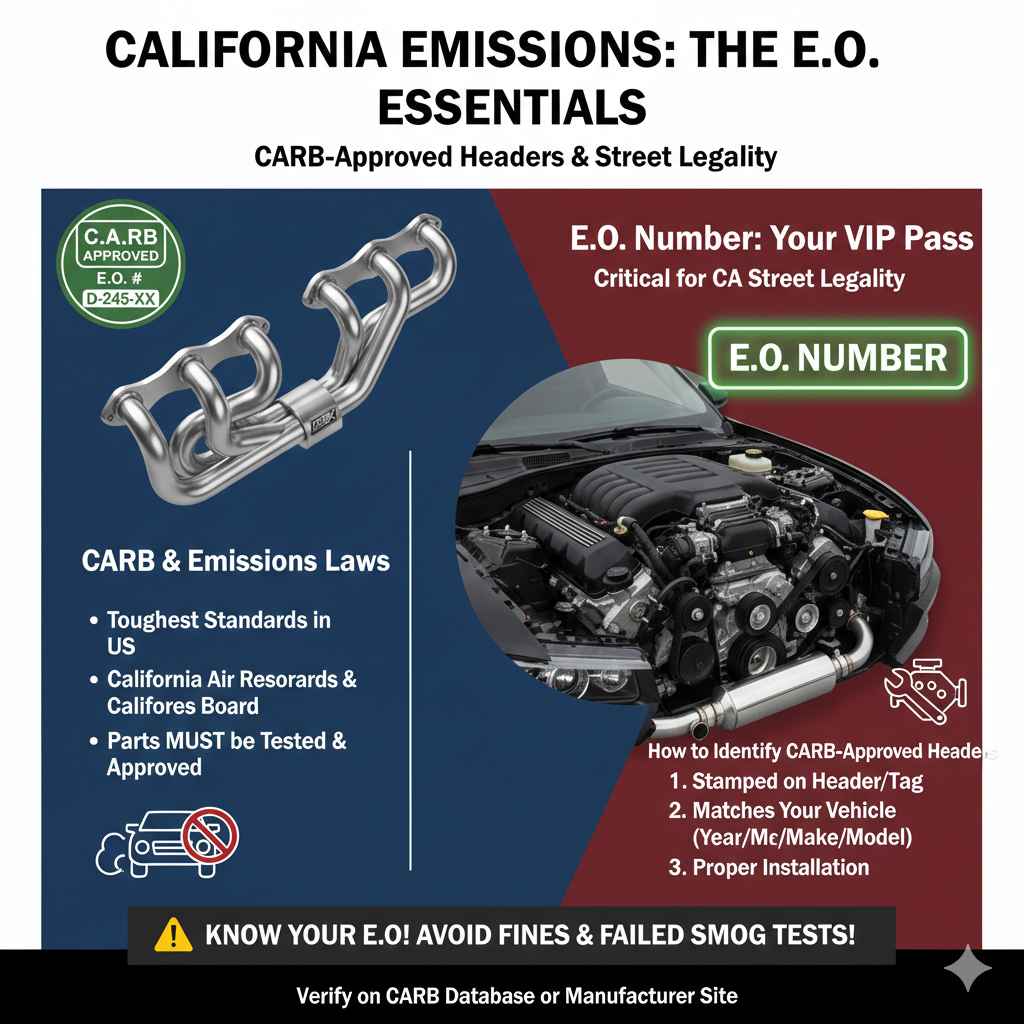
The Critical Component: The Executive Order (E.O.) Number
The E.O. number is the key to unlocking street legality for any aftermarket performance exhaust part in California. Without it, you risk fines and failing your mandatory smog check.
How to Identify a CARB-Approved Header
For a BBK header to be legal for street driving in California, it must meet these requirements:
- It Must Have an E.O. Number: This number is usually stamped directly onto the header itself, etched onto a permanent tag, or clearly listed on the manufacturer’s paperwork or product page.
- It Must Match Your Vehicle: The E.O. number is specific. It only covers the exact make, model, engine size, and year of the vehicle listed in the order. A header legal for a 2015 Mustang might not be legal for a 2015 Camaro, even if they are both V8s.
- Installation by a Professional: While the part is legal, the installation process must also be correct to maintain legality.
You can verify if a specific part number has an E.O. by checking the official CARB database, although manufacturers usually advertise this certification prominently.
BBK Headers and CARB Status: What the Manufacturer Says
BBK Performance is a huge name in the aftermarket world. They make parts for various vehicles. Understanding their product line in the context of California law is crucial for buyers.
Are Any BBK Headers Legal in California?
The answer is often complex because BBK produces many different header designs, ranging from simple shorty headers to full long-tube systems.
Generally, long-tube headers—which offer the biggest performance gains—are the hardest to get CARB approved because they significantly alter the factory exhaust path and catalytic converter placement. These are usually not legal without an E.O. number.
Shorty headers or specific mild headers designed to bolt up directly to the factory catalytic converter sometimes gain approval, but this is rare for high-flow performance headers.
To find out if a specific BBK header model is street legal, you must look up the part number on the official BBK website or contact their customer service directly, asking specifically for the CARB E.O. number associated with that part. A simple “yes, it fits” is not enough; you need proof of compliance.
Table 1: Legal Status Comparison for Performance Headers
| Header Type | Likelihood of CARB E.O. Approval | Street Legal in CA (Generally) |
|---|---|---|
| Long Tube Headers (High Flow) | Low | No (Unless Specific E.O. Exists) |
| Shorty Headers (Direct Bolt-on) | Very Low | No (Unless Specific E.O. Exists) |
| Headers with CARB E.O. Number | High (If Listed) | Yes |
The Smog Check Hurdle: Why Non-Compliant Headers Fail
Even if you manage to install non-CARB-approved BBK headers, you will face significant issues during mandatory biennial smog inspections in California.
The Visual Inspection
The first thing a smog technician does is a visual check. They look under the car to ensure that all emission control components are present and appear to be factory or CARB-approved replacements.
If the technician sees aftermarket headers that drastically change the exhaust path—especially if they eliminate or relocate critical oxygen sensors or catalytic converters—the vehicle will automatically fail the visual test, regardless of how clean the tailpipe emissions are.
The Functional Test (Tailpipe Emissions)
Even if the headers somehow pass the visual check (perhaps the technician misses them or the vehicle is too new for a detailed inspection), the functional test measures pollutants coming out of the tailpipe.
Performance headers are often designed to remove or reduce the number of catalytic converters, which are essential for cleaning up harmful emissions like hydrocarbons (HC) and carbon monoxide (CO). If your headers cause your readings to spike above legal limits, you fail the functional test.
For more details on the required emission standards, you can consult the official CARB website, which details current passenger vehicle emissions requirements.
Street Legal Alternatives to Non-Compliant BBK Headers
If you drive a vehicle in California and want to improve performance safely and legally, you need to focus strictly on parts that carry that golden E.O. number.
Focusing on CARB-Approved Parts
When shopping for exhaust upgrades in California, change your search terms. Instead of just looking for “BBK headers,” look for:
- BBK Headers with CARB E.O. XXXXXX
- CARB-Approved Exhaust Systems
- 50-State Legal Headers
Step-by-Step: Verifying Legality Before You Buy
This simple process will save you time, money, and potential headaches with the DMV or police.
- Identify the Exact Part Number: Find the specific BBK header model number intended for your vehicle.
- Search the Manufacturer’s Site: Go to the BBK website and search that part number. Look closely for a badge or text that says “CARB E.O. Compliant” or lists the actual E.O. number.
- Cross-Reference (Optional but Recommended): If the manufacturer states it is legal, search online forums or call a California-based performance shop that deals with smog compliance to confirm the E.O. number is valid for that part.
- If No E.O. is Found: Assume it is not street legal in California. Do not purchase it for on-road use.
The Off-Road Exception (For Racing Vehicles Only)
California does allow the use of non-emissions-compliant headers, but only under very specific circumstances that do not involve public road driving.
If your vehicle is exclusively used for competition, registered as a “off-highway vehicle,” or used solely on a closed course, certain exemptions may apply. However, for the average daily driver, this exception is not applicable. If you drive the car on any public street, highway, or road, the CARB rules apply.
The True Cost of Illegal Headers in California
Many beginners think that if they just “get away with it” for a year or two, it’s fine. But the risks of running non-compliant BBK headers are significant and often outweigh the small performance gain.
Financial Penalties
If you are caught driving a vehicle with illegal modifications, you can receive a Notice to Appear (NTA) ticket. If you fail to correct the issue and have the illegal parts removed before your next hearing, you face escalating fines. These fines can quickly add up, far exceeding the cost of the correct, CARB-approved parts.
Insurance and Liability
In the event of an accident, if an insurance investigator determines that an illegal modification (like non-compliant headers) contributed to the failure of an emission control system or potentially even the accident itself, your insurance claim could be complicated or denied.
Installation Complexity for Performance Headers
If you do manage to find a set of headers that are CARB approved (which is difficult for high-flow systems), the installation still requires precision, especially concerning sensor placement.
Tools and Preparation for Header Installation (General Guide)
Even for legal headers, the installation process can be tricky. Here are the basic items you’ll likely need:
- Jack and jack stands (Never work under a car supported only by a jack!)
- Torque wrench (Crucial for proper sealing)
- Oxygen sensor socket set
- Penetrating oil (to loosen old, rusted bolts)
- Gaskets and anti-seize compound
- Safety gear (gloves and eye protection)
If you are installing headers that require relocating or adding sensors to maintain compliance, this level of work moves beyond simple DIY maintenance and often requires professional tuning to ensure the engine computer (ECU) functions correctly with the new exhaust flow, as documented by automotive engineering best practices.
Can You Pass Smog With Headers If You Reinstall the Stock Parts?
This is a common question for those who install performance parts knowing they might fail inspection.
Yes, technically, if you remove the illegal BBK headers entirely and reinstall the original, factory exhaust manifolds and associated catalytic converters, your car should pass the smog check. However, this requires significant labor.
You have to:
- Carefully remove the headers.
- Reinstall the factory manifolds (which are often rusty and difficult to remove).
- Ensure all oxygen sensors are correctly seated in the factory locations.
- Drive the vehicle enough cycles for the ECU monitors to reset (this is called “clearing the codes” or “completing the drive cycle”).
This labor is why most enthusiasts in California opt to either buy CARB-legal parts from the start or only perform performance exhaust modifications on dedicated track cars.
BBK Headers: Pros and Cons in the Context of California Law
To make an informed decision, it helps to weigh the benefits against the legal drawbacks specific to California.
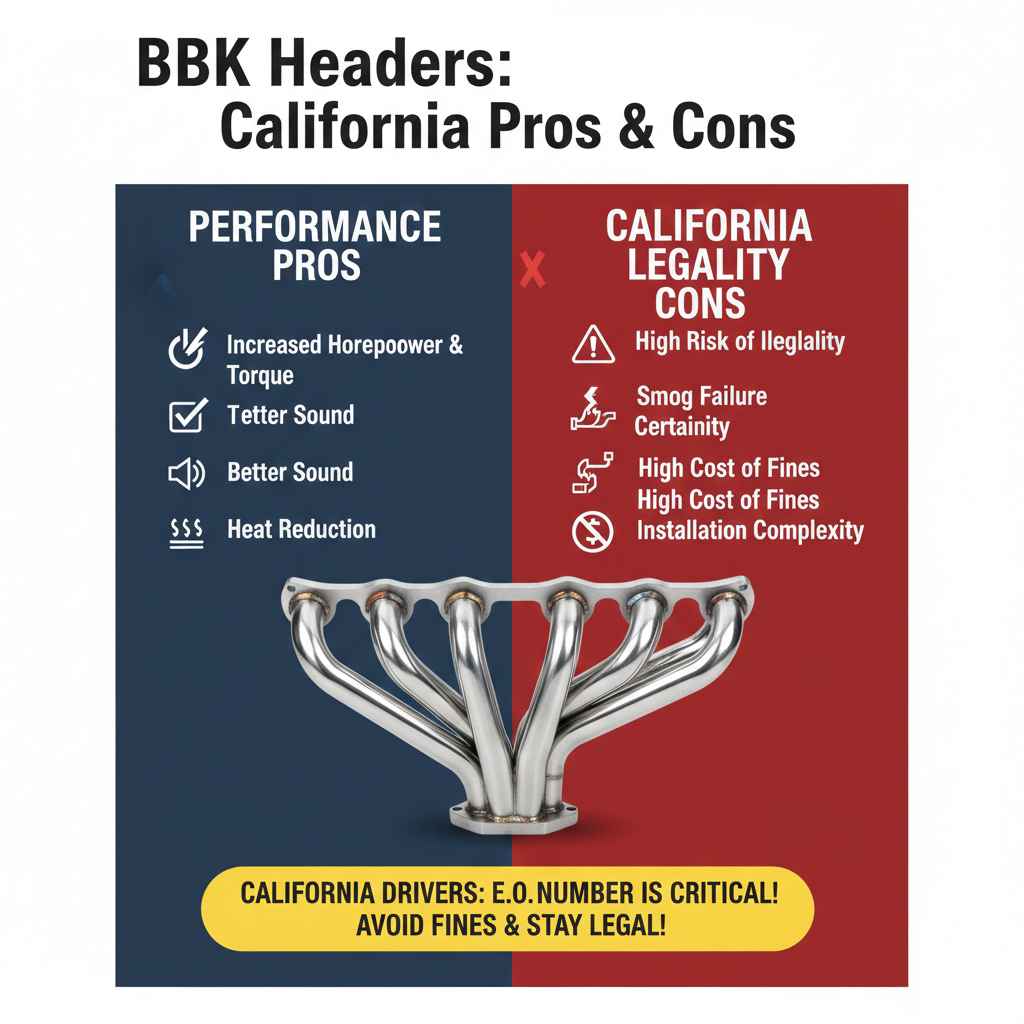
Pros of BBK Headers (Performance Benefits)
- Increased Horsepower and Torque: By improving exhaust scavenging, headers allow the engine to breathe better, resulting in noticeable power gains, especially at higher RPMs.
- Better Sound: They often change the exhaust note to be deeper and more aggressive.
- Heat Reduction: Some designs can reduce under-hood temperatures compared to restrictive factory manifolds.
Cons of BBK Headers (California Specific)
- High Risk of Illegality: Most models lack the mandatory CARB E.O. number.
- Smog Failure Certainty: Guaranteed failure during visual inspection if they are obvious aftermarket pieces without the E.O.
- High Cost of Fines: Potential for significant tickets if caught.
- Installation Complexity: Requires precise sensor management even for legal versions.
Frequently Asked Questions (FAQ) About CA Exhaust Legality
Q1: If my BBK headers don’t have an E.O. number, can I still drive my car in California?
A1: You can legally drive the car, but you cannot legally install or use the headers if your vehicle is intended for street use. You will fail visual smog checks and risk citations.
Q2: What does it mean if a header is advertised as “Off-Road Use Only”?
A2: This means the manufacturer has not submitted it for CARB testing or it failed testing. It should only be used on competition vehicles or vehicles that never touch public roads.
Q3: How can I check if my existing BBK headers are legal?
A3: Look for a physical E.O. stamp on the header itself. If you cannot find one, assume it is not legal. You can also contact BBK with your part number to request their official CARB compliance documentation.
Q4: Do all aftermarket headers in California need an E.O. number?
A4: Yes, any part that replaces or modifies an original emission control component (like manifolds, catalytic converters, or mufflers) generally requires an E.O. number to be street legal in California.
Q5: Will the check engine light come on if I install non-compliant headers?
A5: Often, yes. Headers that change exhaust flow patterns frequently confuse the oxygen sensors, which causes the car’s computer to register an error code, turning on the Check Engine Light (CEL). This is another way you can be flagged during inspection.
Q6: Are there any performance headers made by BBK that are legal in California?
A6: It is rare, but possible for specific, highly restrictive designs. You must confirm the specific E.O. number applies to your exact vehicle year and engine. Always confirm with the manufacturer.
Conclusion: Making the Smart Choice for Your California Ride
Navigating California vehicle regulations can feel like a maze, especially when performance parts like BBK headers are involved. The proven truth here is simple: If you plan to drive your vehicle on public roads in California, you must ensure that any replacement exhaust header carries an official, corresponding CARB Executive Order (E.O.) number.
If your specific BBK headers do not have that number, they are a performance upgrade reserved strictly for competition or off-road track use. For everyday driving confidence, peace of mind during smog checks, and avoiding costly legal trouble, stick to parts that are certified compliant. By focusing on the E.O. number, you maintain the fun of upgrading your vehicle while respecting the crucial air quality standards that keep California beautiful. Enjoy the drive, safely and legally!
Related pick: Check today's price on Amazon


