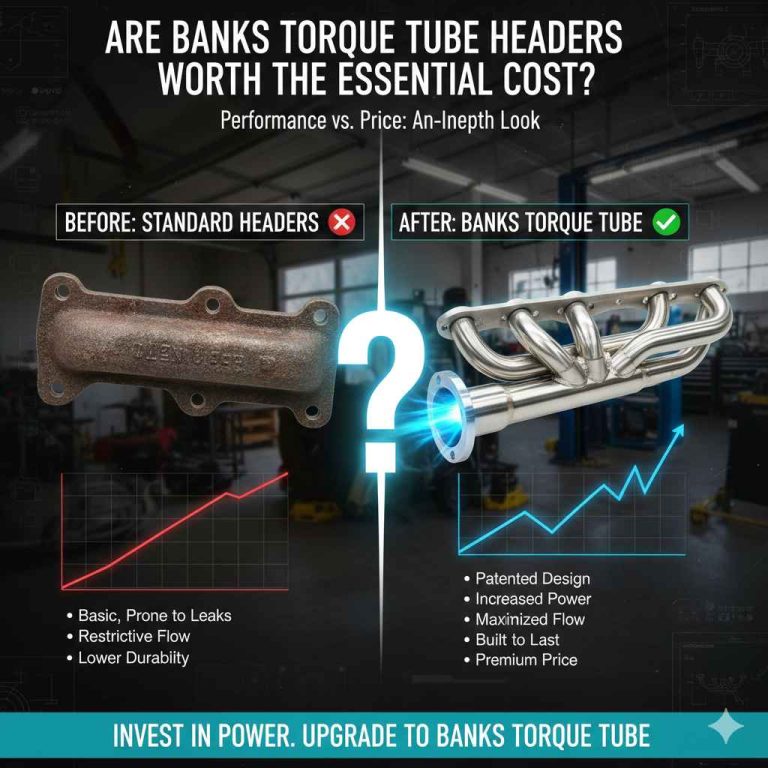
Are Boport Stainless Turbo Headers Worth It? Essential Guide
Boport stainless turbo headers are often worth the investment for drivers seeking better exhaust flow, improved turbo spool, and superior durability over stock manifolds, especially if you frequently drive hard or want a significant performance edge. They provide a clear upgrade path, but always weigh the cost against your specific driving needs.

Certified Automotive Experts
Stainless Steel BBC Turbo Headers Pair 2.25…
- 304 STAINLESS CONSTRUCTION Polished 304 stainless steel construction with mandrel-formed tubing designed for durability, consisten…
- LARGE DIAMETER PRIMARIES 2.25-inch primary tubes feeding a 3.5-inch V-band collector outlet, supporting turbocharger mounting and…
- FORWARD FACING LAYOUT Forward-facing, compact header geometry with angled collector orientation designed to assist clearance in ti…
As an Amazon Associate I earn from qualifying purchases.
Are you staring at your engine bay, wondering if that shiny new set of headers is really necessary? You hear people talk about “turbo spool” and “exhaust scavenging,” but it sounds complicated. Many car owners, especially those new to performance upgrades, face the decision of upgrading their factory exhaust manifold when installing a turbo. Stock manifolds work, but they often limit how fast your turbo can breathe. Boport stainless steel turbo headers are a popular option, but are they worth the money for your car? Don’t worry; we will break down exactly what these parts do, their benefits, and if they make financial sense for your ride. By the end of this guide, you will know exactly what you need to do next.
What Exactly Are Turbo Headers (and Why Do They Matter)?
Before we talk about Boport, let’s keep things simple. Your engine produces exhaust gas—the stuff you smell when you drive behind a diesel truck. This hot gas needs to escape quickly. In a turbocharged car, these exhaust gases first spin the turbine wheel inside the turbocharger, making the magic happen.
The part that connects the engine cylinders to the turbo is called the exhaust manifold (or header, especially when it’s an aftermarket upgrade).
Stock Manifold vs. Aftermarket Header
Think of your engine cylinders like roommates trying to leave a crowded party through a single narrow hallway.
Stock Manifold: Often cast iron, thick, and designed for low cost and long life. They usually have restrictive paths that force the exhaust gases to mix unevenly. This slows down how fast the gas can reach the turbo, leading to slower “spool” (the time it takes for the turbo to start making boost).
Aftermarket Header (Like Boport): These are usually made from tubular stainless steel. Engineers design them to have smooth, equal-length runners (the tubes). This design helps the exhaust pulses move out in a clean, rhythmic wave, which cleans up the flow and dramatically helps the turbo spin up faster and more efficiently.

Introducing Boport Stainless Turbo Headers
Boport is a recognized name in the performance aftermarket world, particularly for certain vehicle platforms. They focus on designing headers specifically for turbocharged applications, aiming to maximize the efficiency of the exhaust path leading into the snail (turbo).
Why Stainless Steel?
When dealing with turbo systems, heat is the enemy, and stainless steel is the hero.
- Heat Management: Exhaust gases coming off the cylinders are incredibly hot—often over 1,500°F (815°C). Stainless steel handles this intense heat much better than cheaper mild steel, resisting warping or cracking.
- Corrosion Resistance: Since stainless steel resists rust, these headers look good and last longer, even when exposed to road salt or moisture.
- Durability: They are built to withstand the vibrations and thermal expansion that come with high-performance driving.
The Big Question: Are Boport Stainless Turbo Headers Worth It?
This is where we need to put on our practical hats. “Worth it” depends entirely on what you plan to do with your car and your budget. Let’s look at the pros and cons through an objective lens.
The Pros: Why People Love Boport Headers
If you are upgrading your turbo or running higher boost levels, these headers offer significant advantages that stock parts cannot match.
- Faster Turbo Spool: This is the main selling point. The smoother flow path means the turbocharger starts spinning sooner, reducing “turbo lag.” You get power more quickly when you press the gas pedal.
- Increased Horsepower and Torque: By allowing the engine to breathe easier, you can often see measurable gains, especially in the mid-to-high RPM range where the turbo is fully engaged.
- Superior Build Quality: Boport is known for high-quality welds and good fitment, which is crucial when dealing with tight engine bays and high temperatures.
- Aesthetic Appeal: Let’s be honest—shiny stainless steel looks fantastic under the hood, especially if you have a show car or just like clean engine bays.
- Longevity: A quality stainless header can easily outlast the rest of the engine if properly installed and maintained.
The Cons: When They Might Not Be Worth It
No upgrade is perfect. Here are the reasons why you might hesitate.
- Cost: Quality stainless steel headers are significantly more expensive than buying a cheap cast replacement manifold. This is a major hurdle for budget-minded DIYers.
- Installation Difficulty: Replacing the manifold usually requires disconnecting the entire exhaust system, dealing with rusty or seized bolts, and potentially needing professional help. It’s a labor-intensive job.
- Not Always Necessary for Stock Power: If you are only driving gently to the grocery store and never planning to increase boost pressure, the gains you see might not justify the high cost.
- Potential for Noise: Headers often change the sound signature of your exhaust. Depending on the design and the rest of your exhaust setup, they can sometimes lead to increased drone or volume, which might not be street-friendly.
Side-by-Side Comparison: Boport vs. Stock Manifold
To help visualize the difference, here is a quick comparison table focusing on the key attributes a beginner needs to understand:
| Feature | Stock Cast Manifold | Boport Stainless Header |
|---|---|---|
| Material | Cast Iron (Heavy) | 304 or 316 Stainless Steel (Lighter) |
| Exhaust Flow Path | Restrictive, uneven runners | Smooth, equal-length runners |
| Turbo Spool Time | Slower (more lag) | Faster (less lag) |
| Heat Resistance | Good, but can crack under extreme heat | Excellent, highly resistant to cracking |
| Typical Cost | Low to Moderate (for replacement) | High (Performance Upgrade) |
When Should a Beginner Upgrade to Boport Headers?
If you are new to car modification, it’s easy to get overwhelmed. Here are three clear scenarios where upgrading to a quality header like Boport makes excellent sense:
Scenario 1: You Are Upgrading the Turbocharger
If you are installing a larger turbocharger—one designed to push more air than stock—the stock manifold immediately becomes the weakest link. A big turbo needs a massive volume of clean, fast exhaust gas to work correctly. Putting a big turbo on a stock manifold is like putting a race engine in front of a garden hose.
Action: If your turbo upgrade plans go beyond a simple replacement, a Boport header is almost mandatory for realizing the full potential of the new turbo.
Scenario 2: You Are Tuning for More Boost (ECU Reflash)
When you use a tuner (or a tuning device) to increase the boost pressure above factory settings, you are forcing more exhaust gas through the system. Stock manifolds are not designed for this sustained, high-pressure operation and can eventually fail or, more commonly, restrict flow so much that the tune cannot achieve its goals safely.
Safety Note: Always ensure your entire exhaust system, from the headers back, can handle the increased flow and heat when increasing boost. Check resources like the SAE International for technical papers on fluid dynamics in engine exhaust, ensuring you understand the physics behind flow restriction.
Scenario 3: You Want Maximum Reliability on Track/Aggressive Driving
If your driving involves frequent bursts of acceleration, high RPMs, or occasional track days, the thermal stress on the stock manifold is immense. Upgrading to a robust stainless header ensures you won’t suffer a catastrophic failure due to heat fatigue, providing peace of mind when pushing the car hard.
DIY Installation Guide: Installing Turbo Headers (Beginner Friendly)
Replacing headers is a moderately challenging job. While Boport headers aim for good fitment, the main difficulty is often fighting old, rusted hardware. Always consult your vehicle’s specific service manual before starting.
Tools You Will Likely Need
Gathering the right tools beforehand prevents frustrating mid-job trips to the hardware store.
- High-quality socket and wrench set (metric or standard, depending on your car)
- Torque wrench (Crucial for proper sealing!)
- Penetrating oil (like PB Blaster or similar)
- Jack stands and a reliable floor jack (Safety First!)
- New exhaust manifold gaskets (always replace these)
- Oxygen sensor removal tool (if applicable)
- Safety glasses and gloves
Step-by-Step Process Overview
This is a general guide. Always refer to a detailed service manual for your specific car model.
Step 1: Preparation and Safety
Ensure the engine is completely cool. Jack up the vehicle safely and support it securely on high-quality jack stands. Never work under a car supported only by a jack. Disconnect the negative battery terminal for safety, especially since you will be working near electrical components like oxygen sensors.
Step 2: Disconnect Sensors and Wiring
Locate and carefully unplug the oxygen sensors (O2 sensors) plugged into the stock manifold or exhaust downpipe. If they are too difficult to remove, you may need to cut the wires and plan on installing new sensors into the Boport headers, which usually come pre-tapped for them. Unbolt any brackets holding the manifold or downpipe in place.
Step 3: Remove the Old Manifold
Spray every bolt connecting the old manifold to the engine head liberally with penetrating oil. Let it soak for 15–30 minutes. Start loosening the manifold bolts from the center cylinders outward. Work slowly. If a bolt breaks, stop and research the best way to extract the stud before continuing, as broken studs can stop the entire project.
Step 4: Clean the Mating Surface
Once the old manifold is off, you must clean the engine head’s gasket surface. Use a plastic scraper or gasket remover to gently scrape off all old gasket material and carbon buildup. A clean, smooth surface is essential for the new header gasket to seal properly. You can check official maintenance standards, such as those outlined by automotive engineering bodies, regarding surface roughness before installation to ensure a leak-free fit.
Step 5: Install the New Boport Headers
Place the new gasket onto the head. Carefully position the Boport header over the studs. Start threading the new header bolts by hand. Do not tighten anything fully yet!
The Torquing Pattern: This is the most important part for preventing leaks. You must tighten the bolts in stages, using the pattern specified in your repair manual (usually starting from the center and working outward). Tighten them in three passes:
- Tighten all bolts to about 50% of the final specified torque.
- Tighten all bolts to 80% of the final specified torque.
- Tighten all bolts to the final specified torque (Use your torque wrench!).
Step 6: Reconnect Everything
Reconnect the downpipe, re-install the O2 sensors (using anti-seize compound on the threads to prevent them from fusing next time), and reconnect any wiring harnesses or support brackets. Double-check every nut and bolt.
Step 7: The Test Drive
Reconnect the battery. Start the car gently and listen immediately for any loud leaks (this usually means a gasket isn’t sealing). Let the car warm up fully. Many header manufacturers recommend running the car for a short period and then re-checking the torque on the bolts after the first heat cycle, as the metal expands and settles.
Boport Material Considerations: 304 vs. 321 Stainless Steel
While Boport generally uses high-quality materials, understanding the difference between common stainless grades can help you assess the long-term value.
Most premium headers use 304 stainless steel because it balances cost, durability, and corrosion resistance well. However, for extremely high-heat applications (like very aggressive race cars), 321 stainless is superior.
| Stainless Grade | Key Additive | Heat Resistance | Cost Implication |
|---|---|---|---|
| 304 Stainless | Chromium and Nickel | Very Good (Handles typical performance driving) | Standard Premium Price |
| 321 Stainless | Titanium Stabilization | Excellent (Resists high-temperature carbide precipitation) | Higher Price Point |
For the average enthusiast asking, “Are Boport stainless turbo headers worth it?”—the answer is almost always yes if they are using quality 304 stainless, as it provides a massive leap over stock without the extreme cost of aerospace-grade materials.
Understanding the Ripple Effect: Supporting Modifications
Installing performance headers is like opening a tap wider; you need to make sure the rest of the plumbing can handle the increased flow. If you install Boport headers without addressing the rest of the system, you might experience diminishing returns or even problems.
1. The Downpipe and Cat/Test Pipe
The pipe immediately following the header (the downpipe) must also have a diameter large enough to accommodate the increased flow. If you install a Boport header but keep a tiny, restrictive stock downpipe, you’ve just pushed the bottleneck one step further down the line.
2. Oxygen Sensors (O2 Sensors)
Your car’s computer relies on O2 sensors to know how much fuel to inject. When you change the flow characteristics so drastically, the factory tune might struggle to compensate, leading to a “Check Engine Light” (CEL).
If the headers move the location of the O2 sensor relative to the exhaust pulse (which they often do), you might need spacers or extenders, or you will definitely need a tune.
3. The Tune (Engine Calibration)
This is non-negotiable if you want to see real gains and ensure safety. After installing headers, the air/fuel ratio (AFR) will change because the engine is breathing differently. A professional tune ensures the Engine Control Unit (ECU) adjusts fuel delivery to match the new exhaust flow, maximizing horsepower while protecting your engine from running too lean (too much air, not enough fuel), which causes destructive detonation.
What Enthusiasts Say About Boport Headers
When researching performance parts, real-world feedback is gold. Across various enthusiast forums focused on turbocharged platforms (like Subaru WRX, Ford EcoBoost, or older DSMs), the general consensus on reputable stainless headers usually centers on these points:
- Fitment Varies: While generally good, some users report minor clearance issues with chassis components or heat shields that required minor hammering or bracket modification.
- Sound Improvement: Almost universally praised for creating a deeper, throatier tone compared to the tinny sound of stock cast iron.
- Longevity Testimony: Many long-term owners report their headers holding up perfectly fine after years of hard use, confirming the stainless steel’s resilience.

FAQ: Beginner Questions About Turbo Headers
Here are clear answers to common questions that often come up when first considering this upgrade.
Q1: Will installing Boport headers automatically void my car’s warranty?
A: In many cases, yes, they can. Any modification that affects the engine’s performance or emissions system can give a dealership grounds to deny a warranty claim related to those systems. However, if the transmission fails and you have new headers, the manufacturer would have to prove the headers caused the transmission failure.
Q2: Do I need new gaskets if I reinstall the stock manifold, or only for the Boport upgrade?
A: You should always install new gaskets anytime you remove and reinstall an exhaust component. Old gaskets compress and degrade, making it very difficult to achieve a proper, leak-free seal upon reinstallation.
Q3: What is “exhaust scavenging” and how do headers help?
A: Scavenging is a process where the exiting pulse of exhaust gas from one cylinder creates a slight vacuum that helps pull the exhaust out of the next cylinder just as its exhaust valve opens. Equal-length headers tune the pipes so these pulses arrive perfectly timed to help each other out, making the engine more efficient.
Q4: Can I install Boport headers without a professional tune?
A: You physically can, but you shouldn’t. Without a tune, your car will likely run rough, the Check Engine Light will illuminate, and you risk running too lean, which can damage the engine over time. A tune is necessary to safely utilize the header’s performance benefits.
Q5: How much performance gain should I realistically expect from just the headers?
A: Alone, the gains might be modest, perhaps 5-15 horsepower, depending on the car. The real value comes when the headers are combined with a high-flow downpipe and a proper tune, unlocking significant potential from the turbo itself.
Q6: How do I know if my new headers are leaking exhaust?
A: The primary sign is a loud, ticking, or puffing noise coming from the engine bay, especially when the engine is cold. A leak near the O2 sensors can also cause the car to run poorly, as the sensors read fresh air instead of true exhaust gas.
Conclusion: Making the Final Decision
Deciding if Boport stainless turbo headers are worth it requires an honest look at your driving habits and performance goals. For the owner who sticks to factory settings and gentle driving, the cost is likely not justified, and the stock manifold will suffice.
However, if you enjoy spirited driving, plan on increasing boost pressure, or are investing in a larger turbocharger, then a high-quality stainless header like those offered by Boport moves from a luxury item to an essential foundation for a reliable, high-performing turbo system. They offer durability, better heat management, and the critical flow improvements needed to let your turbocharger work as it was truly designed to. If performance and longevity under stress are your priorities, these headers represent a sound, long-term investment in your vehicle’s heart.
Related pick: Check today's price on Amazon