

Are BBK Headers Good Camaro? Proven Power Gains
BBK headers are generally considered a good upgrade for Camaro owners looking for proven power gains and a better engine sound. They offer a noticeable performance bump, especially when paired with other airflow mods, and are a solid choice for beginners due to their direct-fit designs.

BBK Performance
BBK Performance 4020 1-3/4" Shorty Tuned Length…
- BBK is your Number One Aftermarket Performance Exhaust Brand in the USA - American Designed and Built
- BBK Exhaust is Built with CNC Mandrel Bent Tubing for 35% Increased Flow Over Stock to Add 10-15 Horespower and Improve Torque and…
- Aircraft Quality Construction, Heavy Gauge 1-3/4" Tubing, 3/8" Laser Cut Flanges, Large Bore Patented Designed Collectors and Cust…
As an Amazon Associate I earn from qualifying purchases.
Thinking about upgrading your Camaro’s exhaust system? It’s easy to feel lost when you start looking at parts like headers. Many Camaro owners wonder if spending money on BBK headers is really worth it. You hear talk about horsepower, torque, and sound, but what does it actually mean for your car?
The good news is that you don’t need to be a professional mechanic to understand this upgrade. Headers are one of the best ways to let your engine breathe better, leading to more power. We are going to break down exactly what BBK headers do for your Camaro, what kind of power gains you can expect, and if they are the right choice for your ride.
Let’s dive in and see why these parts get so much attention from enthusiasts.
Why Headers Matter: Understanding the Exhaust’s First Step
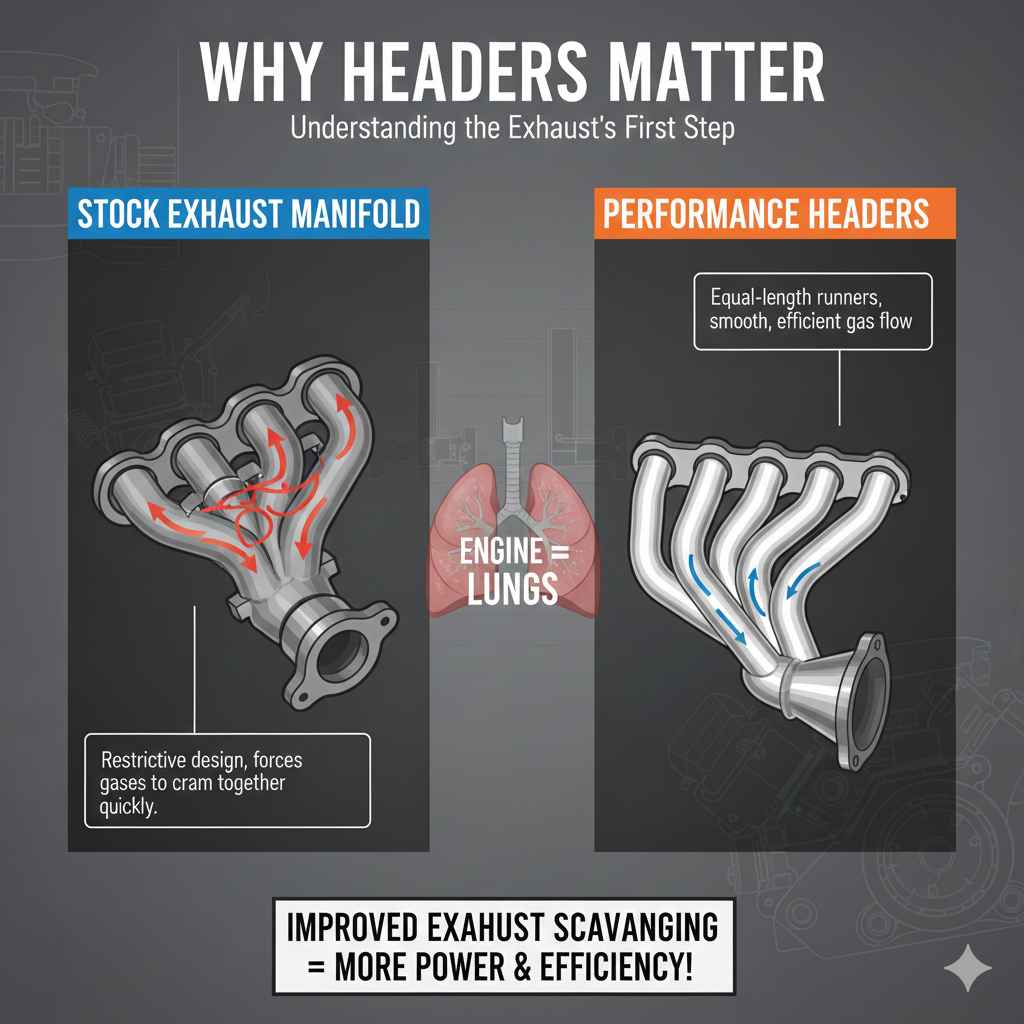
Before we talk about BBK specifically, let’s understand what headers do. Think of your engine like a set of lungs. The stock exhaust manifolds (the parts attached directly to the engine’s cylinder heads) are often restrictive. They try to cram all the exhaust gas from multiple cylinders into one small pipe too quickly.
Headers are replacement exhaust manifolds designed differently. They use individual, equal-length pipes (called runners) for each cylinder before merging them into a collector. This process helps the engine expel spent gases much more efficiently.
The Science Behind Better Breathing
When exhaust gas escapes faster and smoother, it creates a low-pressure area behind the exiting gas. This helps pull the next bit of exhaust gas out of the cylinder sooner. This process is called “scavenging,” and it’s crucial for performance.
Here’s a quick comparison of stock vs. aftermarket headers:
- Stock Manifolds: Often heavy, cast iron, and designed primarily for low noise and cost efficiency. They prioritize sound suppression over flow.
- Aftermarket Headers (Like BBK): Made from smoother, lighter steel tubing. They are designed with tuned lengths and smooth bends to maximize scavenging and flow across the RPM range.
BBK Headers: A Trusted Name in Camaro Upgrades
BBK Performance is a well-known brand in the aftermarket world, especially for American V8 muscle cars like the Camaro. They focus heavily on maximizing airflow. When you see “BBK headers,” you are usually looking at a quality product made for specific applications.
What Makes BBK Headers Stand Out?
BBK offers various styles, but they generally stick to high-quality construction techniques that appeal to both daily drivers and weekend racers. Their main selling points often center around materials and fitment.
1. Material Quality
BBK typically uses 1-1/2” or 1-5/8” stainless steel tubing, depending on the application and engine size (like the popular LS series V8s found in many modern Camaros). Stainless steel resists corrosion better than standard mild steel, which is important since exhaust systems get extremely hot and face moisture.
2. Design and Fitment
A major frustration for beginners is buying a part that doesn’t fit right. BBK headers are often advertised as “direct-fit” or “bolt-on.” This means they are designed to connect to your existing mid-pipe or catalytic converter setup without extensive cutting or welding. This makes installation much safer and easier for the home mechanic.
3. Coating Options
BBK often offers different finishes. You might see options like:
- Bare Steel: Cheapest option, requires custom coating if you want protection.
- Chrome or Ceramic Coated: These coatings help keep the heat inside the header pipe. Keeping the heat inside actually improves scavenging efficiency and protects surrounding engine bay components from excessive radiant heat.
Proven Power Gains: What Can You Actually Expect?
This is the question everyone wants answered: How much faster will my Camaro be? While results vary based on your engine, modifications already present, and tuning, we can look at general trends supported by dyno testing.
The Role of Headers in Performance
Headers alone usually provide gains, but they work best when combined with other parts that increase airflow, such as a better cold air intake and an aftermarket cat-back exhaust system. Headers are crucial because they address the very first restriction point after the cylinder head.
For a naturally aspirated (non-supercharged or non-turbocharged) late-model V8 Camaro (like an SS model), the following gains are commonly reported when installing quality headers:
| Modification Level | Estimated Horsepower Gain (Peak) | Estimated Torque Gain (Mid-Range) |
|---|---|---|
| Headers Only (Stock Tune) | 8–15 HP | 10–20 ft-lbs |
| Headers + Intake + Tune | 20–35+ HP | 25–40+ ft-lbs |
Important Note on Tuning: Installing headers significantly changes how air moves through your engine. To safely and effectively realize the full power potential of those headers, especially on newer Camaros with complex Engine Control Units (ECUs), a custom tune (or performance calibration) is highly recommended. A tune adjusts fuel maps and timing to match the new airflow characteristics. Trying to run aggressive headers without a tune can sometimes lead to running too lean, which is bad for engine health.
Tuning and Emissions Considerations
When discussing performance upgrades, emissions often come up. Headers are available in two main styles regarding emissions equipment:
- Long Tube Headers (LTH): These are the best for performance. They route the exhaust further out before connecting to the rest of the system, often requiring the removal or relocation of the factory catalytic converters. This means they are usually not street legal in many states because they bypass emissions equipment.
- Shorty Headers: These are shorter and designed to bolt up closer to the stock location. They sometimes retain the factory catalytic converters or utilize high-flow aftermarket cats, making them a potentially emissions-friendly option, though performance gains are usually smaller than LTHs.
Always check your local regulations regarding exhaust modifications. For example, organizations like the Environmental Protection Agency (EPA) have strict rules about tampering with federally regulated emission control devices (See EPA guidelines on vehicle tampering).
Choosing the Right BBK Header for Your Camaro
Camaros have spanned many generations (5th Gen, 6th Gen, classic models), and the engine configuration dictates the type of header you need. Choosing correctly is the first step to success.
Step 1: Identify Your Camaro Generation and Engine
Are you working with a 3.6L V6, a 6.2L LS-based V8, or a newer LT-based V8? The header path changes dramatically between these engines. BBK specifically makes headers tailored for these platforms. For example, an LS3 engine in a 5th Gen Camaro needs a different header flange pattern than a modern LT1 in a 6th Gen.
Step 2: Selecting Header Style (Long Tube vs. Shorty)
Your intended use dictates the style:
- Track/Pure Performance: Choose Long Tube Headers (LTH). You will likely need to purchase high-flow catalytic converters or off-road pipes separately if you are ditching the stock setup entirely.
- Daily Driver/Emissions Compliant: Look for BBK Shorty Headers or Long Tubes that specifically include high-flow metallic catalytic converters in the package.
Step 3: Considering Installation Difficulty
For beginners, installation difficulty is key. Headers are notorious for being tight fits. While BBK is known for good fitment, installing headers often requires:
- Lifting the car safely (using jack stands or a lift).
- Disconnecting oxygen sensors (O2 sensors).
- Potentially removing steering components or crossmembers, depending on the angle needed to snake the pipes in.
If you are new to this, be prepared—it is a challenging job that often takes a full weekend for a first-timer, even with good instructions.
Installation Overview: Installing BBK Headers Safely
This is a general overview. Always consult the specific instructions provided with your BBK set. Safety first!
Tools You Will Likely Need
Having the right tools makes this job significantly less frustrating. Don’t try to force things!
- Safety Glasses and Gloves (Essential)
- Jack and Jack Stands (Never work under a car supported only by a jack!)
- Metric and Standard Socket Set (3/8” drive is often best for tight spaces)
- Wrenches (Combination wrenches, especially extensions and swivel sockets)
- Torque Wrench (Crucial for properly securing flanges)
- Penetrating Oil (e.g., PB Blaster or Kroil) to loosen rusty manifold bolts.
- O2 Sensor Socket (A specialized deep socket to remove the sensors without damaging them).
Step-by-Step Installation Guide (General V8 Application)
- Preparation and Safety: Let the engine cool completely (preferably overnight). Disconnect the negative battery terminal. Safely raise the vehicle and secure it firmly on jack stands.
- Disconnect Sensors: Locate the oxygen sensors in the exhaust system (usually before and after the catalytic converter). Carefully unplug the wiring harnesses and use the specialized socket to remove the sensors from the old manifolds. Set them aside safely.
- Remove Stock Manifolds: Spray all manifold bolts with penetrating oil and let them soak for 15 minutes. Starting from the top/easiest bolts, slowly loosen and remove the bolts holding the stock manifolds. Removing the old manifolds can be difficult if the car has high mileage due to rust welding the bolts in place.
- Prepare New Headers: Install any necessary gaskets onto the new BBK headers. If you are installing long tubes, you may need to install your high-flow cats or test pipes now, bolting them loosely to the header collector flange.
- Install Headers: Carefully feed the new BBK headers into position. This often requires maneuvering the pipes around steering components or starter motors. Start threading the collector flange bolts first (if applicable) to hold the pipe in place.
- Torque Down Flanges: Install the cylinder head flange bolts. Tighten them evenly in a cross-hatch pattern, following the torque specification provided by BBK (usually around 18–25 ft-lbs for LS engines). Proper torque prevents leaks.
- Reinstall Components: Reinstall the O2 sensors into the bungs on the new headers. Use anti-seize lubricant on the threads of the O2 sensors before screwing them in—this prevents them from seizing in the header tubes later. Reconnect the wiring harnesses.
- Final Checks and Start-Up: Reconnect the negative battery terminal. Double-check that all tools are clear from the engine bay and that nothing is resting against the hot exhaust pipes. Start the car and listen carefully for leaks. Leaks usually sound like loud ticking near the engine.
Addressing Exhaust Leaks (The Ticking Sound)
If you hear a rapid ticking sound after startup, it’s likely an exhaust leak, usually at the collector flange or where the header meets the cylinder head. If this happens:
Turn the car off immediately. Once cooled, re-torque the bolts. If the leak persists, the gasket may be bad, or the flange might be slightly warped, requiring replacement.
Sound Profile: How Do BBK Headers Change the Camaro’s Voice?
Performance aside, one of the biggest reasons people upgrade headers is for sound. A stock exhaust manifold muffles the natural sound signature of a V8 engine.
BBK headers, especially when paired with an X-pipe or H-pipe setup and a less restrictive cat-back system, dramatically change the tone:
- Deeper Rumble: The flow characteristics allow the engine to produce a much richer, deeper, and more muscular tone at idle and low RPMs.
- Aggressive WOT (Wide Open Throttle): Under full acceleration, the sound becomes much louder and more aggressive—the classic, throaty muscle car sound.
- Drone Factor: Long tube headers, when combined with certain cat-back systems, can sometimes introduce an unpleasant humming sound inside the cabin at a specific cruising RPM (this is called drone). This is why tuning and careful system matching are important.
Comparing BBK to Other Header Brands
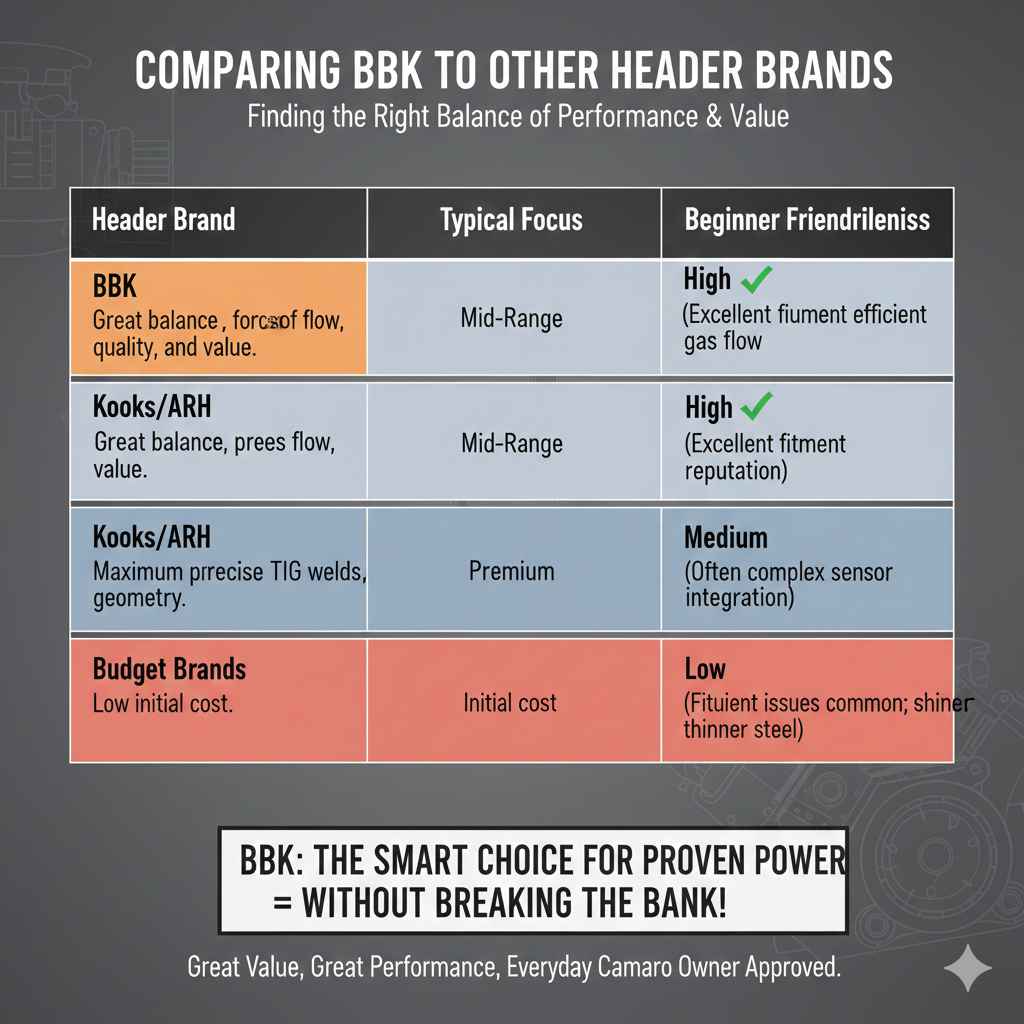
When asking, “Are BBK headers good?” it helps to compare them to competitors like Kooks, American Racing Headers (ARH), or Stainless Works. Often, the differences come down to price point and specific engineering details.
| Header Brand | Typical Focus | Price Point (Relative) | Beginner Friendliness |
|---|---|---|---|
| BBK | Great balance of flow, quality materials, and value. | Mid-Range | High (Excellent fitment reputation) |
| Kooks/ARH | Maximum performance; precise TIG welds, superior scavenging geometry. | Premium | Medium (Often complex sensor integration) |
| Budget Brands | Low initial cost. | Low | Low (Fitment issues common; thinner steel) |
For the everyday Camaro owner seeking a proven, reliable performance boost without breaking the bank on top-tier race parts, BBK sits comfortably in a sweet spot. They offer significantly better flow than stock without the associated high cost of boutique race brands.
Frequently Asked Questions (FAQ) About BBK Headers
Q1: Do I need to tune my Camaro after installing BBK headers?
A: If you install Long Tube Headers (LTH) that remove factory catalytic converters, a tune is strongly recommended for safety and to maximize power. If you install Shorty Headers that retain factory cats, a tune might not be strictly required immediately, but it is still highly beneficial for optimizing performance.
Q2: Will installing BBK headers cause my “Check Engine” light to turn on?
A: Yes, most likely, if you install Long Tube Headers that eliminate the downstream (rear) catalytic converters. The car’s computer monitors converter efficiency. A tune can easily disable the catalyst efficiency monitors (turning off the light).
Q3: Are BBK headers difficult to install for a beginner?
A: Headers are generally considered an intermediate-to-advanced DIY job because space is very tight on a V8 engine. If you are comfortable working under the car and using hand tools, it is achievable, but it requires patience, especially with rusty bolts.
Q4: Will installing headers void my factory warranty?
A: In the US, the Magnuson-Moss Warranty Act generally prevents manufacturers from voiding your entire warranty just because you installed an aftermarket part. However, the dealer can refuse to cover any repairs related to the exhaust system or engine performance if they can prove the headers caused the failure. Proceed with this understanding.
Q5: What material is best: stainless steel or mild steel?
A: Stainless steel is superior. It resists rust and corrosion much better than mild steel, especially the thinner mild steel often used on lower-priced headers. BBK typically uses good quality stainless steel, offering better longevity.
Q6: Can I install headers myself without a lift, just using jack stands?
A: Yes, it is possible, but very difficult for the side pipes if you have a standard height car. Raising the car significantly and using sturdy jack stands on level ground is crucial for safety and providing the necessary room to maneuver the pipes.
Maintenance Tips for Your New Headers
Congratulations on installing your new BBK headers! To keep them performing well and looking good, a little maintenance goes a long way.
Cleaning and Preventing Surface Rust
If your headers are ceramic-coated or raw stainless, they will change color over time due to heat cycling—this is normal. However, keep them clean.
- Initial Heat Cycles: The first few times you drive the car after installation, you might smell burning oil or residue. This is normal as manufacturing oils burn off. Drive gently until this smell stops.
- Cleaning: Use mild soap and water to clean the exterior when the system is completely cool. Avoid harsh chemicals or abrasive pads, especially on ceramic coatings, which can cause them to chip or flake prematurely.
- Checking for Leaks: Periodically check the manifold flange bolts, especially after the first 500 miles, as they can sometimes loosen slightly as the metal settles.
Protecting Oxygen Sensors
Your expensive O2 sensors are now threaded into your performance headers. Since they operate in a much hotter, more direct exhaust stream with LTHs, they might wear out slightly faster than stock.
Always use high-quality anti-seize on the threads when installing them. If your engine runs poorly or you get a persistent O2 sensor code after installation, the sensor itself might need replacement—it’s an easy fix once the headers are already installed!
Conclusion: Are BBK Headers a Worthwhile Upgrade for Your Camaro?
When you look at the evidence—the improved exhaust scavenging, the proven horsepower and torque gains, and the significantly better sound quality—the answer is clear: Yes, BBK headers are a good, reliable performance upgrade for most Camaro owners.
They represent an excellent middle ground. They aren’t the cheapest option, but their reputation for solid build quality and straightforward installation provides great value. You get a meaningful performance increase that complements other bolt-on mods perfectly. Remember, the most power comes when you marry the headers with a good tune. This lets your engine safely take advantage of all that newly available airflow.
Upgrading your headers is one of the most satisfying steps you can take toward unlocking your Camaro’s full potential. Take your time during installation, prioritize safety, and get ready to enjoy a healthier engine note and a noticeable kick in the seat of your pants!
Related pick: Check today's price on Amazon


