Are BBK Shorty Headers Good? Proven Power
BBK Shorty Headers are generally a good upgrade for bolt-on performance gains on many V8 engines, offering improved exhaust flow, a noticeable sound change, and a straightforward installation compared to long tube headers. They deliver reliable, proven power increases, especially when paired with other engine modifications.
Do you want more power and a better sound from your ride but feel overwhelmed by complex engine parts? Many car owners look at exhaust upgrades, and BBK Shorty Headers often pop up. They look simple, but you might wonder if they truly deliver the “proven power” they promise. It is frustrating when you spend money on a part and don’t see real results. Don’t worry; upgrading your exhaust doesn’t require an engineering degree. We are going to break down exactly what BBK Shorty Headers are, how they help your engine breathe better, and if they are the right choice for your vehicle. By the end of this guide, you will know exactly what to expect from these popular components.
Understanding BBK Shorty Headers: The Basics
When we talk about headers, we are talking about the very first part of your exhaust system that bolts directly to the engine’s cylinder head. Think of them as the “breathing tubes” for your engine. Stock, factory exhaust manifolds are often designed for quietness and low cost, not maximum performance. This restricts how fast the hot exhaust gases can escape.
BBK is a well-known brand in the aftermarket performance world, specializing in making parts that help engines breathe easier. “Shorty” headers are different from “long tube” headers. They are shorter and generally stop right before the catalytic converter or the rest of the exhaust piping begins. This design is key to why they are often considered beginner-friendly.
What Makes Shorty Headers Different from Stock Manifolds?
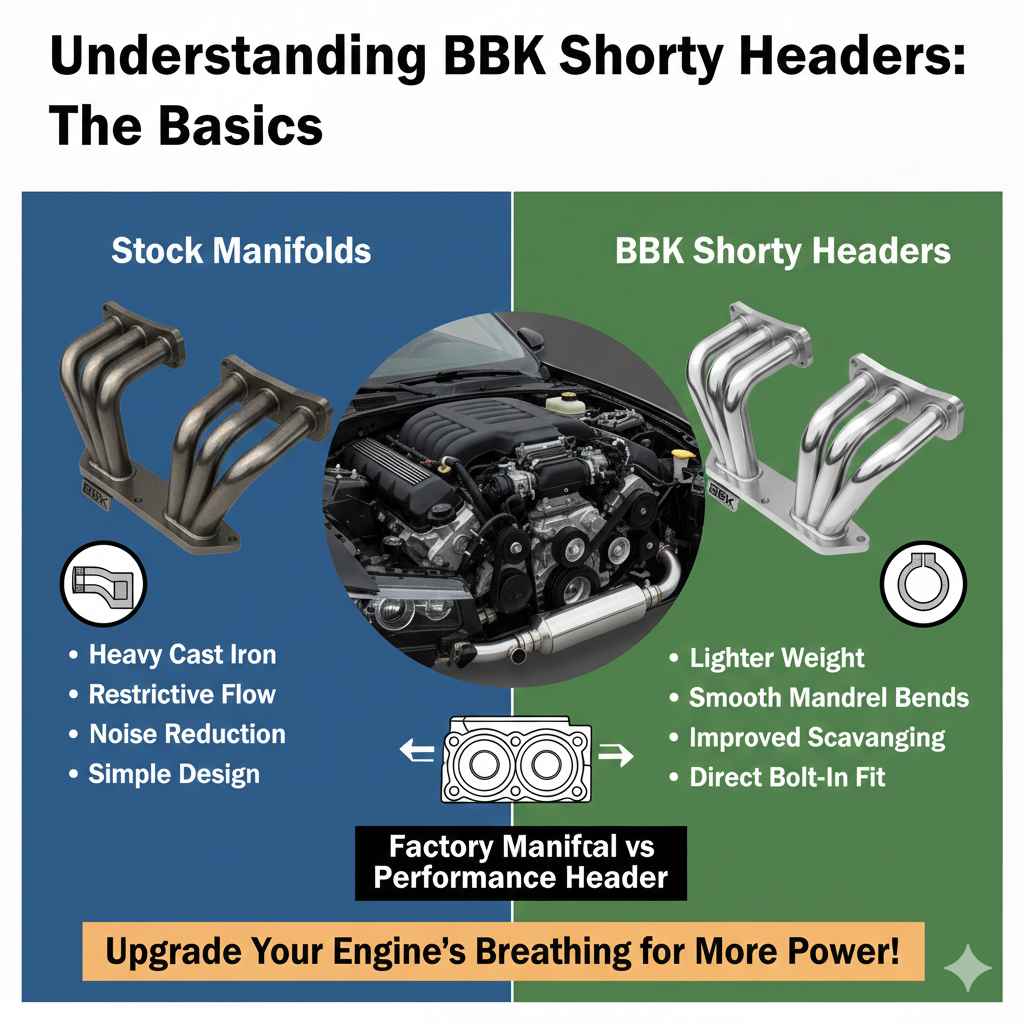
The biggest difference lies in the design and the material. Factory manifolds are typically heavy cast iron and have restrictive runners—the tubes that carry the gas away. Shorty headers, like those made by BBK, use smooth, mandrel-bent tubing. Mandrel bending ensures the tube diameter stays consistent all the way through, unlike crush-bent tubing which squeezes the pipe in the bend.
- Stock Manifolds: Heavy, restrictive flow, optimized for noise reduction.
- BBK Shorty Headers: Lighter weight, smooth, consistent internal diameter, optimized for faster exhaust scavenging (pulling the next pulse out).
- Installation: Shorties are often designed as direct, bolt-in replacements for the factory manifold, making installation much easier for a home mechanic.
The Science of Scavenging (Made Simple)
This is where the “power” comes from. When an engine fires, it pushes out a pulse of hot exhaust gas. If the path is clear and timed right, that pulse can actually help pull the next pulse out of the adjacent cylinder. This process is called scavenging. Good headers are designed to make these pulses arrive in the right order to help clear the cylinder completely.
Shorty headers improve this scavenging effect compared to stock manifolds. They don’t have the long tubes to perfectly tune the pulses like a race header might, but they offer a massive improvement in flow area and smoothness right off the cylinder head. This means less wasted energy pushing out old smoke, and more energy pushing the piston down on the next stroke.
Are BBK Shorty Headers Good? The Performance Proof
The central question is whether they are “good.” For many applications, the answer is a resounding yes, particularly when looking at bolt-on modifications that don’t require extensive tuning or custom fabrication.
What Power Gains Can You Expect?
Power gains are often modest but noticeable, especially on naturally aspirated (non-turbo) engines. Gains usually fall in the 5 to 15 horsepower range, depending heavily on the specific engine, the rest of the exhaust system, and whether the car has been tuned (or “flashed”) to take advantage of the better airflow.
It’s important to manage expectations. Shorty headers alone won’t double your horsepower. They work best as part of a system: better intake, better headers, better exhaust, and a tune to tie it all together. Think of it like opening a blocked drain; the water flows faster, but you need the whole plumbing system working correctly.
Real-World Benefits Beyond Peak Horsepower
While peak HP numbers are fun to talk about, many drivers notice improvements in areas that affect daily driving more:
- Improved Throttle Response: Because the engine clears its spent gases faster, it reacts quicker when you press the accelerator pedal.
- Mid-Range Torque: Shorty headers are often excellent at improving torque in the mid-range RPMs (the speed range you use most often for passing or merging).
- Sound Quality: They usually give the engine a deeper, more aggressive tone without being overly loud inside the cabin, provided the rest of the exhaust remains stock or mild.
BBK Shorty Headers vs. Long Tube Headers: A Comparison
When shopping for headers, you will always run into the long tube vs. shorty debate. Here is a simple comparison to help you decide which fits your goal:
| Feature | BBK Shorty Headers | Long Tube Headers |
|---|---|---|
| Installation Difficulty | Easier; often direct bolt-on replacement. | Harder; usually requires modifying or replacing the mid-pipe/catalytic converters. |
| Maximum Power Potential | Good bolt-on gains (5-15 HP). | Higher potential gains, especially when tuned (15-30+ HP). |
| Ground Clearance | Usually better; they stay close to the engine block. | Can sometimes hang lower, affecting ground clearance. |
| Emissions/Legality | Often easier to keep emissions-legal (if they retain the catalytic converters). | Often require off-road/race use only due to cat placement. |
If you are a beginner looking for a noticeable, relatively simple upgrade, BBK Shorty Headers are the clear winner in terms of ease of installation and keeping things street-legal in many areas. For maximum track performance, long tubes might be better, but they come with more complexity.
Installation Focus: Why Shorties Are Beginner-Friendly
One of the biggest reasons everyday car owners choose BBK Shorty Headers is the installation process. Exhaust work can be intimidating because bolts rust, sensors need disconnecting, and tight spaces are common. Shorty headers simplify this process significantly.
Tool Checklist for Success
Before you start, gather your tools. Having the right gear makes the job safer and much faster. Remember to always work on a cool engine and use proper safety gear, like thick gloves and eye protection.
- Jack and jack stands (never rely only on a jack!)
- Wrench and socket set (metric and standard, depending on your car)
- Torque wrench (essential for proper tightening)
- Penetrating oil (like PB Blaster or WD-40 Specialist Rust Remover Soak)
- Oxygen sensor socket (if your car has sensors in the old manifold)
- Gaskets and new hardware (often included with BBK headers)
- Safety glasses and gloves
Step-by-Step Guide to Swapping Manifolds for Shorty Headers
This is a general guide. Always check the specific instructions that come with your BBK header kit, as every vehicle setup is slightly different. For detailed, engine-specific guides, resources like the SAE International technical papers offer deep dives into fluid dynamics, but for a beginner, following the manufacturer’s manual is key.
- Preparation and Safety: Park the car on a level surface, disconnect the negative battery terminal (safety first!), and let the engine cool completely—ideally overnight.
- Lift the Vehicle: Safely raise the vehicle and secure it firmly on quality jack stands. Never work under a car supported only by a hydraulic or scissor jack.
- Locate and Disconnect Sensors: Find the oxygen (O2) sensors plugged into your stock manifolds. Carefully unplug the electrical connectors and use the specialized socket to remove the sensors from the old manifold.
- Unbolt the Old Manifold: Use penetrating oil on all manifold bolts first. Start by unbolting the exhaust pipe that connects to the manifold. Then, slowly remove the manifold bolts connecting it to the cylinder head. These are often very tight and rusty.
- Remove the Old Manifold: Once all bolts are out, carefully maneuver the old, heavy manifold away from the engine bay.
- Clean Mounting Surfaces: This is crucial! Use a plastic scraper or fine grit sandpaper to carefully clean all old gasket material off the cylinder head mating surface. A clean surface ensures the new gasket seals perfectly.
- Install the New Header: Place the new BBK Shorty Header into position, aligning it with the head bolts. Install the new gaskets (if necessary) and hand-tighten the new header bolts.
- Torque Down Evenly: Using your torque wrench, tighten the bolts following a crisscross or star pattern, tightening them in several small stages until you reach the manufacturer’s specified torque setting. This prevents warping the header flange.
- Reconnect Exhaust and Sensors: Reattach the exhaust piping to the header collector flange. Reinstall the O2 sensors into the new header bungs, ensuring they are snug, and plug the electrical connectors back in.
- Final Checks: Double-check every bolt, hanger, and connection. Reconnect the battery. Start the car and let it idle. Listen carefully for any exhaust leaks (a hissing or ticking sound). If you hear leaks, shut it down and address them immediately before driving.
Addressing Potential Hurdles
Even with shorties, you might hit snags:
- Stuck Bolts: Heat cycling (running the engine) and cooling causes metal expansion and contraction, often fusing bolts to the head. Penetrating oil and patience are your best friends here.
- O2 Sensor Clearance: Sometimes, the location of the O2 sensor bung on the new header might interfere with the wiring harness or frame. BBK usually accounts for this, but always check the routing before final tightening.
- Gasket Leaks: If you don’t clean the head surface perfectly, the gasket will leak. A small leak at the header flange might require re-torquing the bolts after the first heat cycle.
Sound, Emissions, and Longevity: The Long-Term View
Are they good? Yes, if they fit your goals for sound, street legality, and maintenance effort. Let’s look at the long-term considerations.
Exhaust Sound Profile
One of the main reasons people upgrade is the sound. Shorty headers dramatically change the tone compared to restrictive stock manifolds. They usually provide a deeper, throatier rumble at idle and a more aggressive roar under acceleration. Since they usually bolt up to the stock or near-stock mid-pipe and muffler, the sound is often less likely to drone (that annoying low-frequency humming) inside the cabin compared to full, aggressive cat-back systems.
Emissions and Legality Concerns
This is a critical area, especially if you live in an area with strict emission testing (like California or states that adopt CARB standards). Most BBK Shorty Headers designed for street use are designed to retain the factory catalytic converters or include high-flow cats in the short section.
If your new headers move the O2 sensor location significantly, the car’s computer (ECU) might read the exhaust differently, triggering a Check Engine Light (CEL). This usually requires a professional tune or a “spacer” (a small device that threads into the O2 sensor bung to move the sensor slightly out of the direct exhaust stream).
Always verify the specific part number you are buying against your local emissions regulations. Performance upgrades that remove or relocate catalytic converters are almost universally illegal for street use in the United States, according to the U.S. Environmental Protection Agency (EPA) regulations on tampering with emission control systems.
Material Quality and Longevity
BBK generally uses 1-1/2 inch to 1-5/8 inch 304 or 409 stainless steel tubing, depending on the specific product line. Stainless steel is far superior to the mild steel used in many budget headers because it resists rust and corrosion much better.
Durability Factors:
- Material: Higher quality stainless steel (like 304) lasts longer.
- Welds: Look for smooth, consistent welds. BBK typically has good TIG welds.
- Coating: Some BBK headers come ceramic-coated. This coating helps keep the exhaust heat inside the tube (improving scavenging efficiency) and also prevents the exterior from turning dark brown or blue due to extreme heat cycling.
If installed correctly with the proper torque, BBK shorty headers can easily last the life of your vehicle, offering long-term proven power benefits.
When BBK Shorty Headers Shine: Ideal Use Cases
Shorty headers are not a one-size-fits-all solution. They shine brightest in specific scenarios where ease of use and targeted power gains are the priority.
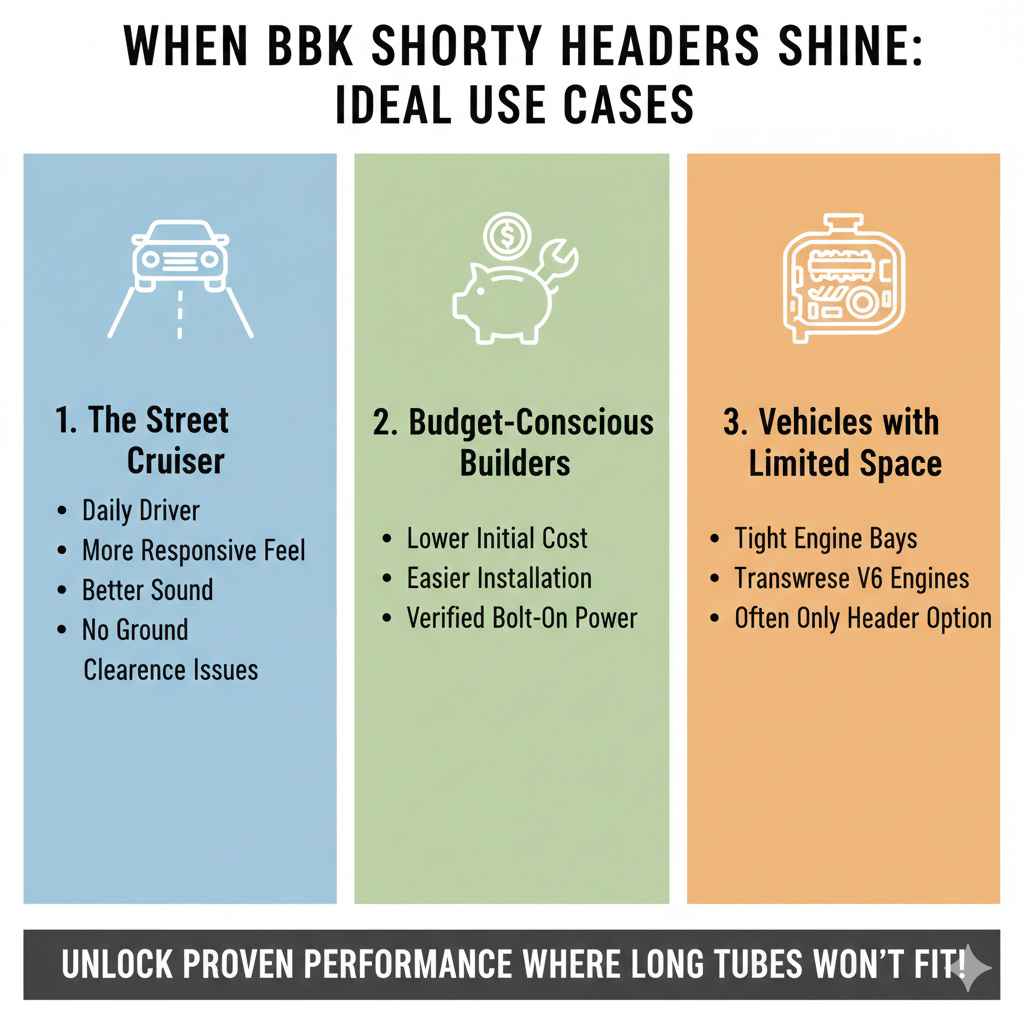
Scenario 1: The Street Cruiser Needing a Boost
If your car is your daily driver, sees highway use, and you want a more responsive feel and a better sound without major headaches, shorties are perfect. They provide the bolt-on performance benefit without the hassle of custom Y-pipes or worrying about extreme ground clearance issues common with long tubes.
Scenario 2: Budget-Conscious Performance Builders
Compared to a full, custom long-tube setup, shorty headers offer a much lower initial investment and significantly lower installation costs (if you pay a shop). You get a verified piece of hardware from a reputable brand that addresses the primary bottleneck (the cylinder head exit) right away.
Scenario 3: Vehicles with Limited Space
Some engine bays, especially in modern front-wheel-drive cars with transverse-mounted V6 engines or complex factory components crammed near the firewall, simply do not have the physical space to run long collector tubes down to the K-member. In these cases, shorty headers are often the only viable header upgrade.
When Might You Want Something Else?
If your goal is building a dedicated drag car or a high-RPM race machine, you might benefit more from long tubes, which are tuned to optimize exhaust pulse timing at very high engine speeds. For most drivers, however, the shorty design provides the best balance of performance, sound, and practicality.
Frequently Asked Questions (FAQ) about BBK Shorty Headers
Here are quick, easy answers to common beginner questions about these exhaust components.
Q1: Will installing BBK Shorty Headers void my factory powertrain warranty?
A: In the US, the Magnuson-Moss Warranty Act generally protects consumers from having their entire warranty voided by aftermarket parts. However, if a dealer can definitively prove that the headers directly caused the failure of a covered component (like an engine issue), they may deny that specific claim. For simple bolt-on parts like headers, this is rare unless the installation was faulty.
Q2: Do I need to get a custom computer tune after installing shorty headers?
A: If your shorty headers retain the factory catalytic converters and you are only replacing the manifold, a tune is usually not strictly required for basic operation, especially on modern fuel-injected vehicles that can self-adjust. However, for maximum power gains and to prevent any potential O2 sensor-related Check Engine Lights, a tune is highly recommended.
Q3: Are BBK Shorty Headers loud?
A: They will make your exhaust sound louder and deeper than stock, but they are typically less extreme than long tube headers. The final volume largely depends on the rest of your exhaust system (mid-pipe and muffler). Many people find the sound profile of shorties alone to be perfect for daily driving.
Q4: Can I use the old O2 sensors with new BBK shorty headers?
A: Yes, you typically reuse your factory oxygen sensors. It is critical that you transfer them carefully. If the new headers place the sensor bung in a different location, you may need an extension cable so the sensor can plug back into its original wiring harness without stretching or melting.
Q5: How long does it take an average person to install BBK Shorty Headers?
A: For someone with basic mechanical experience, a pair of BBK Shorty Headers on a V8 (like a small-block Chevy) can take between 3 to 5 hours, assuming the bolts aren’t seized. If bolts are rusted solid, it can take significantly longer due to drilling and extraction.
Q6: What is the main advantage of stainless steel headers over coated mild steel?
A: Stainless steel (especially 304 grade) is much more resistant to corrosion and rust, meaning it will look better and last much longer than painted or coated mild steel, which often rusts through the coating after exposure to road salt and moisture.
Conclusion: Your Proven Path to Better Exhaust Flow
So, are BBK Shorty Headers good? Absolutely, they are a fantastic product for the everyday driver looking to unlock hidden power and enjoy a better sound without diving into highly complex, expensive, or potentially illegal exhaust modifications. They offer a significant improvement over restrictive factory manifolds by smoothing out the initial exhaust exit path, resulting in better throttle response and tangible horsepower gains across the RPM range.
As your trusted automotive guide, my goal is to give you confidence in your upgrades. BBK Shorty Headers fit that bill perfectly. They are relatively straightforward to install, built from quality materials designed to last, and they deliver on their promise of proven, bolt-on power. By pairing them with a thorough cleaning of the mating surfaces and ensuring proper torquing during installation, you are setting yourself up for a rewarding upgrade that you can enjoy every time you hit the gas. Start with the easy, effective steps, and you’ll be amazed at how much better your engine breathes.