Are 330i Headers Same As 330xi: Essential Guide
No, BMW 330i and 330xi headers are typically not the same. While they share many similarities due to being part of the same E90/E91/E92/E93 generation, the crucial difference in their drivetrain (rear-wheel drive vs. all-wheel drive) means header design and fitment will vary. Always verify compatibility for your specific model year and chassis code before purchasing aftermarket headers.
If you’re a BMW owner, especially one with a 330i or 330xi, you might be wondering about exhaust upgrades. A common question buzzing around car forums and among enthusiasts is whether the headers for a 330i are the same as those for a 330xi. This can be a confusing topic, especially when you’re just starting out with car modifications or maintenance. You want to get the right parts to improve your car’s performance and sound, but you don’t want to end up with something that doesn’t fit, costing you time and money. Don’t worry, we’ve got you covered! This guide will break down the differences, explain why they exist, and help you find the right headers for your specific BMW.
Why Drivetrain Matters for Headers
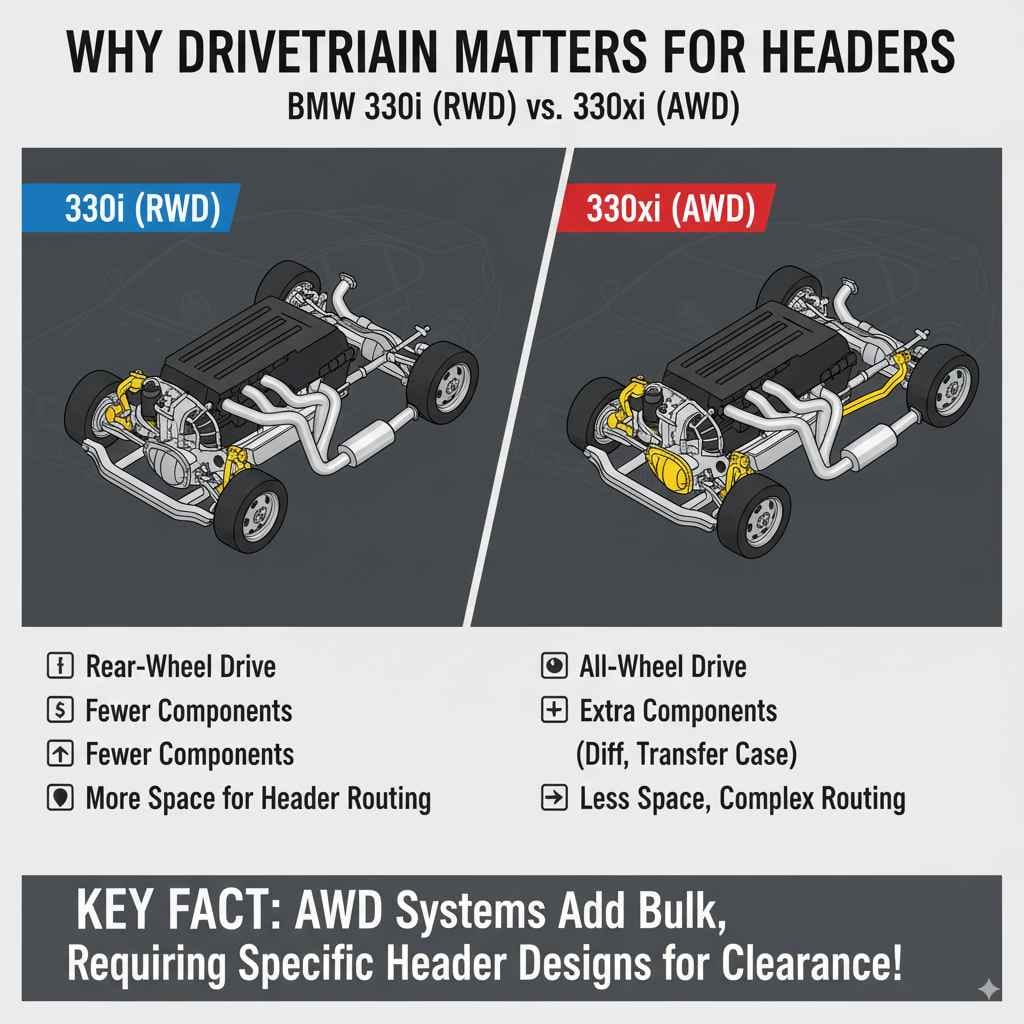
The most significant difference between a 330i and a 330xi is their drivetrain. The “i” suffix in BMW’s naming convention typically refers to “injection,” indicating fuel-injected engines. However, the critical distinction for exhaust components like headers lies in the number of driven wheels. A standard 330i is a rear-wheel-drive (RWD) vehicle. On the other hand, the 330xi is an all-wheel-drive (AWD) version. This AWD system, often referred to as BMW’s xDrive, requires additional components to route power to the front wheels. These extra components, such as the front differential, transfer case, and associated driveshafts, occupy space within the engine bay and under the vehicle. This is where the difference in header design becomes important.
Think of it like fitting a slightly larger toolbox into a car. The basic engine and chassis are similar, but the added AWD equipment creates a different environment under the hood and underneath the car. Headers are precisely engineered to snake around existing components and connect to the exhaust system. Any alteration in the available space—like the presence of an AWD system—can mean that parts designed for one configuration won’t clear or fit properly on the other. This is why exhaust manifold designs, which include headers, are often specific to RWD and AWD models, even within the same car generation.
BMW E90 Generation: A Closer Look
The E90 generation of the BMW 3 Series, which includes models like the 330i and 330xi produced roughly from 2006 to 2011 (with variations for the coupe, convertible, and touring models), is where this header question often arises. Both the 330i and 330xi in this generation were powered by the same or similar naturally aspirated inline-six engines, typically the N52 variant. This engine is renowned for its smooth power delivery and distinctive sound. Because the engine itself is largely the same, the primary reason for different headers boils down to the chassis and drivetrain layout. The integration of the xDrive AWD system in the 330xi necessitates a revised exhaust path from the engine’s cylinder heads. This means that while the engine is the same, the space around it and the routing of surrounding parts differ enough to impact header fitment.
What Are Headers, Anyway?
Before we dive deeper into the differences, let’s clarify what headers are and why they’re a popular aftermarket upgrade. In your car’s engine, the exhaust manifold is the part that collects exhaust gases from each cylinder and funnels them into a single pipe. Stock exhaust manifolds are often designed with manufacturing costs and emissions in mind, and they might not be the most efficient at expelling exhaust gases. This can lead to less-than-optimal engine performance.
Aftermarket headers, also known as “exhaust headers” or “header pipes,” are designed to be a direct replacement for the stock exhaust manifold. They are typically made from materials like stainless steel and are engineered to improve exhaust flow. This improved flow has several potential benefits:
- Better Engine Performance: By allowing exhaust gases to escape more freely and quickly, headers can help the engine “breathe” better. This reduction in exhaust “backpressure” can lead to a slight increase in horsepower and torque.
- Improved Exhaust Sound: Headers can alter the tone of your car’s exhaust, often making it deeper, more aggressive, and sportier.
- Enhanced Throttle Response: A freer-flowing exhaust can sometimes make the engine feel more responsive when you press the accelerator.
- Weight Reduction: Some aftermarket headers are lighter than the stock cast-iron manifolds, contributing to a minor weight saving.
It’s important to understand that headers are a performance upgrade and their effects can vary. For a more in-depth look at how exhaust systems work, you can refer to resources like those from the U.S. Environmental Protection Agency, which explains the role of exhaust systems in emissions control and engine function.
Key Differences Affecting Header Fitment:
When looking at the 330i and 330xi, the differences that impact header design are primarily structural and component-based, stemming directly from the drivetrain.
1. Front Differential and Mounts
The 330xi has a front differential housed near the engine’s front. This component, along with its mounting brackets, takes up space that is otherwise open in the 330i. Headers need to be carefully shaped to clear these components. If headers are designed for a 330i (RWD), they might have pipes that are routed lower or differently, which could interfere with the front differential, its casing, or its mounting points on the 330xi.
2. Front Driveshaft & Transfer Case
The AWD system requires a driveshaft to transfer power to the front wheels. This driveshaft typically runs from the transmission or transfer case forward. The transfer case itself, which splits power between the front and rear axles, is another substantial piece of equipment that affects the undercarriage and engine bay layout. The routing of exhaust headers must account for the presence and position of these components. Headers designed for the 330xi often feature unique bends or a slightly higher tuck to navigate around the front driveshaft and transfer case.
3. Chassis and Subframe Variations
While BMW strives for modularity, sometimes the integration of an AWD system can lead to minor differences in the chassis or subframe design for packaging reasons. These subtle variations can affect the clearance and mounting points for exhaust components. The subframe, which supports the engine and suspension, might be shaped slightly differently or have specific provisions for AWD components that influence how headers are installed.
4. Exhaust Port Flange & Collector
Interestingly, the engine itself (the N52 in many E90 330 variants) has identical exhaust ports on the cylinder head. This means that the flange where the headers bolt to the engine head is usually the same for both the 330i and 330xi. This is often why people think they might be interchangeable. However, the challenge isn’t at the engine head; it’s further down the line where the pipes merge and route towards the rest of the exhaust system, and where clearance issues arise.
Header Design: A Tale of Two Paths
Because of the space constraints imposed by the xDrive system, headers designed for the 330xi almost universally feature a different design compared to those for the 330i. Here’s a general breakdown of what you might observe:
330i Headers (RWD)
- More straightforward routing as there are no front drivetrain components to contend with.
- Pipes might be routed lower or have less aggressive bends.
- Generally, more aftermarket options are available for RWD applications due to higher production numbers and simpler fitment.
330xi Headers (AWD)
- Often feature more complex, sculpted bends to navigate around the front differential, driveshaft, and transfer case.
- May have a slightly different collector shape or position to facilitate clearance.
- The overall profile might be more “tucked up” to provide necessary ground clearance while avoiding interference.
- Fewer aftermarket options might be available compared to the RWD counterpart.
Here’s a table that illustrates the typical differences you’d encounter:
| Feature | 330i Headers (RWD) | 330xi Headers (AWD) |
|---|---|---|
| Drivetrain | Rear-Wheel Drive | All-Wheel Drive (xDrive) |
| Clearance Concerns | Fewer; mainly engine bay components and firewall. | Significant; front differential, transfer case, front driveshaft. |
| Pipe Routing | More direct, potentially lower profile. | More intricate bends, often higher and tucked. |
| Flange to Head | Usually identical. | Usually identical. |
| Commonality | Often more models available. | Fewer specialized models. |
How to Verify Compatibility
When you’re looking to buy headers, it’s crucial to be certain they will fit your specific car. Here’s how to do it:
- Know Your Chassis Code: Be sure of your BMW’s generation and chassis code. For example, the E90 generation encompasses the sedan (E90), touring/wagon (E91), coupe (E92), and convertible (E93).
- Check the Part Description Carefully: Reputable aftermarket parts manufacturers will explicitly state which models their headers are designed for. Look for phrases like “Designed for BMW 330i (E90/E91/E92/E93)” or “Designed for BMW 330xi (E90/E91/E92/E93).” If it only lists one, it’s likely not compatible with the other.
- Consult Manufacturer Websites: Always visit the official website of the header manufacturer. They will have detailed product listings, compatibility charts, and often installation manuals.
- Read Customer Reviews and Forum Discussions: Enthusiasts often share their experiences online. Search forums dedicated to BMWs (like Bimmerpost, E90Post) for discussions about specific header brands and their fitment on 330i vs. 330xi models. Sometimes, someone has already tried to fit the wrong part and can warn others.
- Contact the Seller or Manufacturer Directly: If you are still unsure, don’t hesitate to contact the customer support for the retailer or manufacturer. Provide your car’s exact year, model, and drivetrain (e.g., 2008 BMW 330xi). They should be able to confirm or deny compatibility.
- Compare to Your Stock Manifold: If you have the ability, visually inspect your stock exhaust manifold. You can often see how the pipes are routed and where they might interfere with other components. This can give you clues about what would be needed for an AWD model.
Can You Modify 330i Headers for a 330xi?
While it might sound tempting to buy cheaper 330i headers and try to modify them for your 330xi, this is generally not recommended for beginners, or even most intermediate DIYers. Here’s why:
- Complexity of Bends: Exhaust headers involve precise bends that are crucial for both performance and clearance. Re-bending or fabricating new sections to clear AWD components requires specialized tools (like a mandrel bender), expertise, and often welding.
- Material and Welding: Headers are typically made from stainless steel. Welding stainless steel requires specific techniques and equipment to maintain strength and prevent corrosion. A poorly welded header can leak, fail, or even break off.
- Performance Compromise: Improperly modified bends can disrupt the smooth flow of exhaust gases, negating any performance benefits and potentially even hurting performance. The carefully calculated lengths and diameters of each runner tube in true aftermarket headers are designed for optimal scavenging.
- Cost and Time: The cost of professional modification (if you can find a shop willing to do it) plus your own time often approaches or exceeds the cost of buying the correct, specifically designed headers.
- Potential for Leaks: Any modification points, especially welds, are potential leak points. Exhaust leaks can be noisy, dangerous (releasing toxic fumes into the cabin), and can trigger check engine lights.
For most people, the safest and most effective approach is to purchase headers explicitly designed for the 330xi. Resources like Consumers.gov offer guidance on understanding product information and making informed purchasing decisions for automotive parts.
Installation Considerations
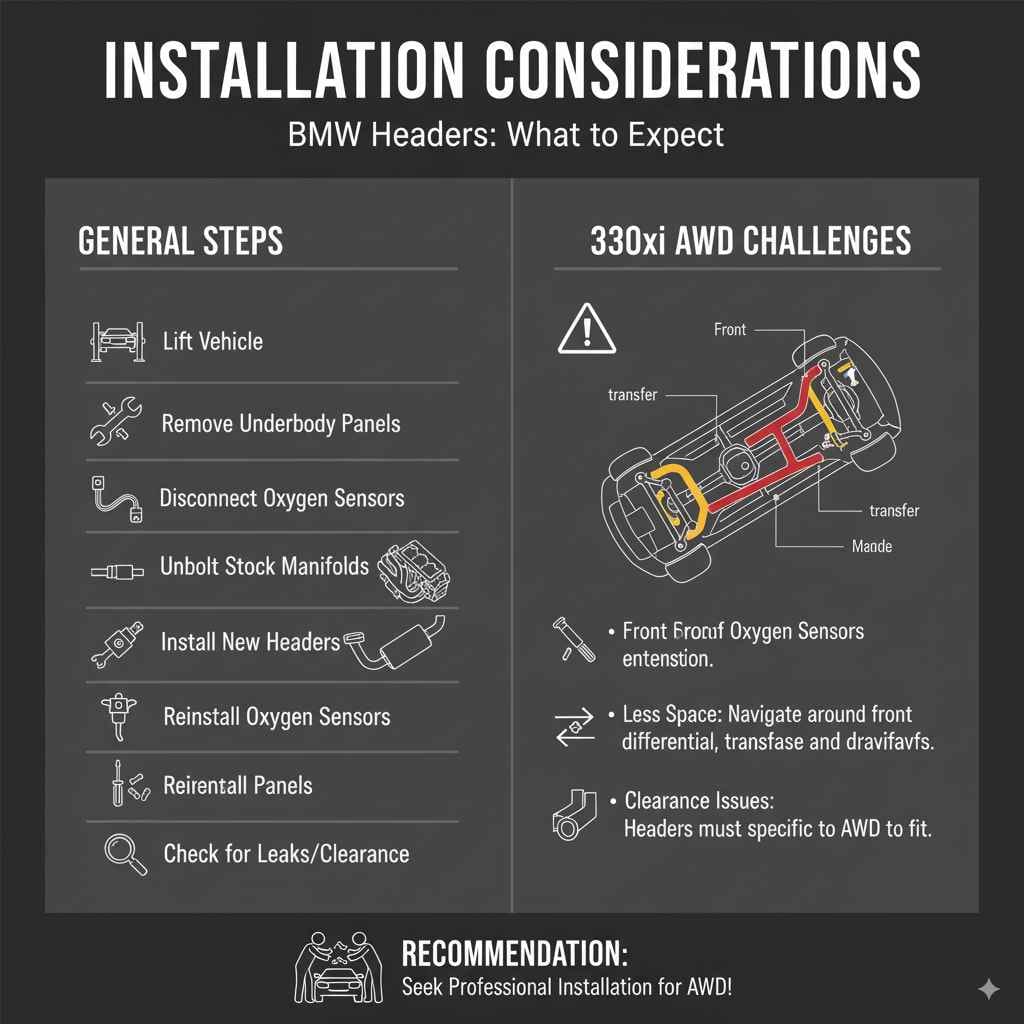
Installing headers, whether for a 330i or 330xi, is a more involved process than changing spark plugs. It typically requires:
- Lifting the vehicle (on a lift or sturdy jack stands).
- Removing underbody panels.
- Disconnecting oxygen sensors.
- Unbolting the stock exhaust manifold(s).
- Bolting on the new headers.
- Reinstalling oxygen sensors (sometimes requiring extensions).
- Reinstalling underbody panels.
- Checking for clearance issues and leaks.
For the 330xi, the installer must be particularly vigilant about the clearance around the AWD components mentioned earlier. A common recommendation is to seek professional installation if you are not comfortable with working underneath a vehicle or are unsure about the process. For those who decide to DIY, it’s wise to have someone assist you and to consult a detailed service manual or installation video specific to your BMW model.
Common Misconceptions and FAQs
Let’s address some frequently asked questions about BMW 330i and 330xi headers.
FAQ Section
Q1: Are the engine heads the same for the 330i and 330xi? Are the exhaust flange bolt patterns identical?
A1: Yes, typically the engine heads and the exhaust flange bolt patterns on the cylinder heads are the same for the 330i and 330xi models within the same generation (e.g., E90 N52 engine). The difference in header fitment arises from the components located below and around the manifold due to the AWD system on the xi models.
Q2: I found headers that claim to fit “all E90 330 models.” Can I trust this?
A2: Be cautious. While some manufacturers might use broad language, it’s always best to verify. Look for explicit mentions of both “330i” and “330xi” or specific chassis codes linked to each drivetrain type. If it’s vague, contact the seller or manufacturer to confirm compatibility for your exact XI model.
Q3: Will installing different headers void my BMW’s warranty?
A3: Aftermarket modifications, including headers, can potentially affect your vehicle’s warranty. If a problem arises that can be directly traced to the aftermarket part or its installation, the manufacturer may deny warranty coverage for that specific issue. It’s advisable to check your warranty terms or consult with your dealership.
Q4: Do headers require an ECU tune?
A4: For many basic aftermarket headers on naturally aspirated engines like the N52, a tune is not strictly required for the car to run. However, to maximize the performance gains from headers and to ensure the engine’s computer is optimally adjusting fuel and timing for the improved exhaust flow (preventing potential lean conditions or check engine lights), an ECU tune is highly recommended. Some high-flow catalytic converters integrated into headers might require a tune to avoid catalyst efficiency codes.
Q5: What’s the difference between headers and a cat-back exhaust system?
A5: Headers (or exhaust manifolds) are the first part of the exhaust system, directly bolted to the engine’s cylinder heads. They collect gases from each cylinder. A cat-back system starts after the catalytic converter and includes the mid-pipe, resonator (if applicable), and muffler. Headers focus on the engine’s “breathing” at the source. Cat-back systems primarily affect the sound and, to a lesser extent, flow further down the exhaust pipe.
Q6: Can AWD components be removed on a 330xi to fit 330i headers?
A6: Theoretically, yes, but it would be an extremely involved and expensive conversion. It would involve removing the front differential, transfer case, front driveshaft, and all associated mounting hardware and potentially modifying the firewall or floor pan.