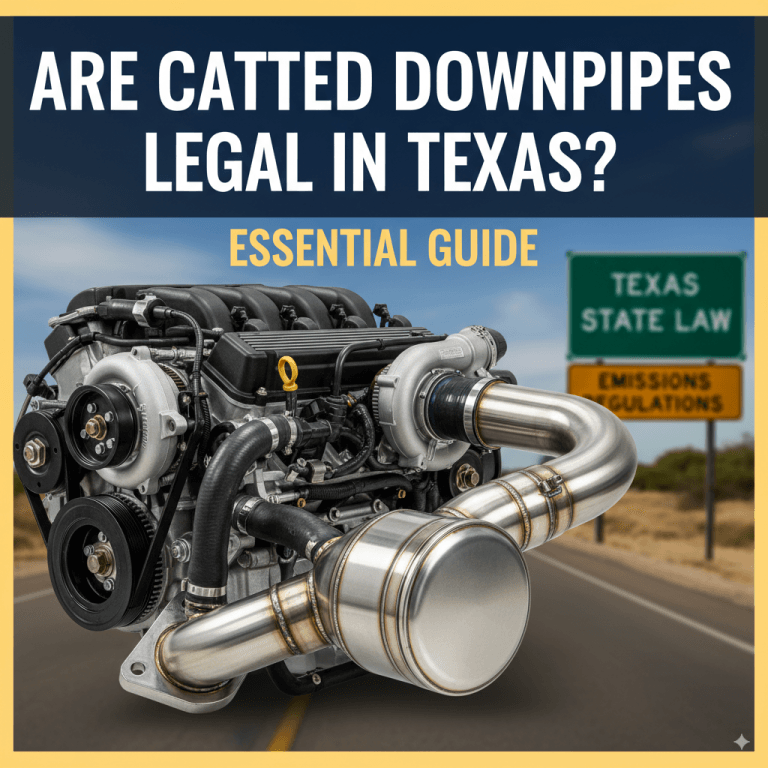
Are Aftermarket Downpipes Legal In California? Proven Rules
Aftermarket downpipes are generally not legal in California for street use due to stringent emissions regulations enforced by the California Air Resources Board (CARB). To be legal, they must have a CARB Executive Order (EO) exemption, which is rare for aftermarket downpipes.
When you’re thinking about giving your car a little boost in performance or a cooler sound, exhaust upgrades often come to mind. For many car owners, especially those new to tuning, understanding aftermarket parts can feel like navigating a maze. One of the most common questions that pops up, particularly for those living in California, is about downpipes.
If you’ve heard that some car parts have tricky rules, especially out west, you’re not alone. California has some of the strictest environmental laws in the country to keep our air as clean as possible. This makes knowing what’s allowed and what’s not super important. We’re here to break down the rules about aftermarket downpipes in California in a way that’s easy to follow. We’ll cover what makes a part legal, what the consequences are if it’s not, and what you need to know before you buy anything. Let’s peel back the layers and get your car running right and legally!
What Exactly is a Downpipe?
Before we dive into California’s rules, let’s quickly talk about what a downpipe actually is. Think of it as a crucial piece connecting your car’s turbocharger (if it has one) to the rest of your exhaust system. It’s usually the first pipe after the turbo.
The downpipe plays a big role in how well your engine breathes. It’s designed to:
- Guide exhaust gases: It efficiently channels hot gases away from the turbo.
- Hold the catalytic converter: On most stock vehicles, the downpipe contains a catalytic converter, which is a vital emissions control device. This is the part that often gets modified or replaced in aftermarket setups.
- Influence performance: A well-designed aftermarket downpipe can reduce exhaust backpressure, allowing the turbo to spool up faster and potentially increasing horsepower.
However, it’s this very part, specifically modifications to the catalytic converter, that lands aftermarket downpipes in a legal gray area, especially in places like California.

California’s Strict Emissions Laws: The Big Picture
California has a unique set of environmental regulations, largely driven by the state’s history with air quality. The California Air Resources Board (CARB) is the main agency responsible for setting and enforcing these standards. CARB’s mission is to ensure that vehicles and their components meet stringent emissions targets to protect public health and the environment.
Why are California’s rules different? It really comes down to air quality. Cities like Los Angeles have historically struggled with smog, and vehicle emissions are a major contributor. To combat this, California has often led the nation in developing and implementing stricter emissions standards than those set by the federal government. Many other states have adopted California’s emissions standards, making these rules impactful far beyond the state’s borders.
When it comes to aftermarket parts, CARB has a specific process for approving them. For a part that affects emissions, like a downpipe with a modified or removed catalytic converter, it must be certified by CARB. Without this certification, it’s considered a “tampering” issue and is not legal for use on public roads in California.
The Crucial Role of the Catalytic Converter
The catalytic converter is the unsung hero of your exhaust system when it comes to clean air. It’s a part of your exhaust system that uses precious metals like platinum, palladium, and rhodium to transform harmful pollutants from your engine into less harmful gases.
Here’s what it does:
- Reduces hydrocarbons (HC): These are unburned fuel vapors that contribute to smog.
- Reduces carbon monoxide (CO): A poisonous gas produced by incomplete fuel combustion.
- Reduces nitrogen oxides (NOx): These gases contribute to smog and acid rain.
A stock catalytic converter is precisely engineered to work with your vehicle’s specific engine and emissions control system. Aftermarket downpipes often aim to improve performance by either:
- Removing the catalytic converter entirely (“cat-less” downpipe): This significantly reduces exhaust restriction but eliminates emissions control.
- Replacing the stock converter with a high-flow or “sport” catalytic converter: While these can be less restrictive than stock, they still need to meet strict emissions standards to be legal.
In California, removing or bypassing the catalytic converter is a direct violation of emissions laws because it releases harmful pollutants into the air, directly counteracting the state’s clean air goals.

What Makes an Aftermarket Part “California Legal”?
For any aftermarket part that could affect vehicle emissions, the key to legality in California is a CARB Executive Order (EO) number.
Here’s how it works:
- Manufacturer Application: The manufacturer of the aftermarket part applies to CARB.
- Testing and Evaluation: CARB rigorously tests the part to ensure it meets or exceeds the state’s emissions standards. This includes testing the effectiveness of any emissions control components.
- Approval and EO Number: If the part passes, CARB issues an Executive Order number for that specific part on specific vehicles or engine families.
- Legality: Only parts with a CARB EO number are legal for sale and use on a vehicle in California.
When it comes to aftermarket downpipes, it is exceptionally rare for them to receive a CARB EO. This is because downpipes are directly in the exhaust stream and often designed to either replace or modify the catalytic converter. For a downpipe to be legal, it would need to include a CARB-approved catalytic converter that meets all emissions requirements, and the manufacturer would need to demonstrate that the entire assembly doesn’t cause the vehicle to pollute more than its original configuration, or even better, reduce emissions.
Are Aftermarket Downpipes Legal in California? The Proven Rules
So, let’s get straight to the point: Are aftermarket downpipes legal in California?
The straightforward answer is: No, most aftermarket downpipes are not legal for street use in California.
Here’s why, based on proven rules and regulations:
- Mandatory Emissions Equipment: California Vehicle Code Section 27156 prohibits the removal or rendering inoperative of any device, including emissions control devices, installed on a motor vehicle by regulation. This means your vehicle must have its original catalytic converters (or CARB-approved replacements) installed and functioning.
- CARB Certification is King: As mentioned, any aftermarket part that can affect emissions must have a CARB EO number. The vast majority of aftermarket downpipes, especially those advertised for “off-road” use or described as “cat-less,” do not have this certification.
- “Off-Road” Use Distinction: Some manufacturers sell “off-road” downpipes, often without a catalytic converter. While these might be legal for use solely on a closed course or for racing purposes, they are strictly illegal for any public road use in California. Law enforcement can, and do, cite vehicles for having non-compliant exhaust systems.
- Inspection and Smog Checks: California has one of the most comprehensive smog check programs in the world. Stations are equipped to detect modifications that bypass or remove emissions control devices. A vehicle with an illegal aftermarket downpipe will fail its smog inspection and cannot be registered.
The Impact of a Cat-less Downpipe on Emissions
A cat-less downpipe essentially removes the primary emissions control device from the exhaust stream. This means that raw exhaust gases, including hydrocarbons, carbon monoxide, and nitrogen oxides, are expelled directly into the atmosphere.
Consider these major implications:
- Significant Pollution Increase: Without a catalytic converter, a gasoline-powered vehicle can emit dozens, if not hundreds, of times more harmful pollutants than a vehicle with a functional converter.
- Failure of Smog Checks: In California, a smog check measures the actual emissions coming out of your tailpipe. A cat-less system will produce readings far exceeding legal limits, making a pass impossible.
- Environmental Harm: This directly contributes to smog, respiratory problems, and other environmental damage that California laws aim to prevent.
The Difference with High-Flow Catalytic Converters
Some aftermarket downpipes feature a high-flow catalytic converter. While these aim to reduce backpressure for performance gains, their legality in California hinges on whether they are CARB-certified.
Here’s the breakdown:
- CARB EO Requirement: A high-flow catalytic converter in a downpipe must have its own specific CARB EO number to be legal in California.
- Effectiveness Testing: CARB assesses if these high-flow units perform their emissions-reducing duties effectively over the vehicle’s lifespan. Simply having a catalytic converter is not enough; it must be an approved one.
- Rarity: Finding aftermarket downpipes with a CARB EO number that are specifically designed to replace a stock downpipe and catalytic converter is extremely rare in the performance parts market. If you do find one, verify the EO number directly on the CARB Executive Order database.
Consequences of Using Illegal Downpipes in California
Using an aftermarket downpipe that is not CARB-legal in California can lead to significant penalties. These are not minor inconveniences; they are serious legal and financial issues.
Common Penalties and Fines
If you are caught by law enforcement or, more commonly, fail a smog inspection, you can face several consequences:
- Failing Smog Check: Your vehicle will not pass its registration renewal, and you will be unable to legally operate it on public roads.
- Fix-It Tickets: Law enforcement officers can issue citations for having an illegal exhaust system. These often require you to correct the issue and present proof of compliance, or face substantial fines.
- Heavy Fines: Fines for emissions violations in California can range from several hundred to thousands of dollars. These fines are designed to deter non-compliance.
- Vehicle Impoundment: In some severe or repeat offender cases, the vehicle itself could be impounded until the emissions system is brought back into compliance.
The “Tampering” Charge
Under California Vehicle Code Section 27156, installing a part that bypasses or disables an emissions control device is considered “tampering.” This is a criminal offense. The intent of the law is to ensure all vehicles on the road meet the specified emissions standards, regardless of whether they are stock or modified.

How to Identify a CARB-Legal Part
When looking for any aftermarket exhaust component, especially a downpipe, for your vehicle in California, it’s crucial to know how to verify its legality.
Looking for the CARB EO Number
A legitimate CARB-approved part will have a label or stamp directly on the part itself that clearly displays its unique Executive Order (EO) number. This number will look something like this: “D-XXX-YY” or “C-XXX-YY”.
Steps to check:
- Find the EO Number: This should be clearly stated by the manufacturer in their product description, on the part itself, or in accompanying documentation.
- Search the CARB Database: Go to the official CARB Executive Order (EO) Search page.
- Enter the Number: Type in the EO number you found.
- Verify Application: Ensure the EO number corresponds to the specific part you are looking at and that it is listed for your vehicle’s make, model, and year.
If a manufacturer claims a part is legal in California but cannot provide a valid CARB EO number, or if the number doesn’t match the part or your vehicle, it is almost certainly not legal for use on public roads.
Alternatives for California Enthusiasts
If you’re looking to enhance your car’s performance or sound in California while staying within the law, here are some legal alternatives that focus on areas not typically regulated by emissions requirements:
Legal Performance and Sound Upgrades
Focus on modifications that do not alter or bypass emissions control systems:
- Cat-Back Exhaust Systems: These systems replace the exhaust components from the catalytic converter back to the tailpipe. They can offer a more aggressive sound and slight performance improvements without affecting emissions. Most cat-back systems are legal in California, provided they don’t violate noise ordinances.
- Performance Air Intakes: A performance air intake can improve throttle response and engine sound. Most intakes are designed to work with the stock emissions equipment and are generally legal, but it’s always wise to check for CARB exemption if available.
- ECU Tuning (with caution): While tuning your engine’s computer can affect performance, extreme tunes that bypass emissions controls are illegal. Tunes that focus on optimizing existing parameters for power without compromising emissions control are in a legally safer area, but still require careful consideration and understanding of CARB’s stance on engine modifications.
- Suspension and Brake Upgrades: Enhancing your car’s handling and stopping power are performance modifications that don’t touch the emissions system and are perfectly legal.
Compliance and Your Vehicle
Always prioritize compliance. The peace of mind that comes with knowing your vehicle meets legal standards is invaluable. It saves you from fines, potential legal troubles, and the hassle of failing and re-doing smog tests.

Frequently Asked Questions (FAQs)
Q1: Can I install an “off-road” downpipe in my car in California?
A1: No, “off-road” downpipes, which typically lack a catalytic converter, are strictly illegal for use on any public roads in California. They are only permissible for use on private property or closed-course racing circuits, provided they do not violate local noise ordinances.
Q2: How do I know if a downpipe is legal in California?
A2: A downpipe is legal in California only if it has a specific Executive Order (EO) number issued by the California Air Resources Board (CARB). You can verify this number on the CARB website. Most aftermarket downpipes do not have this exemption.
Q3: What happens if I’m caught with an illegal downpipe in California?
A3: You could face significant fines, receive a “fix-it” ticket requiring you to uninstall the illegal part, and fail your state smog inspection, preventing vehicle registration renewal. In severe cases, vehicle impoundment is possible.
Q4: Are cat-back exhaust systems legal in California?
A4: Yes, generally cat-back exhaust systems are legal in California because they are located downstream of the catalytic converter and do not affect emissions. However, they must not be excessively loud to comply with noise regulations.
Q5: Can I buy an aftermarket downpipe from another state and use it in California?
A5: No, California emissions laws apply to all vehicles operating within the state, regardless of where the parts were purchased. An out-of-state purchase of a non-CARB-legal downpipe offers no protection from California’s regulations.
Q6: What constitutes a “tampering” violation in California regarding exhaust systems?
A6: Tampering refers to the removal, deactivation, or modification of any emission control device or system. For a downpipe, this typically means removing or replacing the catalytic converter with a non-approved unit, or installing a “cat-less” pipe.
Q7: Where can I find a list of CARB-approved aftermarket parts?
A7: You can find a comprehensive list on the official California Air Resources Board (CARB) website. Specifically, search for their Executive Order (EO) database, where you can look up parts by manufacturer, part number, or EO number.
Conclusion
Navigating the rules for aftermarket car parts in California, especially concerning exhaust systems like downpipes, can feel complex. However, understanding the core principle is key: any part that affects emissions must be certified by CARB. For aftermarket downpipes, this certification is exceptionally rare.
Most performance-oriented downpipes are designed to remove or bypass the factory catalytic converter to reduce exhaust restriction, which is directly contrary to California’s stringent clean air laws. Installing such a part can lead to failed smog checks, hefty fines, and other legal troubles.
For car enthusiasts in the Golden State looking to enhance their vehicle’s performance or sound, legitimate options exist. Focusing on CARB-legal modifications, such as cat-back exhaust systems or performance air intakes that carry an EO number, is the safest and most responsible route. Always remember to verify the legality of any aftermarket part by checking for that crucial CARB EO number. By staying informed and compliant, you can enjoy your vehicle while respecting the Golden State’s commitment to cleaner air.