How To Get Crackles From BMW Performance Exhaust
Getting those awesome crackles and pops from your BMW’s performance exhaust is something many car fans want. It can seem tricky, especially if you’re new to modifying your car. You might wonder if it’s complicated or expensive.
Don’t worry, it’s actually quite achievable with the right information. We’ll walk you through it step by step, making How to Get Crackles from BMW Performance Exhaust simple and clear. Get ready to make your BMW sound amazing.
Understanding BMW Exhaust Crackles
This section explores the science behind the captivating exhaust crackles and pops often desired by BMW owners. We will look at how these sounds are produced, what factors influence them, and why certain BMW models or setups are more prone to them. Understanding the basic mechanics is key to achieving the desired result safely and effectively. This knowledge will help you appreciate the nuances involved and make informed decisions about your exhaust system.
The Science of Exhaust Bursts
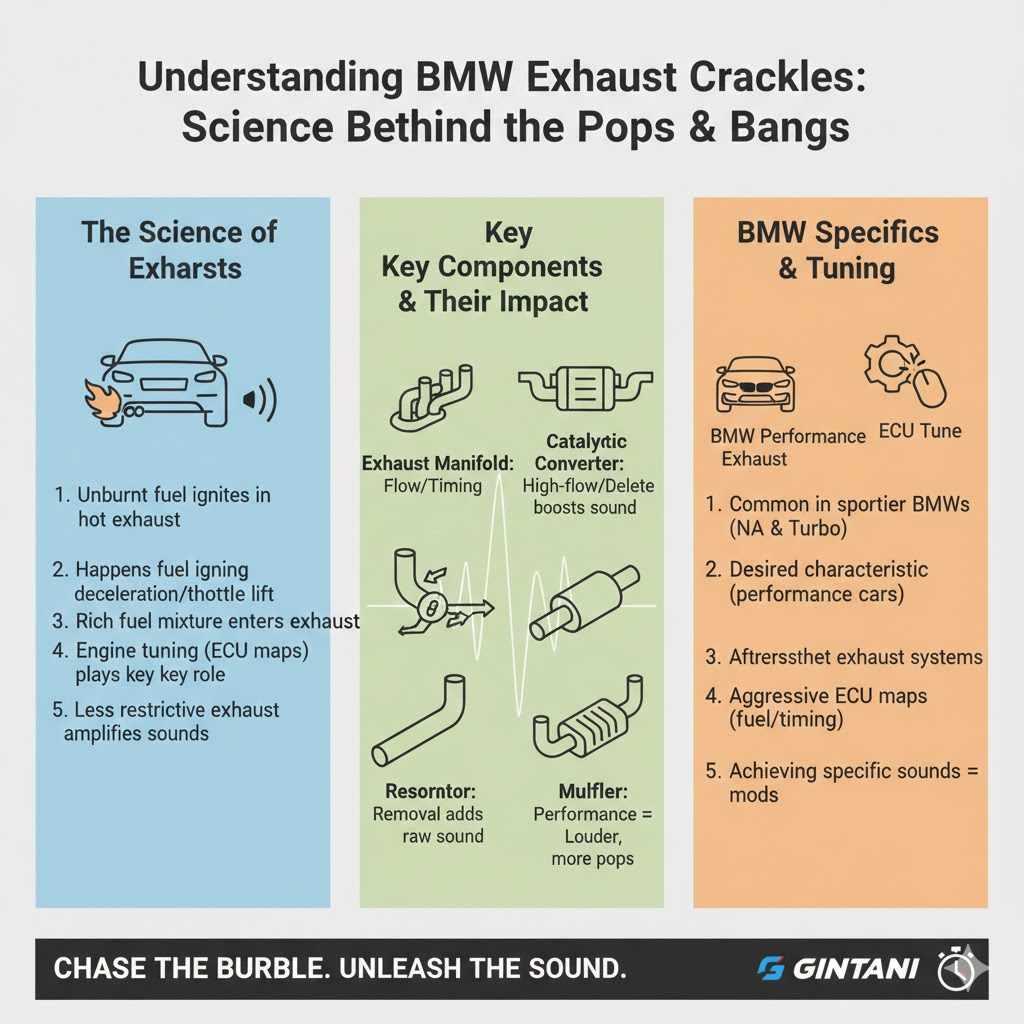
Exhaust crackles, often called overrun burble or deceleration pops, happen when unburnt fuel ignites in the hot exhaust system. This usually occurs during deceleration or when lifting off the throttle after a period of hard acceleration. The sudden release of throttle causes a momentary rich fuel mixture in the cylinders, meaning there’s more fuel than air.
As the engine decelerates, there’s still some fuel getting into the exhaust. When this unburnt fuel meets the hot exhaust gases and components, it can ignite. This creates a small explosion, resulting in the popping and crackling sound.
Several factors contribute to the intensity and frequency of these crackles. The engine’s tuning plays a significant role. Sportier or more aggressive ECU maps can be programmed to favor these sounds by adjusting fuel injection and ignition timing.
The exhaust system itself is also crucial. A less restrictive performance exhaust, often with a straighter pipe design and fewer baffles, allows these detonations to travel more freely and be heard more clearly. The type of catalytic converter, or lack thereof, can also impact the sound, with some aftermarket systems removing or altering them to enhance the acoustics.
For BMWs, particularly those with naturally aspirated engines or turbocharged engines tuned for performance, these crackles are often a sought-after characteristic. It’s a sign of a performance-oriented setup. However, achieving them consistently and to one’s satisfaction can require specific modifications.
This guide will help you understand the components and adjustments that contribute to these desirable exhaust notes, making the quest for BMW exhaust crackles a straightforward process.
- The basic principle involves unburnt fuel igniting in the hot exhaust. This happens when you decelerate after accelerating hard.
A rich fuel mixture, meaning more fuel than air, is key. This mixture enters the exhaust and ignites due to high temperatures. - Engine tuning, like ECU maps, can significantly influence crackle production. Sportier tunes often prioritize these sounds.
The exhaust system’s design is also very important. Less restrictive systems let the sounds escape more easily. - The presence and type of catalytic converters affect the sound. Aftermarket systems might modify or remove them for better acoustics.
Components Affecting Exhaust Sound
The exhaust system is a complex network of pipes and components designed to channel exhaust gases away from the engine and reduce noise. For crackles and pops, the key components that can be modified or that inherently contribute to the sound are the exhaust manifold, catalytic converter, resonator, muffler, and tailpipe. Each part plays a role in shaping the final sound profile of your BMW’s exhaust.
The exhaust manifold collects exhaust gases from the engine cylinders. Its design can influence the flow and timing of these gases. A performance exhaust manifold might improve gas flow, indirectly aiding in crackle formation.
The catalytic converter is crucial for emissions control but also affects sound. A high-flow catalytic converter or a cat-delete pipe (where legal) will significantly increase the volume and intensity of exhaust sounds, including crackles, as it offers less resistance to the exhaust gases.
Resonators are designed to cancel out specific sound frequencies. Removing or replacing a resonator with a straight pipe will allow more of the raw exhaust note, including pops, to pass through. Mufflers are the primary noise-reducing components.
A less restrictive, performance muffler will allow more sound to escape than a stock muffler. Finally, the tailpipe’s shape and size can also subtly influence the exhaust note. Understanding how each of these pieces interacts is vital for anyone looking to achieve specific exhaust sounds from their BMW performance exhaust.
- Exhaust Manifold: Collects gases from cylinders. Performance manifolds can improve flow and indirectly help with crackles.
- Catalytic Converter: Controls emissions but also muffles sound. High-flow or cat-delete pipes boost crackles.
- Resonator: Cancels certain sound frequencies. Removing it allows more raw sound, including pops, to be heard.
- Muffler: The main noise reducer. Performance mufflers let more sound out than stock ones, enhancing crackles.
Modifying Your BMW for Exhaust Crackles
This section delves into the practical modifications you can undertake to achieve those desirable crackles and pops from your BMW’s performance exhaust. We will cover various approaches, from simple adjustments to more involved system changes, while emphasizing legality and safety. The goal is to provide clear, actionable steps for enhancing your car’s exhaust sound to include the sought-after crackling effect.
Aftermarket Exhaust Systems
One of the most effective ways to introduce crackles into your BMW’s exhaust note is by upgrading to an aftermarket performance exhaust system. These systems are specifically engineered to enhance sound and performance, often by reducing restrictions and altering internal designs. A full cat-back system, which replaces everything from the catalytic converter back to the tailpipe, can make a dramatic difference.
Many reputable brands offer exhaust systems for BMW models that are known for their aggressive sound profiles. These systems typically feature larger diameter piping, straighter flow paths, and performance-oriented mufflers and resonators. Some systems might even include valves that can be opened or closed to change the exhaust note, offering a quieter mode for daily driving and a louder, crackle-prone mode for spirited driving.
When choosing an aftermarket exhaust, consider the specific sound you’re after. Some systems focus on deep, throaty tones, while others are designed to produce more pronounced pops and crackles. Reading reviews, watching sound clips, and understanding the materials used (like stainless steel for durability) are important steps.
A well-designed aftermarket system not only adds the desired crackles but can also improve exhaust flow, potentially leading to minor performance gains.
- Cat-Back Systems: These replace the exhaust from the catalytic converter back. They are a popular choice for significant sound changes.
- Valved Exhausts: Some systems have adjustable valves. You can switch between a quieter sound and a more aggressive, crackle-friendly sound.
- Sound Profiles: Different exhausts offer different sounds. Research brands and models to find one that matches your desired crackle intensity.
Resonator and Muffler Deletes
For a more direct approach to increasing exhaust volume and promoting crackles, consider deleting the resonator or muffler. A resonator delete involves replacing the factory resonator with a straight pipe. This component is designed to cancel out specific sound frequencies, so removing it allows more of the raw engine and exhaust sound to pass through, often enhancing pops and crackles.
A muffler delete is a more drastic step, replacing the entire muffler with a straight pipe. This significantly increases the exhaust volume and can lead to very pronounced crackles and pops. However, it also makes the exhaust considerably louder, which might not be desirable for daily driving or may violate local noise ordinances.
It’s essential to be aware of the legal implications and potential downsides, such as increased drone at certain RPMs.
When performing these modifications, it’s crucial to ensure the work is done by a professional to avoid exhaust leaks or structural issues. These deletes are often seen as a budget-friendly way to alter exhaust sound compared to a full cat-back system. They are particularly effective on turbocharged BMW models where the turbocharger can also contribute to the popping sounds during deceleration.
- Resonator Delete:
- Muffler Delete:
- Professional Installation: Always ensure these modifications are installed correctly to prevent leaks and ensure safety.
Catalytic Converter Modifications
Modifying or replacing the catalytic converter can have a profound impact on exhaust sound, including the generation of crackles. The catalytic converter’s primary function is to reduce harmful emissions by converting pollutants into less harmful substances. However, it also acts as a significant baffle, muffling exhaust noise.
Altering or removing it will inevitably lead to a louder and more aggressive exhaust note.
High-flow catalytic converters are a popular option. They use a less restrictive material matrix, allowing exhaust gases to pass through more easily while still performing their emissions control function. This increased flow can enhance the sound, making crackles more audible.
They are generally legal in most regions where emissions testing is required.
Cat-delete pipes, on the other hand, completely remove the catalytic converter and
The impact of catalytic converter modifications on sound is substantial because it directly affects the exhaust gas flow and pressure. By reducing the backpressure, gases can exit the engine more rapidly, which can contribute to the sharp pops heard during throttle release. This is especially true for turbocharged engines where the turbocharger can create pressure waves that are more easily heard when the catalytic converter is less restrictive.
- High-Flow Catalytic Converters: Improve exhaust flow and sound while maintaining emissions compliance.
- Cat-Delete Pipes: Remove the catalytic converter for maximum sound increase and crackles. This is often illegal and may require an ECU tune.
- Legal Considerations: Always check local laws regarding catalytic converter modifications before proceeding.
Tuning for Enhanced Exhaust Crackles
This section focuses on the role of engine tuning, specifically Electronic Control Unit (ECU) remapping, in enhancing exhaust crackles. We will explain how software adjustments can optimize fuel delivery and ignition timing to promote the desired popping sounds. This approach, often used in conjunction with exhaust hardware modifications, can provide a more refined and tunable solution for achieving the perfect exhaust note on your BMW.
ECU Remapping Explained
Your BMW’s ECU, or engine control unit, is essentially a small computer that manages numerous engine functions, including fuel injection, ignition timing, and throttle response. When you modify your car’s exhaust hardware, the ECU’s original settings might not be perfectly optimized for the new setup. ECU remapping, also known as chipping or tuning, involves reprogramming this unit to alter these parameters.
For exhaust crackles, a skilled tuner can adjust the fuel maps to create a slightly richer fuel mixture during deceleration. This means more unburnt fuel enters the exhaust system, increasing the likelihood of ignition and subsequent pops. Additionally, ignition timing can be adjusted.
By slightly retarding the ignition timing under certain deceleration conditions, the combustion process can be made to continue into the exhaust manifold, creating those characteristic burble sounds.
The goal of tuning for crackles is to create a noticeable enhancement without negatively impacting drivability, fuel economy, or engine reliability. A good tune will be balanced, ensuring that the engine runs smoothly in all driving conditions while still delivering the desired exhaust notes when you want them. This makes ECU remapping a powerful tool for fine-tuning your BMW’s sound.
- Fuel Mixture Adjustment: The ECU can be programmed to inject slightly more fuel during deceleration. This richer mixture is key for crackles.
- Ignition Timing Retardation: Adjusting when the spark plug fires can cause combustion to continue into the exhaust. This creates pops and crackles.
- Optimizing for Hardware: Tuning ensures the ECU works harmoniously with any exhaust modifications you’ve made.
Sport Mode and Driving Techniques
Many modern BMWs come equipped with a “Sport” or “Sport+” driving mode. Engaging these modes often alters the engine’s and transmission’s behavior, and importantly, can also influence exhaust sound. In Sport mode, the car’s computer typically sharpens throttle response, holds gears longer in automatic transmissions, and can even adjust the active exhaust valves (if equipped) to a more aggressive setting.
When your BMW is in Sport mode, the engine management system may be programmed to allow for more frequent and pronounced exhaust crackles. This is often achieved through specific fuel and ignition adjustments that are active only in these performance-oriented modes. The intention is to provide a more engaging and visceral driving experience, where the sounds emanating from the exhaust complement the car’s dynamic capabilities.
Beyond just selecting a driving mode, certain driving techniques can help elicit these crackles. The most common method is to accelerate hard, then abruptly lift off the accelerator pedal while the transmission is still in a lower gear. This rapid deceleration coupled with the rich fuel mixture from the preceding acceleration is the perfect recipe for exhaust pops.
Practicing this technique, especially in Sport mode, can help you consistently generate those desired sounds from your BMW performance exhaust.
- Sport Mode Benefits: Activating Sport mode can automatically adjust settings to promote more crackles and pops.
- Throttle Lift-Off: Accelerating hard and then quickly releasing the throttle pedal is a primary technique to trigger exhaust crackles.
- Gear Selection: Lower gears tend to produce more noticeable crackles during deceleration due to higher engine RPMs.
Legal and Practical Considerations
This section addresses important legal and practical aspects associated with modifying your BMW’s exhaust system for enhanced crackles. We will cover noise regulations, emissions compliance, and the importance of professional installation to ensure your modifications are safe, legal, and sustainable for your vehicle. Understanding these factors is crucial before making any changes to your exhaust.
Noise and Emissions Regulations
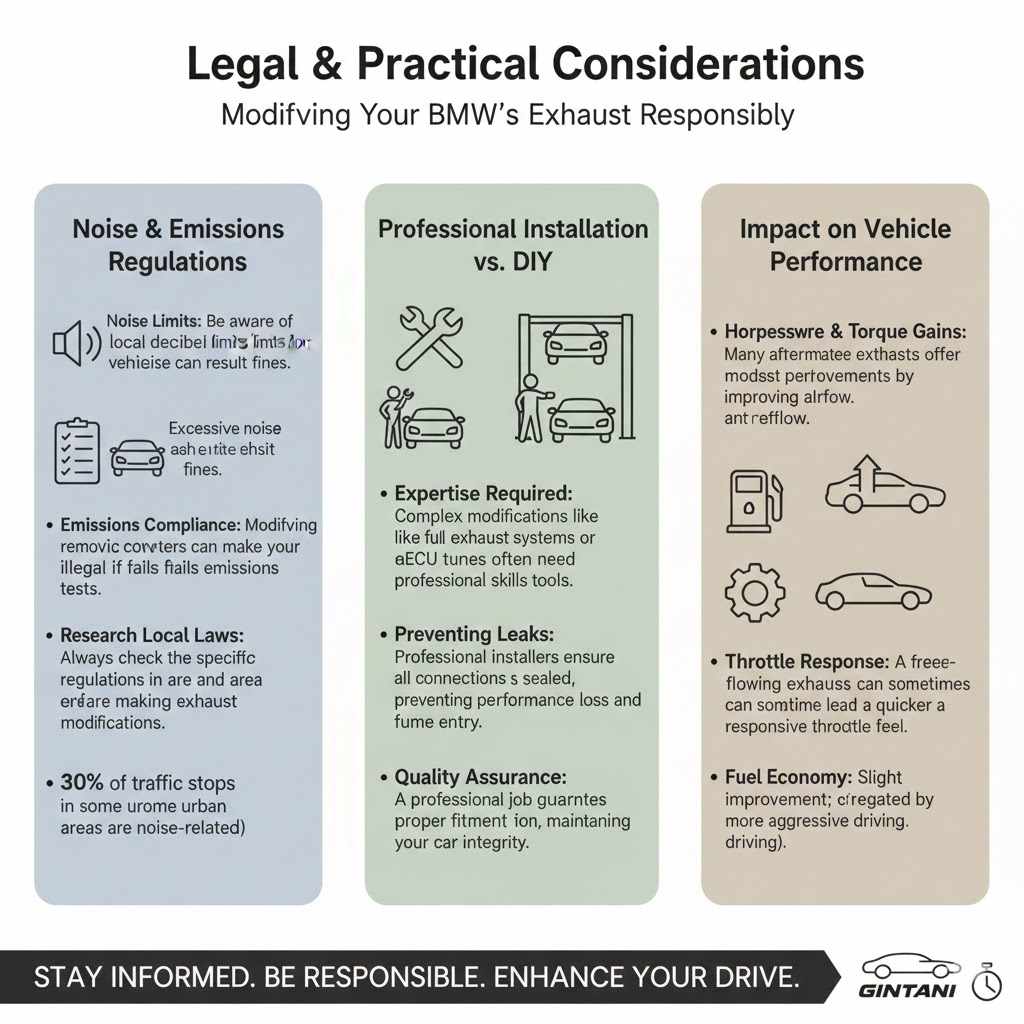
It’s vital to be aware of local noise and emissions regulations when modifying your BMW’s exhaust system. Many regions have strict limits on how loud a vehicle can be, especially during nighttime hours. Excessively loud exhaust systems can lead to fines, mandatory repairs, or even your vehicle being impounded.
Always research your local laws to ensure your modifications comply.
Emissions regulations are also a significant factor. Modifying or removing catalytic converters, for instance, can make your vehicle illegal to operate on public roads if it no longer meets emission standards. This is particularly important for vehicles that undergo regular emissions testing.
High-flow catalytic converters are often a good compromise, offering improved sound and flow while generally remaining within legal emissions limits.
Ignoring these regulations can lead to considerable trouble. It’s not just about avoiding tickets; it’s about responsible vehicle ownership and environmental stewardship. Many aftermarket exhaust manufacturers provide information on whether their products are street-legal in different regions, which can be a helpful guide.
Choosing modifications that balance sound enhancement with legal compliance is the most sensible approach.
- Noise Limits: Be aware of local decibel limits for vehicle exhausts. Excessive noise can result in fines.
- Emissions Compliance: Modifying or removing catalytic converters can make your car illegal if it fails emissions tests.
- Research Local Laws: Always check the specific regulations in your area before making exhaust modifications.
Professional Installation vs. DIY
While some exhaust modifications can be tackled as a DIY project, many are best left to professionals. Installing an entire cat-back system, replacing exhaust manifolds, or modifying catalytic converters requires specialized tools, knowledge, and often a lift. Improper installation can lead to exhaust leaks, which can cause performance issues, dangerous fumes to enter the cabin, and an unpleasant exhaust note.
Professional exhaust shops have the experience to ensure a perfect fit, secure connections, and proper sealing. They can also advise on the best products for your specific BMW model and your desired sound. For modifications like ECU remapping, it’s essential to use reputable tuning companies that have a proven track record with BMW vehicles.
A poorly executed tune can harm your engine.
A DIY approach might save money on labor, but the risk of costly mistakes or subpar results is higher. For critical components like catalytic converters or for complex systems, investing in professional installation provides peace of mind and ensures the job is done correctly and safely. This also helps in maintaining the longevity and performance of your BMW.
- Expertise Required: Complex modifications like full exhaust systems or ECU tunes often need professional skills and tools.
- Preventing Leaks: Professional installers ensure all connections are sealed, preventing performance loss and fume entry.
- Quality Assurance: A professional job guarantees proper fitment and function, maintaining your car’s integrity.
Frequently Asked Questions
Question: Will getting crackles from my BMW exhaust affect performance?
Answer: Generally, modifications that enhance crackles, like performance exhaust systems or high-flow cats, can improve exhaust flow and potentially offer slight performance gains. However, overly aggressive changes or poorly done tuning could negatively impact performance or drivability.
Question: How loud will my BMW exhaust be with crackles?
Answer: The loudness depends on the specific modifications. A resonator delete will make it louder, while a full performance exhaust with valves offers adjustable loudness. Cat-back systems are typically louder than stock but often within reasonable limits.
Loudness also increases with engine RPM and load.
Question: Can I get crackles from a stock BMW exhaust?
Answer: Stock exhausts are designed for quiet operation. While some BMWs have sophisticated active exhaust systems that can produce pops in sport modes, achieving significant crackles usually requires aftermarket modifications to the exhaust system or ECU tuning.
Question: Is it possible to add crackles to a diesel BMW?
Answer: Diesel engines produce exhaust sounds differently than gasoline engines. While it’s possible to modify a diesel exhaust for a different sound, achieving the characteristic gasoline engine “crackles and pops” is generally not feasible or desirable due to the fundamental differences in combustion and exhaust characteristics.
Question: What are the main risks of exhaust modification?
Answer: Risks include violating noise and emissions laws, voiding your warranty, potential for exhaust leaks, increased cabin drone, and, with poor tuning, engine damage or reduced reliability. It’s crucial to research and choose reputable parts and installers.
Summary
Achieving those exciting crackles from your BMW performance exhaust is definitely within reach. By understanding how these sounds are made, exploring options like aftermarket exhaust systems, resonator deletes, or high-flow catalytic converters, and considering ECU tuning, you can tailor your car’s sound. Always prioritize legal compliance and professional installation for the best and safest results. Your BMW can sound as thrilling as it drives.