Do Catless Downpipes Throw Codes Outback XT: Essential Guide
Yes, installing catless downpipes on an Outback XT will very likely throw codes. This is because the car’s computer expects to see data from the catalytic converter, and without it, sensors register a problem, triggering the Check Engine Light. This guide details why and how to manage these codes.
Tired of that pesky Check Engine Light popping up after your Outback XT’s exhaust upgrade? Many enthusiasts love the sound and performance boost from catless downpipes, but the unintended consequence is often a dashboard warning. It’s a common frustration, leaving you wondering if something is seriously wrong or if you can even drive your turbocharged Subaru. Don’t worry! This guide is here to break down exactly why this happens and, more importantly, how you can manage it with simple, beginner-friendly steps. We’ll ensure your Outback XT runs smoothly and sounds incredible, without the constant worry of error codes.
Upgrading your Outback XT’s exhaust system can be an exciting project. The rumble and extra ‘oomph’ can transform your driving experience. However, when you swap out the factory downpipe for a catless version – a part that removes the catalytic converter entirely – you’re essentially changing how your car’s engine breathes and how its emissions are processed. This modification, while appealing for performance, directly impacts sensors designed to monitor the health of the catalytic converter. Without it, these sensors send signals that the car’s computer, also known as the Engine Control Unit (ECU), interprets as a fault. The result? The Check Engine Light illuminates, indicating a problem and potentially impacting your car’s performance or emissions compliance.
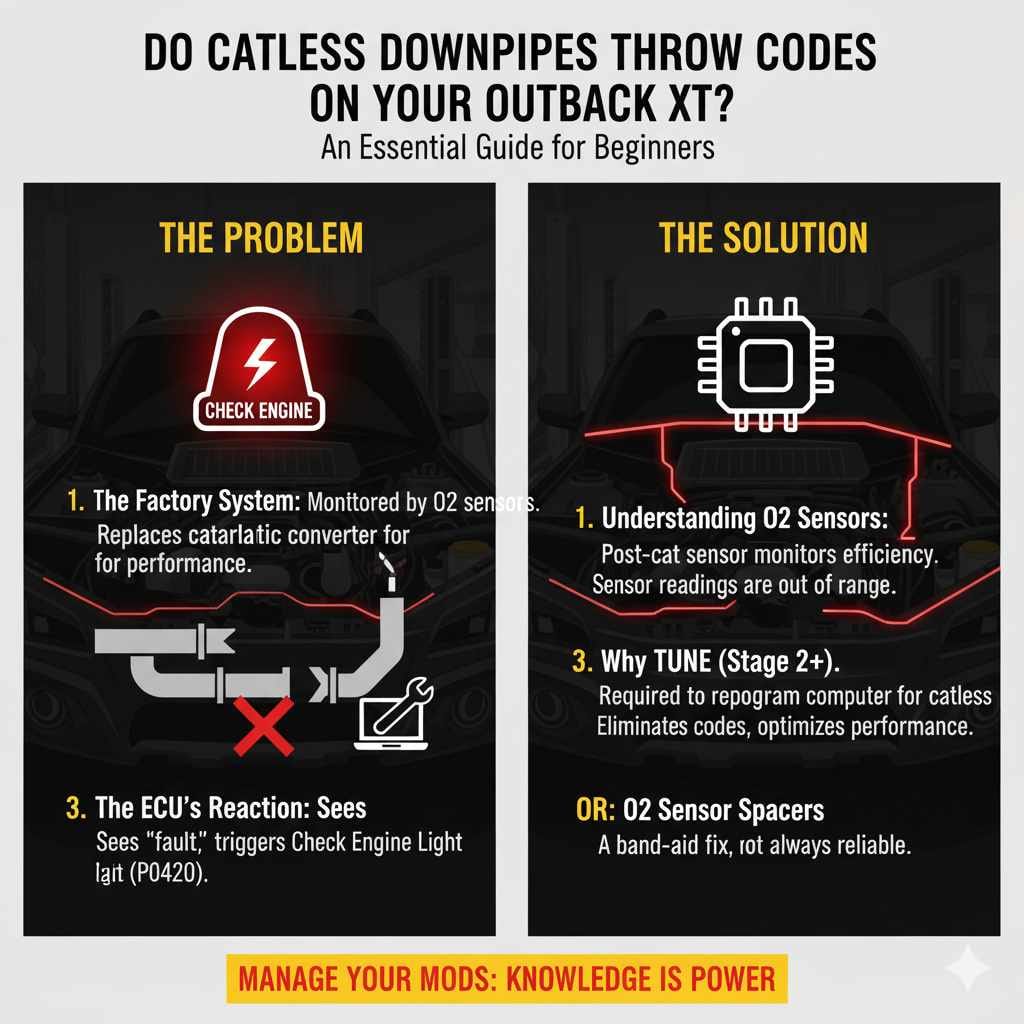
Understanding why this happens is the first step to fixing it. For beginners, the world of exhaust codes might seem confusing, but it’s quite straightforward once you know the basics. The main culprit is the oxygen sensors (O2 sensors) that monitor the exhaust gases. When the catalytic converter is removed, the readings from these sensors change dramatically, exceeding the parameters the ECU is programmed to accept. This triggers diagnostic trouble codes (DTCs), commonly referred to as “throwing codes.”
Why Catless Downpipes Trigger Codes on Your Outback XT
Your Outback XT, like most modern cars, relies on a sophisticated system to monitor its emissions. The catalytic converter is a crucial part of this system. Its job is to convert harmful pollutants in your exhaust into less harmful substances. To ensure the catalytic converter is working efficiently, your Subaru is equipped with oxygen sensors placed before and after it.
Here’s a simple breakdown of the process:
- Oxygen Sensors (O2 Sensors): Your car has at least two O2 sensors in the exhaust system related to the downpipe: one upstream (before the catalytic converter) and one downstream (after the catalytic converter).
- Sensor Readings: The upstream O2 sensor measures the oxygen content in the exhaust gas entering the catalytic converter. The downstream O2 sensor measures the oxygen content after the catalytic converter.
- Catalytic Converter’s Role: A functioning catalytic converter “cleans” the exhaust, causing a specific chemical reaction. This reaction changes the oxygen levels in the exhaust gas between the upstream and downstream sensors. The ECU expects to see this difference.
- Catless Downpipe Impact: When you remove the catalytic converter, there’s no longer a chemical reaction happening. The exhaust gas composition remains largely the same before and after the area where the converter used to be.
- ECU Confusion: The downstream O2 sensor will report readings that are not significantly different from the upstream sensor. The ECU is programmed to detect this lack of change and interprets it as a fault, often indicating a problem with the catalytic converter’s efficiency. This leads to codes like P0420 (Catalyst System Efficiency Below Threshold Bank 1) or P0430 (for vehicles with two banks). In some cases, you might also get codes related to the O2 sensors themselves if their readings are outside expected ranges.
Think of it like your car having a “report card” for its emissions system. The catalytic converter is the main subject, and the O2 sensors are the teachers sending reports. When the converter is gone, the “teacher” (downstream O2 sensor) sends a report that doesn’t make sense to the “principal” (ECU), and the principal writes a note home (the Check Engine Light).
Common Codes You Might See
When installing catless downpipes on your Outback XT, you’re most likely to encounter codes related to the efficiency of the catalytic converter. The exact codes can vary slightly depending on the specific Subaru model and year, but here are the most frequent ones:
- P0420 – Catalyst System Efficiency Below Threshold (Bank 1): This is the most common code. Bank 1 refers to the side of the engine that contains cylinder #1. For most Outback XTs, there’s only one bank to worry about in this regard. This code means the ECU has detected that the catalytic converter isn’t working as efficiently as it should be, based on the readings from the downstream O2 sensor.
- P0430 – Catalyst System Efficiency Below Threshold (Bank 2): This code is less common for the Outback XT as it typically only has one exhaust bank that includes the catalytic converter. However, if your vehicle has a V-engine configuration with two distinct exhaust systems, this might appear.
- O2 Sensor Codes (e.g., P0130 – P0167): While less direct, removing the catalytic converter can sometimes lead to unusual exhaust flow or sensor performance, causing the ECU to flag issues with the O2 sensors themselves.
These codes are not indicating a mechanical failure of your engine components but rather a discrepancy in the expected sensor data caused by the modification. It’s important to know that these codes will almost always come on if your catless downpipe setup doesn’t have a solution built-in.
Solutions and Workarounds for Catless Downpipe Codes
Fortunately, there are several well-established ways to deal with the Check Engine Light after installing catless downpipes on your Outback XT. These solutions range from simple electronic tricks to more involved tuning.
1. O2 Sensor Spacers / Cheater Cages
This is often the first and most budget-friendly solution attempted by enthusiasts. An O2 sensor spacer, also known as an O2 sensor adapter or “cheater cage,” is a small, threaded piece that screws into the downstream O2 sensor port. It has a small opening or a “getter” inside that restricts the amount of exhaust gas that reaches the sensor. This trick fools the downstream O2 sensor into reporting a slightly different reading than the upstream sensor, making the ECU believe the catalytic converter is functioning (even though it’s not installed).
How It Works:
The downstream O2 sensor essentially checks if the exhaust gas composition has changed after passing through the catalytic converter. With a catless setup, the composition doesn’t change significantly. The spacer limits the gas flow so the sensor doesn’t see “too much” of the same thing, thus bypassing the efficiency code. Many aftermarket downpipes have a dedicated bung (threaded hole) for this spacer.
Pros:
- Inexpensive
- Easy to install (screws into the O2 sensor bung)
- Reversible
Cons:
- Not 100% effective for all vehicles or situations. Sometimes, the ECU can still detect the discrepancy.
- Doesn’t address actual engine tuning or optimize performance.
- May not pass strict emissions testing if the sensor is still checked.
2. Catalytic Converter “Warmers” or “Simulators”
These are more advanced electronic devices designed to mimic the output signal of a functional catalytic converter. They are wired into the O2 sensor circuit, typically between the downstream O2 sensor and the ECU. This device actively “fakes” the signal the ECU expects to see, providing a consistent, acceptable reading.
How It Works:
Unlike a simple spacer, a catalytic converter simulator is an electronic module. It takes the raw signal from the downstream O2 sensor, processes it, and sends a modified signal to the ECU that indicates proper catalytic converter function. Some high-end versions might even have features to adjust parameters based on engine load and RPM.
Pros:
- Generally more effective than spacers for preventing codes.
- Can provide a more stable “pass” for the ECU.
Cons:
- More expensive than spacers.
- Requires basic electrical wiring knowledge for installation, which might be intimidating for absolute beginners.
- It’s still a workaround, not a fundamental fix for emissions.
3. ECU Tuning (Cobb Accessport, VersaTuner, etc.)
This is the most comprehensive and recommended solution if you’re serious about performance and reliability with catless downpipes. ECU tuning involves reprogramming your vehicle’s Engine Control Unit (ECU) to account for the absence of the catalytic converter. This is often done using an access port device or specialized tuning software.
How It Works:
A professional tuner or a reputable off-the-shelf tune (like those from Cobb Tuning for Subaru) will adjust the ECU’s parameters. This includes disabling the specific diagnostic checks for catalytic converter efficiency, ensuring the O2 sensor readings (or lack thereof) are no longer flagged as errors. Furthermore, a proper tune can optimize fuel delivery, ignition timing, and boost pressure to take advantage of the reduced exhaust restriction from the catless downpipe, leading to tangible performance gains.
Pros:
- Most reliable method for preventing codes.
- Allows for performance optimization, unlocking the full potential of the catless downpipe.
- Can improve drivability and overall engine response.
- A “Stage 2” tune is specifically designed for modifications like a catless downpipe.
Cons:
- Most expensive option.
- Requires purchasing a tuning device (like a Cobb Accessport) and often custom or off-the-shelf maps.
- Requires careful attention to ensure you choose a reputable tuner and map suitable for your exact setup.
- May void certain aspects of your vehicle’s warranty.
- Crucially, makes your vehicle illegal for road use in many regions due to emissions regulations.
For Subaru vehicles, Cobb Tuning is a very popular and well-respected platform. Their Accessport allows users to flash different maps onto their ECU. You would typically purchase an Accessport and then select a “Stage 2” map designed for a catless downpipe. You can find information on Subaru ECU tuning through resources like MotoringFile or dedicated Subaru forums.
4. Driving Habits (Not Recommended for Long Term)
In some very rare cases, a light might flicker on and then turn off on its own after a few drive cycles. This is highly unlikely with catless downpipes, as the fault is persistent. Relying on the Check Engine Light to just disappear is not a viable strategy for this type of modification.
Important Considerations for Your Outback XT
Beyond just managing the codes, there are other critical factors to keep in mind when modifying your Outback XT’s exhaust system, especially with catless downpipes.
Emissions Testing and Legality
This is perhaps the most significant hurdle. In many regions (including most of the United States and Europe), driving a vehicle with removed or modified catalytic converters is illegal. The catalytic converter is a mandated emissions control device.
- Emissions Testing: If your state or country performs emissions inspections, your Outback XT will fail if it doesn’t have a functional catalytic converter. The OBD-II system readiness monitors will not be satisfied, and the vehicle will be flagged.
- Fines and Penalties: Driving a vehicle that doesn’t meet emissions standards can result in significant fines, and you may be required to remove the illegal modification.
- Environmental Impact: Catalytic converters play a vital role in reducing air pollution. Understand the environmental consequences of removing this component.
For this reason, many people choose catless downpipes for track-day cars or vehicles used in regions without strict emissions testing. If your vehicle is a daily driver in a regulated area, a high-flow catted downpipe is often a better compromise, though it can still sometimes trigger codes, albeit less frequently. You can learn more about emissions standards for vehicles from the U.S. Environmental Protection Agency (EPA).
Performance Gains and Risks
Catless downpipes reduce exhaust backpressure, allowing the turbocharger to spool up faster and potentially produce more power at higher RPMs. This is why they are popular for performance tuning.
However, without proper tuning, these gains can be accompanied by risks:
- Running Lean: The ECU might not correctly adjust fuel delivery for the increased airflow, potentially leading to a “lean” condition (too much air, not enough fuel). Running too lean can cause excessive engine temperatures and even damage pistons.
- Turbo Lag (Paradoxical): While generally reducing spool time, an improperly tuned engine can sometimes exhibit worse or inconsistent response.
- Engine Longevity: Aggressive tunes or modifications that push the engine beyond its designed limits without adequate internal reinforcement can shorten its lifespan.
This is where a good ECU tune becomes essential, not just for clearing codes but for ensuring the engine operates safely and performs optimally with the new hardware. A “Stage 2” tune specifically accounts for the changes introduced by a catless downpipe.
Sound and Drone
Catless exhaust systems are significantly louder than stock. The sound characteristic also changes.
- Increased Volume: Expect a much more aggressive and louder exhaust note.
- Drone: Many aftermarket exhaust systems, especially without a catalytic converter, can produce an unpleasant droning sound at certain RPMs, typically on the highway. This can make long drives uncomfortable.
If sound is a major concern, consider researching exhaust setups that are known for producing a desirable tone without excessive drone. Some aftermarket downpipes might include a muffler or resonator to help mitigate this, but a fully catless setup typically prioritizes flow over quiet operation.

Choosing the Right Solution for Your Outback XT
Deciding which solution to use depends on your budget, technical skill, and goals for your Outback XT.
For the Budget-Conscious Beginner:
Start with a quality O2 sensor spacer. They are cheap and easy to install. Purchase one specifically designed for Subaru applications if possible. Be prepared that it might not work perfectly and you may need to upgrade if the code returns.
For Improved Reliability Without Full Tuning:
Consider a catalytic converter simulator. These offer better code prevention than spacers but require a bit more effort and cost. Ensure you buy from a reputable vendor.
For Maximum Performance and Reliability:
ECU tuning via a device like the Cobb Accessport with a Stage 2 OTS (Off-The-Shelf) map or a custom tune is the gold standard. This is the only method that truly optimizes your car for the new hardware and ensures it’s running safely and powerfully, while also eliminating codes. This is the route most performance enthusiasts take.
Here’s a quick comparison table to help you decide:
| Solution | Ease of Installation | Cost | Reliability (Code Prevention) | Performance Optimization | Legality (Emissions) |
|---|---|---|---|---|---|
| O2 Sensor Spacer | Very Easy | Low | Moderate (Can fail) | None | Illegal |
| Catalytic Converter Simulator | Moderate (Basic wiring) | Medium | High | None | Illegal |
| ECU Tuning (Stage 2 Map) | Moderate to Advanced (Device setup/flashing) | High | Very High | Yes | Illegal |
Remember to always consult your Outback XT’s specific service manual or reliable online resources for detailed installation instructions for any part you choose.
Frequently Asked Questions (FAQ)
Q1: Will installing catless downpipes immediately cause a Check Engine Light on my Outback XT?
A: Yes, in almost all cases. The car’s computer (ECU) is programmed to monitor the catalytic converter’s efficiency using O2 sensors. Removing the converter changes sensor readings, triggering the ECU to log a fault code and illuminate the Check Engine Light.