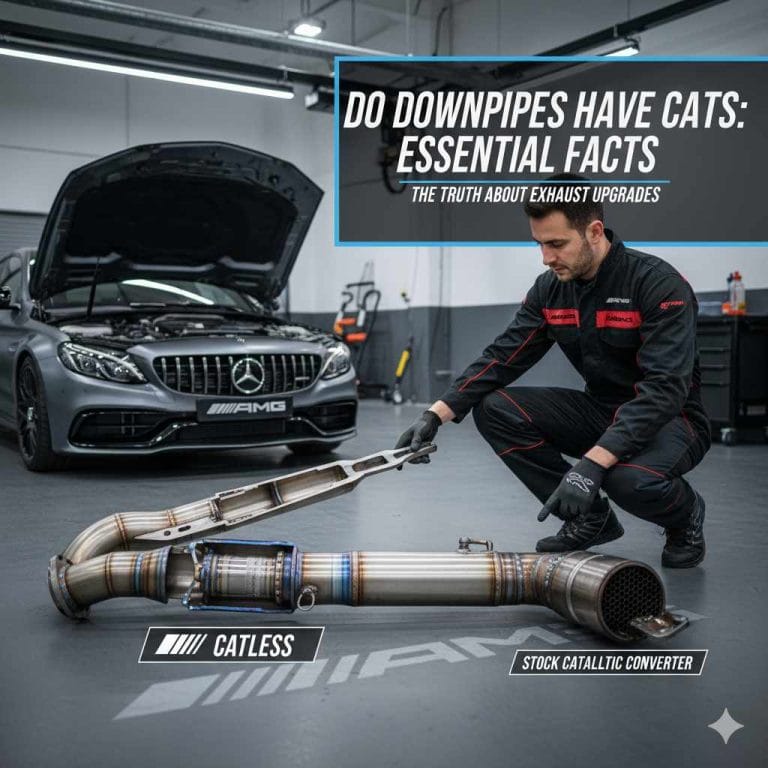
Do Catted Downpipes Improve Performance? Essential Guide
Yes, catted downpipes can improve performance by allowing your engine to exhale more freely, leading to slight gains in horsepower and torque, especially when paired with other modifications. They also help keep your car legal and emissions-compliant.
Ever wondered if changing your car’s downpipe makes a difference? You’re not alone! Many car owners hear about aftermarket parts like “downpipes” and wonder what they do, especially those with a “cat” in them. Sometimes, even slight changes can make your car feel a bit zippier or sound a bit sportier. Many people wonder if these parts are worth the upgrade. This guide is here to clear the air, in simple terms, about catted downpipes. We’ll break down exactly what they are, how they work, and if they can truly boost your car’s performance. Get ready to understand your exhaust system better and make informed choices for your ride – no confusing jargon required!
What Exactly is a Downpipe, and Why the “Cat”?
Let’s start with the basics. Think of your car’s exhaust system like a pathway for the gases your engine produces after burning fuel. These gases need to get out of the way so your engine can keep running smoothly. The downpipe is one of the very first parts of this pathway, located right after the turbocharger (if your car has one) or the exhaust manifold.
Its main job is to collect exhaust gases and direct them towards the rest of your exhaust system, eventually leading them out the tailpipe. The “cat,” short for catalytic converter, is a crucial component designed to clean up those exhaust gases. It uses special metals like platinum, palladium, and rhodium to convert harmful pollutants into less harmful substances before they leave your car. This is essential for meeting emissions standards and keeping our air clean.
The Role of the Catalytic Converter
The catalytic converter is like a filter and a chemical reactor. As hot exhaust gases flow through its ceramic honeycomb structure, chemical reactions occur. These reactions transform gases like carbon monoxide (CO), unburnt hydrocarbons (HC), and nitrogen oxides (NOx) into carbon dioxide (CO2), water (H2O), and nitrogen (N2). It’s a vital piece of equipment for environmental protection. You can learn more about how catalytic converters work from the U.S. Environmental Protection Agency (EPA) [https://www.epa.gov/greenvehicles/how-catalytic-converters-work].
Why “Catted” Downpipes?
When people talk about “catted downpipes,” they mean a downpipe that includes an integrated catalytic converter. This is the standard setup on most factory vehicles. Aftermarket “catless” downpipes, on the other hand, remove this component entirely. While catless pipes might offer slightly more performance, they are often illegal for road use because they bypass crucial emissions control. Catted downpipes aim to balance performance with environmental responsibility and legality.

How Do Downpipes Affect Engine Performance?
Your engine needs to breathe, and that includes exhaling exhaust gases efficiently. Think of it like trying to run a marathon after holding your breath for a long time – it’s much harder! When exhaust gases can flow out of the engine more easily, it reduces what engineers call “backpressure.”
Understanding Backpressure
Backpressure is the resistance to exhaust gas flow. Imagine a narrow pipe versus a wide one. Water flows much more easily through a wide pipe. Similarly, exhaust gases flow more easily through a larger, less restrictive pipe. High backpressure can make it harder for the engine to push out exhaust gases, which can:
- Reduce power output.
- Increase engine temperature.
- Make the engine less efficient.
How a Downpipe Can Help
A well-designed aftermarket downpipe, whether catted or not, is typically larger in diameter and smoother on the inside than a stock pipe. This improved design helps to:
- Reduce Backpressure: By providing a less restricted path for exhaust gases.
- Improve Turbo Spool (for turbocharged cars): With less backpressure, a turbocharger can spin up faster, meaning your engine gets more boost sooner, leading to quicker acceleration.
- Increase Airflow: A freer-flowing exhaust allows the engine to process more air and fuel, potentially leading to more power.
Do Catted Downpipes ACTUALLY Improve Performance?
This is the million-dollar question! And the answer is: it depends. For most everyday cars, especially naturally aspirated (non-turbocharged) ones, the performance gains from just a catted downpipe might be modest, often in the range of 5-15 horsepower. However, on turbocharged or supercharged vehicles, the impact can be more significant.
Performance Gains: What to Expect
Here’s a breakdown of where you’re likely to see improvements:
- Turbocharged/Supercharged Cars: These engines benefit the most. A catted downpipe can help the turbo spool up faster, reduce turbo lag, and allow the engine to breathe more freely under boost. This can lead to noticeable gains in horsepower and torque, particularly in the mid-range RPMs.
- Naturally Aspirated Cars: The gains here are usually less dramatic. You might feel a slight improvement in throttle response and a bit more power at higher RPMs, but don’t expect a massive leap.
- Sound Improvement: Many aftermarket downpipes, even catted ones, can alter the exhaust note, often making it deeper and sportier.
The Importance of Other Modifications
It’s crucial to understand that a downpipe is usually part of a system. For the biggest performance gains, a catted downpipe often works best when paired with other complementary modifications, such as:
- A freer-flowing exhaust system (cat-back exhaust).
- An upgraded intake system.
- Engine tuning (ECU reflash or chip tuning). Tuning optimizes the engine’s computer (ECU) to take advantage of the improved airflow from the new downpipe and other modifications.
Without tuning on a turbocharged car, the engine’s computer might not be able to take full advantage of the improved airflow, and in some cases, it could even lead to less optimal performance. Think of it like upgrading to a bigger pipe but not telling your engine it can push more air – it won’t know what to do with it!
Catted vs. Catless Downpipes: Key Differences
This is a common point of confusion for beginners. Let’s break down the core differences between a catted and a catless downpipe.
Catted Downpipes
What they are: These are aftermarket pipes that include a high-flow catalytic converter. The goal is to improve exhaust flow compared to the stock converter while still ensuring emissions compliance.
Pros:
- Legality: Generally legal for road use as they retain the catalytic converter.
- Emissions Compliance: They help your car meet environmental regulations.
- Performance Improvement: Offer gains, especially on turbocharged cars, by reducing backpressure compared to stock.
- Reduced Exhaust Smell: The catalytic converter helps burn off some of the less pleasant exhaust odors.
- Check Engine Light: Less likely to trigger a “Check Engine” light compared to catless pipes, as the factory sensors still see a functioning catalyst.
Cons:
- Performance Ceiling: May offer slightly less performance than a catless pipe due to some flow restriction from the catalyst.
- Cost: Can be more expensive due to the precious metals in the catalytic converter.
Catless Downpipes
What they are: These are aftermarket pipes that completely remove the catalytic converter. They offer the least restriction to exhaust flow.
Pros:
- Maximum Performance Potential: Offer the least restriction, potentially leading to the highest horsepower and torque gains, especially when tuned.
- Loudest Exhaust Note: Often produce the most aggressive exhaust sound.
- Cheaper: Less expensive to manufacture as they don’t contain precious metals.
Cons:
- Illegality: Illegal for use on public roads in most regions due to emissions violations.
- Environmental Impact: Release unfiltered harmful pollutants into the atmosphere.
- Check Engine Light: Highly likely to trigger a “Check Engine” light because the exhaust sensors detect the absence of a functional catalytic converter.
- Exhaust Smell: Can produce a strong, acrid exhaust smell due to unfiltered gases.
- Failed Emissions Tests: Will almost certainly cause your vehicle to fail emissions inspections.
Here’s a quick comparison table:
| Feature | Catted Downpipe | Catless Downpipe |
|---|---|---|
| Legality (Road Use) | Generally Legal | Generally Illegal |
| Emissions | Compliant | Non-Compliant |
| Performance Gains | Moderate to Significant (especially with turbo) | Maximum Potential |
| Check Engine Light | Less Likely | Highly Likely |
| Exhaust Smell | Minimized | Strong/Acrid |
| Cost | Higher | Lower |
For most car owners who want a blend of performance and compliance, the catted downpipe is the way to go. It offers a good balance without the legal and environmental headaches of a catless pipe.
Installation: What’s Involved?
Installing a downpipe can range from a fairly straightforward job to something a bit more involved, depending on your vehicle and your comfort level with car mechanics. If you’re new to working on cars, it’s always a good idea to have a qualified mechanic do the job.
Tools You Might Need
Here’s a general list of tools that might be helpful if you decide to tackle this yourself:
- Socket wrench set with various extensions
- Torque wrench
- Pliers (for hose clamps)
- Penetrating oil (like WD-40) to loosen stubborn bolts
- Jack and jack stands (always use safely!)
- Gloves and safety glasses
- New gaskets and hardware (if not included with the downpipe)
General Installation Steps (May Vary by Vehicle)
- Safety First: Park your car on a level surface and engage the parking brake. Safely lift your vehicle using a jack and secure it with jack stands. Never work under a car supported only by a jack.
- Locate the Stock Downpipe: It’s usually the largest pipe directly after the turbocharger or exhaust manifold.
- Disconnect Sensors: Carefully disconnect any oxygen sensors plugged into the stock downpipe. These sensors provide crucial data to your engine’s computer.
- Remove Heat Shields: There are often metal heat shields protecting surrounding components. You’ll need to remove these.
- Unbolt the Stock Downpipe: Loosen and remove the bolts connecting the downpipe to the turbocharger/manifold and the exhaust system further down. This can be the trickiest part, as bolts can be rusted or seized. Use penetrating oil liberally.
- Remove the Stock Downpipe: Gently maneuver the old downpipe out of the way.
- Install the New Catted Downpipe: Position the new downpipe, ensuring it aligns correctly.
- Install New Gaskets and Hardware: Use new gaskets between the downpipe and the turbo/manifold, and the downpipe to the next section of the exhaust. Tighten all bolts to the manufacturer’s specifications using a torque wrench.
- Reconnect Sensors: Plug the oxygen sensors back into their ports on the new downpipe.
- Reinstall Heat Shields: Put all heat shields back in place.
- Lower the Vehicle: Carefully lower your car off the jack stands.
- Start and Check for Leaks: Start the engine and listen for any exhaust leaks (a hissing or puffing sound). Check for any warning lights on your dashboard.
Important Note: Always refer to a service manual specific to your car’s make and model for detailed instructions and torque specifications. If you’re unsure about any step, it’s best to consult a professional mechanic. Even with external resources like guides from manufacturers of performance parts, such as Injen Technology [https://www.injen.com/blog/downpipes-explained/], it’s vital to prioritize safety when working on your vehicle.
Catted Downpipes and Emissions Compliance
This is critical for any car owner. The catalytic converter is the primary component responsible for reducing harmful emissions from your engine. Installing a catted downpipe, especially one designed to meet specific emissions standards (like CARB-compliant parts in California), helps ensure your vehicle remains street-legal and environmentally responsible.
Meeting Emissions Standards
In many parts of the world, especially in the United States and Europe, vehicles must undergo regular emissions testing. A functioning catalytic converter is essential for passing these tests. Catted downpipes are designed to function similarly to a stock catalytic converter but with improved flow. This means:
- Your car can still reduce harmful pollutants.
- You are more likely to pass emissions inspections.
- You avoid fines and potential legal trouble associated with tampering with emissions control systems.
The “Check Engine” Light
Modern cars have sophisticated systems that monitor the performance of the catalytic converter using oxygen sensors. If a downpipe doesn’t include a functional catalyst, or if the catalyst is too restrictive (in the case of a faulty stock one), the engine control unit (ECU) will often detect a problem and illuminate the “Check Engine” light. A properly designed catted downpipe should allow the oxygen sensors to read correctly, minimizing the chance of this happening. However, it’s not impossible, especially if the new catalyst is very different from the stock one, or if the car’s ECU is particularly sensitive.

Frequently Asked Questions (FAQ)
Q1: Will a catted downpipe make my car’s exhaust louder?
A: Yes, generally. Even with a catalytic converter, aftermarket downpipes tend to be less restrictive than stock ones, which can lead to a deeper, sportier exhaust note. The change in sound is usually noticeable but typically not as extreme as with a catless pipe.
Q2: Can I pass emissions testing with a catted downpipe?
A: In most cases, yes. Catted downpipes are designed to retain the emissions-controlling function of a catalytic converter. However, it’s essential to choose a reputable brand and ensure it’s legal for road use in your specific region. Regulations can vary, so it’s wise to check local laws.
Q3: How much horsepower will a catted downpipe add?
A: The amount varies greatly depending on your car model, engine type (turbocharged vs. naturally aspirated), and other modifications. For turbocharged cars, you might see anywhere from 10-30+ horsepower gains, especially when combined with tuning. For naturally aspirated cars, gains are often more modest, perhaps 5-15 horsepower.
Q4: Is a catted downpipe difficult to install?
A: It can be a moderate DIY job for some, but it often involves working in tight spaces and dealing with potentially rusted bolts. If you’re not experienced with car repairs or lack the proper tools, it’s best to have a professional mechanic install it to ensure it’s done correctly and safely.
Q5: Will a catted downpipe void my car’s warranty?
A: Replacing any part of your exhaust system with an aftermarket component could potentially affect your warranty, especially if the issue that arises is related to the exhaust. The Magnuson-Moss Warranty Act in the U.S. generally protects consumers’ warranties unless the aftermarket part clearly caused the failure. However, it’s always a good idea to check your specific warranty terms or consult with your dealership.
Q6: What’s the difference between a “high-flow” cat and a standard one in a downpipe?
A: A “high-flow” catalytic converter has a less dense honeycomb structure, allowing exhaust gases to pass through more easily with less restriction, thereby reducing backpressure. This improves performance over a standard factory cat while still performing its emissions-cleaning function.
Conclusion
So, do catted downpipes improve performance? The simple answer is yes, they can! For many car owners, especially those with turbocharged vehicles, a catted downpipe is a valuable upgrade. It helps your engine breathe better, leading to more power and better responsiveness, all while keeping you compliant with emissions regulations.
Remember, a catted downpipe is often part of a larger performance package. For the best results, consider how it might work in conjunction with other upgrades, like a sport exhaust or an engine tune.