
Do Downpipes Require A Tune C63 AMG: Essential Guide
For a C63 AMG, installing aftermarket downpipes often does require a tune. While some may fit physically, they change exhaust flow and sensor readings, typically leading to check engine lights and performance issues without ECU recalibration. A tune ensures optimal performance, safety, and prevents costly errors.
Thinking about upgrading your C63 AMG’s exhaust with new downpipes? It’s an exciting step that many enthusiasts consider for better sound and performance. But a common question pops up: “Do downpipes require a tune?” It’s a valid concern, and the answer can seem a bit complicated. Many car owners worry about causing problems or voiding warranties. Don’t let the technical details stress you out! This guide is here to break it all down in a simple, easy-to-understand way. We’ll walk you through exactly why a tune might be necessary and what you need to consider. Let’s make sure your C63 AMG upgrade is smooth and successful!
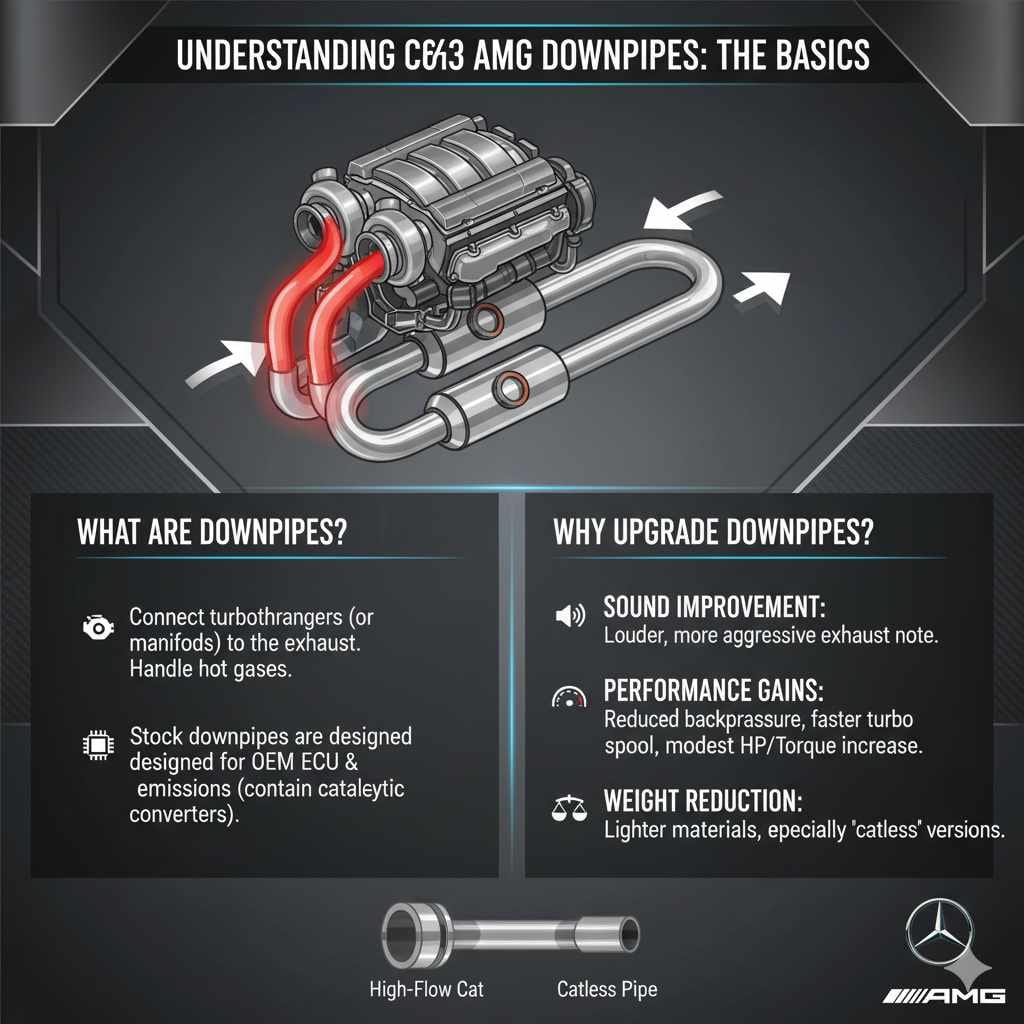
Understanding C63 AMG Downpipes: The Basics
Your C63 AMG’s exhaust system is more than just a way to quiet down engine noise. It’s a sophisticated network that helps your engine breathe. The downpipes are a critical part of this system. They connect your turbochargers (or exhaust manifolds on older models) directly to the rest of the exhaust, usually including the catalytic converters. They handle a lot of hot exhaust gases and play a big role in how smoothly your engine can expel these gases.
In a stock C63 AMG, the downpipes are designed with specific dimensions and flow characteristics to work perfectly with the engine’s computer (ECU). They often contain catalytic converters, which are essential for reducing harmful emissions. When you change these downpipes to aftermarket versions, especially “catless” or “high-flow” ones, you’re altering how the exhaust gases flow and at what speed they reach the oxygen sensors.
Why Upgrade Downpipes?
Enthusiasts often upgrade their downpipes for a few key reasons:
- Sound Improvement: Aftermarket downpipes, particularly those without catalytic converters, can significantly change the exhaust note, often making it louder and more aggressive.
- Performance Gains: By reducing backpressure, new downpipes can help the turbochargers spool up faster and allow the engine to breathe more freely. This can lead to modest horsepower and torque increases. Even high-flow catalytic converters offer some improvement over stock.
- Weight Reduction: Some aftermarket downpipes can be lighter than the stock units, especially if they remove the heavy catalytic converters and associated heat shielding.
The Crucial Question: Do C63 AMG Downpipes Need a Tune?
Now, let’s get straight to the heart of the matter. For most C63 AMGs, especially those from the W204, W205, and W206 generations, installing aftermarket downpipes generally does require an ECU tune. Here’s why:
1. Oxygen Sensor Readings
Your C63 AMG’s engine is meticulously managed by its ECU. A key part of this management involves oxygen sensors (O2 sensors), also known as lambda sensors. These sensors are positioned in the exhaust stream, usually before and after the catalytic converter. They measure the amount of oxygen in the exhaust gases, which tells the ECU if the air-fuel mixture is too rich or too lean.
When you install aftermarket downpipes, especially those that remove or replace the stock catalytic converters with less restrictive ones:
- The exhaust gas flow changes significantly. It becomes faster and less turbulent.
- The O2 sensors receive different readings. The sensor positioned after the catalytic converter (post-cat O2 sensor) is designed to detect the efficiency of the stock catalytic converter. If the cat is removed or its flow is drastically altered, this sensor will detect a change that the ECU interprets as a problem.
These altered readings will almost always trigger a “Check Engine” light (CEL). This isn’t just an annoying dashboard light; it indicates that the engine’s management system is detecting an anomaly it cannot correct on its own.
2. Catalytic Converter Efficiency
Stock downpipes contain catalytic converters that are vital for emissions control and are carefully calibrated to operate within a specific temperature and flow range. Aftermarket downpipes, whether “catless” (no catalytic converters at all) or “high-flow” (with less restrictive converters), disrupt this balance.
The ECU monitors catalytic converter efficiency using the downstream O2 sensor. If this sensor reports readings that indicate the converter isn’t doing its job (which is often the case with modified downpipes), the ECU will flag it as a fault.
For more information on emissions and catalytic converters, you can check out resources like the U.S. Environmental Protection Agency (EPA) website, which provides detailed information on vehicle emissions standards and technology. For instance, the EPA’s section on green vehicle emissions highlights the role of these components.
3. Performance and Safety Implications Without a Tune
Running a C63 AMG with aftermarket downpipes without a proper tune can lead to several issues:
- Check Engine Light (CEL): As mentioned, this is almost guaranteed. It can mask other potential engine issues.
- Reduced Performance: While downpipes alone can offer gains, the stock ECU might try to compensate for the changes in unexpected ways. Without a tune, the engine may not be able to take full advantage of the improved exhaust flow, or it might even run less efficiently or smoothly.
- Fuel Mixture Problems: The ECU relies on O2 sensor data to determine the correct air-fuel ratio. If it’s getting bad data due to modified downpipes, it might inject too much or too little fuel, leading to poor fuel economy, rough idling, or even engine damage in extreme cases.
- Transmission Issues: In some cases, a persistent CEL or incorrect engine behavior can affect how the transmission shifts, leading to a less refined driving experience.
Types of Aftermarket Downpipes for the C63 AMG
When you’re looking at aftermarket downpipes, you’ll typically encounter two main types for the C63 AMG:
| Type of Downpipe | Description | Impact on Tuning | Pros | Cons |
|---|---|---|---|---|
| Catless Downpipes | These replace the stock catalytic converters entirely with a straight pipe. | Definitely Requires a Tune. The O2 sensors will detect missing catalysts, triggering CELs and incorrect readings. | Maximum potential power gains, deepest exhaust sound, significant weight reduction. | Illegal for road use in most regions due to emissions, will cause CEL, may fail emissions tests, significantly altered exhaust note can be too loud for some. |
| High-Flow Cat Downpipes | These use specially designed, less restrictive catalytic converters than the stock units. | Often Requires a Tune for optimal results and to prevent CELs, though some are designed to be more “tune-friendly” than catless. | Improved exhaust flow over stock while still retaining some emission control, potentially less chance of CEL than catless (but still likely), generally less extreme sound than catless. | Still may trigger CEL without a tune, less performance gain than catless, can be expensive, still may not pass strict emissions tests. |
It’s important to note that “tune-friendly” high-flow downpipes are still a compromise. While they might use advanced catalyst technology to improve flow, the ECU is still expecting a very specific input from the O2 sensors. Without a tune to recalibrate those expectations, problems can still arise.
What Exactly is an ECU Tune?
An ECU tune, also known as ECU remapping or flashing, is the process of modifying your car’s Engine Control Unit (ECU) software. The ECU is essentially the brain of your car, controlling everything from fuel injection and ignition timing to turbocharger boost pressure and throttle response.
A stock tune is designed for reliability, drivability, and meeting emissions standards. However, it’s often conservative to ensure it works universally across a wide range of conditions. Aftermarket upgrades like downpipes change the engine’s operating parameters. A tune is necessary to:
- Adjust Fuel Maps: Ensure the correct amount of fuel is delivered based on the new exhaust flow.
- Modify Ignition Timing: Optimize spark plug firing for better performance and efficiency with the new setup.
- Recalibrate O2 Sensor Readings: Tell the ECU to ignore or expect different sensor data so no CEL is triggered and the engine runs smoothly. This is often done by physically moving O2 sensors further away from the exhaust flow using a “spacer” or by disabling that specific sensor input in the ECU software. However, disabling sensors or relying on spacers alone isn’t a full solution.
- Adjust Boost Pressure: For turbocharged cars like the C63 AMG, a tune can often increase boost pressure for more power.
- Optimize for Downpipe Specifics: Ensure the engine is operating safely and efficiently with the new airflow characteristics introduced by the aftermarket downpipes.
The Tuning Process for C63 AMG Downpipes
When you decide to tune your C63 AMG after installing downpipes, you’ll typically work with a professional tuning shop or a reputable tuner. The process usually involves:
1. Diagnosis and ECU Access
The tuner will first ensure your car is healthy and then access the ECU. This is often done via the OBD-II port (On-Board Diagnostics), though sometimes it might involve removing and bench-flashing the ECU if direct access is difficult or unavailable for your specific model.
2. Custom or Off-the-Shelf (OTS) Tune
There are two main approaches:
- Off-the-Shelf (OTS) Tune: These are pre-written maps developed by tuning companies for specific popular modifications. For example, there might be an OTS map for “C63 AMG with catless downpipes and aftermarket intake.” You can often flash these yourself using specialized tuning devices.
- Custom Tune (Dyno Tune or E-Tune): This is generally preferred for optimal results and safety. A custom tune involves the tuner calibrating the ECU specifically for your car and your modifications. This is done either on a dynamometer (a machine that measures power output and allows for controlled testing) or remotely (E-tune), where you send logs of your car’s performance, and the tuner sends back revised maps. A custom tune ensures the engine is running optimally under various conditions.
3. Flashing the ECU
Once the tune is prepared, it’s uploaded to your car’s ECU. This process typically takes a short amount of time.
4. Testing and Verification
After flashing, the tuner will likely test the car to ensure everything is working correctly. This involves checking for any error codes, monitoring engine parameters, and confirming performance improvements. A dyno run is a great way to verify power gains and ensure the tune is safe.
DIY vs. Professional Installation and Tuning
The decision to tackle the installation or tuning yourself depends on your skill level and available tools.
Downpipe Installation:
Installing downpipes can be a moderately difficult DIY job. It involves working under the car, dealing with tight spaces, rusted bolts, and potentially hot exhaust components. Tools you might need include:
- Socket set and wrenches
- Torque wrench
- Jack and jack stands (never rely solely on a jack!)
- Penetrating oil for rusted bolts
- Exhaust hanger removal tool
- Safety glasses and gloves
It’s crucial to have the car safely supported on jack stands. If you’re not comfortable with this type of mechanical work, it’s best left to a professional mechanic. You can find instructions and advice on reputable automotive forums or through VIMEO videos from experienced installers.
ECU Tuning:
ECU tuning is almost always best left to professionals. While flashing devices are relatively user-friendly, understanding the nuances of engine management, safe AFRs (Air-Fuel Ratios), boost targets, and ignition timing requires significant expertise. An improperly done tune can be catastrophic for your engine.
For instance, attempting to “tune out” O2 sensors without a proper understanding can lead to incorrect fuel delivery or timing, potentially causing detonation (knocking) which is extremely damaging to engine internals. Automotive research sites often discuss the risks of improper tuning, underscoring the importance of professional expertise.
Benefits of Tuning After Downpipe Installation
When done correctly, tuning your C63 AMG after installing new downpipes offers several advantages:
- Unlockened Performance Potential: The engine can finally take full advantage of the improved exhaust flow, leading to noticeable power and torque gains.
- Elimination of Check Engine Lights: The annoying CEL will be gone, and your car will function as intended by the ECU.
- Smoother Drivability: The tune ensures the engine runs efficiently, leading to better throttle response and a more refined driving experience.
- Ensured Engine Longevity: A properly calibrated tune keeps engine parameters within safe limits, protecting your engine from damage that could occur with incorrect fuel mixtures or timing.
- Compatibility: The tune ensures all engine components work in harmony, even with the modified exhaust.
Potential Downsides and Considerations
While the benefits are great, there are a few things to keep in mind:
Cost: Quality aftermarket downpipes and a professional tune can be a significant investment. Expect to pay several hundred to over a thousand dollars for parts and tuning, depending on the brand and service.
Emissions: Catless downpipes are illegal for street use in most areas due to emissions regulations. Even high-flow cat downpipes might not pass a strict emissions test. Be aware of your local laws and regulations. The EPA and state-specific agencies have guidelines regarding emissions modifications. For example, California’s Bureau of Automotive Repair has strict rules regarding aftermarket exhaust components.
Warranty: Modifying your exhaust and tuning the ECU can potentially void your vehicle’s powertrain warranty. Always check your warranty documentation or speak with your dealership regarding modifications.
Noise: Aftermarket downpipes, especially catless ones, will make your C63 AMG significantly louder. This can be desirable for some but may be too intrusive for others, especially for daily driving or in areas with noise ordinances.
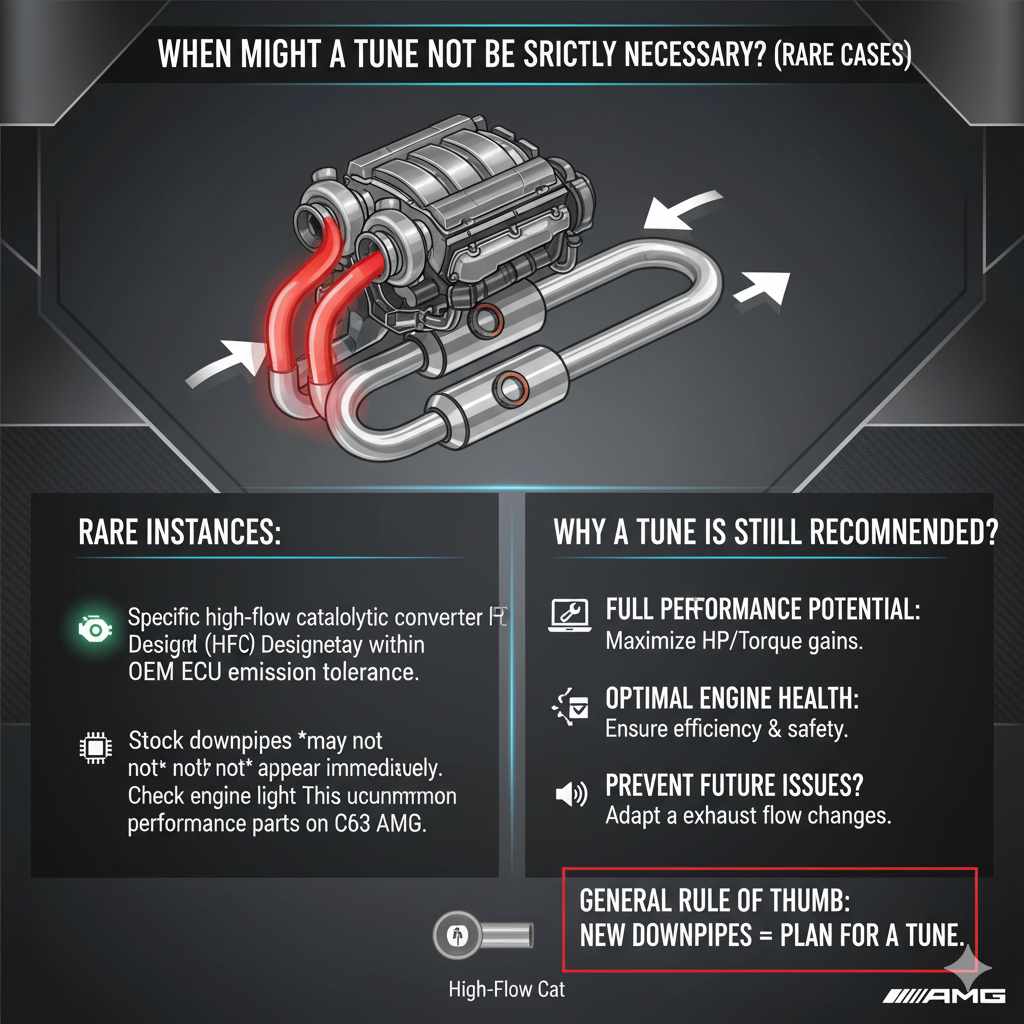
When Might a Tune NOT Be Strictly Necessary? (Rare Cases)
In very rare instances, some very specific aftermarket downpipes might not immediately throw a check engine light. These are typically high-flow cat downpipes designed with extremely efficient catalysts that still fall within the OEM ECU’s acceptable tolerance range for catalytic converter efficiency. However, this is uncommon for performance-oriented aftermarket parts, especially on sophisticated vehicles like the C63 AMG.
Even in these situations, an ECU tune is still highly recommended to:
- Extract the full performance potential of the exhaust modification.
- Ensure the engine is running at peak efficiency and safety.
- Prevent potential issues down the line, as exhaust flow differences can still affect long-term engine health.
Therefore, the general rule of thumb for a C63 AMG is: if you’re upgrading the downpipes, plan for a tune.
Alternatives to Downpipe Replacement
If the cost, legal implications, or complexity of downpipe upgrades and tuning seem daunting, there are other ways to enhance your C63 AMG’s exhaust experience:
- Cat-Back Exhaust System: This replaces the exhaust system from the catalytic converters back to the tailpipe. It primarily affects sound and can offer minor performance gains without typically requiring a tune.
- Muffler Delete: Removing the mufflers can significantly alter the sound for a more aggressive tone, generally without needing a tune. However, this is also often illegal for street use.
- Resonator Delete: Similar to muffler deletes, this affects sound and usually doesn’t require a tune, but legality can be an issue.
These options are generally less invasive and less likely to cause CELs compared to full downpipe replacement. They offer a different balance of sound, performance, and ease of implementation.
Conclusion
So, do downpipes require a tune on a C63 AMG? The overwhelming answer is yes. While there might be extremely rare exceptions with specific high-flow cat designs, installing aftermarket downpipes almost always necessitates an ECU tune to prevent check engine lights and ensure your powerful Mercedes performs as it should. A tune recalibrates your car’s brain to understand the new exhaust flow, ensuring safety, maximizing performance, and maintaining smooth drivability.
Upgrading your C63 AMG’s downpipes can be a rewarding modification, transforming its sound and performance. By understanding the need for a tune and working with reputable professionals, you can confidently make this upgrade. It’s about ensuring your AMG not only sounds incredible but also runs optimally and reliably. Enjoy the journey of enhancing your C63 AMG!


