How to Check If an O2 Sensor Is Causing Exhaust Issues
Check the O2 sensor by reading live data and comparing upstream and downstream behavior: if one sensor is stuck lean or rich while the others switch normally, or if its signal stays flat after warm-up, suspect the sensor or its wiring. Misdiagnosis can waste money on parts that do nothing and leave a real exhaust or fuel problem unfixed. This guide shows how to tell whether the sensor is the fault, the victim, or only reporting another issue.
O2 sensor fault-isolation matrix

- Measures AC/DC voltage, current, resistance, and more
- Large backlit screen helps readings stay clear
- Rechargeable with auto-ranging for easier troubleshooting
| Symptom | Likely sensor position | First test | Expected OBD-II clue | Common false cause |
|---|---|---|---|---|
| Black smoke, strong fuel smell, poor mpg | Upstream, pre-cat | Scan live data and fuel trims | P0130 through P0131, or related oxygen-sensor codes | Misfire, vacuum leak, leaking injector, high fuel pressure |
| Rough idle, hesitation, stalling | Upstream, pre-cat | Check sensor switching and compare trim values | P0030, P0130, P0131, P0161 | Ignition fault, intake air leak, wiring damage |
| Check engine light with little drivability change | Downstream, post-cat | Review downstream live data after warm-up | P0420 or P0430 | Catalytic converter wear, exhaust leak near the converter |
| High emissions test failure | Upstream or downstream | Read codes and inspect for exhaust leaks | P0130 through P0161, plus P0420 or P0430 | Engine runs rich, misfire, bad catalyst |
| Sulfur or rotten-egg smell | Upstream issue first, then catalyst check | Look for rich-running data and scan pending codes | P0130 through P0161, sometimes P0420 | Overheated catalytic converter, fuel mixture fault |
Use the symptom that bothered you first, then pick the first test in the table. That order matters. A code can point at the sensor, but it can also point at wiring, a misfire, or a converter that is doing the wrong job.
Upstream versus downstream quick split
Upstream oxygen sensors sit before the catalytic converter and help control fuel mixture. Downstream sensors sit after the converter and mainly watch catalyst efficiency. That difference changes everything: a bad upstream sensor can affect drivability and fuel economy, while a failing downstream sensor usually turns on the light without large drivability symptoms.
Say your truck starts idling rough and the exhaust smells fuel-rich. That is an upstream problem until proven otherwise, because the sensor that feeds mixture control is the one most likely to disturb how the engine runs. By contrast, a post-cat code with smooth driving usually points to monitoring trouble or a catalyst issue, not a fuel-control collapse.
What an O2 sensor does in exhaust diagnosis
An oxygen sensor measures oxygen in exhaust so the engine computer can keep air-fuel ratio near the ideal petrol target of roughly 14.7:1. If the reading is wrong or slow, the computer may add too much fuel or pull too much fuel, which can create rich or lean running and trigger a check engine light.
How oxygen readings affect fuel mixture
On conventional narrowband upstream sensors in closed loop, healthy readings should switch repeatedly between about 0.1V and 0.9V. A lean mixture can correspond to around 0.1 volts, and a rich mixture can correspond to around 0.8–0.9 volts. When the signal moves normally, the computer can fine-tune mixture. When it sticks or lags, fuel control goes off course.
Why upstream sensors affect drivability more than downstream sensors
The upstream sensor sits before the catalytic converter, so its signal helps control fuel delivery. That is why upstream faults can contribute to rough idle, hesitation, stalling, black smoke, poor fuel economy, and high emissions. A bad O2 sensor can hurt fuel economy when the mixture is being corrected the wrong way.
The downstream sensor sits after the catalytic converter. Its job is to monitor converter efficiency. A failing downstream sensor often sets a light but does not usually create the same drivability complaints because it is not the main fuel-control input.
What happens when the reading is wrong or slow
Bad O2 sensors may lead to excess fuel in your engine. That can mean rich running, soot at the tailpipe, and more stress on the catalytic converter. Slow switching is also a problem, because the computer waits longer to correct mixture and may overshoot in both directions.
A common first-timer mistake is assuming the O2 sensor is bad when a cracked exhaust manifold is actually letting extra air into the system. A small leak upstream of the sensor can pull in outside air and make the sensor report lean exhaust even when the engine itself is not the real problem.
How can I tell if the O2 sensor is causing my exhaust problem?
Start with the symptom, then verify the sensor signal instead of guessing. If the complaint is rich running, rough idle, or bad mileage, focus on the upstream sensor and fuel trims. If the complaint is mainly a catalyst-efficiency code with smooth driving, focus on downstream data, wiring, and the converter itself.
Start with the symptom that led you here
Black smoke, rotten-egg smell, and strong fuel odor point toward rich running. Rough idle, hesitation, and stalling also point toward upstream fuel-control trouble. A check engine light alone is too broad to diagnose anything by itself, because the ECU can set it for oxygen-sensor circuit and performance faults as well as many other issues.
Check for codes, then confirm with live data
Use an OBD-II scanner to read stored and pending diagnostic trouble codes. Oxygen-sensor-related codes can appear outside a single neat range, so look at the specific code and the bank and sensor position instead of relying on a shortcut. Pending codes matter because they often show a pattern before the light stays on.
Rule out exhaust leaks, misfires, and wiring faults first
Before buying parts, inspect the connector, the wiring, and the exhaust path near the sensor. Misfires can flood the exhaust with oxygen and make sensor readings look wrong. Vacuum leaks, exhaust leaks, and damaged wiring can all imitate a bad sensor. A failing catalytic converter can also confuse the picture.
Suppose a sedan shows P0131 and runs rough at idle. If the upstream sensor signal is flat while the wiring has heat damage near the manifold, the sensor may be innocent and the wiring may be the real fault. That is the kind of detail a code reader alone will not give you.
What OBD2 codes point to a bad oxygen sensor?
Codes such as P0030, P0130, P0131, and P0161 can point to oxygen-sensor circuit or heater-related faults, but oxygen-sensor-related problems are not limited to that group. P0420 and P0430 are different: they often point to catalyst efficiency, not a direct sensor failure.
Why P0420 and P0430 often point beyond the sensor itself
P0420 indicates catalyst system efficiency below threshold for Bank 1. P0430 is the same kind of catalyst-efficiency concern on the other bank. Those codes can appear when the converter is worn out, when there is an exhaust leak, or when an upstream sensor or fuel issue has already stressed the converter.
Why pending codes matter
Pending codes show the computer has seen a fault but has not fully committed it yet. That is useful when symptoms are early or intermittent. If the sensor signal looks suspicious and a pending oxygen-sensor code matches the bank and sensor position, you have a stronger case than with a single stored code alone.
| Code type | What it usually points to | What it does not prove |
|---|---|---|
| P0130 through P0161 | Oxygen-sensor circuit, heater, or response problem | That the sensor itself is dead |
| P0420 | Catalyst efficiency below threshold for Bank 1 | That the downstream sensor is the only fault |
| P0430 | Catalyst efficiency below threshold on the other bank | That the converter alone is bad |
How do you test an O2 sensor before replacing it?
Test the sensor with live data first, then confirm with the right test method for the sensor type. You are looking for a signal pattern that makes sense after warm-up, not one fixed at one value. Flatlined readings, very slow switching, or a signal that stays rich or lean can point to a failed sensor or wiring fault. On some modern wideband or air-fuel-ratio systems, a simple voltmeter check at the connector is not the right way to judge sensor operation.
Scan tool live-data checks
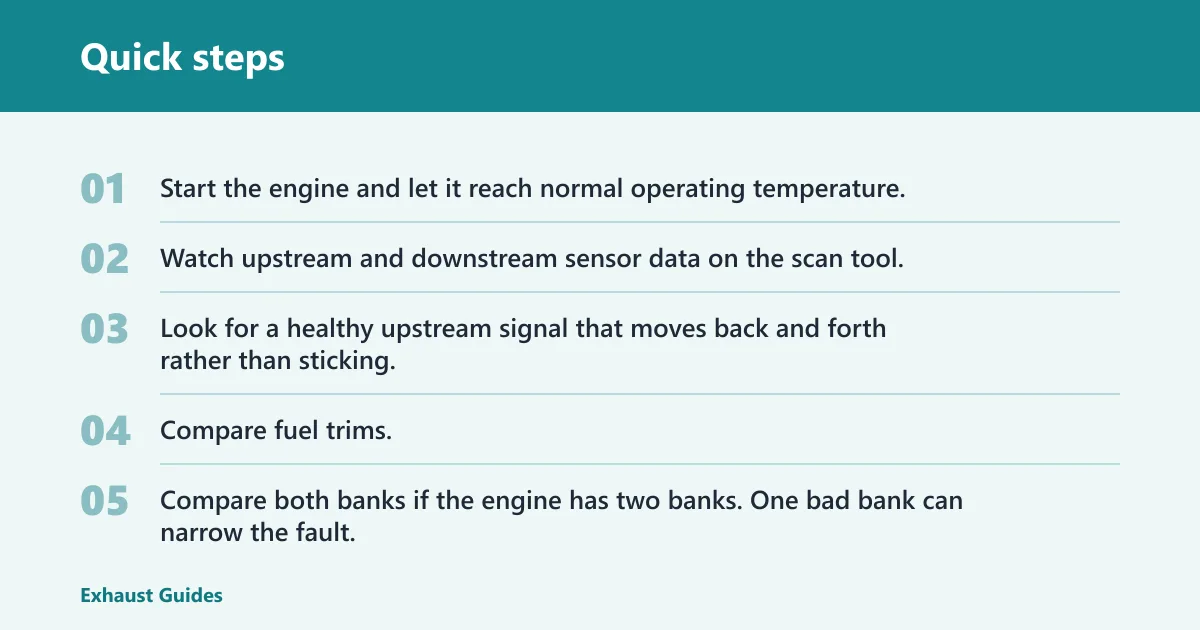
- Start the engine and let it reach normal operating temperature.
- Watch upstream and downstream sensor data on the scan tool.
- Look for a healthy upstream signal that moves back and forth rather than sticking.
- Compare fuel trims. Excessively positive trims can suggest a lean condition; large negative trims can suggest rich correction.
- Compare both banks if the engine has two banks. One bad bank can narrow the fault.
A healthy upstream sensor should switch repeatedly once the engine is warm. The downstream sensor should usually be steadier. If the downstream signal mirrors the upstream signal too closely, the converter may not be storing oxygen well, or there may be an exhaust or sensor problem upstream of it.
Voltmeter checks and expected switching range
On a conventional switching sensor, a voltmeter can help confirm whether the signal is alive at the connector. Expect movement around 200 to 800 millivolts after warm-up, with the exact pattern depending on the system. Some wideband and air-fuel-ratio sensors do not diagnose by a simple voltage swing, so use the meter only where the system design allows it. A sensor stuck at a fixed voltage may indicate a failing sensor, or an open, shorted, or missing heater-power circuit.
Use the meter to check power and ground at the heater circuit as well. A sensor that never gets hot enough may never switch correctly. That can look like a sensor fault when the real issue is the heater feed, fuse, relay, or wiring.
What flatline, slow-switching, or stuck-rich readings suggest
A flat line near low voltage can point to a lean condition, an exhaust leak, an open circuit, or a sensor that is no longer responding. Check trims and leaks before deciding the sensor is bad. A flat line near high voltage can point to rich running, a shorted circuit, or a sensor that is biased high. Slow switching can point to aging sensor response or a fuel-control issue that keeps correcting late.
Upstream vs downstream O2 sensor problems
Upstream sensor problems usually show up as drivability and fuel-trim complaints. Downstream problems usually show up as catalyst-monitoring faults. Keep those jobs separate. If you treat every O2 code the same way, you can miss a real fuel problem or replace a sensor that is only reporting a bad converter.
Pre-cat sensor symptoms and fuel-control clues
The upstream sensor sits before the catalytic converter. If it fails, the engine computer can overfuel or underfuel the engine. That can create rough idle, hesitation, stalling, black smoke, and poor fuel economy. Fuel trims often drift away from normal because the computer keeps chasing a bad signal.
Post-cat sensor symptoms and catalyst-monitoring clues
The downstream sensor sits after the catalytic converter. If it fails, the car may drive almost normally while the light stays on. The main clue is often a catalyst-efficiency code rather than rough running. That is why a post-cat fault is not the same as a fuel-control fault.
Sensor failure versus catalyst-monitoring issue
| Problem type | Typical clue | Likely next step |
|---|---|---|
| Upstream sensor failure | Rough idle, hesitation, black smoke, fuel-trim drift | Check live switching, heater circuit, and wiring |
| Downstream sensor or catalyst-monitoring problem | P0420 or P0430 with little drivability change | Inspect exhaust leaks, compare upstream and downstream data, assess converter condition |
Can a bad O2 sensor cause smoke or odor?
Yes. A bad upstream O2 sensor can cause rich running, which can create black smoke, a sulfur or rotten-egg smell, and high emissions. Those signs do not prove the sensor is bad, though. They can also come from misfires, fuel delivery faults, or a converter that is overheating.
Black smoke and rich running
Black smoke usually means too much fuel. If the upstream sensor is reporting wrong or not switching, the computer can feed extra fuel and the exhaust will carry soot. That is one of the clearest cases where an O2 fault can become a visible exhaust problem.
Sulfur or rotten-egg smell
That smell often appears when the catalytic converter is overloaded with excess fuel. The sensor may be the first bad part in the chain, but the converter can become the part that you smell. Do not ignore that pattern. It can mean heat damage is already building.
High emissions and catalyst stress
Rich running raises emissions and can damage the catalytic converter. That is why an upstream sensor fault deserves more urgency than a simple light with no symptoms. Fixing the mixture problem early is usually cheaper than replacing a converter after it has been overheated.
Can you drive with a faulty O2 sensor?
Sometimes you can drive briefly, but the answer depends on which sensor failed and how the engine is running. A downstream fault with no drivability symptoms is usually less urgent than an upstream fault that causes rich running, black smoke, or stalling. If the mixture is wrong, address it quickly.
Short-term risk versus long-term damage
If the car still runs normally and the code points to a downstream sensor, short trips may be possible while you diagnose it. If the engine is running rich or lean, the risk changes. Excess fuel can damage the catalytic converter, and a converter is usually far more expensive than a sensor.
When to stop driving and diagnose now
Do not keep driving if you see black smoke, smell strong fuel or sulfur, or feel major drivability problems. Those symptoms suggest the engine may be feeding the converter too much raw fuel. That is the point where a sensor, wiring, fuel-control issue, or misfire needs prompt attention.
Why catalyst damage can cost more than the sensor
The catalytic converter is the expensive part in this chain. A bad O2 sensor can make the converter work too hard, and the converter can fail as a result. If P0420 or P0430 appears after a period of rich running, the converter may need to be checked, not just the sensor.
Frequently asked questions
What are the symptoms of a bad oxygen sensor in the exhaust?
Common symptoms include a check engine light, poor fuel economy, rough idle, hesitation, stalling, high emissions, black smoke, and a sulfur or rotten-egg smell. The symptom pattern matters. Upstream faults usually affect how the engine runs. Downstream faults usually affect monitoring more than drivability.
Can a bad O2 sensor cause black smoke or a rotten egg smell?
Yes, especially if the upstream sensor causes the engine to run rich. That can create black smoke and overload the catalytic converter, which may produce a sulfur smell. Those signs also fit misfires, fuel delivery faults, or a converter that is already overheated.
Can I drive with a faulty O2 sensor for a while?
Maybe, but only if the engine runs normally and the fault points to a downstream sensor or a mild monitoring issue. If the engine runs rich or lean, or if you see smoke or smell fuel, keep driving to a minimum. Rich running can damage the catalytic converter quickly.