Catalytic Converter Replacement Cost Kia
Kia catalytic converter replacement usually runs about $900 to $3,000+, but the right quote depends on the engine, converter location, and whether the part is OEM, direct-fit aftermarket, or a universal unit. EPA guidance, insurer coverage terms, and parts-catalog pricing all point to the same thing: a bad diagnosis can send you chasing the wrong part, so compare the full quote before you approve repairs.
Kia converter cost table

This table breaks a Kia catalytic-converter quote into the pieces that change the final bill: the converter itself, labor, gaskets and hardware, sensors, diagnosis, and any reset or reflash work. It also separates common Kia layouts by model family and gives a diagnose-first or replace-now recommendation for each scenario.
| Model family | Common years asked about | Common engine/layout | Converter location | Parts | Labor | Gaskets and hardware | Sensors | Diagnosis and reset | Total range | Likely price drivers | Replace now vs diagnose first |
|---|---|---|---|---|---|---|---|---|---|---|---|
| Kia Soul | 2013, 2015, 2016 | 2.0L and similar four-cylinder layouts | Often front manifold on some trims; rear underfloor on others | $450 to $1,600 | $250 to $700 | $40 to $140 | $120 to $350 | $100 to $250 | $900 to $3,040 | Engine size, manifold-integrated design, access around the exhaust, and whether the quote includes both sensors | Diagnose first if the only clue is P0420; replace now only if the converter is broken, melted, stolen, or confirmed failed |
| Kia Forte | 2014, 2015, 2016, 2017, 2018, 2020, 2021 | 1.8L/2.0L four-cylinder variants | Front manifold on some engines; rear direct-fit on others | $400 to $1,700 | $220 to $650 | $35 to $130 | $120 to $320 | $100 to $250 | $875 to $3,050 | Generation, exact engine code, bank/location, and whether the replacement is an OEM-style manifold unit or a rear converter only | Diagnose first if the car has P0420 plus rough running, misfires, or fuel-trim issues |
| Kia Sportage | Common early and late model years with different layouts | 2.0L, 2.4L, and similar SUV-specific packages | Mixed: some manifold-mounted fronts, some underfloor rears | $550 to $2,000 | $300 to $900 | $50 to $160 | $120 to $350 | $120 to $300 | $1,140 to $3,710 | SUV exhaust routing, tighter access, rusted fasteners, and manifold-integrated designs on some engines | Replace now if the converter is physically damaged or stolen; otherwise diagnose for oil use, leaks, or misfire first |
| Kia Optima | Common sedan years across multiple generations | 2.4L, 2.0T, and similar sedan layouts | Front manifold on some trims; rear underfloor unit on others | $500 to $2,100 | $250 to $850 | $40 to $150 | $120 to $350 | $100 to $300 | $1,010 to $3,750 | Engine configuration, emissions package, and whether the converter is built into the exhaust manifold | Diagnose first if the code appears with misfire, fuel-trim, or exhaust-leak symptoms |
Parts, labor, and hidden add-ons
Parts and labor are the two biggest slices of the bill. EPA rules and state emissions programs make the exact converter type matter, especially on vehicles with a manifold-integrated front converter. Labor can rise fast when the shop has to remove shields, work around rust, or replace sensors and hardware at the same time.
Hidden charges matter too. Gaskets, clamps, bolts, oxygen sensors, diagnosis, and reset work can add several hundred dollars to a quote. On some Kia setups, the replacement also requires verifying readiness monitors or checking for a stored code history after the repair.
Replace now versus diagnose first
Replace now only when the converter has clear physical damage, has been stolen, or has already been verified as failed after a proper diagnostic check. If the only clue is a catalyst-efficiency code, the safer move is to confirm the cause first and avoid installing a converter that may be damaged again by the same underlying problem.
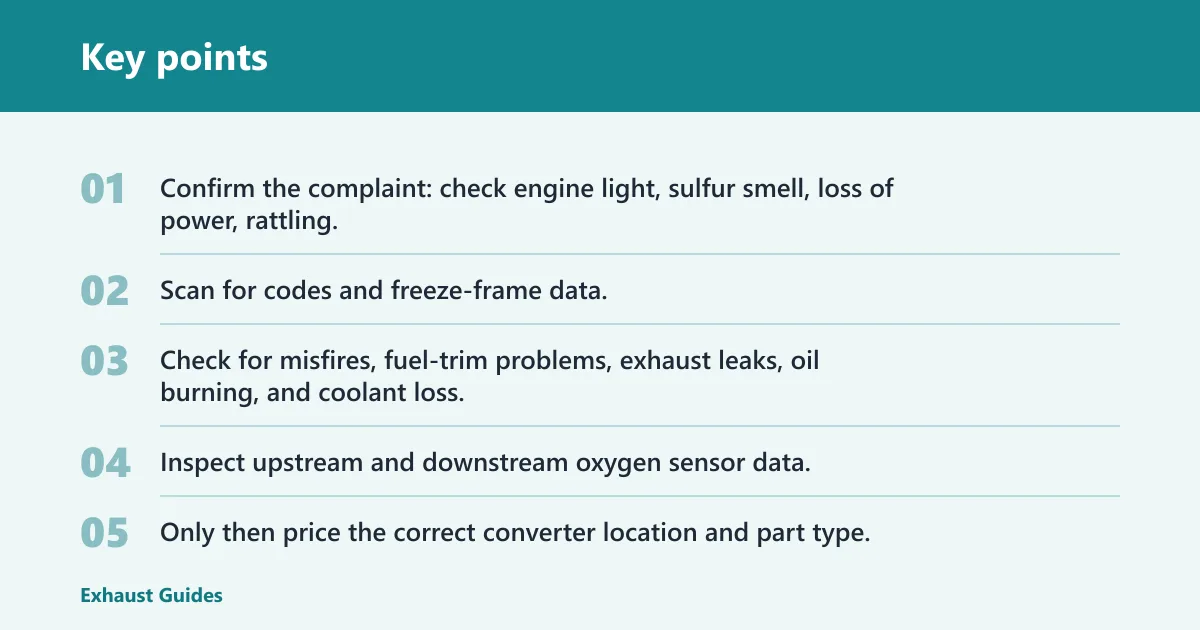
- Confirm the complaint: check engine light, sulfur smell, loss of power, rattling, or failed emissions test.
- Scan for codes and freeze-frame data.
- Check for misfires, fuel-trim problems, exhaust leaks, oil burning, and coolant loss.
- Inspect upstream and downstream oxygen sensor data.
- Only then price the correct converter location and part type.
How much does a Kia converter cost?
For most Kia owners, the part alone is only part of the answer. A quote can look low because it covers only the converter shell, or high because it includes a manifold assembly, sensors, fasteners, diagnosis, and labor on a tight layout. Parts-catalog data and repair-estimate sources both show that layout matters as much as the badge.
Generic marketplace listings are not a good basis for repair guidance. For pricing, the better references are parts catalogs, shop estimates, and emissions-compliance rules that define what can legally be installed where. That is why a Kia quote should be judged by engine, bank, and location rather than by a single average number.
What changes the quote most
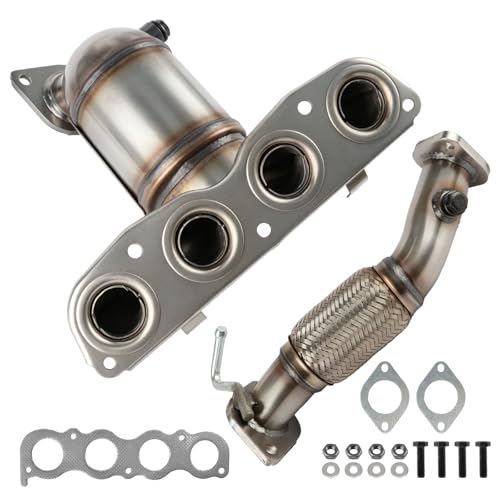
The biggest swing comes from converter location. A manifold-mounted converter is usually more expensive than a rear underfloor unit because the assembly is larger and the labor is tighter. Engine size matters too, and access matters as well. If the shop must remove shields, loosen rusted hardware, or work around tight underbody space, labor climbs fast.
Why newer layouts can cost more
Some Kia layouts place the converter close to the engine, where heat is higher and replacement parts are built as a larger unit. That can raise both parts cost and labor. If the converter is part of the manifold, the quote can look very different from a rear direct-fit replacement on the same model line.
Say your 2016 Kia Soul has a P0420 code and a shop quotes a front converter assembly plus two oxygen sensors. That estimate should be much higher than a rear direct-fit part alone, because the labor, hardware, and emissions fitment are different even before diagnosis is added.
When the number looks low, and why that matters
A very low quote can mean the shop has not included sensors, gaskets, or a proper diagnostic check. It can also mean the wrong converter type was priced. If the quote does not specify bank, location, emissions standard, and whether the part is direct-fit or universal, the number is not complete enough to approve.
What does the converter price include?
A Kia catalytic converter quote should show the converter assembly, the hardware needed to install it, the labor to reach it, and the diagnostic steps used to confirm the failure. If those pieces are missing, the final bill can jump later.
Converter assembly or direct-fit part
The main part can be an OEM converter, a direct-fit aftermarket unit, or a universal unit. OEM usually matches the original layout most closely. Direct-fit aftermarket parts are built for a specific vehicle and location. Universal units may fit physically but can create legal or inspection problems depending on emissions rules and how the vehicle is certified.
Gaskets, clamps, bolts, and heat shields
Exhaust work often needs fresh gaskets and hardware because old fasteners seize or break during removal. Heat shields may need to come off and go back on, and damaged studs can add both time and cost. On some Kia front-converter designs, this hardware can be a meaningful part of the quote.
Oxygen sensors and shop diagnosis
Many quotes include one or more oxygen sensors, especially if the sensors are aged or contaminated. Diagnosis is separate from replacement. The Federal Trade Commission and EPA both emphasize consumer caution around emissions-repair claims and parts fitment, and a catalyst-efficiency code alone does not prove the converter has failed.
Why does Kia model matter?
Kia model matters because the converter’s shape, location, and emissions package change the job. A Soul, Forte, Sportage, and Optima can all need different parts and different labor even when the symptom is the same.
Kia Soul years and common layouts
The Kia Soul is one of the most searched Kia variants for converter pricing, especially for 2013, 2015, and 2016. Pricing changes with engine size and layout, and some versions place the converter on the manifold while others use a separate underfloor unit. That difference changes both parts and labor.
Kia Forte years and engine differences
The Kia Forte spans several pricing bands across 2014, 2015, 2016, 2017, 2018, 2020, and 2021 model years. The generation matters. So does the engine. A shop that does not confirm the exact engine code can quote the wrong part or miss a manifold-integrated setup.
Kia Sportage and Optima pricing changes
The Kia Sportage often costs more than a comparable sedan because of exhaust routing and access. The Kia Optima can also land in a higher band when the engine configuration or emissions package uses a larger assembly. That is why two Kias with the same code can have very different estimates.
Picture a Sportage that has a rattling exhaust and a P0420 code after a long period of oil consumption. The converter may be damaged, but the oil-burning problem has to be addressed too, or the new converter can fail early.
Should you replace after P0420?
Not automatically. P0420 is a catalyst-efficiency code, which means the engine computer thinks the converter is not storing or cleaning exhaust as well as expected. That can happen because the converter is worn out, but it can also happen because the engine is sending bad exhaust to the converter or because the sensors are reporting incorrectly.
What P0420 means
In plain terms, the engine computer thinks the converter is not cleaning exhaust as well as it should. That can happen because the converter is worn out, but it can also happen because the engine is sending dirty exhaust into the converter or because the sensors are lying about what they see.
Misfires, leaks, oil use, and coolant loss
Check for misfire codes, rough idle, cracked exhaust joints, and evidence of oil or coolant entering the exhaust stream. Any of those can make the converter look bad. A converter replacement is a poor fix if the engine is still dumping contamination into the exhaust.
When diagnosis should come first
Diagnosis should come first when the car still drives normally, the converter is not physically damaged, and the only clue is a catalyst-efficiency code. That is especially true on older Kias, where the car may be worth less than a complete converter assembly and related labor.
Is OEM or aftermarket better for Kia?
Neither is always better. The right choice depends on fitment, emissions compliance, warranty coverage, and how close the replacement needs to match the original layout. For street use, EPA-compliant fitment matters more than a low sticker price alone.
EPA-compliant options for street use
The EPA’s converter guidance is clear that emissions parts are not interchangeable in every situation. For a Kia, the safer choice is the part that matches the exact engine, bank, and converter location and meets the relevant emissions standard for the vehicle and your state. A cheap universal unit may not be the right answer if inspection readiness matters.
Fitment, warranty, and inspection readiness
Aftermarket parts can be a good value if they match the exact Kia engine, bank, and converter location. OEM parts often cost more, but they can make sense when the vehicle is newer, the converter is manifold-integrated, or the owner wants the closest match to the original emissions setup.
When dealer parts make sense
Dealer parts make the most sense when the vehicle has a complex manifold converter, the exact fitment is hard to source, or the owner wants the highest confidence in inspection readiness. That does not make dealer parts mandatory. It just makes them a stronger option in some Kias.
Theft and insurance considerations
Stolen converters are a common reason for replacement. Insurers typically treat catalytic-converter theft as a comprehensive-coverage loss, not a collision loss, so the policy has to be checked before assuming the repair will be covered.
Claim documentation matters. A theft claim is easier to process when the owner has a police report, clear photos of the damage, and a shop estimate that identifies the missing converter and any related exhaust damage. If the theft also cut wiring or damaged sensors, that should be listed too.
How much is it to get your catalytic converter replaced?
For a Kia, the answer usually depends on the model, engine, and converter location more than on the badge alone. A direct-fit rear unit can be far cheaper than a front manifold converter, and the final bill can move a lot once sensors, hardware, diagnosis, and labor are added.
Frequently asked questions
How much is it to get your catalytic converter replaced on a Kia?
Most Kia owners should expect a broad range rather than one flat price. A basic direct-fit replacement may land under about $1,500, while a manifold-integrated setup with sensors and labor can run much higher. The exact bank, engine, and emissions layout drive the quote.
What does catalytic converter replacement cost for a Kia Soul?
A Kia Soul can be one of the more moderate Kia repairs, but the year and engine matter.
Why does catalytic converter replacement cost vary so much by Kia model?
Because Kia models do not share the same exhaust layout. Soul, Forte, Sportage, and Optima each use different engines, converter locations, and emissions packages. A manifold-mounted converter takes more parts and labor than a rear direct-fit unit, so the bill changes fast.
Is a Kia catalytic converter expensive because of parts or labor?
Both matter, but labor can become the bigger problem when access is tight. The converter part may be only part of the quote. Gaskets, hardware, sensors, and diagnostic time can add several hundred dollars, especially on a front manifold setup or a rusty exhaust.
Should I replace a Kia catalytic converter after a P0420 code?
Not before checking the rest of the system. P0420 can mean a bad converter, but it can also come from misfires, exhaust leaks, oil burning, coolant loss, or a bad oxygen sensor. A proper diagnosis should come first unless the converter is visibly damaged.
Can a stolen catalytic converter be covered by insurance on a Kia?
Often yes, if the policy includes comprehensive coverage. That is the coverage that may help with theft. Collision coverage alone is different and may not apply. Keep the police report, photos, and shop estimate ready because claim paperwork can affect payment speed.
Is OEM or aftermarket better for Kia catalytic converter replacement?
Either can be the right choice if the part is the correct EPA-compliant fit for your Kia. OEM usually gives the closest match, while aftermarket can lower cost. What matters most is exact engine fitment, converter location, and inspection readiness after installation.
What other repairs can look like a bad catalytic converter on a Kia?
Misfires, bad oxygen sensors, exhaust leaks, oil consumption, and coolant burning can all mimic converter failure. Those issues can set catalyst-efficiency codes or make the converter perform poorly. If those problems stay untreated, a new converter may not solve the real complaint.
How much does labor add to catalytic converter replacement on a Kia?
Labor can add a small amount on an easy rear direct-fit job or a large amount on a manifold-mounted unit. Tight access, rusted hardware, sensor removal, and heat shields all increase time. That is why two Kias with the same code can produce very different labor totals.
How much is it to get your catalytic converter replaced: the short answer?
The short answer is that there is no single Kia price. Start by confirming the exact engine, bank, and converter location, then compare the part, labor, hardware, sensor, and diagnosis lines. If a quote skips those details, ask for a revised estimate before approving the work.
What should you ask before approving a Kia converter quote?
Before you approve the repair, make the shop spell out the exact converter location, part type, and what is included in the total. That keeps you from paying for the wrong unit or missing hardware, sensors, or diagnosis that will show up later.
- Is this the front manifold converter or the rear underfloor converter?
- Is the part OEM, direct-fit aftermarket, or universal?
- Does the quote include both sensors if they are needed?
- Are gaskets, bolts, clamps, and heat shields included?
- Did you verify misfires, fuel-trim issues, leaks, oil use, and coolant loss first?
- Does the part match the vehicle’s emissions standard and state requirements?
- Is the quote based on the exact engine code and bank number?
- What diagnosis or reset work is included after installation?