Catalytic Converter Cost Honda Pilot
A Honda Pilot catalytic converter replacement usually costs about $900 to $2,500 with aftermarket parts, and $1,800 to $4,000+ with OEM or CARB-compliant parts, depending on model year and which converter is replaced. A bad diagnosis can waste hundreds on the wrong part and still leave the check-engine light or inspection failure unresolved. This guide breaks down year-by-year price drivers, labor, emissions rules, theft damage, and how to judge whether a quote is fair.
What drives Honda Pilot converter prices by year
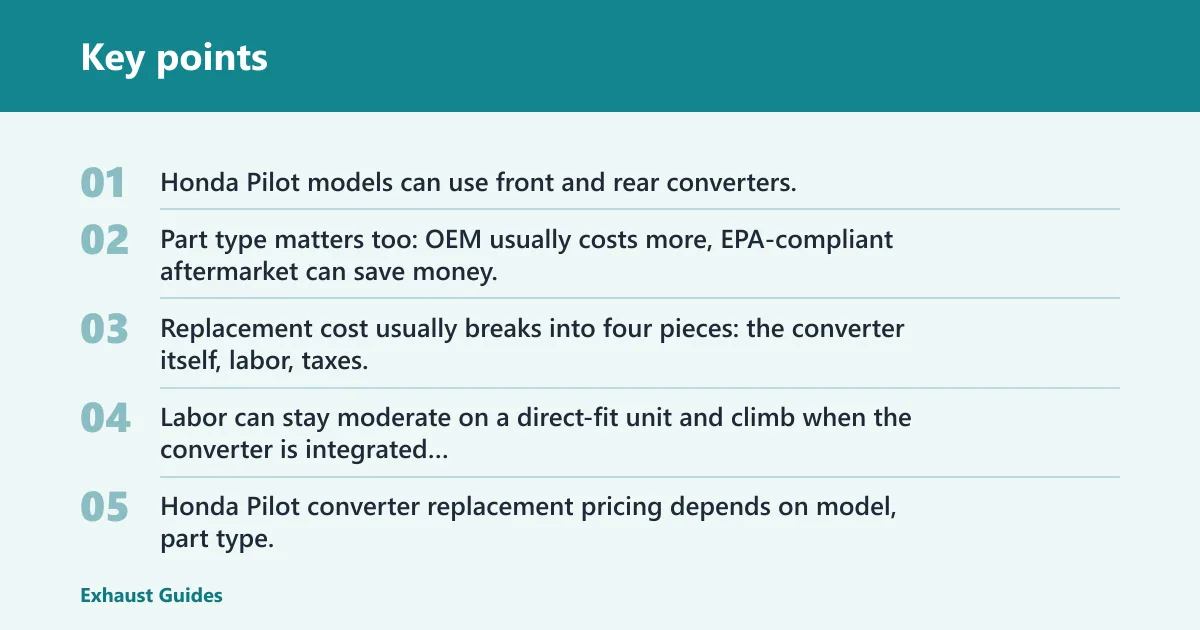


The main price driver is fitment. Honda Pilot models can use front and rear converters, and the exact layout changes by generation and engine packaging. Part type matters too: OEM usually costs more, EPA-compliant aftermarket can save money, and CARB-compliant parts often sit at the top end because they must meet stricter state rules.
Replacement cost usually breaks into four pieces: the converter itself, labor, taxes, and shop fees. Labor can stay moderate on a direct-fit unit and climb when the converter is integrated into a larger exhaust section, rusted hardware slows the job, or the shop has to fight seized studs and oxygen sensors.
Typical part-price bands by model year
Honda Pilot converter replacement pricing depends on model, part type, and local labor rates. That is the right lens for a Pilot quote. The table below gives a practical way to think about the common quote bands owners see, especially when comparing OEM, EPA-compliant aftermarket, and CARB-compliant options.
| Pilot year group | Common converter position | Typical part type | Parts price | Labor | Total estimate |
|---|---|---|---|---|---|
| 2003-2008 | Front or rear, depending on engine/exhaust layout | EPA aftermarket or OEM | $250-$1,200 | $350-$900 | $900-$2,100 |
| 2009-2015 | Front and rear converter layout is common | EPA aftermarket, OEM, or CARB | $400-$1,800 | $400-$1,000 | $1,100-$3,000 |
| 2016-2022 | Bank-specific front and rear placement varies | OEM or CARB-compliant aftermarket | $700-$2,500+ | $500-$1,200 | $1,800-$4,000+ |
Those totals can move up when the shop adds diagnostic time, exhaust gaskets, broken studs, or a replacement oxygen sensor. They can move down if only one converter needs replacement and the hardware comes apart cleanly.
Why OEM and aftermarket quotes differ
OEM parts usually carry the highest price because they are built to factory spec and often priced as assembly-level parts. Aftermarket EPA-compliant converters can cost less, but the fit has to match the Pilot’s year, engine, and converter location. A wrong fit can trigger another code or an inspection failure.
CARB-compliant parts matter in states that require them. If your state or inspection program calls for CARB approval and the shop quotes an EPA-only part, the lower price can turn into a second repair bill later. That is one of the clearest ways to judge whether a quote is truly fair.
What changes by model year
A Pilot catalytic-converter quote can swing by hundreds of dollars based on generation alone. Older models often have simpler pricing and more aftermarket options. Newer models may have tighter packaging, more expensive emissions parts, and a stronger need to verify state compliance before ordering anything.
First-generation Pilot fitment differences
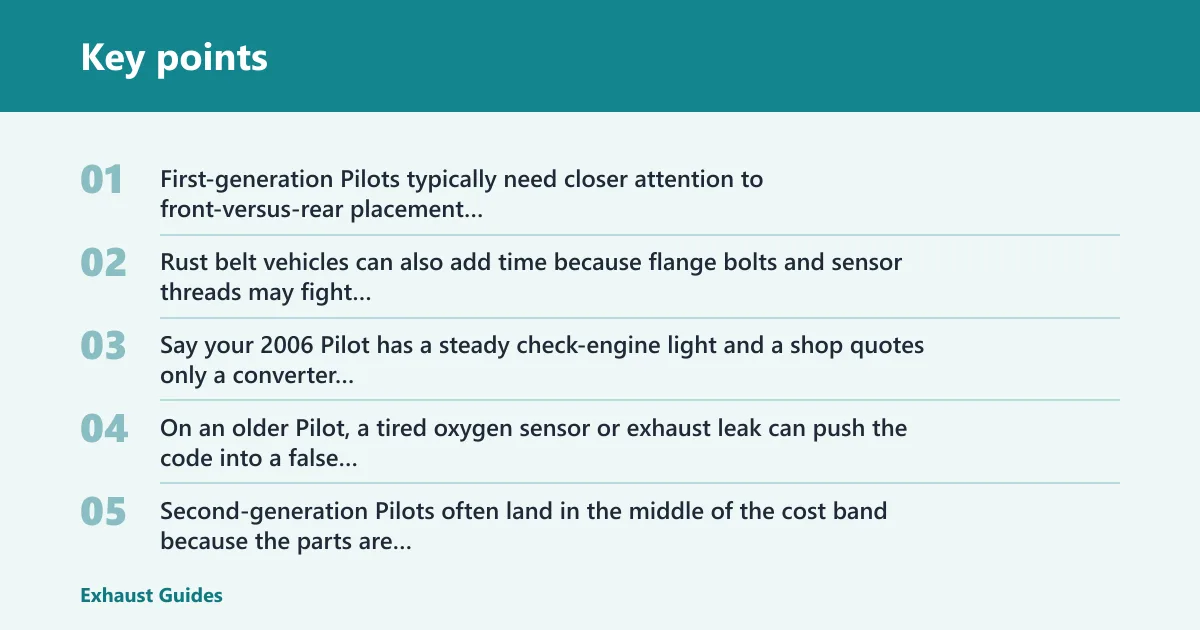
First-generation Pilots typically need closer attention to front-versus-rear placement and to whether the converter is sold as a direct-fit unit or as part of a larger exhaust section. That affects both parts price and labor. Rust belt vehicles can also add time because flange bolts and sensor threads may fight removal.
Say your 2006 Pilot has a steady check-engine light and a shop quotes only a converter without any sensor data. That quote is incomplete. On an older Pilot, a tired oxygen sensor or exhaust leak can push the code into a false converter diagnosis and make a $900 repair turn into a $1,600 mistake.
Second-generation Pilot pricing patterns
Second-generation Pilots often land in the middle of the cost band because the parts are still available, but the converter may be tied to a specific bank or exhaust section. That makes position more important. A quote for the wrong side of the vehicle can look cheap until the shop realizes the part does not match the engine layout.
Walmart lists Honda-compatible direct-fit converters for Pilot among other models, which shows that aftermarket supply exists. Walmart also shows a direct-fit Honda/Acura EPA-compliant converter priced at $167.99, an EPA-compliant Honda Accord converter priced at $89.99, and a Chevy/GMC/Cadillac converter kit priced at $238.99. Those listings illustrate how much part price can vary by vehicle and fitment, even before labor is added.
Third-generation Pilot layout and emissions compliance
Third-generation Pilots can carry higher replacement costs because emissions parts and fitment requirements are more exacting. CARB-compliant options can be much pricier than federal EPA parts. That gap matters if your state inspection rules do not allow a federal part in place of a CARB-approved one.
Honda catalytic converters contain platinum, palladium, and rhodium. Those metals are part of why the parts are expensive and why theft happens. But theft risk should not be confused with repair cost. A quote still needs to be judged by fit, diagnosis, and legality first.
Does your quote look fair?
A fair quote should match the converter position, the part type, and the diagnostic work already done. If the estimate jumps straight to replacement without checking codes, live sensor data, or exhaust leaks, the shop may be pricing a guess. That is where many bad quotes start.
If your estimate shows OEM pricing, ask why an EPA-compliant direct-fit part would not work. If it shows an aftermarket converter, ask whether it is EPA-compliant or CARB-compliant, and whether it matches your state’s rules. A lower part price is only useful if the vehicle stays legal and the light stays off.
Compare converter position and part type
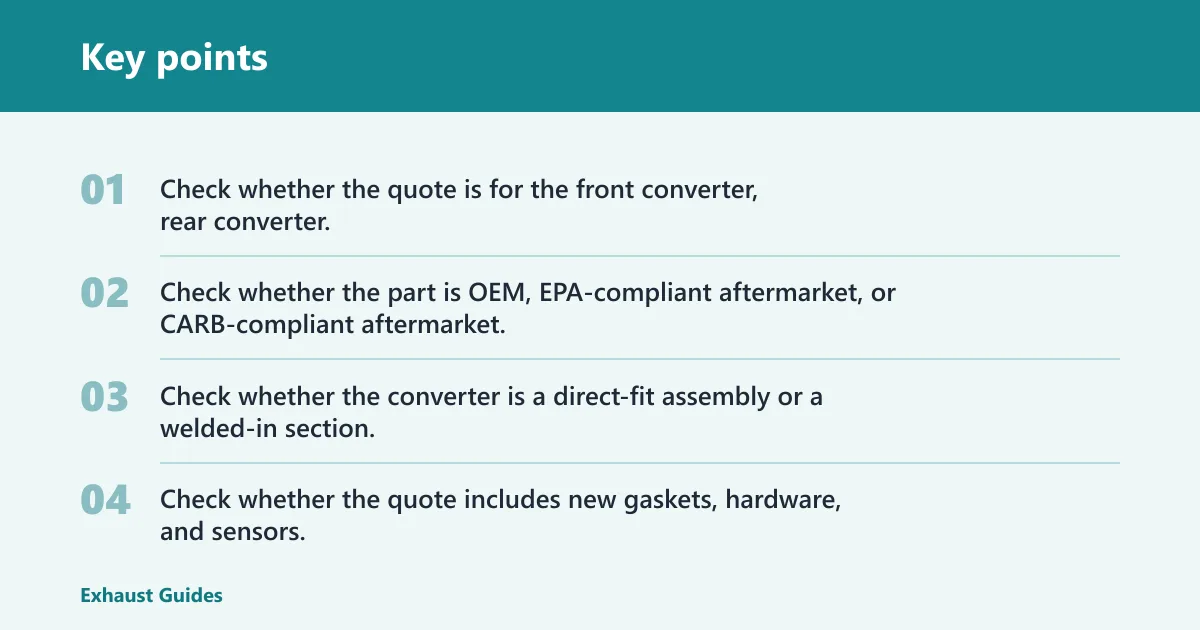
- Check whether the quote is for the front converter, rear converter, or a bank-specific unit.
- Check whether the part is OEM, EPA-compliant aftermarket, or CARB-compliant aftermarket.
- Check whether the converter is a direct-fit assembly or a welded-in section.
- Check whether the quote includes new gaskets, hardware, and sensors.
Check warranty length and labor hours
Warranty matters because converter failures are expensive to revisit. A short parts warranty with a high labor bill is weak protection. Ask how many labor hours are included and whether the warranty covers emissions failure, rattles, or premature efficiency loss.
Suppose a shop quotes $2,700 for a 2011 Pilot with a CARB converter, but the labor line is high and the warranty is short. That can be fair only if the part is correct for your state and the estimate includes diagnosis, sensors, and stubborn exhaust hardware. Otherwise, the number may be padded.
Watch for missing diagnostic charges
The diagnosis should not be skipped. A basic OBD2 scanner can read the code before money is spent. That matters because P0420 means catalyst system efficiency below threshold, not automatic converter failure. A proper quote should note whether the shop checked live data, sensor response, and exhaust leaks first.
P0420 diagnosis before replacement
P0420 is common on Pilots, but it does not prove the converter is bad by itself. The code points to catalyst efficiency below threshold, which can come from the converter, the oxygen sensor, an exhaust leak, wiring damage, or another upstream problem. Replacing the converter without checking those items can waste money fast.
What the code means on a Pilot
On a Honda Pilot, P0420 tells you the catalyst system is not performing as expected. It is a diagnostic clue, not a verdict. If the rest of the exhaust and sensor system is not checked, the replacement can miss the real fault.
How an oxygen sensor can mimic converter failure
A bad oxygen sensor can mimic a failing catalytic converter. Sensor data that looks lazy, noisy, or stuck can push the engine computer toward a P0420 decision even when the converter itself is still serviceable. Wiring problems can do the same thing.
That is why scan data matters. A good diagnosis looks at upstream and downstream O2 sensor behavior, fuel-trim data, and whether the exhaust stream is leaking before the converter ever gets priced out.
What an OBD2 scanner can confirm
An OBD2 scanner can read the stored code before parts are ordered. It can also show live sensor behavior, which helps separate a weak converter from a sensor problem. That is especially useful before you pay for a high-cost OEM or CARB part.
Honda says a steady warning light means avoid high speeds and inspect immediately. If the warning light flashes, Honda says to stop safely. That guidance matters because a flashing MIL can signal active misfire or catalyst-damaging conditions, not a simple nuisance light.
Where the converter sits on a Pilot
Honda Pilot converter placement varies by generation and engine layout. Some models use front and rear converters, and the bank or position can change the price because parts are not interchangeable. That is why a generic “converter replacement” quote can be misleading.
Front and rear converter placement
The front converter is often closer to the engine and can be easier or harder to reach depending on the generation. The rear converter may sit farther downstream and can carry its own labor and part cost. A bank-specific quote is more useful than a generic one.
Why bank and position matter for price
Bank and position matter because the wrong part will not fit, and the right part can still differ in price by side of the vehicle. A quote that ignores this usually misses hardware, sensor, or labor differences. That is a red flag on a Pilot.
How fitment changes across generations
Older Pilots may have broader aftermarket support. Newer Pilots can be more sensitive to exact fitment and emissions compliance. That does not mean the newer parts are impossible to source. It means the shop has to match the vehicle more carefully before quoting a final total.
Honda Pilot quote checklist
Use this checklist to compare quotes before approving a repair. It keeps the estimate tied to the exact Pilot, the exact converter position, and the diagnostic work that should have happened first. A clean quote should answer every row.
| Model year | Converter position | Part type | Parts price | Labor | Total estimate | Warranty | P0420/O2-sensor test before quoting? |
|---|---|---|---|---|---|---|---|
| 2006 | Front or rear, confirm by VIN and bank | EPA aftermarket or OEM | $250-$1,200 | $350-$900 | $900-$2,100 | Ask for mileage and months | Yes or no |
| 2011 | Bank-specific front or rear | EPA aftermarket, OEM, or CARB | $400-$1,800 | $400-$1,000 | $1,100-$3,000 | Ask for mileage and months | Yes or no |
| 2017 | Front and rear fitment may differ | OEM or CARB-compliant aftermarket | $700-$2,500+ | $500-$1,200 | $1,800-$4,000+ | Ask for mileage and months | Yes or no |
The checklist works best when the shop writes down the diagnostic basis for replacement. If the answer to the test question is “no,” ask for code data, live O2-sensor readings, and a leak check before approving anything.
Can you keep driving?
You can sometimes keep driving a Pilot with a steady MIL long enough to get it diagnosed, but you should avoid hard driving and high speeds until the cause is known. If the light flashes, Honda says to stop safely. That is a different situation and needs immediate attention.
Steady MIL versus flashing MIL
A steady light usually means the vehicle should be inspected soon, especially if P0420 is stored. A flashing light points to a more urgent fault. That distinction matters because a converter replacement quote is not the first decision when misfire or fuel-dump conditions are active.
Performance and fuel-economy symptoms
A clogged converter can cause sluggish acceleration and poor fuel economy. A rotten-egg smell is listed as a failing-converter symptom, and a rattle from under the car can signal internal honeycomb breakage. Those signs support diagnosis, but they still do not replace code and sensor checks.
Inspection and emissions failure risk
Emissions testing can fail with a bad converter. If the wrong part is installed, the vehicle can still fail inspection because of emissions legality or fitment issues. That is why California-compliant versus federal EPA-compliant parts must be sorted before the order is placed.
Frequently asked questions
How much does it cost to replace a catalytic converter on a Honda Pilot?
Year, converter position, labor, and state emissions rules can move the total a lot. Diagnosis should come before the part order.
How much is a catalytic converter for a Honda Pilot?
Part-only pricing can range from a few hundred dollars for some EPA-compliant aftermarket units to well over $1,000 for OEM or CARB-compliant parts. The exact number depends on the Pilot’s year, whether it is the front or rear converter, and whether your state requires CARB approval.
How much does a catalytic converter cost for a 2011 Honda Pilot?
A 2011 Honda Pilot often lands in the middle of the price band, with many quotes falling around $1,100 to $3,000 installed. The final number depends on which converter is replaced, the part type, and whether the shop confirms P0420 with sensor data before ordering parts.
How much does a catalytic converter cost for a 2006 Honda Pilot?
A 2006 Honda Pilot often costs less than newer models, but the total can still reach about $900 to $2,100 installed. Rust, exhaust hardware condition, and whether the issue is actually a converter, an oxygen sensor, or an exhaust leak will change the quote.
Is a bad oxygen sensor causing the same problem as the converter?
Yes. A bad oxygen sensor can mimic a failing catalytic converter, and the same is true for wiring faults or exhaust leaks. That is why a P0420 code should be checked with an OBD2 scanner and live sensor data before you approve a converter replacement.
Can you drive with a failing catalytic converter?
You may be able to drive briefly with a steady warning light, but you should inspect the vehicle soon and avoid high speeds. If the warning light flashes, Honda says to stop safely. A clogged converter can hurt performance and fuel economy, and emissions testing can fail.