Exhaust Manifold Repair Cost
Exhaust manifold repair cost is commonly reported in the range of about $150–$400 for a gasket or fastener fix, about $300–$700 for resurfacing or stud repair, and about $600–$1,500+ for manifold replacement, depending on engine layout and labor. Leave a leak alone and the bill can rise from broken studs, melted wiring, O2 sensor damage, and failed emissions tests. This guide maps symptoms to the most likely repair path and price band.
Exhaust manifold cost table
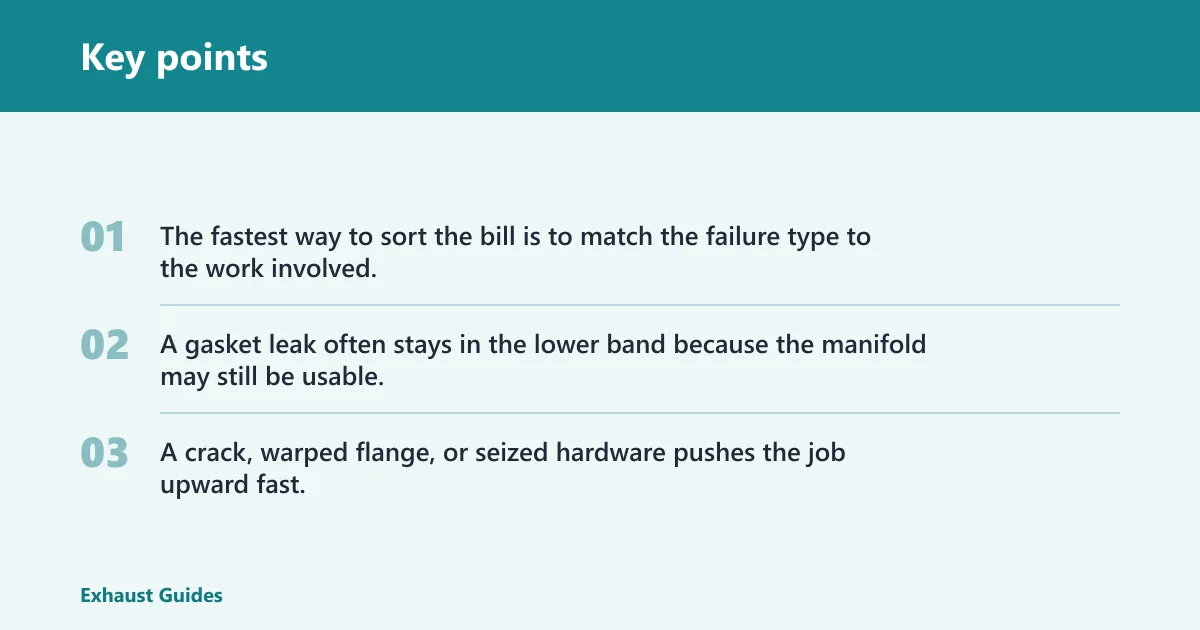


The fastest way to sort the bill is to match the failure type to the work involved. A gasket leak often stays in the lower band because the manifold may still be usable. A crack, warped flange, or seized hardware pushes the job upward fast, especially on cramped engines.
| Failure type | Likely symptoms | Typical labor hours | Parts needed | Realistic total cost band |
|---|---|---|---|---|
| Cracked manifold | Sharp ticking on cold start, exhaust smell, soot near the crack, possible misfire or power loss | 2 to 8 hours | New manifold or qualified repair part, gasket, hardware if disturbed | $300–$1,500+; replacement often lands higher than repair |
| Gasket leak | Ticking or hissing at the head, smell under load, soot at the flange, leak may get louder when cold | 2 to 5 hours | Manifold gasket, bolts or studs if worn, possibly seals and heat shield hardware | $150–$400, with harder layouts rising above that |
| Warped flange | Leak at one edge of the joint, uneven soot pattern, repeated gasket failure | 3 to 6 hours | Gasket, machining or resurfacing work, new hardware if removed | $300–$700, sometimes more if the flange is too thin to machine |
| Broken or seized studs | Persistent leak, missing fastener, visible corrosion, long delay before teardown is finished | 3 to 8 hours | Replacement studs or bolts, extraction tools, thread repair inserts if needed | $250–$900+, with broken hardware adding a large labor charge |
What does an exhaust manifold do?
The exhaust manifold bolts to the cylinder head and routes exhaust gas away from the cylinders. Most units are cast iron or tubular steel, and the joint to the head depends on a gasket. That joint is where many failures start, and it is also where leaks are easiest to confuse with a cracked part.

Cast iron vs tubular stainless construction
Cast iron manifolds are common on stock engines. They are usually cheaper to replace than tubular stainless pieces, but thermal cycling can crack them over time. Tubular stainless manifolds often cost more because they are less common in everyday repair work and are more performance-oriented in design.
How the gasket seals the joint
The gasket seals the manifold-to-head surface. If it leaks, the sound can be a tick or hiss that sounds very much like a crack. A leak at the gasket can also leave soot on the head or flange, which is why diagnosis should include the sealing surface and not only the manifold body.
Why leaks and cracks get confused
A leak near the flange can mimic a cracked manifold because both can make similar noises and smells. A technician should also inspect nearby heat shields, O2 sensors, and the downstream flange. Damage in those areas can change the repair plan and the final bill.
How much does it cost to fix?
Most repairs are said to be closer to $150 to $400, while repair costs are said to vary from about $150 to $1,000. Typical professional replacement cost is given as $400 to $1,500. A cracked manifold example totals $264, a 2012 Ford Focus manifold machining job totals $497, a Dodge Ram broken-bolt repair example totals $611, and a BMW turbo flange repair example totals $765.
What the parts and labor usually include
On a simple gasket job, the bill may cover a gasket, fresh hardware, and labor to remove and reinstall the manifold. Labor often drives the total, especially when access is tight. Independent shops are priced at $80 to $120 per hour, while dealership or urban shop rates are $130 to $200+ per hour.
When replacement costs more than repair
Replacement costs more when the manifold is cracked beyond repair, the flange is too damaged to machine, or the part includes an integrated catalytic converter. Some modern engines use an integrated catalytic converter as part of the manifold assembly, and that can raise parts cost sharply.
Why does the bill change so much?
The same leak can bring very different quotes because labor time changes with engine layout, fastener condition, and shop rate. Labor hours are described as 2 to 8 hours. A tight bay, rusted hardware, or a two-bank V-engine can turn a small leak into a much larger bill.
Labor rate by region and shop type
Independent shops usually price lower than dealer or city-center rates, so the same work can cost less even with the same parts. A baseline shop rate of $80 per hour is used in one cost example, but real-world pricing can climb well above that in larger cities or dealership settings.
Inline-4, V6, and V8 access differences
An inline-4 often gives better access than a transverse V6 or V8 because the manifold is easier to reach from above or below. On a transverse engine, the rear bank can sit close to the firewall. That can add time just to reach the fasteners, let alone remove a cracked part.
One bank versus both banks
On a V6 or V8, one bank may be the only side that fails. That matters because one-bank repair and both-bank replacement are different jobs. If both banks are removed, labor time and gasket count rise, and the final quote can move from a few hundred dollars into four figures.
Cramped engine bays
Cramped bays increase the chance that technicians must remove heat shields, move brackets, or work around steering and accessory components. That extra disassembly is part of why two cars with the same symptom can get very different estimates.
Can a cracked manifold be repaired?
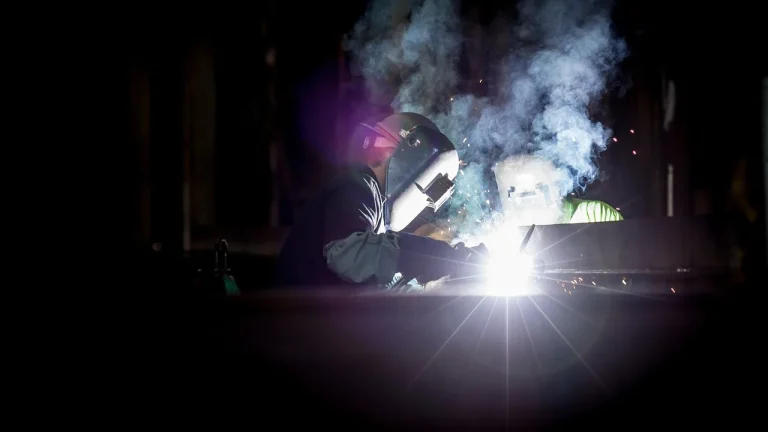
Sometimes, but not always. A crack can sometimes be welded or otherwise repaired if the material, location, and thickness allow it. Cast iron and tubular stainless do not behave the same way, and a repair that looks cheaper at first can fail again if the part is already too thin or distorted.
When welding may be possible
A small, accessible crack in a removable cast iron or tubular manifold may be repairable, especially if the flange is still sound. The repair must also leave enough material around the crack to hold up under heat cycling. If not, replacement is usually the safer call.
When machining or resurfacing helps
Resurfacing or machining can work for a warped flange. It is sometimes cheaper than replacing the whole manifold, which is why a 2012 Ford Focus machining job can land in the middle range rather than the top. But machining is limited by flange thickness, so it is not a universal fix.
When replacement is the safer call
If the manifold is cracked through a high-stress section, the flange is too thin, or the part includes a damaged integrated catalytic converter, replacement is often the better choice. The same is true when a welded repair would leave the joint uneven or likely to leak again.
Say your inline-4 starts ticking cold, but the sound fades as the engine warms. That often points to a gasket leak or a hairline crack near the flange, not a full manifold failure. If the flange is flat and the hardware comes out clean, the repair can stay near the lower end of the range.
What hidden costs should you expect?
Broken exhaust studs are one of the biggest hidden costs. Extraction can add 1 to 3 labor hours, and thread repair may be needed if the hole is damaged. Heat shields, O2 sensors, and downstream flange damage can also add parts and time that never show up in the first quick estimate.
Broken exhaust studs and extraction
Broken or seized exhaust studs often turn a simple gasket job into a longer repair. Rusted studs may snap during removal, and the technician may need extractors, heat, drilling, or careful clean-up of the threads. That is where many quotes jump by several hundred dollars.
Thread repair and heli-coils
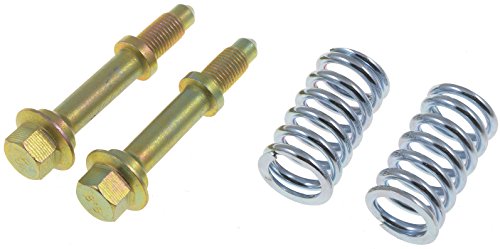
If the cylinder-head threads are damaged, a thread insert or similar repair may be needed. That adds labor because the hole must be cleaned, drilled, tapped, and checked before reassembly. A cheap gasket job can stop being cheap once the fasteners stop cooperating.
Heat shields, O2 sensors, and flange damage
Heat shields can hide cracks or rattle enough to sound like an exhaust leak. O2 sensors may need to come out for access, and a damaged downstream flange can keep the leak alive even after the manifold itself is replaced. Those checks belong in the estimate.
Integrated catalytic converter cost impact
On some modern engines, the manifold and catalytic converter are combined. That assembly raises part cost and can push the job into a different emissions-related repair category. If the converter is part of the manifold, the price is not comparable to a plain cast iron manifold swap.
How to confirm the diagnosis before paying
Start with the symptom pattern, then verify the leak location before approving replacement. Ticking at cold start, hissing under load, exhaust smell in the cabin or near the hood, soot on the flange, and power loss all fit manifold-side trouble. But the leak may be at the gasket, hardware, or a downstream joint rather than the manifold body.
What to inspect first
- Check for soot around the head-to-manifold joint.
- Inspect the manifold body for visible cracks or burn marks.
- Look at studs, bolts, and threads for corrosion or breakage.
- Inspect heat shields, O2 sensors, and nearby wiring.
- Check the downstream flange before approving manifold replacement.
Why a gasket leak can mimic a crack
A gasket leak can make the same cold-start tick that a crack makes. The difference is often the exact spot where soot appears and whether the noise changes when the engine warms. If the leak is at the flange and the manifold is intact, a gasket and hardware job may solve it for far less than a replacement.
Suppose a V6 with a transverse layout has a hiss from the rear bank and a broken stud on teardown. The quote can jump because access is poor and the fastener work adds hours. That job is very different from a front-bank gasket on an inline-4.
Frequently asked questions
How expensive is an exhaust manifold repair?
For a gasket or hardware fix, the bill often lands near $150 to $400. If the flange needs machining or studs need extraction, the total can move into the $300 to $700 range. A cracked manifold or integrated catalytic converter can push the cost much higher.
How much does it cost to get an exhaust manifold replaced?
Typical professional replacement cost is given as $400 to $1,500, but modern assemblies with an integrated catalytic converter can exceed that. A simpler job may stay near the low end, while a tight engine bay, rusted fasteners, or dealer labor rates can move it up fast.
How much does exhaust manifold repair cost?
The spread comes from failure type, access, shop rate, and whether the work stops at a gasket or expands into stud extraction or resurfacing.
What does exhaust manifold replacement usually cost?
Replacement usually costs more than repair because the manifold itself may need to be bought new, and labor can be heavy on transverse or cramped engines. For many vehicles, a practical estimate is $600 to $1,500+, especially when hardware, gaskets, and related exhaust parts are added.
Can you repair a cracked exhaust manifold instead of replacing it?
Sometimes. A crack may be welded or repaired if the material, wall thickness, and location allow it, but not every cast iron or tubular manifold is a good candidate. If the crack is large, the flange is warped, or the part is too thin, replacement is safer.
How much extra do broken exhaust manifold bolts add to the bill?
Broken or seized studs often add 1 to 3 labor hours, and thread repair can add more. On a rusted engine, that can raise the bill by a few hundred dollars. The exact jump depends on access, corrosion, and whether the head threads need inserts or other repair.
Is a gasket leak cheaper to fix than a cracked manifold?
Yes, usually. A gasket leak often stays in the lower repair band because the manifold itself may be reusable, while a cracked manifold may require welding, machining, or full replacement. The gap gets even wider if the crack involves a turbo flange or integrated catalytic converter.