How Much Does Exhaust Manifold Replacement Cost on Diesels?
Exhaust manifold replacement on diesels is often about $700 to $2,500, but turbo-mounted or rusted-stud jobs can be higher, sometimes around $3,000 to $5,000+ at a dealer or heavy-duty shop. Ignore the leak long enough, and the manifold can crack, the head flange can warp, and a gasket job can turn into broken studs, turbo damage, or a much larger bill. This guide breaks down labor, gaskets, studs, turbo removal, access time, and why pickup, van, and medium-duty quotes differ.
Diesel manifold replacement cost
On a diesel pickup, the manifold itself is only part of the bill. The quote usually stacks parts, labor, gaskets, studs, and any turbo or exhaust hardware that has to come off to reach the flange. A simple job lands near the lower end; seized fasteners, tight access, and emissions hardware push it up fast.
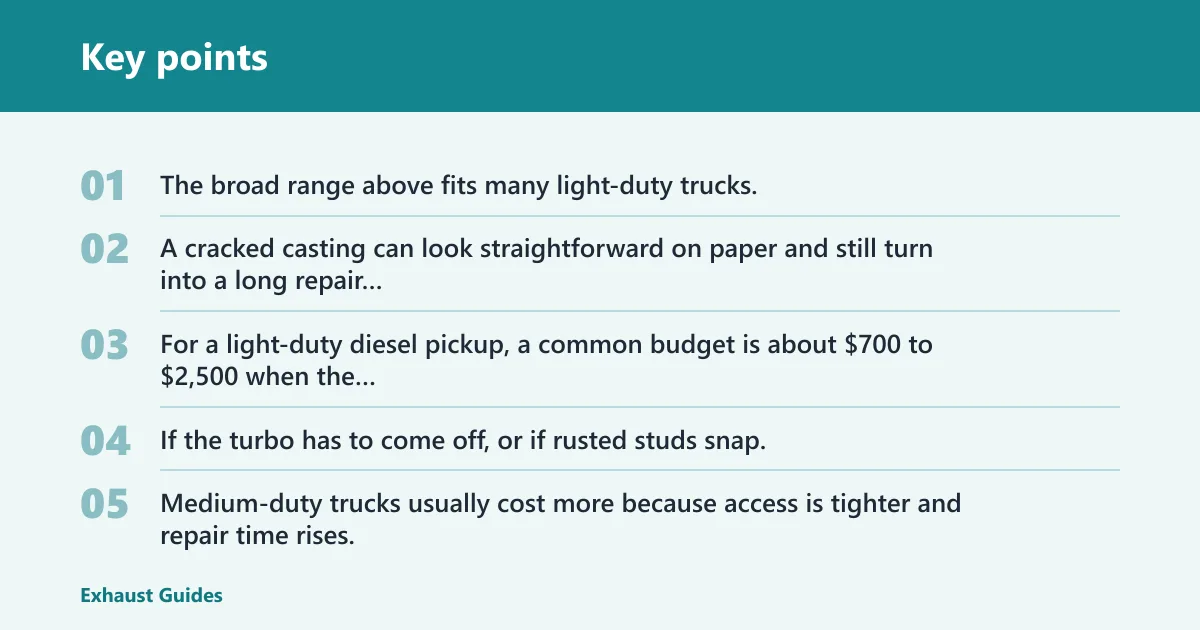
The broad range above fits many light-duty trucks, but the final invoice shifts by engine bay layout and what the shop finds during teardown. A cracked casting can look straightforward on paper and still turn into a long repair once broken studs and damaged sealing surfaces show up.
Light-duty pickup range
For a light-duty diesel pickup, a common budget is about $700 to $2,500 when the manifold, gaskets, and standard labor are the main items. If the turbo has to come off, or if rusted studs snap, the total can move beyond that quickly.
Medium-duty truck range
Medium-duty trucks usually cost more because access is tighter and repair time rises. Cab tilt, body-mounted equipment, and crowded exhaust routing can turn a normal replacement into a longer teardown, so the same part swap can quote much higher than on a pickup.
Heavy-duty diesel range
Heavy-duty diesel work often reaches dealer or fleet-shop pricing because of labor time, hardware size, and adjacent systems. On larger trucks, the manifold area may sit near EGR, DPF, and SCR components, so diagnosis and removal can take longer even before the broken hardware is addressed.
Why diesel manifold jobs cost more
Diesel exhaust manifold work costs more because the job is rarely just a manifold swap. Labor rates are higher, the part may sit behind a turbocharger, and old fasteners are more likely to snap. That makes the repair path longer and less predictable than many gasoline-engine exhaust jobs.
Labor rate differences
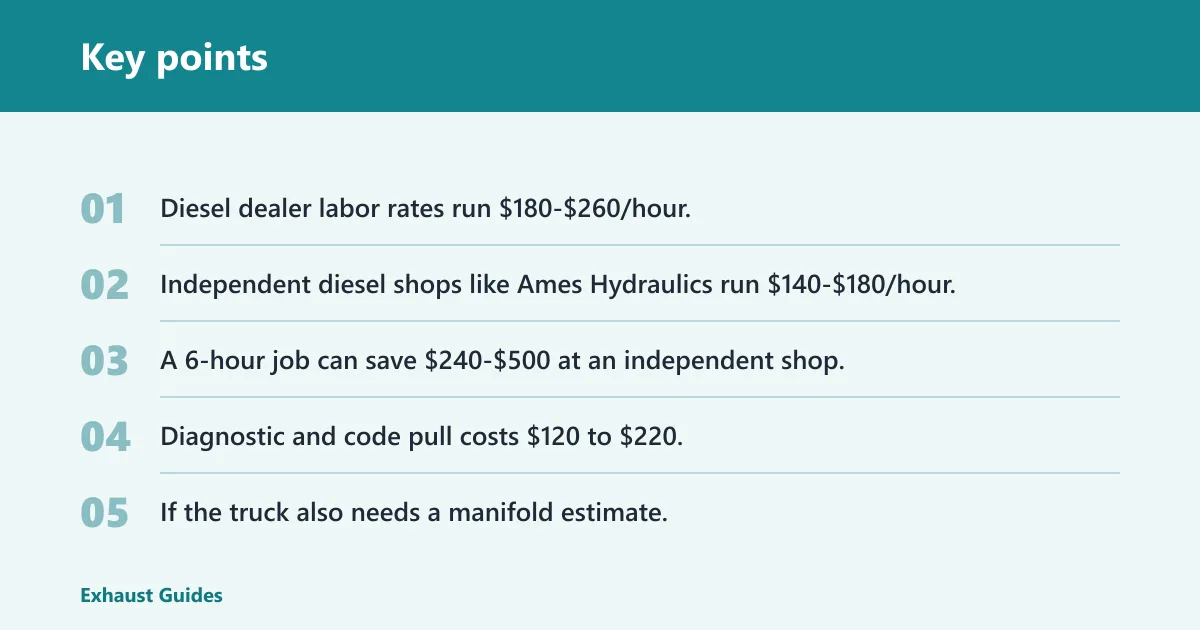
Diesel dealer labor rates run $180-$260/hour. Independent diesel shops like Ames Hydraulics run $140-$180/hour. A 6-hour job can save $240-$500 at an independent shop, which matters when the repair already includes teardown, inspection, and reassembly time.
Diagnostic and code pull costs $120 to $220, and that is often the cheapest diesel mechanic service tier. If the truck also needs a manifold estimate, expect the bill to include inspection time before the shop commits to the final labor path.
Access difficulty
Access drives cost as much as the part does. Tight engine bays, cab tilt procedures, and major disassembly add hours because the shop may need to remove intake ducting, shields, turbo plumbing, or nearby heat protection just to reach the fasteners.
Picture a late-model pickup with the rear bank manifold tucked close to the firewall. The same cracked casting can take far longer to remove than an exposed front-bank part, even if the manifold price is similar.
Rust and seizure
Rusted or welded fasteners raise cost because broken studs are common on diesel exhaust manifolds. Heat cycling, corrosion, and previous overtorque can seize bolts in the head or snap them during removal, and that adds drilling, extraction, thread repair, or flange cleanup to the job.
Thread pitch and torque matter here because the repair must seal evenly on reassembly. If threads are damaged or the flange is warped, the shop may need extra machine work or replacement hardware to get a reliable seal.
Does the turbo have to come off?
Often, yes. If the turbocharger blocks the manifold, the shop may remove it first to reach the flange and the rear fasteners. That adds labor because the turbo brings its own gaskets, oil supply line, oil return line, and mounting hardware into the repair path.
Fixed-geometry turbo context
On a fixed-geometry turbo setup, access can still be tight, but the removal path is sometimes simpler because the hardware is less crowded. Even then, the shop may still need to disconnect oil lines and exhaust connections before the manifold can come off cleanly.
VGT access differences
Variable-geometry turbochargers can add more packaging complexity. The actuator, housings, and nearby lines may crowd the work area, so what looks like a manifold job can quickly become a turbo service job with longer labor and more gasket replacement.
Oil line and flange removal
If the turbo comes off, the quote should name the oil supply and return lines, flange seals, and any heat shield or clamp hardware. Reusing old seals on those connections is a risk, especially if the turbo has been heat-cycled for years and the fasteners fought the original removal.
What usually gets replaced with the manifold?
Most diesel manifold replacements include more than the casting itself. Gaskets, studs, bolts, nuts, and seal surfaces often need attention because a new manifold will not seal well against damaged hardware or a warped flange. Shops that skip these items can create a comeback leak.
Gaskets and seals
Manifold gasket replacement is common because the old gasket may already be heat-hardened or crushed. If the leak symptoms include soot trails, ticking under load, or a hot exhaust smell near the head, the gasket is part of the repair path whether the manifold is cracked or simply no longer sealing.
A common first-timer mistake is to budget only for the casting. The parts counter may quote a manifold, but the actual seal depends on the gasket face, not just the metal part in the box.
Studs, bolts, and nuts
Studs and bolts are often replaced because removal can stretch, twist, or break them. Reusing damaged hardware risks uneven clamping and another leak. On diesel engines, the repeated heat cycling around the exhaust side makes old fasteners far more likely to fail on the next service.
Flange and pipe hardware
Flange and pipe hardware often needs replacement when the mating surface is pitted or bent. If the pipe flange no longer sits flat, the shop may need new clamps, springs, or gasket rings so the repair seals under boost and exhaust heat.
Diesel manifold replacement cost breakdown table
The table below shows how a shop can build a quote. The hidden hardware column is where many estimates change after teardown, because broken studs, damaged threads, and turbo-adjacent parts are often not visible at the start.
| Vehicle class | Likely labor hours | Parts list | Hidden hardware costs | Quote red flags |
|---|---|---|---|---|
| Light-duty pickup | 4 to 8 hours | Manifold, gasket set, studs or bolts, turbo gaskets if removed | Broken studs, flange cleanup, oil line seals, heat shields | No mention of turbo removal; reused fasteners with no allowance for breakage |
| Medium-duty truck | 6 to 12 hours | Manifold, gasket set, mounting hardware, pipe seals, possible EGR-adjacent seals | Cab tilt labor, seized fasteners, thread repair, extra exhaust clamps | Flat labor price with no inspection note; no line item for seized hardware |
| Heavy-duty diesel | 8 to 16 hours | Manifold, gasket set, high-temp hardware, turbo seals if removed, pipe hardware | Major disassembly, bracket removal, corrosion repair, emissions-adjacent labor | Quote omits access labor; no allowance for diagnostic time or additional teardown |
If a quote lists only the manifold and one labor line, ask what happens when a stud snaps or the turbo has to be removed. A complete estimate should say whether gasket surfaces are being cleaned, whether hardware is included, and whether the repair assumes easy access or major disassembly.
What signs mean a cracked exhaust manifold instead of a bad turbo?
A cracked exhaust manifold usually shows exhaust noise, soot near the flange, and a leak that is strongest near the cylinder head or manifold seam. A bad turbo more often adds boost issues, oil residue around the turbo housing, or shaft-related symptoms that do not match a simple exhaust leak.
The distinction matters because a manifold quote can turn into turbo work if the shop finds a leak at the turbo inlet or outlet. On diesels, the noise may sound similar at idle, so the inspection has to separate a casting crack, a gasket leak, and a turbo seal problem before parts are ordered.
Crack versus gasket leak
A cracked manifold often leaves soot trails along the casting or near a runner. A gasket leak tends to show up at the flange interface, especially after heat cycling loosens the seal. Both can trigger ticking sounds, but the repair path is different once the source is pinned down.
Turbo leak signs
Turbo leak signs usually involve more than an exhaust tick. Oil seepage at the turbo center section, unusual whine, or boost loss under load points beyond the manifold alone. If the turbo is damaged, the repair may cross into the $1,400 to $3,800 replacement range before manifold labor is even finished.
EGR and exhaust-adjacent confusion
Nearby EGR piping, DPF connections, DEF dosing hardware, and SCR components can confuse the diagnosis. Leaks in those areas may sound like a manifold crack, and soot in the wrong place can send the estimate in the wrong direction without a careful inspection.
Suppose a medium-duty diesel has a ticking sound on cold start and a black stain near the rear of the head. If the stain sits at the gasket seam, the repair may be a manifold and gasket job; if the stain starts at the turbo joint, the quote can shift toward turbo removal and new seals.
Frequently asked questions
How much does exhaust manifold replacement cost on a diesel pickup?
A diesel pickup manifold replacement usually lands between $700 and $2,500 when the job is straightforward. The bill rises if the turbo must come off, if studs break, or if the shop must spend extra time on rusted hardware and sealing surfaces. Dealer pricing often lands higher than independent shop pricing.
Why is diesel exhaust manifold replacement so expensive?
It is expensive because the part is rarely the whole repair. The same source rates are higher, access is tight, and diesel fasteners often seize from heat and corrosion. Turbo removal, gasket replacement, and nearby emissions hardware can add hours before the new manifold even goes on.
Does labor cost more if the turbo has to come off first?
Yes. Turbo removal usually adds labor because it means extra disassembly, more gasket surfaces, and more fasteners to handle. The shop may also need to disconnect oil supply and return lines, inspect mounting flanges, and replace seals that would not be touched on a direct-access manifold job.
Can I replace a diesel exhaust manifold without replacing the studs and gaskets?
Sometimes, but it is not the safest default. If the studs are clean, straight, and reusable, a shop may keep them. Gaskets are different; they often compress and age, so many repairs include new gaskets to avoid another leak after the manifold is reinstalled and torqued.
How much extra does rusted hardware add to manifold replacement?
Rusted hardware can add a lot because broken studs mean extraction work, thread repair, or replacement fasteners. The final increase depends on how many studs snap and whether the flange or head threads are damaged. A quote that ignores seized hardware is usually too optimistic.
Is dealer labor much higher than an independent diesel shop?
Usually yes. On a repair that takes several hours, that difference can be large enough to change the decision even before parts and hardware are added.
What other parts usually get replaced with a diesel exhaust manifold?
Common add-ons include the manifold gasket set, studs, bolts, nuts, turbo gaskets, and oil line seals if the turbo comes off. On modern diesels, nearby EGR, DPF, DEF, or SCR components may also need inspection, and that can add diagnostic time or replacement parts to the quote.