Catalytic Converter vs Pre Cat
A pre-cat is typically the small, fast-lightoff catalyst close to the exhaust manifold, while the catalytic converter sits farther downstream and handles most emissions cleanup; if one fails, check sensor data before replacing parts. A wrong diagnosis can bring repeat check-engine lights, wasted parts costs, and failed emissions tests. This guide shows how to tell the two apart, what each does, and how to separate converter faults from oxygen-sensor or heater-code problems.
| Factor | catalytic converter | pre cat | Winner |
|---|---|---|---|
| Location | Farther downstream in the exhaust system, usually under the floor or near the middle of the pipe. | Very close to the engine, often in or near the exhaust manifold or the front pipe. | pre cat |
| Purpose | Main emissions-control converter that reduces hydrocarbons, carbon monoxide, and nitrogen oxides. | Fast-lightoff catalyst that helps control cold-start emissions right after startup. | tie |
| Warm-up behavior | Heats more slowly because it sits farther from the exhaust ports. | Heats faster because exhaust energy reaches it sooner. | pre cat |
| Common failure signs | Reduced power, poor fuel economy, glowing check engine light, or restriction from melting, clogging, or contamination. | Cold-start emissions issues, catalyst-efficiency codes, and possible restriction or damage near the engine. | catalytic converter |
| Diagnostic clues | Downstream oxygen-sensor behavior, pressure or restriction checks, and exhaust-system inspection matter most. | Upstream sensor behavior, cold-start efficiency, and early light-off data matter most. | tie |
| Replacement implications | Must match the vehicle’s emissions certification; may be direct-fit or universal, and Federal/EPA or CARB-compliant depending on the car and state. | If the vehicle uses one, replacement still has to match the emissions label and local rules. | catalytic converter |
How exhaust location guides diagnosis
The practical difference is location and job timing. The pre cat is the near-engine fast-lightoff catalyst, while the main catalytic converter is the primary exhaust unit that does most of the ongoing cleanup once the system is warm.
That distinction matters because a code, smell, or power loss does not point to one part by itself. A cold-start complaint can fit a pre cat problem, while a restriction or efficiency fault farther downstream often points to the main converter or an oxygen-sensor issue.
Location in the exhaust path
The pre cat sits close to the exhaust manifold or front pipe, where it gets heat quickly from the engine. The main catalytic converter sits farther downstream, often under the floor, where exhaust has already cooled somewhat.
That layout is why some engines use both parts. The near-engine unit starts working quickly after startup, then the main converter carries the load during normal driving.
Why the difference matters for diagnosis
Diagnosis changes with location. If the engine is cold and the problem shows up at startup, the pre cat deserves attention first; if the car has poor power at speed, a glowing warning light, or a restriction code pattern, the main converter and exhaust flow deserve a closer look.
Never assume one bad reading proves the converter itself is dead. On 1996-and-newer OBD-II vehicles, scan data and emissions labels often give better direction than part swapping does.
Pre-cat vs main catalytic converter
The core trade-off is simple: the pre cat heats fast and helps the first minutes after startup, while the main catalytic converter handles the larger share of exhaust cleanup once everything is warm. That makes the pre cat more about cold-start control and the main converter more about sustained emissions treatment.
Location
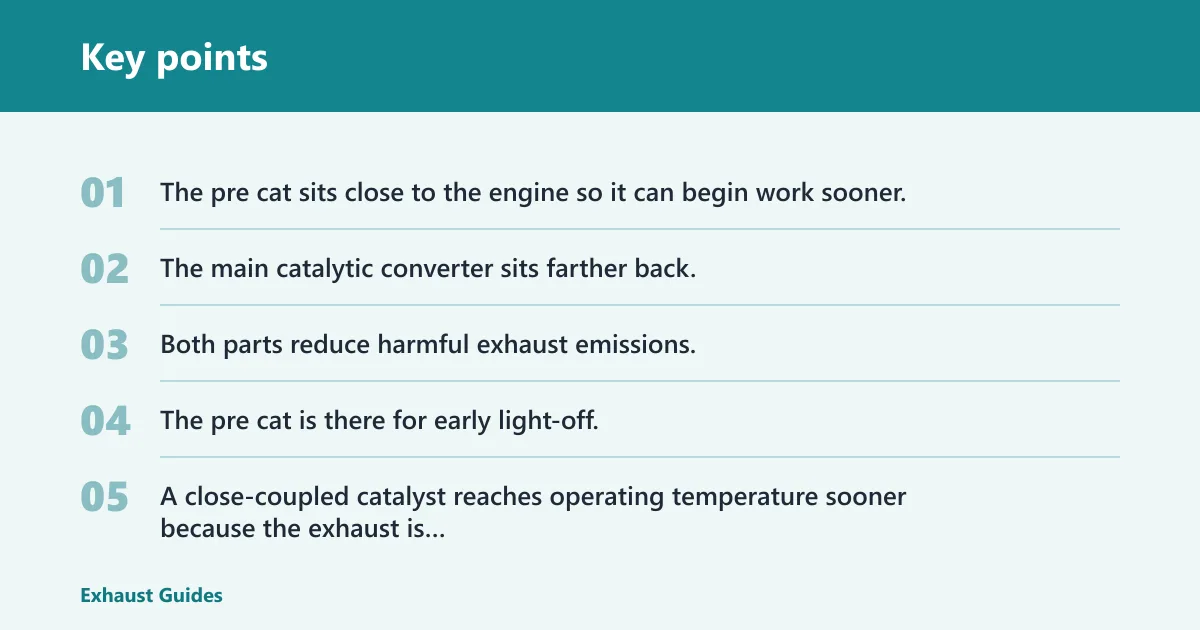
The pre cat sits close to the engine so it can begin work sooner. The main catalytic converter sits farther back, where packaging and heat management are different.
Purpose
Both parts reduce harmful exhaust emissions, but they do not do it at the same time or in the same place. The pre cat is there for early light-off; the main converter is the primary treatment stage.
Warm-up behavior
A close-coupled catalyst reaches operating temperature sooner because the exhaust is hotter when it arrives. That is why the pre cat matters most during cold start, when raw emissions are highest.
Common failure signs
A failing main converter often shows up as reduced power, poor fuel economy, a glowing check engine light, or a restriction problem. A failing pre cat can create the same lamp, but the clue is more likely to appear around cold start or near-engine heat damage.
Diagnostic clues
Upstream and downstream oxygen sensor readings help separate catalyst faults from sensor faults. If the sensor data is erratic, slow, or inconsistent with exhaust flow, the converter may be fine and the sensor or a leak may be the real problem.
Replacement implications
Replacement is not just about fit. On OBD-II vehicles, the emissions certification on the VECI label controls what kind of converter you can install, and state rules can make that choice stricter.
Say your hatchback throws a P0420 code after a month of short trips. If the upstream and downstream oxygen sensor traces look wrong at the same time, replacing the converter first can waste money; a sensor fault or exhaust leak may be driving the code.
What does a pre cat do on a car?
A pre cat helps clean exhaust right after startup, before the main converter has fully warmed up. That matters because cold-start exhaust carries more pollutants, and the near-engine catalyst can reach effective temperature faster than the underfloor unit.
Some engines use a pre cat to meet cold-start emissions targets more quickly. Others do not use one at all, relying on the main converter layout and engine calibration instead.
In plain terms, it is there to help the system “light off” sooner. Once that happens, the main catalytic converter takes over the heavier workload during normal driving.
How do you tell which part is bad?
Start with the symptom pattern, then confirm with oxygen sensor data and an exhaust inspection. A cold-start problem near the engine points toward the pre cat, while restriction, poor power, or persistent catalyst-efficiency faults farther downstream point more toward the main converter.
Use oxygen sensor readings first
Upstream sensor data should usually switch as the engine runs; downstream data should be steadier when the catalyst is working well. If both sensors act the same way, the converter may not be storing oxygen properly, but a sensor fault can create that same pattern.
OBD-II catalyst checks rely on that comparison. That is why a P0420 code is only a clue, not proof.
Read P0420 as a clue, not a verdict
P0420 is a catalyst-efficiency code. It can be caused by a worn or contaminated converter, but it can also come from oxygen-sensor faults, exhaust leaks, or a restriction that changes the sensor signals.
Picture a sedan with a fresh P0420 and no drivability complaint. If the exhaust has a leak ahead of the rear sensor, the code can appear even though the catalyst is still serviceable.
Watch for restriction or contamination
A clogged or overheated converter can often show up as loss of power, rising exhaust backpressure, or a hot, stressed exhaust section. Contamination from oil burning or coolant intrusion can also damage the catalyst substrate and create the same warning signs.
Arnold Auto Repair notes that a failing converter can cause reduced power, poor fuel economy, or a glowing check engine light, and that severe converter problems can damage the engine. That risk is tied to restriction or contamination, not to every mild efficiency fault.
When the pre cat is bad but the main converter is still healthy
This happens when the near-engine catalyst loses efficiency while the downstream unit still passes enough exhaust treatment to keep the car running normally. The vehicle may still start, idle, and cruise well, but it can fail emissions testing or set catalyst codes after cold starts.
That is one reason the pre-cat/main-cat distinction matters. A healthy main converter does not erase a damaged pre cat, and the reverse is true as well.
Could the oxygen sensor be the real problem?
Yes. Oxygen-sensor faults can mimic converter failure because the scan tool is comparing sensor behavior, not directly watching catalyst chemistry. If the sensor is lazy, biased, or misreporting, the computer may blame the converter and set a P0420-style fault.
That is why the diagnosis should include both upstream and downstream sensor readings, plus an exhaust leak check. A leak ahead of the sensor can pull in extra oxygen and distort the data enough to look like a bad converter.
- Check the stored code and freeze-frame data.
- Compare upstream and downstream oxygen sensor behavior.
- Inspect the exhaust for leaks, dents, or crushed sections.
- Look for oil burning, coolant loss, or other contamination sources.
- Only then decide whether the pre cat, main converter, or a sensor needs replacement.
Choose a replacement that matches your emissions label
On a 1996 and newer OBD-II vehicle, the under-hood VECI label is the first thing to check. MagnaFlow says that label is typically under the hood, on or near the underside of the hood or radiator shroud, and it shows whether the car is Federal/EPA or California/CARB certified.
That label matters because Federal/EPA catalytic converters are used in most states, but they cannot be sold or installed in California, Colorado, or New York. CARB-compliant converters are required for regulated vehicles in those states, and they need a valid Executive Order number.
MagnaFlow also notes that 1995 and older vehicles are pre-OBDII, and that its Standard Grade converter is designed for those pre-OBDII vehicles. For OBD-II vehicles with California and Federal emissions systems registered outside CARB states, MagnaFlow lists OEM Grade converters instead.
Direct-fit vs universal
A direct-fit converter is shaped for a specific vehicle and is usually the simpler route for fitment and emissions compliance. A universal converter may fit more than one layout, but it still has to match the vehicle’s certification and installation rules.
Universal does not mean “works everywhere.” It only means the installer has more fabrication work, not fewer compliance checks.
Choose pre cat repair or main cat repair if…
Choose pre cat repair if the complaint shows up most clearly during cold start, the near-engine catalyst is cracked or heat-damaged, or the upstream sensor data points to poor early light-off. Choose main converter repair if the underfloor unit is restricted, contaminated, or the vehicle has sustained loss of power and catalyst-efficiency faults after warm-up.
Do not replace either part before checking the oxygen sensors and the exhaust for leaks or restrictions. That step can separate a true converter fault from a sensor problem quickly enough to avoid a wrong part purchase.
- Choose pre cat repair if the problem is worst right after startup.
- Choose pre cat repair if the near-engine housing is cracked, burned, or physically broken.
- Choose catalytic converter repair if the underfloor converter is restricted or contaminated.
- Choose catalytic converter repair if power loss, poor fuel economy, and a catalyst code appear together.

Frequently asked questions
What is a pre catalytic converter?
A pre catalytic converter is the near-engine catalyst used on some vehicles to help control emissions faster after startup. It sits closer to the exhaust manifold than the main converter, so it heats more quickly and begins treating exhaust earlier in the drive cycle.
Is a pre cat the same as a catalytic converter?
No. A pre cat is a type of catalytic converter, but it is not the main downstream unit most people mean when they say “catalytic converter.” The pre cat helps with fast light-off; the main converter does the larger share of emissions cleanup.
Can a bad pre cat cause a check engine light?
Yes. A bad pre cat can trigger a check engine light, especially if it fails catalyst-efficiency checks or becomes damaged enough to affect exhaust flow. The same light can also come from oxygen-sensor faults, so scan data matters before replacement.
How do I tell if my pre cat or main cat is failing?
Check where the symptom appears first. Cold-start issues and near-engine heat damage point toward the pre cat, while restriction, reduced power, and persistent efficiency faults after warm-up point toward the main converter. Upstream and downstream oxygen sensor readings help confirm which part is actually bad.
Do I need a CARB or EPA converter replacement?
Check the under-hood VECI label on your 1996 and newer OBD-II vehicle. If it shows California/CARB certification and you are in a regulated state, you need a CARB-compliant converter with a valid EO number; Federal/EPA converters are not allowed for sale or installation in California, Colorado, or New York.
Can a catalytic converter damage the engine if it fails?
Yes, if it fails badly enough to become restricted or contaminated. A blocked converter can raise backpressure, hurt performance, and in severe cases damage the engine. A simple efficiency fault is less urgent than a restriction fault, but it still needs diagnosis.