Exhaust Reducer vs Coupler: What’s the Difference?
An exhaust reducer changes tube diameter. A coupler joins two pipes with the same diameter. Use a reducer for size changes and a coupler for straight splicing. Mix them up and you get leaks, fitment problems, or a part that will not seat. In exhaust work, the right choice also has to match the fitting standard: ASME B16.9 for buttweld reducers, ASME B16.11 for socket-weld and threaded fittings, and ASME B36.10M for pipe wall-thickness and schedule context. This guide explains the terms, size rules, and common exhaust uses.
| Decision factor | Exhaust Reducer | Coupler | Winner |
|---|---|---|---|
| Pipe size match | Joins two different sizes | Joins equal sizes | Reducer when sizes differ; coupler when they match |
| Alignment | Can introduce a size step or offset by geometry | Keeps a straight same-size joint | Coupler for straight splicing |
| Service type | Best for transitions and adapter work | Best for same-diameter repairs | Reducer for transitions; coupler for repairs |
| Best exhaust use case | Muffler inlet changes, unequal-size tubing, welded transitions | Clamp-on splice, same-OD repair, straight extension | Reducer for muffler adapters; coupler for same-OD extensions |
Reducer vs coupler at a glance
The difference is simple: one changes size, the other connects like size to like size. In exhaust work, that choice affects slip fit, clamp overlap, and whether the joint seals without forcing misalignment into the run. A reducer also has to be matched to the correct fitting family and geometry, while a coupler is mainly a straight connector.
Core distinction in one sentence
Use a reducer when the pipe diameters do not match; use a coupler when the diameters already match and you only need a straight join.
A common first-timer mistake is buying a reducer for a broken section that is already the same diameter end to end. That usually creates an awkward step, poor overlap, or a clamp area that sits off-center.
What is the difference between an exhaust reducer and a coupler?
An exhaust reducer changes from one tube diameter to another, while a coupler ties together two same-size pipes. In muffler and exhaust repair language, that means the reducer solves a size problem and the coupler solves a straight-join problem. For standard buttweld transitions, ASME B16.9 is the governing reference; for smaller forged socket-weld and threaded pieces, ASME B16.11 applies.
Reducer coupling and reducing coupling: same term, different contexts
Reducer coupling and reducing coupling are interchangeable terms for a fitting that joins two pipe sizes. In pipe work, the real choices are fitting type, geometry, and grade. The term can also be confused with a rotating equipment coupling, so context matters.
Why exhaust users mix up reducer, coupler, and reducer sleeve
In exhaust work, “coupler” usually means a straight sleeve for equal-size tubing. “Reducer” points to a size-changing adapter. People then use “reducer sleeve” as shop shorthand, which can hide whether the part is a welded transition, a clamp-on sleeve, or a simple same-size connector.
When should you use each one?
Use a coupler for equal-size slip joints and simple straight repairs. Use a reducer when the outlet and inlet do not share the same diameter, such as a muffler inlet, an adapter change, or a transition between different exhaust sections.
Equal-size slip joints and straight exhaust repairs
If both pipe ends are the same outside diameter, a coupler is the cleanest choice. It lets you center the joint, keep clamp pressure even, and avoid forcing one pipe into a size change it does not need. For a straight repair, that is the default call.
Unequal-size transitions, muffler inlets, and adapter work
If the muffler inlet is smaller than the pipe, or a repair section has a different diameter, a reducer is the correct part. That is the exhaust-specific version of the same pipe-work logic used in industrial systems: different sizes need a size-changing fitting. For a muffler swap, the reducer is the part that makes the mismatch buildable.
Clamp-on repairs versus welded connections
A clamp-on repair with equal sizes favors a coupler because you can preserve overlap and keep the joint straight. A welded transition favors a reducer because the fitting becomes part of the permanent size change rather than just a sleeve over the break. If the joint will be welded, the reducer is usually the cleaner fabrication choice.
- Measure the existing pipe size before buying any adapter.
- Choose a coupler if the two ends are the same diameter.
- Choose a reducer if the diameters differ.
- Check whether the connection must be clamp-on or welded.
- Verify material compatibility before mixing stainless and mild steel.
How do you measure the pipe before ordering?
Measure the exhaust pipe outside diameter first, then confirm whether the joint needs an inside slip fit or an outside sleeve fit. For an adapter, the number that matters is the actual tube diameter at the connection point, not a guess based on vehicle model alone.
Exhaust OD vs ID: what to measure
For most exhaust parts, OD is the key number because tubing and adapters are commonly specified by outside diameter. If the fit is a slip joint, check whether the mating part is meant to slip over the pipe or into it. That decides which dimension matters at the joint.
How schedule and wall thickness affect fit
Wall thickness changes the gap between OD and ID, so two parts with similar nominal size can still fit differently. ASME B36.10M is the pipe wall thickness and schedule reference used alongside fitting standards, and it matters when you match pipe size context to a reducer or coupler.
Stainless-to-mild transitions and corrosion fit
Mixing stainless and mild steel needs more than diameter matching. A dissimilar-material joint can corrode at the interface, so the connector material and the service environment both matter. If the reducer or coupler is the wrong material grade, the fit may assemble cleanly and still fail early.
Reducer coupling standards and styles
Buttweld reducers follow ASME B16.9. Socket-weld or threaded couplings follow ASME B16.11. Those are not the same fitting family, and they do not solve the same exhaust problem. ASME B16.9 covers standard wrought buttwelding fittings, including concentric and eccentric reducers, while B16.11 covers forged socket-welding and threaded fittings in smaller nominal sizes.
Buttweld reducer: ASME B16.9, NPS 1/2 to 48, concentric or eccentric
Buttweld reducers are standard for welded joints and are described as standard for NPS 2 and larger process piping. The cited size range runs from NPS 1/2 through 48. They are available as concentric or eccentric, so the geometry must be chosen before the part is ordered.
Socket-weld and threaded coupling: ASME B16.11, NPS 1/8 to 4
Socket-weld and threaded couplings follow ASME B16.11 and apply to smaller piping. Socket-weld and threaded couplings are different from buttweld reducers because they are coupling types rather than welded size-changing reducers used in larger pipe work.
ASME B36.10M and ASTM A234 WPB in reducer selection
ASME B36.10M gives the pipe size and schedule context that sits alongside the fitting standard. ASTM A234 WPB is the default carbon-steel grade in the cited example, so material choice is part of the order, not an afterthought.
Do exhaust reducers come in concentric and eccentric styles?
Yes. Exhaust reducers can be concentric or eccentric, and the choice affects how the centerline runs through the joint. In exhaust work, that matters less for appearance than for fit, drainage, and whether the system stays aligned through the transition.
Concentric reducers: shared centerline and symmetric reduction
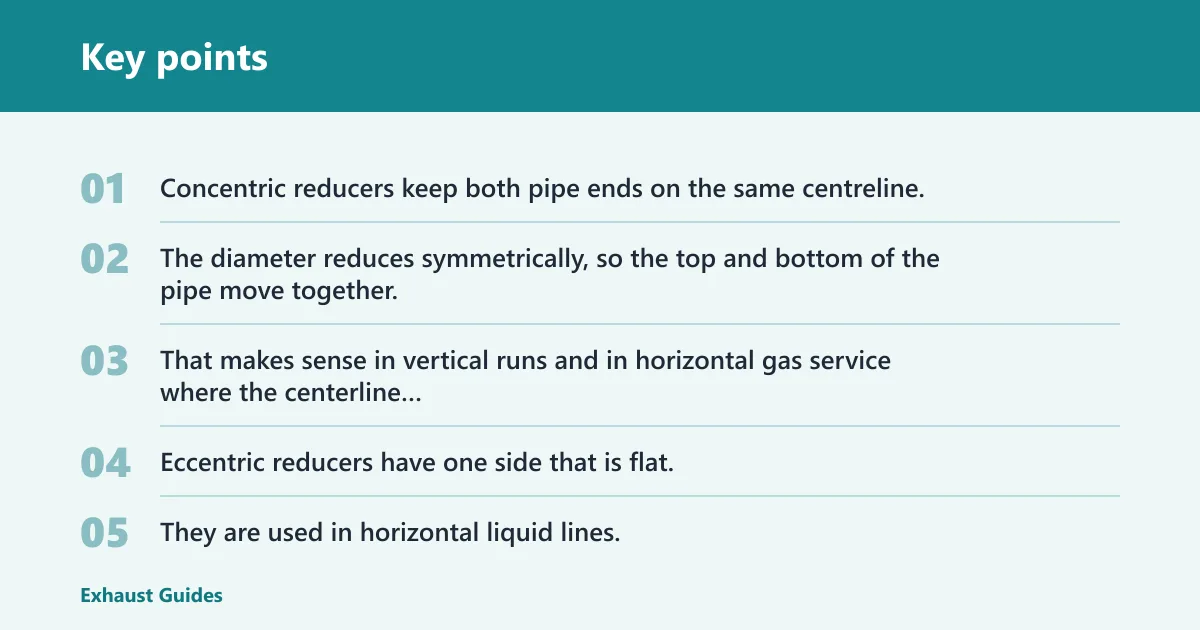
Concentric reducers keep both pipe ends on the same centreline. The diameter reduces symmetrically, so the top and bottom of the pipe move together. That makes sense in vertical runs and in horizontal gas service where the centerline should stay centered through the change.
Eccentric reducers: BF and TF orientation, drainage, and suction
Eccentric reducers have one side that is flat. BF means bottom flat, and TF means top flat. They are used in horizontal liquid lines, where orientation affects drainage and pump suction. In exhaust work, the same geometry can matter if you are trying to preserve floor clearance or keep a transition tucked to one side. A BF or TF call should be made before fabrication, not after the part is on the bench.
Why the wrong orientation creates rework
If BF or TF is omitted from a purchase order, the wrong reducer can arrive and force rework. That usually means cutting, reordering, or flipping the joint path after the part is already in hand. The mistake is avoidable if the flat side is specified up front.
Suppose a muffler inlet is about 2.25 inches and the pipe section feeding it is about 2.50 inches. A reducer is the right family of part. A straight coupler would not solve the diameter mismatch, and a wrong BF or TF choice could leave the flat side on the wrong edge of the run. On a real exhaust adapter job, that is the difference between a clean tuck under the floorpan and a section that has to be cut back and re-angled.
| Pipe size match | Alignment | Service type | Best exhaust use case |
|---|---|---|---|
| Equal size | Straight | Clamp-on repair | Coupler for same-OD splice |
| Unequal size | Centered transition | Welded fabrication | Exhaust Reducer for size change |
| Equal size | Centered | Muffler replacement | Coupler when the inlet already matches |
| Unequal size | Offset or flat-side needed | Horizontal run | Exhaust Reducer with correct BF or TF |
| Equal size | Any straight overlap | Extension or patch | Coupler for direct joining |
Choose Exhaust reducer if…
Choose Exhaust Reducer if the pipe sizes differ, the muffler inlet is smaller than the tubing, or the joint needs a welded transition. Also choose it when a flat-side orientation is required, especially in a horizontal run where BF or TF must be controlled. If there is any size mismatch, the reducer wins.
Choose Coupler if…
Choose Coupler if the pipes are the same diameter, the repair is a straight splice, or the goal is to preserve a clean slip fit with clamp overlap. If the joint already matches size, a coupler is usually the simpler and more direct fix. For a same-OD repair, do not overcomplicate it.
Reducer coupling standards and sizing mistakes
The usual ordering mistakes are easy to spot. People mix up size change with straight joining, or they choose the right fitting family but omit the geometry and material details that make the part usable. In practice, the fastest way to avoid error is to decide first on size change, then on standard, then on orientation.
Why people confuse reducer coupling with reducing coupling
People confuse the terms because both point to the same fitting idea: a connector that joins two pipe sizes. The wording changes by context, but the functional choice stays the same. The mistake is usually not vocabulary; it is ordering the wrong type of joint for the exhaust job.
Failure cases from mis-sized adapters and misaligned joints
A mis-sized adapter can leak at the clamp, leave too little overlap, or create a step that will not seat properly. A misaligned joint can pull the system sideways and load the hanger points. In exhaust work, those errors show up as noise, seepage, or a part that needs to be cut out again. The decision rule is simple: if the sizes differ, buy the reducer; if the sizes match, buy the coupler.
Reducer decision matrix
This checklist turns the terms into a parts choice. Use it before ordering so the joint, size, and material all match the exhaust work you are actually doing.
Reducer or coupler?
| Check | If yes | Best pick |
|---|---|---|
| Equal-size slip joint | The pipe OD matches on both ends | Coupler |
| Unequal-size transition | The inlet and outlet are different diameters | Exhaust Reducer |
| Clamp-on repair | You need straight overlap and even clamp pressure | Coupler |
| Stainless-to-mild transition | Materials differ and corrosion risk matters | Exhaust Reducer |
| Muffler-inlet adaptation | The muffler throat is a different size than the tube | Exhaust Reducer |
Checklist notes
- Equal-size slip joints want a coupler, not a size-changing adapter.
- Unequal-size transitions need a reducer so the joint can step cleanly.
- Clamp-on repairs work best when the overlap matches the pipe size.
- Stainless-to-mild transitions need material review, not diameter matching alone.
- Muffler-inlet adaptations often need a reducer because inlet and tube sizes rarely match exactly.

- Joins two 2.5-inch exhaust pipes
- One-piece stainless steel construction
- Smooth, clean edges help fitment
Frequently asked questions
When should I use an exhaust reducer instead of a coupler?
Use an exhaust reducer when the two pipe sizes do not match, when the muffler inlet is smaller than the tubing, or when a welded transition is needed. Use a coupler when the repair is straight, same-size, and centered.
Can a reducer coupling join two different pipe sizes?
Yes. Reducer coupling and reducing coupling are interchangeable terms for a fitting that joins two pipe sizes. That is the key distinction from a coupler, which is meant for same-size joining in a straight run.
Is a reducing coupling the same as a reducer?
In this context, yes. The terms are used interchangeably for a fitting that joins two pipe sizes. The more important choice is not the wording but whether you need a size change, a concentric form, or an eccentric form.
What standard applies to reducer couplings in pipe work
Buttweld reducers follow ASME B16.9. Socket-weld or threaded couplings follow ASME B16.11. ASME B36.10M is the schedule and wall-thickness reference used alongside those fitting standards when you are matching pipe and part size context.