Catalytic Converter vs o2 Sensor
A bad oxygen sensor usually sets a sensor code or shows abnormal switching; a bad catalytic converter more often sets P0420/P0430, with downstream O2 activity that closely mirrors the upstream sensor or low catalyst efficiency after warm-up. Misdiagnosis wastes parts, misses the real fault, and can leave fuel economy and emissions worse. This guide shows code patterns, fuel-trim clues, live scan data, and symptom checks that separate catalyst failure from O2-sensor failure and from problems that mimic both.
| Decision factor | catalytic converter | o2 sensor | Winner |
|---|---|---|---|
| Code pattern | P0420 or P0430 with no sensor-specific code can point here, especially after the engine is fully warm. | P013x or P014x codes often point to an oxygen sensor circuit, heater, or response fault. | o2 sensor |
| Live data pattern | Downstream signal is nearly as active as upstream after warm-up, suggesting low oxygen storage. | Upstream signal is slow, stuck, biased rich, or biased lean; downstream may be misleading because the input is wrong. | tie |
| Fuel trims | Trims may be near normal if the converter alone is weak. | Extreme short-term or long-term trims often point to the sensor or to an engine fault that the sensor is reporting. | o2 sensor |
| Typical failure clue | Can clog, melt, contaminate, or break internally; often follows misfire, oil burning, or coolant contamination. | Can fail from heater faults, wiring damage, contamination, or slow response rate. | tie |
| Best next test | Check for exhaust leaks, misfire history, fuel-trim faults, and compare upstream versus downstream waveforms. | Check heater power, ground, connector condition, and response to rich/lean snap tests on the scan tool. | o2 sensor |
Catalytic converter vs o2 sensor
The catalytic converter sits in the exhaust system and uses precious metals to reduce HC, CO, and NOx. The oxygen sensor measures exhaust oxygen so the ECU can adjust fueling; the upstream sensor helps with closed-loop fuel control, while the downstream sensor checks whether the converter is storing oxygen and cleaning up exhaust well enough.
Those roles overlap on the scan tool. A weak upstream signal can drive bad fueling that makes the converter look inefficient, and a lazy downstream sensor can make a healthy converter look tired. One code does not settle the question.
What each part changes in the diagnosis
The converter is judged mainly by efficiency data and by how the downstream waveform behaves relative to the upstream one. The sensor is judged by response speed, heater operation, wiring integrity, and whether fuel trims make sense. If fuel trims are abnormal, the problem may be upstream of both parts.
P0420 can appear after about a 20-minute drive, even when short-term and long-term fuel trims stay close to zero and there are no sensor-specific codes. That pattern leans toward converter efficiency loss or an exhaust leak near the converter, not an automatic sensor replacement.
Catalytic converter vs o2 sensor diagnosis table
This table turns the fault into a test path. Read stored and pending codes first, then check live data, then inspect the engine and exhaust for faults that can fool both parts.
| Symptom/code pattern | Most likely cause | Next test |
|---|---|---|
| P0130, P0131, P0132, P0133, P0134, P0135, P0136, P0137, P0138, P0140, P0141, and P0144 are commonly listed as sensor-related codes. | Sensor circuit, heater fault, wiring damage, or sensor response problem | Check heater power and ground, inspect connector pins, and watch live sensor switching |
| P0420 or P0430 with normal fuel trims and no misfire codes | Converter efficiency below threshold, or downstream sensor lying | Compare upstream and downstream waveforms, then check for exhaust leaks before the converter |
| Upstream O2 switches rapidly; downstream is almost as active as upstream | Weak converter oxygen storage, exhaust leak, or downstream sensor fault | Inspect exhaust joints and flanges, then test the downstream sensor response rate |
| Upstream O2 stays slow, stuck rich, or stuck lean; trims are heavily positive or negative | Upstream sensor problem or engine fault such as vacuum leak, fuel delivery issue, or misfire | Check fuel trims at idle and 2500 rpm, then inspect for vacuum leaks and intake leaks |
| P0420 plus misfire code, fuel smell, or black exhaust soot | Misfire or rich running damaging the converter | Fix the misfire first, then recheck catalyst performance after drive cycles |
| P0420 plus lean trims and hiss near exhaust manifold or flange | Exhaust leak skewing oxygen readings | Smoke test or seal the leak, then clear codes and retest live data |
Code patterns that matter most
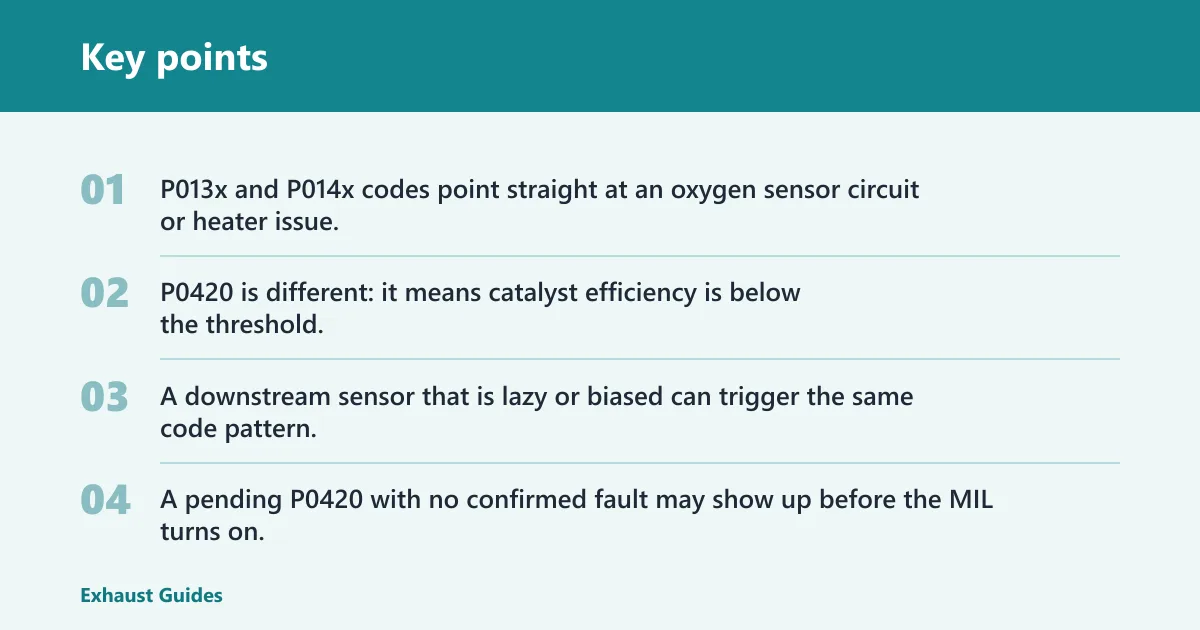
P013x and P014x codes point straight at an oxygen sensor circuit or heater issue. P0420 is different: it means catalyst efficiency is below the threshold, not that the converter is automatically dead. A downstream sensor that is lazy or biased can trigger the same code pattern.
Pending codes matter too. A pending P0420 with no confirmed fault may show up before the MIL turns on, which is useful if you are checking whether the fault is repeatable or only appears during one drive condition.
Can a bad O2 sensor cause a P0420 code?
Yes. A bad O2 sensor can set P0420 when it skews fuel control, switches too slowly, or sends a downstream signal that makes the converter look inefficient. The code is a catalyst-efficiency flag, not proof that the converter itself has failed.
When P0420 is a sensor problem
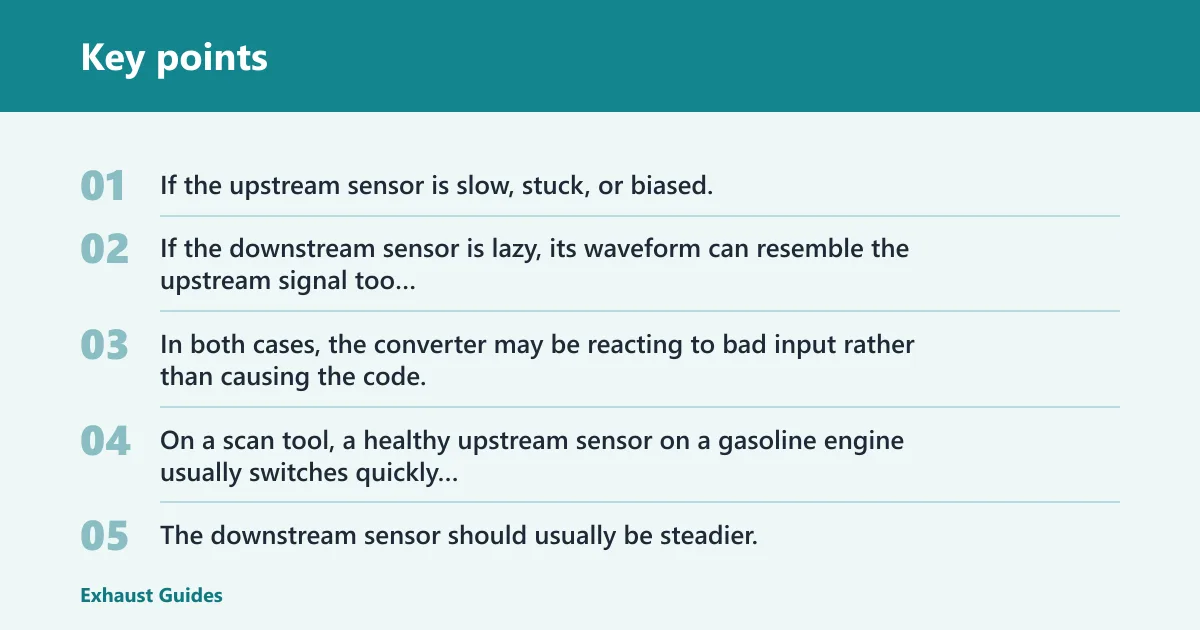
If the upstream sensor is slow, stuck, or biased, the ECU may run rich or lean enough to distort catalyst operation and monitoring. If the downstream sensor is lazy, its waveform can resemble the upstream signal too closely and create a false efficiency failure. In both cases, the converter may be reacting to bad input rather than causing the code.
On a scan tool, a healthy upstream sensor on a gasoline engine usually switches quickly once closed loop begins. The downstream sensor should usually be steadier. If both waveforms look nearly the same, the fault can be a weak converter, but it can also be an exhaust leak or a bad downstream sensor.
When P0420 points back to the converter
If trims are reasonable, there are no sensor circuit codes, and the downstream sensor stays active in a pattern similar to the upstream sensor after warm-up, the converter is more suspect. Physical damage, melting, contamination, or internal breakage can reduce oxygen storage and trigger P0420 even when the sensors are fine.
What live data should look like
Use an OBD-II scan tool that can show stored codes, pending codes, live O2 data, and fuel trims. A useful pattern is rapid upstream switching with a steadier downstream trace on a warm engine. If the downstream trace follows the upstream trace too closely, the converter, the downstream sensor, or an exhaust leak needs attention.
Can a bad catalytic converter damage the o2 sensor?
Yes. A failing converter can overheat, melt, contaminate, or physically break, and those conditions can shorten O2 sensor life. It can also happen the other way around: a misfire or rich mixture can damage the converter first, then leave the sensor reading contaminated exhaust.
How misfires and overheating create follow-on damage
Misfire sends raw fuel into the exhaust. That extra fuel can overheat the converter and sometimes create a sulfur smell or a glowing converter shell. Rich running can do similar damage over time, while a lean condition can push the ECU into corrections that distort exhaust chemistry and monitoring.
A common first-timer mistake is to replace the converter after one P0420, then find the misfire or vacuum leak that caused the failure still present. That pattern can ruin the new converter quickly.
Contamination, melting, and breakage signs
Oil burning and coolant contamination can coat the catalyst surface. Internal collapse can restrict flow, which may create loss of power at higher load, heat buildup, or rattling from broken substrate. Those signs point more to converter damage than to an isolated sensor problem.
Why sensor replacement alone may not fix the fault
If the converter is restricted or chemically spent, a new sensor will not restore oxygen storage. If the engine is still misfiring, running rich, or sucking in unmetered air, the replacement sensor may be damaged again. Fix the cause before replacing either part.
Upstream vs downstream sensor patterns
The upstream O2 sensor is mounted before the converter. It changes rapidly as mixture swings and helps the ECU trim fuel in closed loop. A slow or biased upstream sensor can mimic converter trouble because the ECU may correct the wrong way for long enough to set efficiency codes.
Upstream sensor switching and fuel-trim control
On a healthy engine, the upstream signal should swing rich-to-lean quickly once warm. Short-term fuel trim should move around zero as the ECU corrects. If the sensor is lazy, the ECU may chase a false mixture reading, and the downstream pattern may look abnormal even when the converter is not the original fault.
Downstream sensor steadiness and catalyst monitoring
The downstream sensor sits after the converter and should usually be steadier than the upstream sensor on a healthy system. Its job is to show that the converter is buffering oxygen and cleaning up exhaust. If it mirrors the upstream signal too closely, the converter may be weak, the downstream sensor may be wrong, or an exhaust leak may be skewing the sample.
What a lazy sensor looks like on the scan tool
A lazy sensor often switches slowly, gets stuck on one side, or ignores forced rich/lean changes. That can look like converter failure if you only read the code. The fix is to compare both sensors under the same conditions and confirm heater operation and wiring condition first.
What else can mimic both faults?
Exhaust leaks, vacuum leaks, misfires, and rich running can all fake a converter problem. These faults can change the oxygen content the sensors see, distort fuel trims, and trigger P0420 even when the converter and one or both sensors are still serviceable.
Exhaust leaks before or near the converter
A leak ahead of the downstream sensor can pull in outside air and make the oxygen reading look leaner than it really is. That can imitate low catalyst efficiency. Check manifold joints, flex pipes, flange seals, and welds before replacing the converter.
Vacuum leaks and lean running
A vacuum leak can drive the mixture lean, especially at idle, and the upstream sensor will report that change. Fuel trims usually rise positive as the ECU adds fuel. If the leak is large enough, the converter may be blamed even though the root cause is unmetered air.
Misfire, rich running, and raw-fuel damage
Misfire and rich running are not only diagnosis problems; they can damage the converter. Raw fuel in the exhaust overheats the catalyst and can contaminate it. That is why a P0420 with misfire history should send you to engine faults first, not straight to a converter purchase.
Choose catalytic converter if… / Choose o2 sensor if…
Choose the catalytic converter if the code is P0420 or P0430, fuel trims are reasonable, there are no sensor circuit codes, and the downstream waveform stays too active after warm-up even after you have checked for exhaust leaks and misfire history. Choose the o2 sensor if you have P013x or P014x codes, a slow or stuck sensor signal, heater faults, or fuel trims that point to a bad upstream reading rather than a dead converter.
Stop and inspect engine faults first if trims are extreme, there is a vacuum leak, there is any misfire, or the exhaust has a leak before the converter. That rule prevents the common mistake of replacing the wrong part and leaves you with a diagnosis that matches the data.
- Read stored and pending codes with an OBD-II scan tool.
- Check fuel trims at idle and at a steady cruise.
- Compare upstream and downstream O2 waveforms on a warm engine.
- Inspect for exhaust leaks, vacuum leaks, and misfire history.
- Test sensor heater circuits and wiring before replacing a converter.


Frequently asked questions
Is the bad part my catalytic converter or O2 sensor?
Use the code pattern and the live data together. If the upstream sensor is switching normally but the downstream sensor mirrors it too closely, the converter is more suspect.
How can I tell if the catalytic converter or O2 sensor is bad?
Check fuel trims, sensor response, and exhaust leaks. A bad upstream sensor often shows slow or biased switching, while a weak converter usually shows a downstream waveform that looks too much like the upstream trace. A scan tool makes that difference visible without guessing.
Does an oxygen sensor affect the catalytic converter?
Yes. The upstream oxygen sensor controls fuel trim, so a bad reading can create rich or lean operation that hurts catalyst performance. The downstream sensor also affects diagnosis, because its signal is used to judge whether the converter is storing oxygen and cleaning exhaust properly.
What does the O2 sensor after the catalytic converter do?
The downstream sensor monitors catalyst efficiency. On a healthy system it should usually be steadier than the upstream sensor, because the converter should smooth out oxygen changes. If it switches almost like the upstream sensor, the converter may be weak or the sensor may be misleading the ECU.
Can a failing catalytic converter damage the O2 sensor?
Yes. Overheating, melting, contamination, and internal breakage can all shorten sensor life. Misfires and rich running can also send raw fuel through the converter, which damages both the catalyst and the sensor. If the root cause remains, sensor replacement alone will not hold.