How Much Does It Cost to Repair a Catalytic Converter Flange Leak?
A catalytic converter flange leak often costs about $150 to $450 to fix if it is only a gasket or hardware job. Bent flanges, broken studs, or a cracked converter can push repair costs to roughly $500 to $1,500 or more. Left alone, the leak can bring noise, fumes, failed inspections, and heat damage near the exhaust joint. This guide breaks down the likely failure points, what each repair costs, and when the fix turns into converter replacement.
Typical cost range

- Made of high-quality metal materials resistant to high temperatures
- Provides excellent sealing and insulation to prevent gas leaks
- Includes bolts and nuts for easy installation
The short answer is simple: diagnosis costs far less than parts replacement, and the flange job can range from a small gasket repair to full converter replacement. A shop may charge $100 to $250 for diagnosis, $150 to $350 for a flex pipe repair if the adjacent section is damaged, and $2,293 to $2,468 for catalytic converter replacement when the converter itself is the problem.
That spread matters because a catalytic converter flange is the inlet or outlet connection point where the converter joins the pipe. It can leak at the gasket, the flange face, the hardware, or the pipe end. The farther the damage runs into corroded fasteners or a cracked converter neck, the more the bill shifts from repair to replacement.
Typical shop price bands
For a small welded or spliced exhaust repair, current estimates can run $80 to $220. A welded exhaust repair can also take about 0.3 to 1.5 full-time workdays at $30 per hour, which shows why labor often overtakes parts cost even when the broken part looks small.
AutoMotoFlux lists catalyst inlet or outlet leak labor at 1.4 to 2.1 hours, and manifold-to-downpipe flange leaks at 0.7 to 1.2 hours. That puts the flange job in the same general labor zone as other undercar exhaust repairs, but rust and access can turn a short job into a long one.
What pushes the bill up
Labor usually drives the bill. Shops in different regions price the same flange repair differently, and dealers often quote higher than independent exhaust shops. Rusted studs, seized nuts, cramped access, and heat shields that must be moved all add time.
Diagnosis also matters. The same source lists diagnostic time at 0.8 hours for isolating a leak, and Current Cost lists diagnostics at $100 to $250. If the leak is near the converter and the source is unclear, that diagnostic step can save you from replacing a converter that is still serviceable.
Parts versus labor
Some estimates put gasket parts at about $40 to $45 for a gasket job, while labor can be about $372 to $545 for that same work. That split is the point to remember: a flange gasket may be inexpensive, but getting to it, cleaning the faces, replacing fasteners, and tightening everything correctly is where the money goes.
Suppose the leak is at a rusty outlet flange on a compact car in a salt-state climate. The gasket itself may be a minor line item, but cutting seized hardware and cleaning a warped face can add more labor than the parts are worth. That is why one quote can be far above another even for what sounds like the same repair.
What fails at the flange?
The flange area fails in a few distinct ways, and each one leads to a different bill. A gasket leak is the cheapest common case. Warped flange faces, broken studs or nuts, and a cracked converter inlet or outlet move the repair into more expensive territory because the joint can no longer seal with a simple gasket swap.
Exhaust flange gasket wear
An exhaust flange gasket is a low-cost wear part, often MLS or graphite depending on the vehicle. When it fails, the leak may sound like a ticking or sharp hiss near the joint, and you may see soot around the seam. If the flange faces are still flat and the hardware comes apart cleanly, this is the best-case repair.
Warped flange faces
A warped flange face prevents the gasket from seating evenly. That usually calls for resurfacing, replacement of the flange section, or a more involved weld repair. If the flange is only slightly out of shape, a shop may be able to correct it without replacing the converter, but severe warpage usually means more labor and more heat on old metal.
Broken studs, nuts, or bolts
Broken hardware changes the job fast. A missing or seized stud can mean drilling, extraction, or replacing the flange section entirely. The gasket may still be the wear item, but the hardware often decides whether the repair stays under a few hundred dollars or climbs much higher.
Cracked converter inlet, outlet, or corroded pipe section
If the converter neck or the adjoining pipe is cracked, the seal cannot be restored with a gasket alone. A cracked inlet or outlet often requires converter replacement or a welded pipe section, depending on where the damage sits. This is where the estimate can jump toward the $2,293 to $2,468 replacement range.
How shops confirm the leak
A proper exhaust leak diagnosis should come before any parts order. Shops look for soot, rust trails, and black marks around the converter flange, then listen for hissing or ticking while the engine runs. If the sound is unclear, smoke or pressure testing can isolate the leak and help separate a flange leak from an upstream exhaust leak.
- Inspect the flange, gasket, and nearby pipe for soot and heat staining.
- Check the flange face, studs, nuts, and bolt holes for rust or distortion.
- Use smoke or pressure testing if the leak is not obvious.
- Confirm whether the leak is at the gasket, the flange itself, or the converter neck.
- Verify oxygen sensor readings after the leak is sealed.
Smoke testing is especially useful when the noise is faint or the exhaust pulse only opens the leak under load. A pressure test can help too, but it must be done carefully so the system is not overstressed. The goal is simple: fix the joint you actually have, not the one the code suggests.
Can a flange leak cause P0420?
Yes. A catalytic converter flange leak can trigger a check engine light and may contribute to a P0420 code, but P0420 is not proof that the converter is bad. Exhaust leaks can skew upstream or downstream oxygen sensor readings, which can make the engine computer think catalyst efficiency is low even when the converter itself is still usable.
Why sensor readings can change
When outside air enters through a flange leak, the oxygen sensors may read leaner than they should. That can affect fuel trim and catalyst monitoring. If the leak is near the converter inlet, the readings can be distorted enough to set codes that look like a converter failure.
When to recheck after repair
After the leak is fixed, the vehicle may need a drive cycle before the computer runs its monitors again. If the original issue was only a flange leak, the code may clear or stop returning after the repair and relearn. If the code returns, the next check should focus on sensors, wiring, or actual converter performance.
Flange leak repair table
Use this table to compare repair versus replacement before you approve work. The visible clues matter, but the flange location, rust, and fastener condition matter more. A small gasket job can stay local to the joint, while a cracked converter neck or rotten pipe section can pull the whole assembly into the estimate.
| Failure point | Visible clues | Likely parts needed | Typical shop cost band |
|---|---|---|---|
| Gasket leak | Soot ring at the flange, ticking or hissing, no major pipe damage | Exhaust flange gasket, possibly new hardware | $150 to $450 |
| Warped flange | Uneven flange face, recurring leak after gasket replacement | Flange repair or replacement, gasket, hardware | $250 to $700 |
| Broken stud or nut set | Missing fastener, stripped threads, leak after clamp-up | Studs, nuts, bolts, gasket, possible extraction labor | $200 to $600 |
| Cracked converter inlet or outlet | Crack at the converter neck, soot from the can side, failed seal despite new gasket | Converter replacement or welded converter-area repair | $500 to $1,500+ |
| Corroded pipe section | Pitted pipe, flaking metal, leak spreads beyond the flange face | Pipe section, flange, gasket, hardware | $200 to $800 |
Use the table this way: if the problem stays at the gasket and hardware, the quote should cluster near the lower end. If the converter neck or the adjoining pipe is rotten, a simple reseal is no longer realistic. That is the point where multiple quotes help, because one shop may quote a weld repair while another jumps straight to converter replacement.
Repair or replace the converter?
A gasket or hardware fix is enough when the flange faces are sound, the converter housing is intact, and the pipe section has enough solid metal to hold a seal. Once the flange is warped beyond correction, the converter neck is cracked, or rust has eaten through the pipe end, the repair becomes a converter-area replacement job rather than a seal job.
When a flange repair is enough
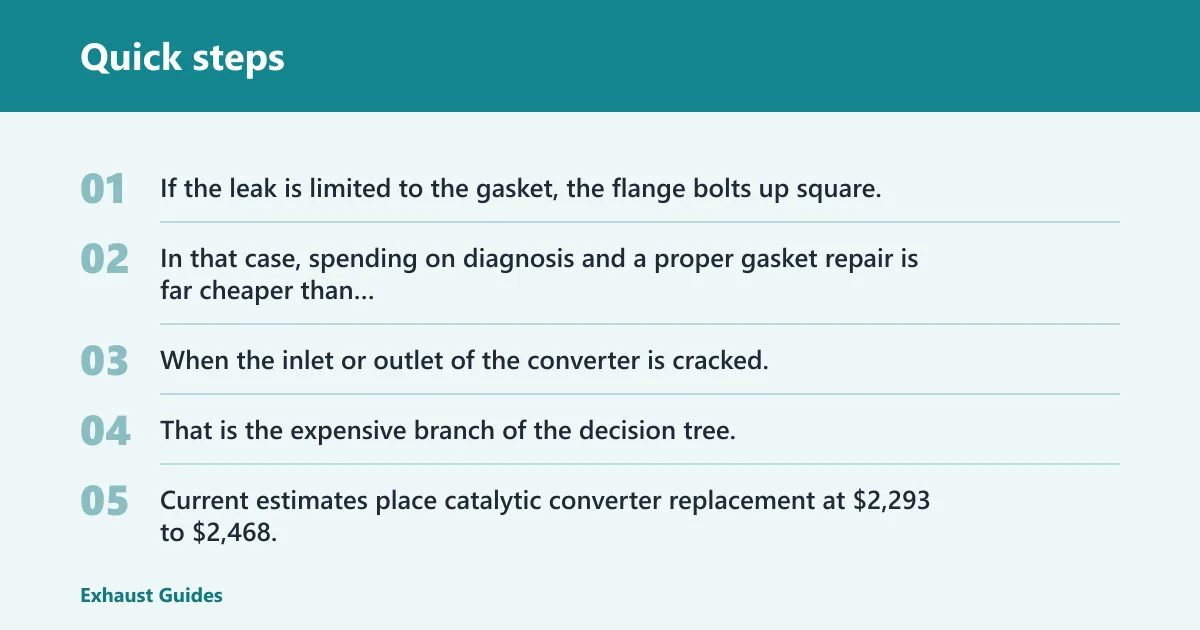
If the leak is limited to the gasket, the flange bolts up square, and the pipe is not paper-thin with rust, a flange repair is usually the right answer. The converter can stay in place. In that case, spending on diagnosis and a proper gasket repair is far cheaper than replacing a good converter.
When the converter must come off
When the inlet or outlet of the converter is cracked, the converter assembly itself may need replacement. That is the expensive branch of the decision tree. Current estimates place catalytic converter replacement at $2,293 to $2,468, which is a very different bill from a gasket or hardware repair.
How to avoid an unnecessary replacement
Get the exhaust leak diagnosis before approving a converter. Ask whether the leak is at the gasket, the flange face, the studs, or the converter neck. Independent exhaust shops may price this work differently from dealers, and a second quote can keep a repairable flange leak from being treated like a failed converter.
A common first-timer mistake is to assume a small exhaust rattle near the engine means the catalytic converter itself has failed, when a cracked flange gasket may be the real source of the leak. Suppose a midsize sedan has a leak at the converter outlet flange, a soft hiss at idle, and a stored P0420 code. If the leak is fixed first and the sensors are rechecked after the drive cycle, the code may point somewhere else entirely.
How much does it cost to repair a catalytic converter flange leak?
For a gasket or hardware repair, expect roughly $150 to $450 in many shops, with diagnosis sometimes billed separately at $100 to $250. If the flange is warped, the studs are broken, or rust has damaged the converter neck, the bill can move into the $500 to $1,500+ range. Converter replacement is far more expensive.
Can a catalytic converter flange leak be fixed without replacing the converter?
Yes, if the damage is limited to the gasket, the hardware, or a repairable flange face. The converter does not need replacement unless the inlet, outlet, or housing is cracked or rusted through. A smoke test or visual inspection helps separate a local flange problem from a converter failure.
What does a shop charge to diagnose an exhaust leak near the catalytic converter?
That fee should cover inspection for soot, rust, and noise, plus smoke or pressure testing if needed. Diagnosis is worth paying for when the code and the symptoms do not clearly point to one joint.
Is a flange leak cheaper than replacing the catalytic converter?
Yes. A flange leak is usually much cheaper because the repair may only need a gasket, some hardware, or a short weld. The gap is large enough that diagnosis comes first.
How long does a catalytic converter flange repair take?
If the fasteners come apart cleanly, a flange repair can be a short job. The same source lists 1.4 to 2.1 hours for a catalyst inlet or outlet leak and 0.7 to 1.2 hours for a manifold-to-downpipe flange leak. Corroded hardware, broken studs, and cramped access can extend that time quickly.
What parts usually fail at a catalytic converter flange connection?
The usual failure points are the flange gasket, the flange face, the studs or nuts, and the pipe end near the converter. The gasket is the cheapest part, but the flange can warp, fasteners can seize, and the converter neck can crack. Each one changes the repair plan and the quote.
Will a catalytic converter flange leak cause a check engine light?
It can. A leak near the converter can alter oxygen sensor readings enough to trigger a light, especially if the leak is upstream of the downstream sensor. The light does not prove the converter is bad. It only tells you the engine computer has detected a problem worth diagnosing.
Can a catalytic converter flange leak trigger a P0420 code?
Yes. A flange leak can contribute to P0420 because outside air and altered exhaust flow can confuse the catalyst monitor. That code is a clue, not a verdict. The leak should be fixed and the sensors checked again before anyone decides the catalytic converter itself has failed.