

Exhaust Tip Styles for Trucks: Which One Fits Best?
For most trucks, a straight slash-cut or angle-cut tip fits best if you want low contact risk and an easy install; choose dual-wall stainless only if you have the clearance and want a heavier look. Bad fitment can rattle, soot the bumper, or leave the tip hanging past the body line. This guide compares truck exhaust tip styles, materials, clamp-on versus weld-on mounting, and the clearance checks that keep you from buying the wrong one.
Truck exhaust tip basics


An exhaust tip changes appearance first. It can also shift sound a little, mainly by changing how the exhaust exits and how much open area the tip has. It does not create major power gains, so fit, exit location, and clearance matter more than shape alone.
On trucks, the three dimensions that matter most are inlet diameter, outlet diameter, and overall length. Measure the tailpipe outside diameter before ordering, because that is the fitment number the inlet must match. A tip that looks right can still fail if the inlet is off by even a small amount.
Style choices also depend on where the pipe exits. A rear exit near the bumper needs more attention to body clearance. A side exit near the rear tire needs enough room for suspension movement, heat, and road debris. That is why a style that works on one truck can be a poor fit on another.
What size exhaust tip do you need?
Measure the tailpipe outside diameter first, then match the tip inlet to that number. Most exhaust tip openings for trucks measure between 2.5 and 5 inches. Gas trucks need 2.5-3.5 inch tips, while most diesel trucks work best with 4-5 inch tips.
After inlet size, check the outlet diameter and overall length. The visible end of a truck tip can be 6-10 inches wide, and 8 inches is common on lifted diesel trucks. Bigger visible ends can look right on tall trucks, but they can also sit too close to a bumper or step if the exit is tight.
Match inlet, outlet, and length
The inlet must fit the tailpipe. The outlet sets the visible opening and partly shapes the look. Overall length controls how far the tip projects beyond the body line, which matters more on short beds, rear exits, and trucks with molded bumper corners.
A common first-timer mistake is choosing a polished tip just because it looks aggressive, even if the exit angle clashes with the truck’s rear bumper and cutout. A 5-inch outlet may look right, but if the inlet does not match the tailpipe outside diameter, the install becomes awkward or impossible. Check all three numbers before you order.
Check bumper and suspension clearance
The article recommends checking bumper clearance and ground height. That matters because the exhaust moves with drivetrain shift, frame flex, and suspension travel. Leave room for the tip to move without touching the bumper, hitch, spare tire, or nearby bodywork.
A 7-inch visible tip may fit on paper, but the outer edge can sit too close to the plastic corner under load. In that case, a shorter or more angled style is usually the safer choice.
Clamp-on or weld-on tip?
Clamp-on exhaust tips make sense when you want a serviceable install and the option to remove or replace the tip later. Weld-on exhaust tips are better when you want a fixed, cleaner-looking install and the fit is confirmed. Clamp-on is often the safer choice for non-permanent fitment.
The tradeoff is simple. Clamp-on depends on the correct diameter match and a secure clamp. Weld-on depends on safe welding practices and the right position before final attachment. If the truck may change soon, clamp-on is easier to service. If the goal is a permanent finish, weld-on is cleaner.
When clamp-on makes sense
Choose clamp-on when you want less risk, less labor, or a quick swap. It works well for stock-height gas trucks, for owners who may later change the exhaust, and for trucks where the tip may need periodic removal for cleaning or winter corrosion checks.
Clamp-on also helps if the tailpipe has enough straight section for a secure grip. If the pipe is short, angled, or tucked close to the bumper, the clamp may be harder to position well. In that case, the final result can look uneven or sit too far out.
When weld-on is the better fit
Weld-on makes sense when the tip should stay put and follow the body line closely. It is a good match for fixed rear-exit builds, cleaner visual goals, and setups where a clamp would sit awkwardly. It also avoids clamp marks on the pipe.
Safety matters here. Welding should be done with proper protection, on a cool exhaust, and away from fuel lines, wiring, and heat-sensitive parts. A poor weld can create a crooked tip, poor seal, or future cracking at the joint.
Best exhaust tip style by truck setup
This matrix is the fastest way to match style to use case. It compares common truck setups by clearance risk, sound preference, visual goal, recommended style, and watch-outs. Use it after you know the tailpipe size and before you pick a finish or mount style.
| Truck type | Clearance risk | Sound preference | Visual goal | Recommended style | Watch-outs |
|---|---|---|---|---|---|
| Stock-height gas trucks | Low to moderate near the bumper | Mild tone change | Clean, subtle finish | Single-wall angle cut or slash-cut | Match inlet to tailpipe outside diameter; do not oversize the outlet just for looks |
| Diesel trucks | Moderate, especially with rear exits | Slightly deeper tone, more soot exposure | Heavier, more aggressive look | Dual-wall stainless, rolled-edge, or angle cut | Soot buildup is more visible; keep clearance from the bumper and nearby trim |
| Lifted trucks | Moderate at suspension travel points | Open, pronounced exit look | Large visible end | Angle cut or dual-wall stainless, often around 8 inches visible end | Check movement from frame flex and exhaust hanger stretch; avoid a tip that hangs too low |
| Towing-focused trucks | Moderate near hitch and trailer gear | Stable, controlled tone | Practical, durable finish | Single-wall or stainless angle cut | Keep the outlet clear of hitch hardware and trailer wiring; avoid extra length that can snag |
| Off-road trucks | High under departure angles and debris impact | Low-drone setup | Compact, protected exit | Turn-down or short angle cut | Turndown exit tips point downward toward the ground, which helps hide the outlet but can collect dirt and moisture |
| Trucks with tight bumper clearance | High at the body line | Small change preferred | Neat fit with no protrusion | Short single-wall slash-cut | Measure projection carefully; long tips can touch the bumper, valance, or paint under load |
How to read the matrix
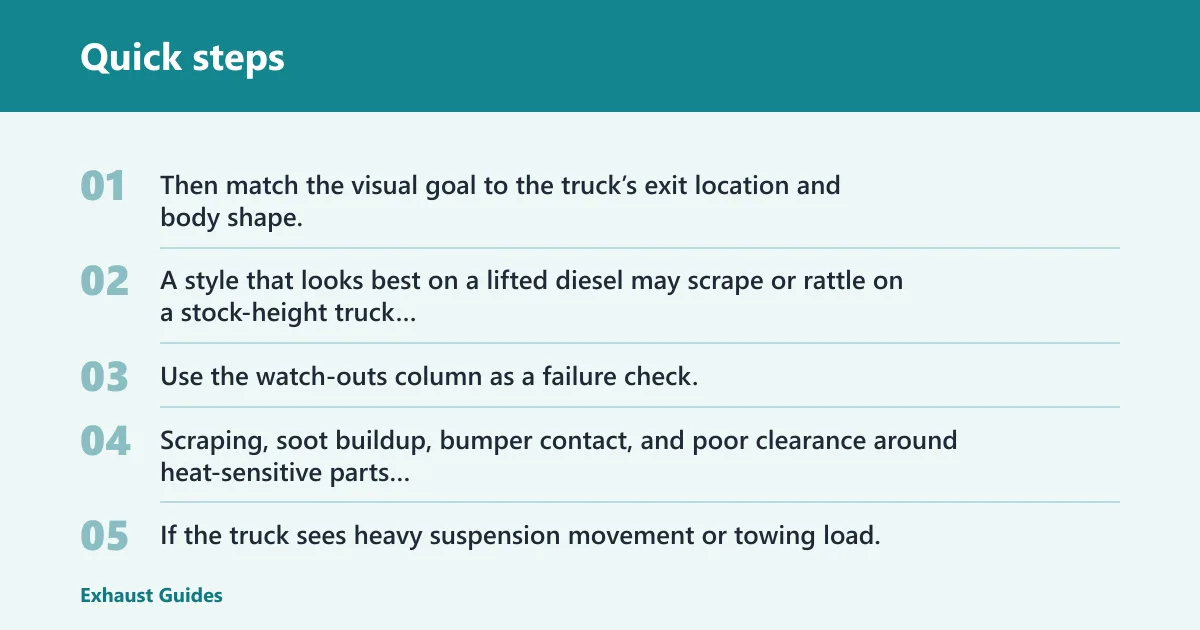
Start with clearance risk, not appearance. Then match the visual goal to the truck’s exit location and body shape. A style that looks best on a lifted diesel may scrape or rattle on a stock-height truck with a close bumper cutout.
Use the watch-outs column as a failure check. Scraping, soot buildup, bumper contact, and poor clearance around heat-sensitive parts are the most common problems. If the truck sees heavy suspension movement or towing load, move one step toward shorter and simpler.
Stock-height gas trucks
For stock-height gas trucks, a single-wall angle cut or slash-cut tip usually fits best. It gives a clean appearance without demanding extra clearance. Gas trucks generally need 2.5-3.5 inch tips, so the visual change should stay proportional to the tailpipe and rear bumper opening.
A dual-wall tip can work if the bumper and body line leave enough room. If space is tight, the heavier look can quickly become a contact problem. A modest style is usually easier to live with over the long term.
Diesel trucks and soot
Diesel trucks often work best with 4-5 inch tips, and soot buildup is part of the equation. A polished stainless steel tip is the safer choice for rain, snow, and salted roads because stainless steel tips resist rust and last long. The finish also keeps maintenance more predictable.
Double-wall tips use two layers of metal, which gives a thicker visual edge. Rolled-edge tips have a thick, inward-curved edge. Both can suit diesel setups, but both also show soot near the outlet, so cleaning access matters.
Picture a diesel with a rear exit behind the passenger-side rear tire. A 4.5-inch stainless tip can look balanced, but if it sits too close to the bumper or mud flap, soot and heat mark the nearby parts over time. A shorter projection often solves that issue.
Lifted, towing, off-road, and tight-clearance setups
Lifted trucks often accept larger visible ends more easily because the body sits higher from the ground. That is why 8 inches is common on lifted diesel trucks. Even so, the exhaust still moves with suspension and drivetrain shift, so the hanger system must support it well.
Towing-focused trucks need extra attention to exit location near the hitch and trailer gear. Off-road trucks need protection from departure angle strikes and debris. Trucks with tight bumper clearance need the shortest practical projection and the cleanest alignment possible.
Which material fits your climate?
Stainless steel is often the most practical all-around choice for wet climates, salted roads, and longer service life. It resists rust and keeps its finish better than lower-cost metals. Black-coated and carbon fiber tips can work, but both need more attention to heat, clearance, and wear.
Titanium handles high heat better but costs more. That makes it a niche choice for owners who want that material and can justify the price. For most trucks, stainless steel offers the simplest balance of durability and maintenance.
Stainless steel for wet and salty roads
If the truck lives where roads stay wet or salted, polished stainless steel is the safest pick. It is the material least likely to cause trouble from rust stains, flaking finish, or early replacement. It also suits clamp-on and weld-on installs equally well.
Maintenance is still needed. Road film, soot, and winter grime should be cleaned before they build up. Stainless reduces corrosion risk, but it does not remove the need to inspect the inlet clamp or weld seam.
Black-coated finish tradeoffs
Black-coated tips can look good on dark trucks and on builds that want a lower-profile rear view. The tradeoff is that the coating can show wear sooner near the hottest zones and at the outlet edge. Clearance still matters, because heat marks are harder to hide on a dark finish.
If you choose black-coated, check the exit path carefully. A tip that runs close to the bumper, hitch, or rear valance may discolor faster than expected. Heat-sensitive parts nearby deserve the same attention as the finish itself.
Carbon fiber caution points
Carbon fiber tips are a premium appearance choice, but they need extra caution. Heat sensitivity and clearance are the main concerns. If the exit is close to the pipe or bodywork, the material choice can become a durability problem instead of a styling upgrade.
A carbon fiber tip should not be the default choice for a tight rear exit or a truck that sees hard towing or off-road use. If you want the look, verify bumper clearance, ground height, and nearby heat exposure before buying.
Style choices by use case
Angle cut tips are a popular choice for trucks because they look clean and work in many rear-exit layouts. Single-wall tips are the most common type. Turn-down tips suit hidden or dirt-prone exits, while oval and square shapes are mainly about appearance and bumper geometry.
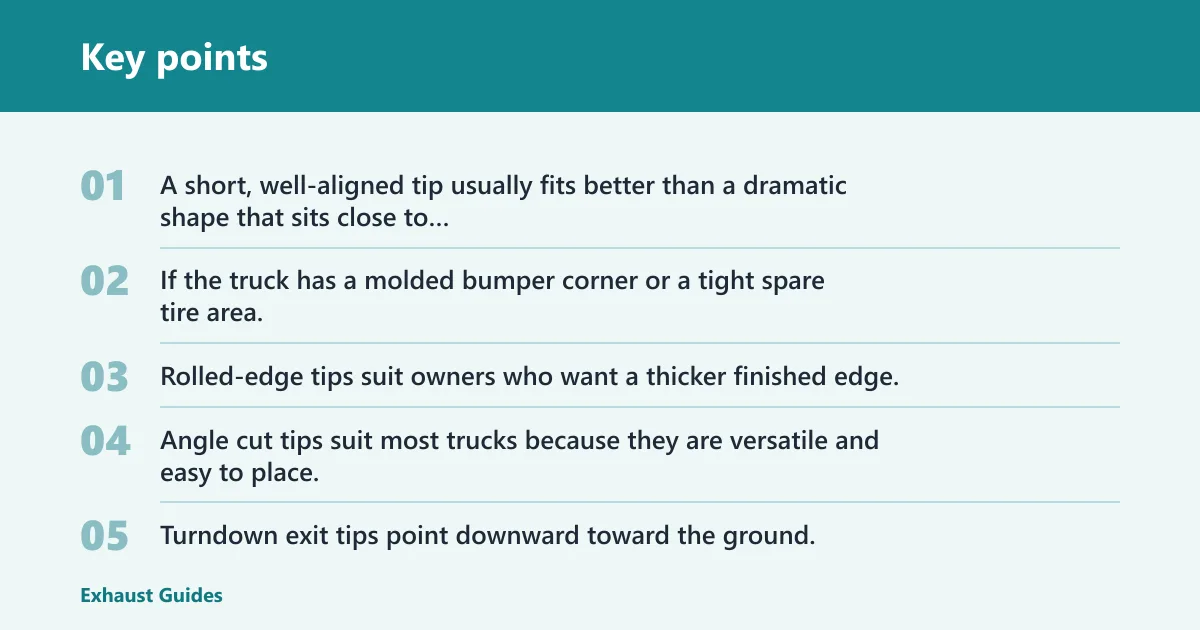
Style should follow the truck’s exit path. A short, well-aligned tip usually fits better than a dramatic shape that sits close to the body. If the truck has a molded bumper corner or a tight spare tire area, simple often works best.
Rolled edge, angle cut, and turn-down
Rolled-edge tips suit owners who want a thicker finished edge. Angle cut tips suit most trucks because they are versatile and easy to place. Turndown exit tips point downward toward the ground, which can help where there is little room behind the bumper.
Turn-down styles can also reduce visible soot on the rear fascia. The downside is ground exposure. Dirt, salt, and moisture can collect more easily, especially on trucks used on rough roads or in winter.
Single-wall, double-wall, and dual split
Single-wall tips are the most common type and usually the easiest to fit. Double-wall tips use two layers of metal and create a more finished edge. Dual split tips suit trucks that want a broader visual presence, but they need more room and careful alignment.
Choose thicker-looking styles only if the rear of the truck can support them visually and physically. Bigger is not automatically better. A bulky tip that crowds the bumper can look unfinished if it sits too close to the body or hangs low.
Oval, square, and slash-cut looks
Oval and square tips change the rear profile more than sound. Slash-cut tips give a sharper, more directional look, while oval and square shapes can better match some bumper openings. The right one depends on the rear cutout, not on a universal rule.
A good visual match usually keeps the tip aligned with the body line and the bumper opening. If the truck has a rounded rear bumper, a square tip can look forced. If the bumper is angular, a slash-cut or square profile can sit more naturally.
What should you check before buying a truck exhaust tip?
Check bumper clearance, hitch clearance, bodywork clearance, and ground height before buying. Then inspect the exhaust hanger and rubber isolator. If those parts are worn, the exhaust can move more than expected, causing rubbing, rattles, or contact with heat-sensitive parts.
Also note exit location and bed length. A short-bed truck may expose the tip more than a long-bed truck with the same tailpipe route. The correct style depends on where the pipe ends, how far it can move, and how much room the body gives it.
Exhaust hanger and rubber isolator condition
An exhaust hanger controls movement from drivetrain shift and heat expansion. That matters on lifted trucks and towing setups, where the system sees more motion. If the hanger is stretched or cracked, the tip can shift into the bumper or start to rattle.
A rubber isolator absorbs vibration and prevents metal-to-metal contact. Wear in that part can lead to noise or damage, especially when the exhaust heats up and moves. If the tip choice seems tight, the mounting hardware needs inspection before installation.
Exit location, bed length, and ground height
Rear exit, side exit, and turndown setups all need different checks. Bed length changes where the tip ends relative to the axle and bumper. Ground height changes how much road debris and slope contact the tip will see.
Use the truck’s actual clearance, not a generic size chart, to make the final choice. The wrong combination can cause scraping on driveways, soot on the bumper, or a tip that sits too far out past the body line. Fit first, style second.
Frequently asked questions
What exhaust tip style fits best on my truck?
For most trucks, a straight slash-cut or angle-cut tip fits best because it is easy to place and less likely to contact the bumper or bodywork. Choose dual-wall stainless only if you have the clearance and want a thicker look. The best fit depends on exit location and body shape.
Should I choose a clamp-on or weld-on exhaust tip for a truck?
Choose clamp-on if you want a serviceable install and may remove or replace the tip later. Choose weld-on if you want a fixed, cleaner-looking result and the fit is confirmed. Clamp-on is the better non-permanent option; weld-on is better when the final position will not change.
What size exhaust tip do I need for my truck tailpipe?
Measure the tailpipe outside diameter before ordering. That number determines the inlet size more than appearance does. From there, check the outlet diameter and overall length. Gas trucks usually need 2.5-3.5 inch tips, while most diesel trucks work best with 4-5 inch tips.
Are stainless steel exhaust tips better for trucks?
Yes, for most trucks. Stainless steel tips resist rust and last long, which makes them the safest choice for rain, snow, and salted roads. They also hold up well whether you choose clamp-on or weld-on mounting, so the material choice is easy to justify for daily use.
Will a bigger tip change truck sound or performance?
A bigger tip can slightly change sound, often toward a deeper tone, but the change is usually modest. It does not create major power gains. If the tip size gets too large for the setup, it can create fitment problems without any useful performance benefit.
How much clearance should an exhaust tip have on a lifted truck?
Leave enough room for suspension movement, drivetrain shift, and heat expansion. There is no single number that fits every truck, so check bumper clearance, ground height, hitch space, and nearby heat-sensitive parts. On lifted trucks, 8 inches is common on lifted diesel trucks, but only if the fit allows it.
Can I use a black-coated or carbon fiber exhaust tip on a truck?
Yes, but both need extra caution. Black-coated tips can show wear near hot spots, and carbon fiber tips need careful attention to heat sensitivity and clearance. If the truck sees heavy towing, tight rear bumper space, or off-road impacts, stainless steel is the safer long-term choice.


